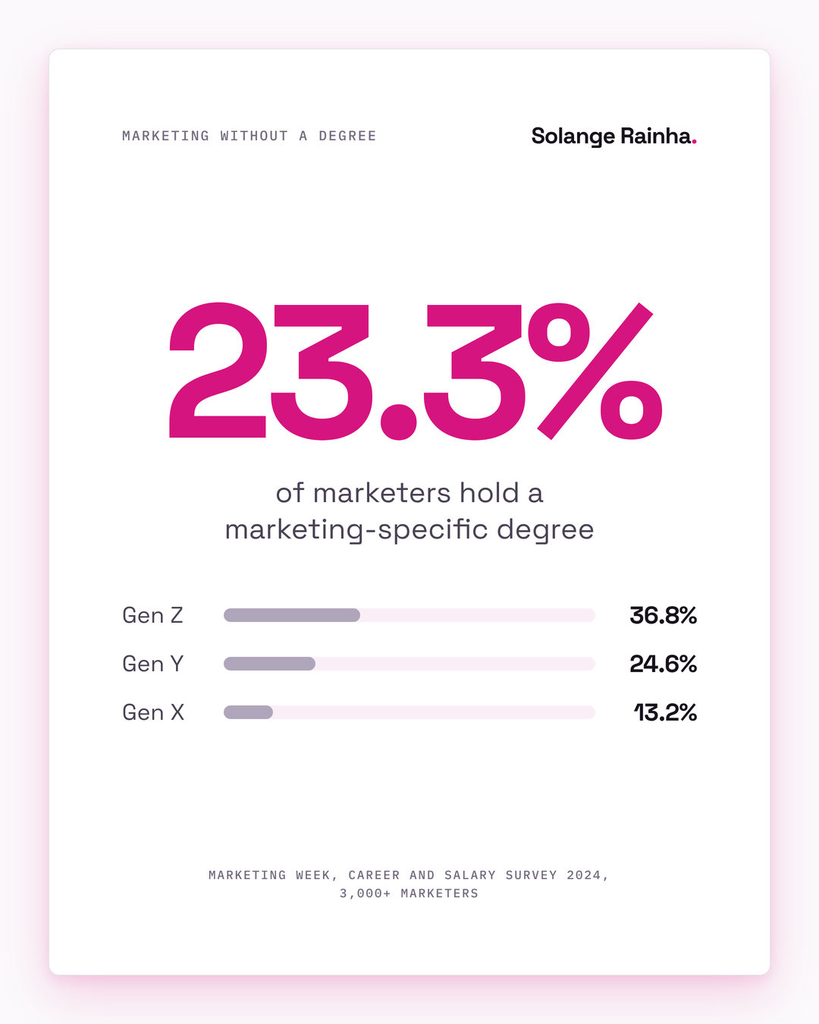
You can build a career in marketing without a degree in it, and most marketers already have: only 23.3% of the more than 3,000 marketers in Marketing Week’s 2024 Career and Salary Survey hold a marketing-specific degree. At my first job out of university, a senior manager told me I’d never work in marketing because I hadn’t studied it, and I’ve spent more than a decade in the field since. Research going back decades ranks tested skills well above education as a predictor of job performance, but hiring practice lags the press releases: Harvard Business School and the Burning Glass Institute found fewer than 1 in 700 hires changed when companies dropped degree requirements. A degree still helps with fundamentals and with getting past a filter; in marketing, it’s a poor test of who’s good.
I’ve never put this job on my CV: five months of sales and operations support at an industrial wire factory, covering order processing, logistics coordination, customer emails, database maintenance and the mail. It was my first job after university and the worst professional experience of my life, the kind that follows you home and sits on your chest late at night. I’ll leave the details there, except to say I got out, and getting out was the right call.
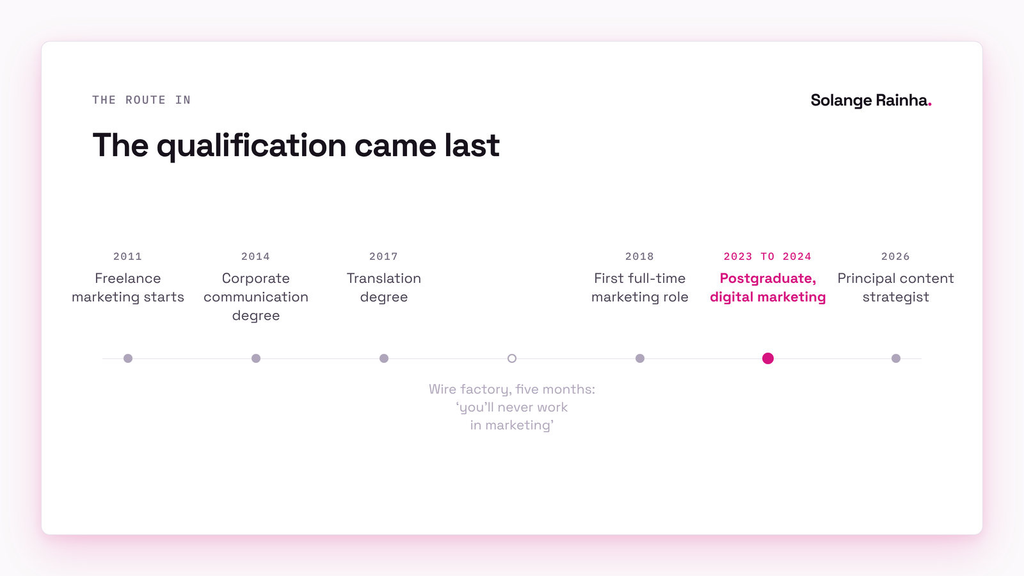
There’s one moment from those five months I’ve carried for years, and not in a good way at first: a manager well above me, the sort who says this kind of line without appearing to think twice, told me flatly that I’d never work in marketing. He didn’t soften it into “it’ll be hard” or “you’ll need to build experience”; he said never. The reason was simple: I hadn’t studied marketing, so it wasn’t for me. I’d studied corporate communication and then translation, and neither degree said marketing on it, so I took it personally, because he meant it personally.
I’m writing this more than a decade into a marketing career built without a marketing degree, because that sentence turned out to be one of the most useful lines anyone ever handed me. It didn’t motivate me in any tidy, inspirational way, but it was a clean, confident example of a belief that’s wrong, common and quietly expensive, and those are worth taking apart.
Can you work in marketing without a degree in it?
Yes, and most marketers do, even if hiring is slow to admit it. What that manager said to my face is what plenty of hiring still believes in silence: the degree is the gate, and if you didn’t pass through it, you don’t belong on the other side. Working in marketing without a degree in it is supposed to be the exception, when Marketing Week’s 2024 Career and Salary Survey shows it’s the usual route, with fewer than a quarter of marketers holding a marketing-specific degree.
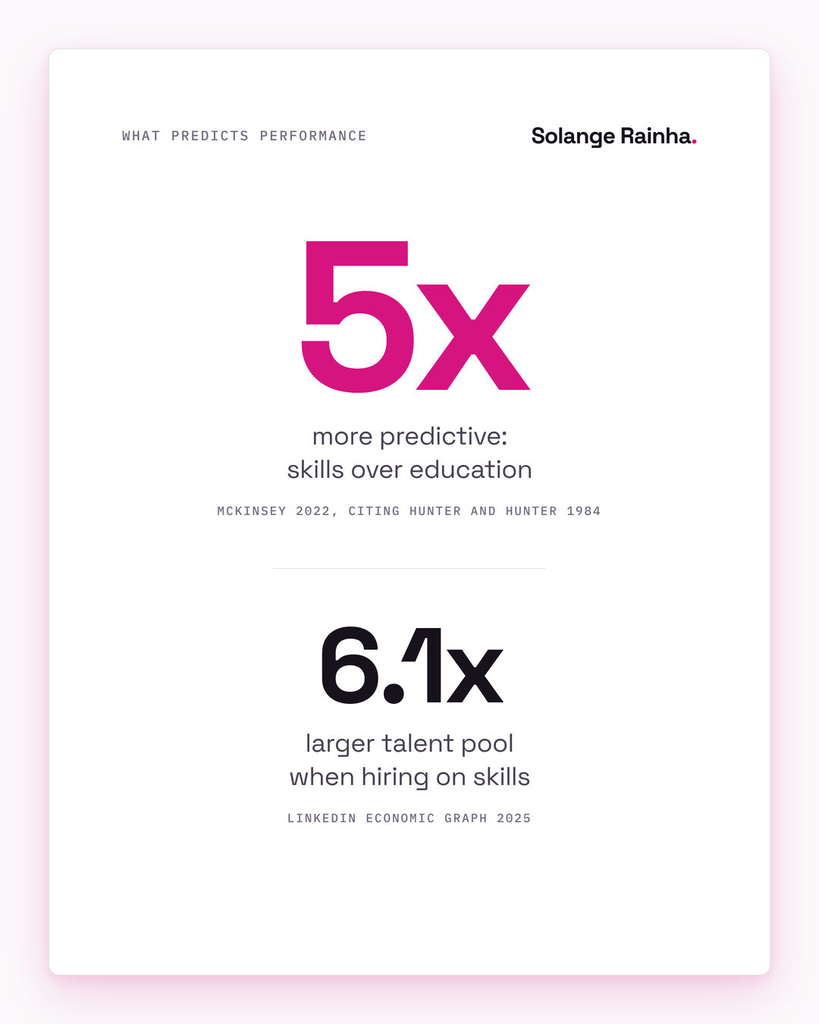
The evidence against the gate has been around for a long time: McKinsey’s 2022 piece on skills-based hiring cites research showing hiring for skills is five times more predictive of job performance than hiring for education, a finding that goes back to Hunter and Hunter’s 1984 meta-analysis of what predicts performance at work. LinkedIn’s 2025 Economic Graph report puts a size on the cost of ignoring it: hiring on skills makes the talent pool 6.1 times larger globally, and 6.3 times larger for workers without a bachelor’s degree.
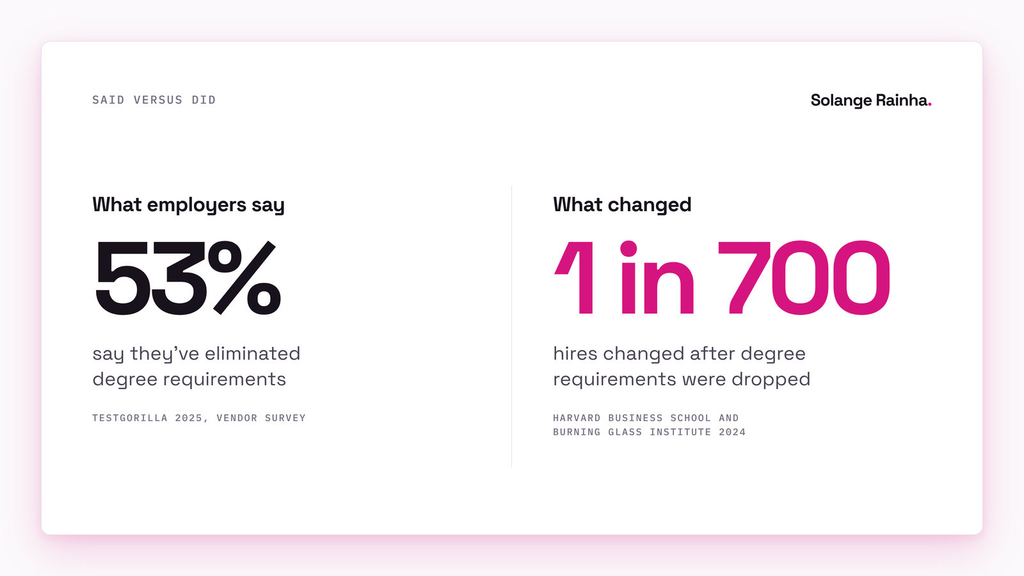
Employers say they’ve heard: in TestGorilla’s 2025 State of Skills-Based Hiring survey of 1,084 people making hiring decisions in the US and UK, 85% said they use skills-based hiring and 53% said they’d eliminated degree requirements. TestGorilla sells skills tests, so read that as a self-report from a company with a reason to like the trend.
What marketing rewards is a set of qualities a marketing degree doesn’t reliably produce: taste, the ability to write like a person, an instinct for what an audience wants, and the stomach to ship a piece of work and own the result. I’ve worked alongside people from every background you can think of, and the link between “studied marketing formally” and “good at marketing” is far weaker than the gatekeepers need it to be.
A degree tells you someone finished a degree: it’s an occasionally useful signal and a terrible fence, and in marketing the fence keeps out some of the best people.
What builds a marketing career without a marketing degree?
Work, mostly, and a lot of it in public. For 14 years I held full-time roles and ran marketing for small businesses on the side, which taught me more than any classroom could, because a wrong call cost a small business its own money that week. I’ve stood up marketing functions from nothing, rebuilding one company’s whole content operation in 90 days because there was nobody else to do it, and I built brand positioning for companies that had none, the exact strategic work the degree was supposed to be the prerequisite for. Some of that range came from working across six wildly different industries, none of which my transcript predicted.
It all came with the work, and with a stubbornness I can trace directly back to a factory and a man who thought my future was his to predict.
When a company later changed its whole buyer profile mid-quarter and I had to rebuild the content strategy as it happened, nobody asked what I’d majored in; they asked whether I could fix it. I could, and on the job that’s the only credential that’s ever counted.
I did add a formal marketing qualification eventually, years in: a postgraduate course in digital marketing in 2023 and 2024, taken while I was doing the work. It sharpened my vocabulary and confirmed a lot of what experience had already taught me, but it didn’t give me permission to start, because I’d started long before, which is the point that manager missed.
When does a marketing degree help?
More often than the revenge version of this story would admit. In technical or regulated fields the degree does heavy lifting, and I’d never pretend otherwise. Even in marketing, formal study shortcuts fundamentals that self-teaching leaves patchy, and the next generation seems to agree: 36.8% of Gen Z marketers in Marketing Week’s survey hold a marketing-specific degree, against 13.2% of Gen X.
The shift away from degrees is also slower and messier in practice than the headlines suggest: in their 2024 study, Harvard Business School and the Burning Glass Institute looked at companies that publicly dropped degree requirements and found fewer than 1 in 700 hires changed as a result. Joseph Fuller, the Harvard professor who co-authored it, put it this way:
“Changing your hiring policy is, at best, the end of the beginning.”
| Formal marketing study | Learning on the job | |
|---|---|---|
| Fundamentals and vocabulary | Covered in order | Patchy until you fill the gaps |
| Feedback | Grades, weeks later | Results, within days |
| Taste and writing | Depends on the person | Built by shipping and being wrong |
| Signal to a hiring filter | Easy to read | Has to be shown, in a portfolio or a track record |
| What it can’t do | Prove you’re good at the job | Get you past a filter that only reads degrees |
So my case for marketing without a degree is narrower than “degrees are dead, follow your passion”. Valuing the credential is fine; using its absence to tell a 24-year-old, with total confidence, what she’ll never be allowed to become is where it goes wrong. Treating marketing without a degree as disqualifying is the same lazy reflex as reading any unusual line on a CV, or a short tenure, as a defect instead of as information, and it’s how hiring misses the candidates whose value doesn’t fit the usual template, a problem I broke down in the hiring research asymmetry.
What should you do if someone says you’ll never work in marketing?
Treat it as information about them, then get to work. Someone reading this is being managed by a version of that man right now and being told, in so many words, that the career they want is off-limits because their paperwork’s wrong. If that’s you, here’s what I wish someone had handed me at that desk.
People who are sure about the ceiling above you are usually describing their own. Someone who believes a career is a locked room you need the right key to enter is telling you how they got in, and you can get in another way. Some of the best marketers I know arrived from journalism, teaching, hospitality and selling products to people face to face, and the detour is what made them good. A line like his can also stay with you for years, and an unusual route is reliable fuel for the imposter syndrome so many marketers carry.
Marketing without a degree only stays a problem while the work is thin, so your job is to get good enough that the question stops coming up, and to keep the receipts, which is the whole case I made in what got me hired, personal brand or not. Nobody has asked me in years what I studied, because the work answers it before the question can form. That’s the unsatisfying, entirely usable revenge: his prediction stopped counting for anything, with anyone, me included. The wire factory gave me one gift worth keeping, and instead of a reference it was a sentence I got to spend the next decade disproving.
I still think about that manager occasionally, usually right before I hit publish on a piece I’m proud of, and then I get back to the work.
Frequently asked questions
Yes. Most marketers already do: only 23.3% of the more than 3,000 marketers in Marketing Week’s 2024 Career and Salary Survey hold a marketing-specific degree. Marketing rewards skills you can show, such as writing, audience judgement and the results of campaigns you ran, and research McKinsey cites finds skills five times more predictive of job performance than education. Some employers still filter on degrees, so a portfolio and a track record do the work a diploma would.
A marketing degree is worth it for structured fundamentals, a shared vocabulary and getting past hiring filters that still read degrees, and it’s becoming more common: 36.8% of Gen Z marketers hold one, against 13.2% of Gen X, according to Marketing Week’s 2024 survey. It’s a weak predictor of who’s good at the job. A postgraduate qualification taken while working can add the vocabulary without delaying the experience.
Fewer say they do. In TestGorilla’s 2025 survey of 1,084 US and UK hiring decision-makers, 53% said they’d eliminated degree requirements, though TestGorilla sells skills tests. Practice lags the policy: Harvard Business School and the Burning Glass Institute found fewer than 1 in 700 hires changed at companies that dropped degree requirements. Expect some filters to persist, and lead applications with work samples and results.
Treat it as information about the speaker’s assumptions, and keep your own verdict on your potential. Confident claims about the limits of someone else’s career usually describe the speaker’s own route in. The response that lasts is building demonstrable skill and a record of results until the qualification question stops coming up, and keeping evidence of the work so you can show it when asked.