I’ve spent most of my 15 years in marketing as an individual contributor by choice. When the individual contributor vs manager decision comes down to keeping your current role or getting a promotion, companies take their best maker off the work and hand them a job they never asked for. They lose twice, and an IC track with the same pay fixes most of that.
You’ve probably seen it happen: someone is great at the work, so the company makes them a manager, and a year later their team is struggling and the former best maker is quietly miserable. The individual contributor vs manager decision shouldn’t work like that, but in most companies it does, largely because pay and seniority depend on how many people report to you.
An individual contributor (IC) is someone whose rank comes from the work they do themselves and not from a team, like a principal engineer or a senior strategist. I’ve had Manager in my job title in five roles with zero direct reports in any of them, and today I’m a Principal Content Strategist, which is the kind of senior IC position most marketing teams still don’t offer.
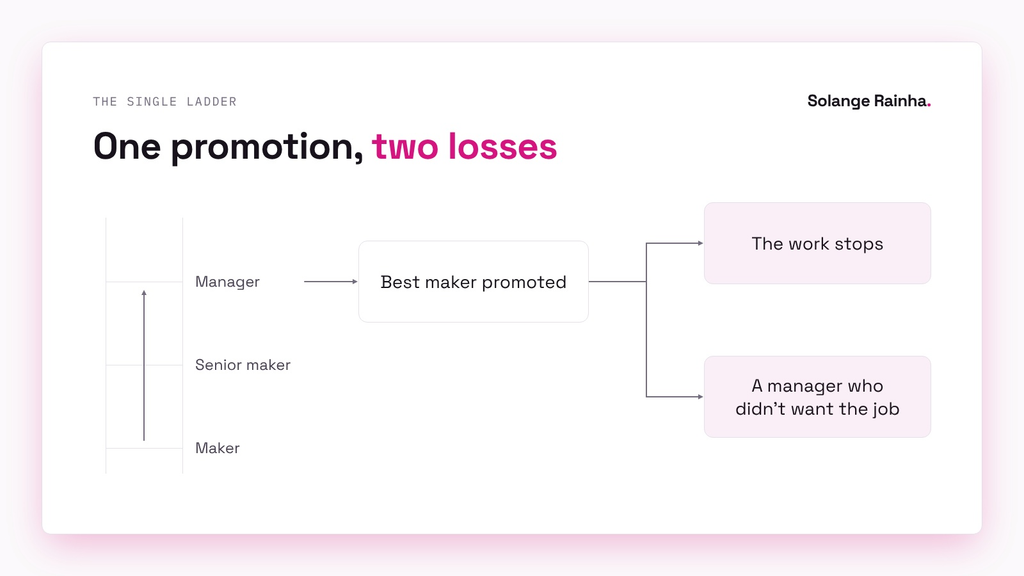
Why does the best maker rarely become the best manager?
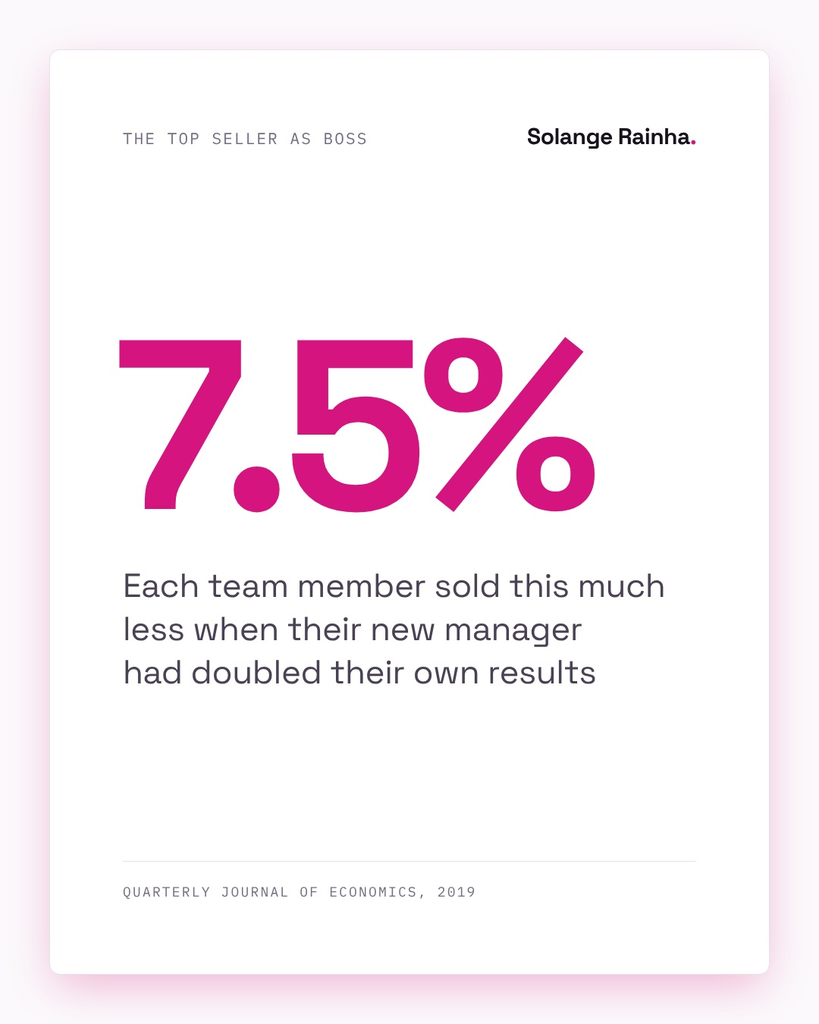
The best maker rarely becomes the best manager because the two jobs need different skills, and most promotion decisions only look at one of them. Alan Benson tracked 53,035 sales workers at 214 US firms with Danielle Li and Kelly Shue, and their 2019 study in the Quarterly Journal of Economics found that companies were 14.3% more likely to promote someone with twice the sales. Among new managers, that same doubling went with a 7.5% drop for each person they led, so the people most likely to get the job ended up running weaker teams.
Research from Gallup in 2014 says much the same, with about one in 10 people having high talent to manage and companies picking the wrong candidate 82% of the time. The Peter principle is the old idea that companies keep promoting people until they reach a job they’re bad at, and the sales study is close to a measured version of it. We judge a top seller or writer on their own output, whereas a manager’s results come from other people’s work, so being great at the first job tells you very little about the second.
Why do companies keep promoting makers anyway?
Companies keep promoting makers because a single career ladder leaves them nothing else to give. In most organisations, pay bands and a say in planning both depend on headcount, so when a high performer asks for more money or more influence, all HR can offer is a team. Promoting your best seller also looks fair, and the sales study found that firms put current sales ahead of other signals they already had. The cost shows up later in the new team’s results, where nobody links it to the decision.
Charity Majors, who’s written for years about moving back and forth between engineering and management, put it plainly in a 2020 post on why returning to hands-on work isn’t a demotion:
“Management is not a promotion, it’s a change of career.”
Marketing is behind here: Will Larson’s 2020 guide to staff-plus roles describes four kinds of senior engineer who lead without managing anyone, and plenty of software teams have levels for them. In content marketing, most companies still expect a writer to become a content manager and then head of the function, with less hands-on work at every step.
What do companies lose when they promote the best maker?
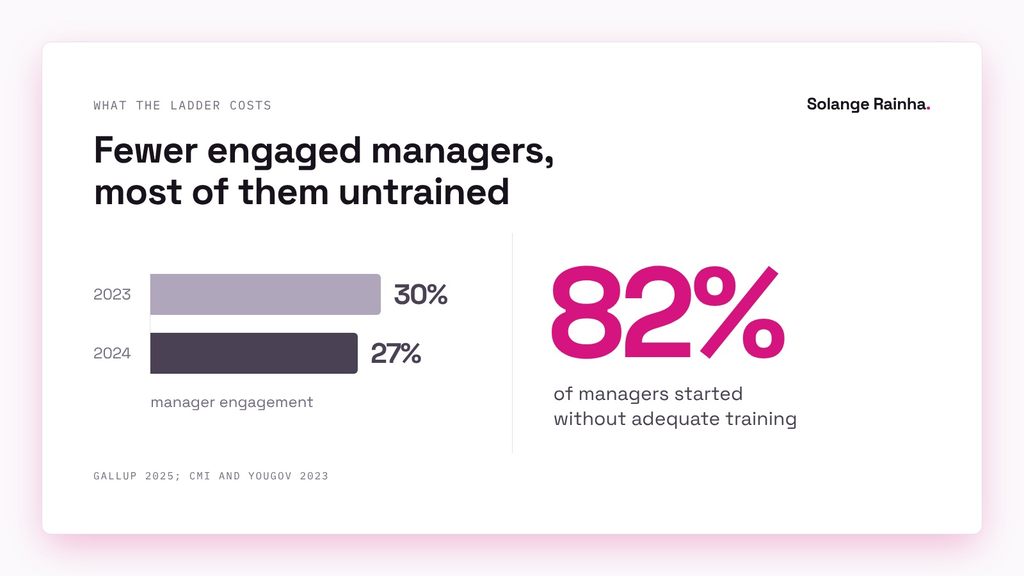
Companies lose the work first, since the best maker now spends the week on one-on-ones and hiring, so the craft that earned the promotion mostly stops. They also get a manager who didn’t want the job, and Gallup’s data shows what that costs. Its 2025 State of the Global Workplace report found that manager engagement fell from 30% to 27% in 2024, and its 2014 research estimates that managers account for at least 70% of the difference in engagement between teams.
Poor preparation makes it worse: the Chartered Management Institute (CMI) and YouGov surveyed more than 4,500 people in the UK in 2023. They found that 82% of managers came into the role without adequate training, and half the people who worked for an ineffective boss planned to leave within 12 months. So a promotion that a company uses to keep a high performer can end up costing it that person and part of their team. An untrained, reluctant manager is also the one filling in the appraisal forms, and annual performance reviews mostly measure the person doing the rating anyway.
What does a good individual contributor track look like?
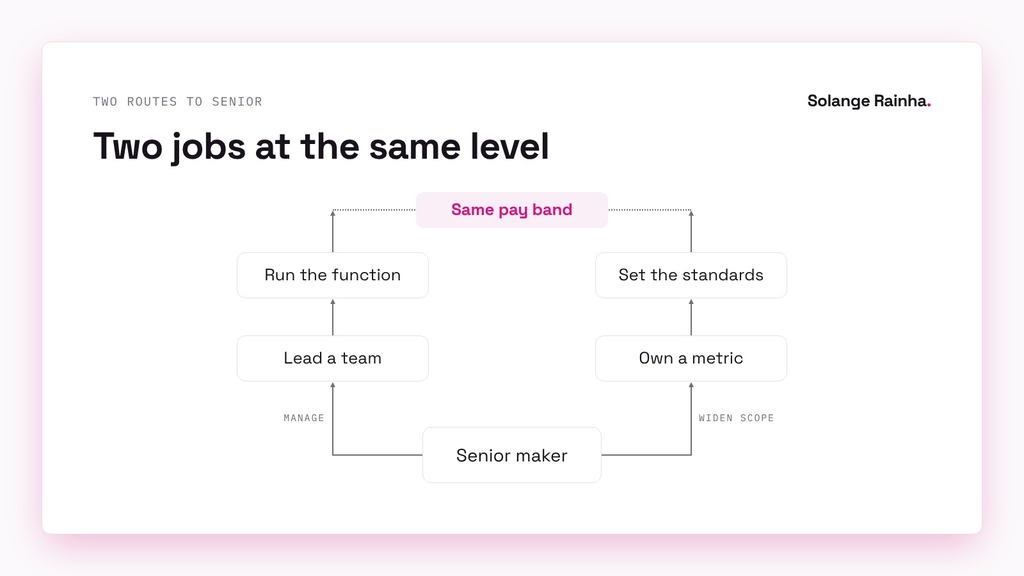
A good individual contributor track treats senior makers the same as managers at their level, and the quickest test is whether a principal-level IC can earn as much as a director. If not, the IC track is a title change and nothing else.
| Single ladder | Dual track | |
|---|---|---|
| How do you get a raise? | You manage more people. | You widen your scope, or pick management. |
| Who decides what you work on? | Your manager does. | The IC does, within goals they agreed with their manager. |
| What happens to the best maker? | The company moves them into management. | They keep making things, with more influence. |
| Can you go back if management doesn’t fit? | Everyone sees going back as a demotion. | It’s a sideways move at the same level. |
| What gets you a good review? | Your team hits its targets. | Your own work changes something the business tracks. |
Most IC tracks fail on measurement, because without a team to show, companies count output. In my last role I asked my manager to set my target on pipeline instead of downloads, since volume says little about what a senior IC is worth. I was a team of one, and that content operation contributed to 48% marketing-sourced pipeline in peak months, so I could argue for my level without a single direct report. If you’re designing the track, pick the content metrics that show impact before you write the level descriptions, because people will work toward whatever you measure.
Decision rights count as much as pay, and a senior IC who needs permission for everything is doing a junior’s job for more money. Most of what made me useful on my own came from owning the content function instead of just taking orders, and I report my results as contribution, not credit, which is exactly what a good IC track should reward.
How do you make the individual contributor vs manager decision?
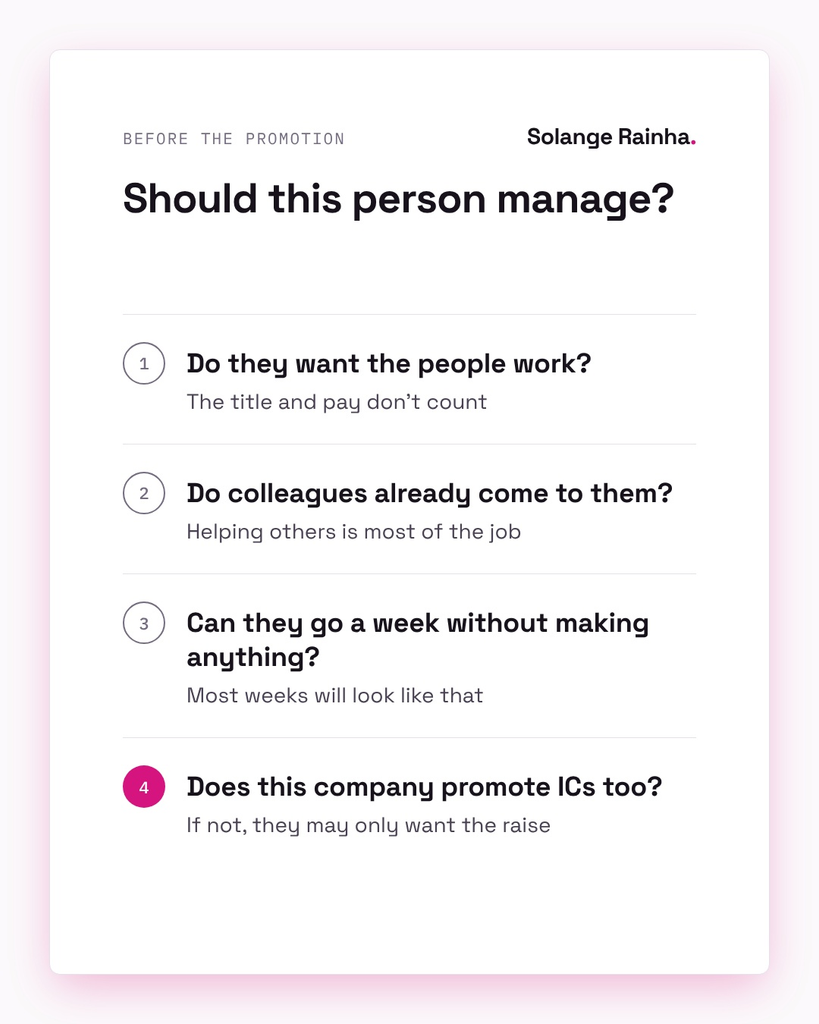
Someone should manage when they want the people work for its own sake and have already shown they’re good at helping others improve. The sales study also found that doubling a new manager’s experience of working with others before the promotion went with 12.3% to 16.9% higher team sales, which makes it a far better signal than their own results. In practice, look for the person colleagues already go to when they’re stuck, especially if they offer feedback unprompted and actually enjoy it when someone else gets the credit.
I’ve led people once: I coordinated four freelance social media specialists in the UK, the USA, Italy and Brazil during live race coverage, and I wrote up what managing a distributed marketing team taught me. I learned a lot from it, and I still went back to the work, because I enjoy making things myself more than leading the people who make them. I’m open to running a team if a role needs it, and an IC track is what lets someone say yes to management for the right reasons instead of because it’s the only promotion on offer.
How do you grow without managing?
You grow without managing by widening your scope, which usually means owning a metric the business watches and writing down the rules other people follow. In content, that could look like taking on positioning or measurement as well as production, or building the editorial standards a whole company writes to.
Mentoring doesn’t need direct reports either: reviewing other people’s drafts, or creating the guide new hires learn from, builds the influence a principal-level title calls for. I’ve found a documented content system does more for a team of one than extra headcount, and setting one up is what makes an IC worth paying at a senior level.
If someone’s pushing you toward management and you’re not interested, say what you want instead, in terms of scope and level, before you say no. “I’d like to own measurement across content and web, at the same level as a manager” gives your company a proposal to work with.
What I’d do differently
I’d have asked for the scope and level in writing much sooner, instead of accepting a Manager title as the only way a company could tell me I was senior. All those job titles made my work history confusing, since nobody can tell which ones came with a team. My full CV now says plainly that I was the only content person in most of them.
I’d also have asked earlier what senior IC work looked like in each company, because one that hasn’t written it down will go back to counting headcount as soon as budgets get tight. Are you unsure whether you want a team? Ask your manager one question: what does the next level look like here if I don’t manage anyone?
If you’re designing career paths or deciding whether to make the switch yourself, message me on LinkedIn and tell me how you’re handling it.
Frequently asked questions
Companies judge an individual contributor on the work they do themselves, and a manager on what their team produces. Both can be senior: a principal strategist and a head of content can be at the same level and earn as much as each other, if the company has a dual track. The day-to-day is very different, though, so make sure you know which week you’d rather have before you pick one.
Yes, you can earn a promotion without managing anyone in companies that have an individual contributor track with levels like staff and principal. On that track, promotion depends on wider scope, such as owning a metric or a function’s strategy (or setting the standards other people follow). In companies with a single ladder, it’s much harder, and your title may say Manager without any reports.
Moving from manager back to individual contributor isn’t a demotion when the company pays both tracks the same at each level. Where a single ladder ties rank to headcount, it often does mean less money and status, which is a design problem. Check the salary band for the IC role before you make the switch.
Turning down a management promotion works best when you come with a counter-offer. Ask to own a wider area, such as measurement or positioning, at the seniority that role would bring. Base the reason on where you add the most value, not on what you dislike. Ask your manager to confirm in writing what you agreed, so the conversation doesn’t start over at the next review.
Companies build a dual career ladder by writing level descriptions for individual contributors that match the management ones on pay and decision rights. Each one needs criteria that measure the scope of the work and not how much someone produces. Start with the senior IC roles in the teams where your best makers face the most pressure to manage.