Yes, you can bring notes to an interview, and I think you should. Interviewers work from a prepared question list and take notes the whole way through, so marking a candidate down for doing the same rewards memory over judgement. Here’s what goes on my notes page, how I use it on camera without reading from it, where notes go wrong, and what hiring managers should judge instead.
Every interview I’ve done in nearly ten years has been a video call for a remote role, and for every one of them I’ve had a page of notes on the desk next to my keyboard. Most of us were taught that if you bring notes to an interview it reads as weak, as if the interview were a memory test and glancing down counted as cheating, which I think is backwards. An interview is two sides deciding whether they want to work together, and the person on the other end of the call is already reading from a list of planned questions and typing up what I say, usually in a window I can’t see. My notes show I did the homework, and no remote marketing job I’ve had has ever needed me to recite facts on cue.
Why do interviewers get notes when candidates don’t?
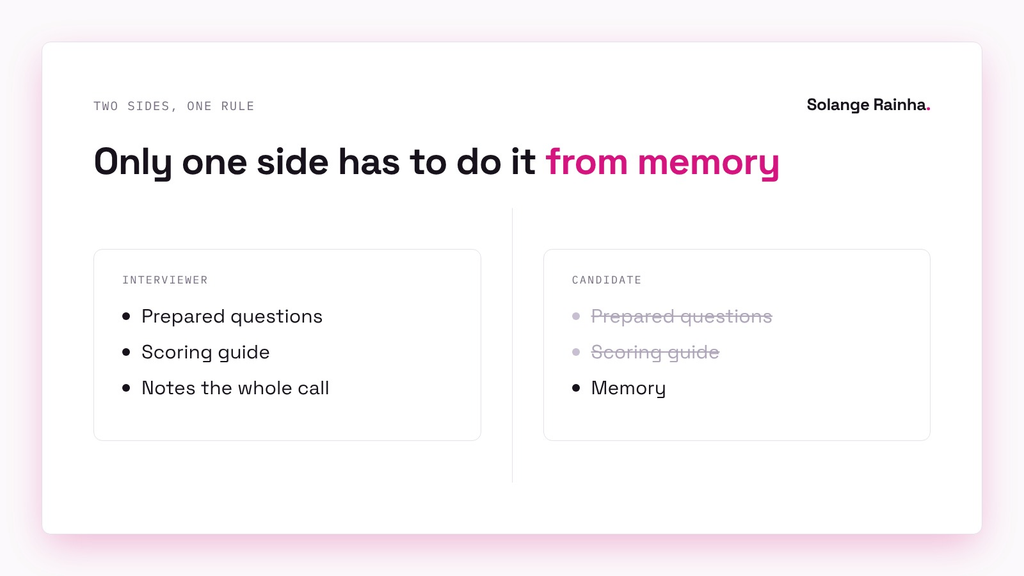
Google’s guide to structured interviewing on its re:Work site is about as mainstream as hiring advice gets. Interviewers use planned questions vetted for the role, score answers on standardised rubrics with example answers from poor to outstanding, and write everything down for the rest of the panel (Google re:Work). The instruction is blunt:
“Interviewers take detailed notes of applicant responses.” (Google re:Work)
That’s good practice, and the evidence backs it. A 2022 re-analysis of selection research led by Paul Sackett put structured interviews at the top of the predictors of job performance, with a mean operational validity of .42 against .31 for cognitive ability (SIOP).
So the interviewer joins the call with a script and a scoring sheet open, while the candidate is expected to pull 15 years of work out of their head with nothing in front of them. On video the double standard is even easier to spot, because you can watch the interviewer’s eyes drop to their notes between answers. I wrote about the research gap between employers and candidates in hiring research asymmetry, and a ban on candidate notes is that same imbalance squeezed onto one sheet of paper.
| Interviewer | Candidate, by default | |
|---|---|---|
| Prepared questions | Planned and vetted for the role in advance | Expected to come up with some at the end |
| Reference material | Rubric with example answers, open on screen | None |
| Notes during the call | Typed up on every answer | Often read as unprepared |
| Record afterwards | Shared with the hiring panel | Whatever they remember once the call ends |
What does a remote marketing job actually test?
Recall under pressure isn’t on any job description I’ve applied to. Remote work in particular is research and judgement done with every tab open, which means reading a market and knowing where to find the figures when someone asks in Slack. When I caught a tracking error at my current job that was miscounting 43% of site traffic, it was with GA4 open and a spreadsheet beside it, because nobody does that from memory.
A notes page shows those skills in miniature: it tells the interviewer I looked into their company and picked the evidence worth citing, and that I know what I need to learn from them before I’d say yes. Take the page away and you end up testing a skill I’ll never use at work instead of the prep I do every day.
What goes on my notes page?
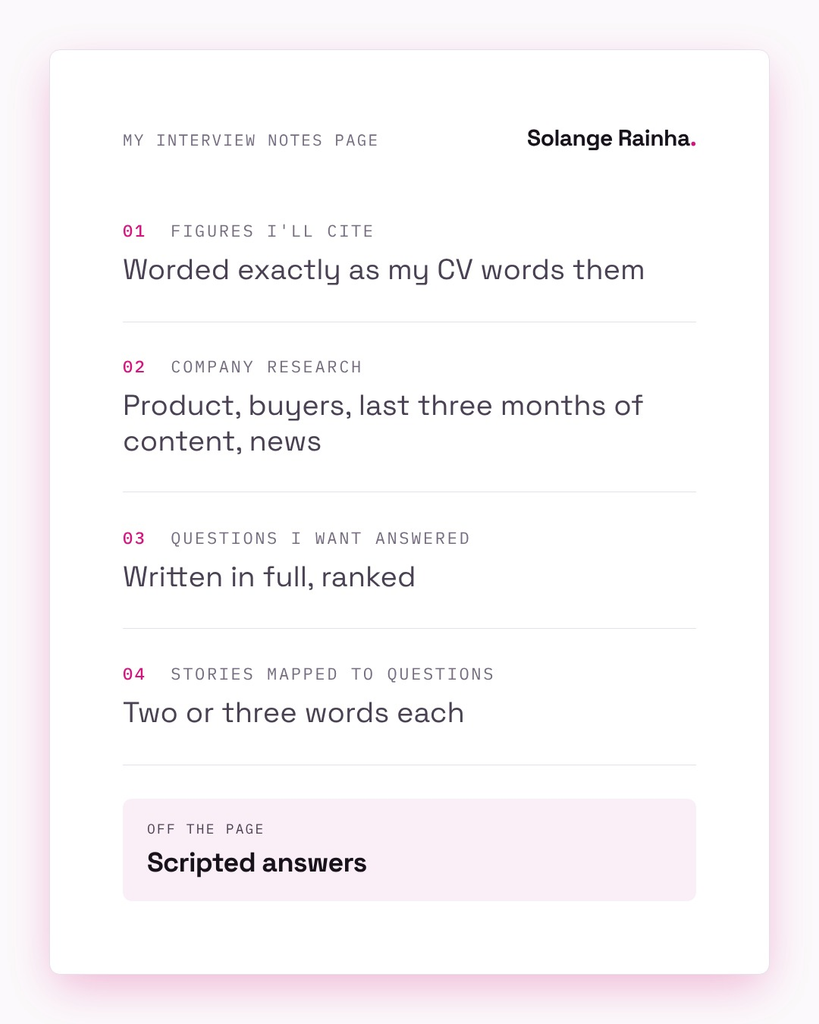
I use one A4 page, printed or handwritten, on the desk beside the keyboard and split into four blocks (copy the layout as is, if it helps).
The figures I’ll cite, worded exactly the way my CV words them. “Contributed to 48% marketing-sourced pipeline in peak months” and “drove 48% of pipeline” are different claims, and nerves are when one turns into the other. I wrote up where that figure came from in the 48% marketing-sourced pipeline breakdown, and the rest sit on my results page.
Then company research: what they sell and who buys it, what their blog and LinkedIn have done over the last three months, and any news about funding, layoffs or leadership changes. I got strict about this after three jobs ended for reasons I couldn’t have controlled but could have spotted earlier, which I covered in employer due diligence.
The questions I want answered go next, written out in full and ranked, so if the call runs short I still ask the two that decide whether I’d take the job. For remote roles that list always includes how the team works across time zones and how decisions get made in writing, and several more come straight from contract negotiation red flags.
Last, stories mapped to likely questions: two or three words per story, next to the question it answers. A line like “pushback from sales” sits next to the story about rebuilding content strategy for an ICP pivot, and that’s all the prompt I need.
The full answers stay off the page, because if I write one out I’ll read it and it’ll sound like it. A few cue words are enough to jog my memory, and I do the talking.
How do you use notes in a video interview without reading from them?
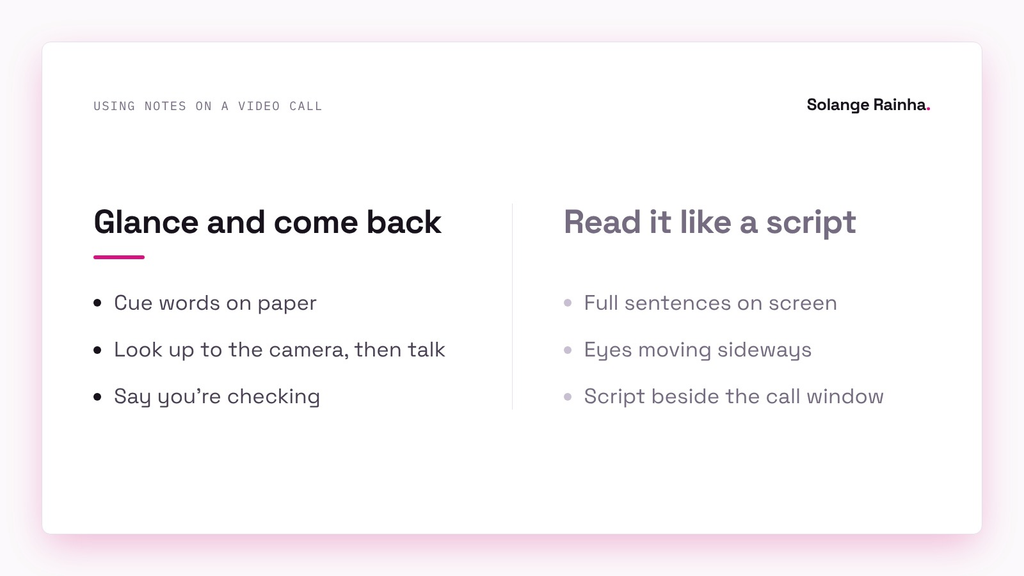
Keep them on paper and look at them openly. The camera shows where your eyes go, so a script on a second screen or in a window beside the call makes your eyes track sideways line by line, and everyone on the call can see it. A glance down at a page on the desk looks like checking something, which is what you’re doing.
I look down for the word and back up at the camera before I start talking, and since I only write cue words on the page, there’s nothing there I could read in full sentences anyway. Before I look down I say “let me check my notes”, which takes two seconds and tells the interviewer the glance is deliberate.
When a question isn’t covered on the page, I answer it anyway. The page is there for when my head goes blank, and most of the time it sits beside the keyboard untouched.
Doesn’t AI cheating make notes on video look suspicious?
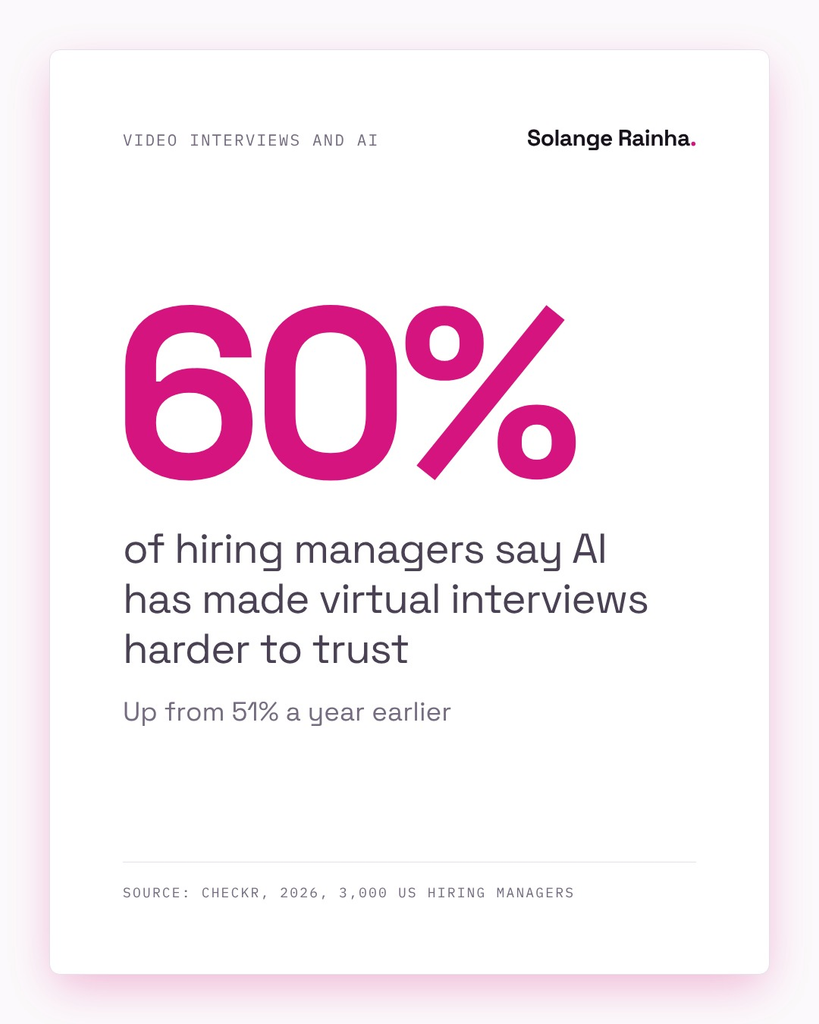
It does, and that’s the strongest reason to be open about your notes. Hiring teams spent 2025 and 2026 worrying about candidates feeding questions into AI tools mid-call: Computerworld reported that Google, Cisco and McKinsey were bringing back in-person interviews partly to counter it (Computerworld, 2025), and Checkr’s October 2026 survey of 3,000 US hiring managers found 60% say AI has made virtual interviews harder to trust, up from 51% a year earlier (Checkr, 2026). Recruiter Sara Nibler told Fortune that interviewers keep catching candidates reading straight off their monitors (Fortune, 2026).
So the glance that used to look like nerves can now look like a hidden screen. What interviewers are trained to watch for is a pattern, though: BrightHire’s guide on spotting AI use tells them to look for steady reading across several answers rather than a single glance away from the camera (BrightHire). A glance down at cue words on paper, named as you do it, keeps you well clear of that. These days I’d go one step further and mention the page at the start of the call (“I’ve got a page of notes here, so you’ll see me look down now and then”), because it answers the question before the interviewer has to ask it.
Does interview anxiety make notes more useful?
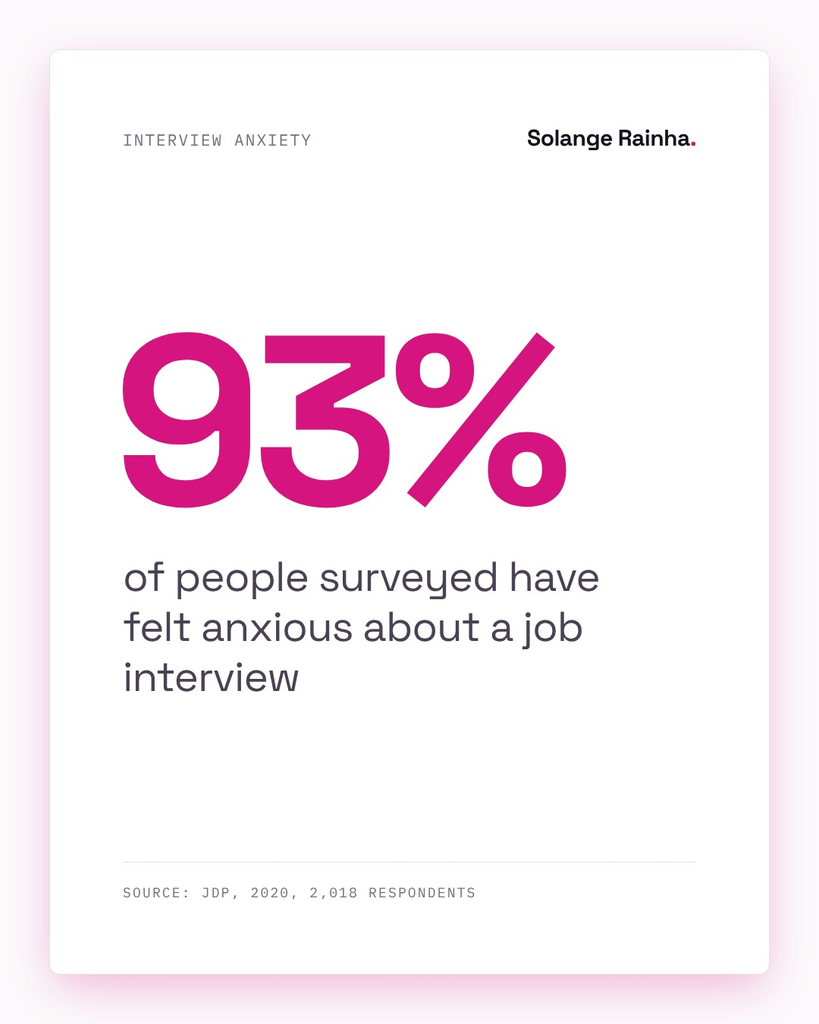
Yes, and anxiety is the default state for candidates. JDP’s survey of 2,018 Americans, published in 2020, found 93% had felt anxious about job interviews, and only public speaking made respondents more nervous (JDP). The same survey found about 62% prepare anecdotes ahead of time, so most candidates already do the work and then get told to leave it off the desk.
Attentional control theory, set out by Michael Eysenck and colleagues in 2007, describes anxiety as a drain on the attention and working memory you need to pull information up on demand (Eysenck et al., 2007). Video adds its own load: a Stanford study of 9,787 people led by Géraldine Fauville found that those who felt anxious seeing their own face on screen reported more video call fatigue, even after accounting for how much they used video calls (Fauville et al., 2023). A page that holds the figures frees your head for the bit an interviewer should be judging, which is the thinking.
For neurodivergent candidates the gap is wider. Law firm Lewis Silkin’s October 2026 note on neuroinclusive recruitment lists permission to use notes among the adjustments employers can offer, alongside remote settings, because competency interviews demand fast recall under time pressure (Lewis Silkin). In the case behind that note, Bryce v Coventry City Council, the Employment Appeal Tribunal sent part of an autistic candidate’s claim back because a tribunal had read his calm manner as proof he wasn’t stressed (EAT judgment, 2026). If you can’t tell how stressed someone is by looking at them, and on a video call you’re looking at a head and shoulders, a rule that rewards looking calm is screening for the wrong trait.
Where do interview notes go wrong?
The first trap is reading answers word for word: your eyes leave the camera for long stretches, and the interviewer stops having a conversation and starts listening to a recording. A script in a window next to the call feels invisible, but steady reading like that is what interviewers now watch for as a sign of AI help. The urge to script everything hits hardest the night before, which is when you should be cutting words from the page.
The second trap is notes standing in for preparation, like a page copied from the job ad and the About page that you’re seeing properly for the first time on the call. That’s a prop, and it shows the minute someone asks a follow-up. Wanting to hide your prep in the first place comes from the same place as imposter syndrome in marketing, the belief that competent people never need help.
What should hiring managers judge instead?
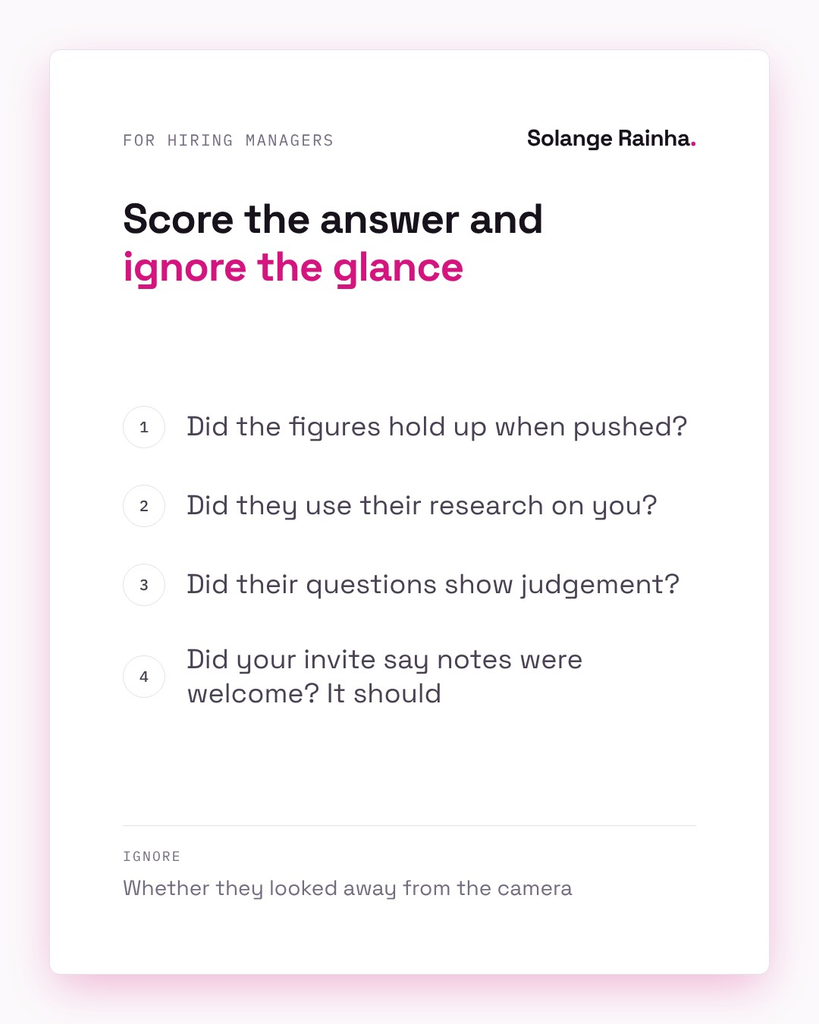
Judge the answers against the rubric (that’s the whole point of having one) and treat whether someone looked away from the camera as noise. What’s worth scoring is whether their figures held up when you pushed and whether they used what they’d learned about your company, plus the judgement their own questions showed about the role.
If you want to make it easy, do what BrightHire recommends and say in writing before the call whether notes are allowed, along with what format the call takes. It costs nothing, and when 93% of people surveyed have felt anxious about interviews, you’ll see a lot more of how they actually think.
When shouldn’t you bring notes to an interview?
Some assessments do test recall, and that’s fair: a language test, a proctored certification exam, or a role where speaking cold is the job, like live broadcasting. If the format’s unclear, ask by email beforehand whether notes are fine, which is a good sign in itself.
A few interviewers will still mark it down, though, and I’d rather find that out on the call than three months into the job. Someone who treats a page of research as cheating is showing me how they’ll treat preparation once I’m on the team, and after being laid off more than once I’ve learned to weigh that kind of signal before I sign anything.
Frequently asked questions
Yes, it’s OK to bring notes to an interview, including a video interview, and it usually reads as preparation. Interviewers in structured interviews, like those in Google’s re:Work guide, work from prepared questions and take detailed notes. Keep the page short and leave scripted answers off it.
An interview notes page works best in four blocks: figures worded exactly as your CV words them, research on the company, your own questions ranked by importance, and two or three cue words per story mapped to likely questions. Leave full answers off, because you’ll read them and it’ll show.
You can use notes in a video interview, but keep them on paper on your desk and look down at them openly. Reading from a second screen or a window beside the call makes your eyes move sideways line by line, which interviewers now treat as a sign of AI help. Mentioning the page at the start of the call clears up any doubt.
Hiring managers shouldn’t mark candidates down for using notes in an interview unless the assessment specifically tests recall. JDP’s 2020 survey found 93% of Americans had felt anxious about job interviews, and notes ease the load on working memory. Score the answer against the rubric and ignore the glance.