Cross-industry content marketing experience transfers far better than most hiring managers assume, as long as you know which parts move intact and which don’t. Strategic frameworks, editorial systems, measurement and stakeholder management carry over between B2B sectors unchanged. Tone, formats, persona complexity and sales cycle assumptions need recalibrating in the first few weeks, while domain vocabulary, buyer psychology, competitive dynamics and regulation have to be learned from scratch over three to six months. This is the breakdown from six industries of my own: B2B SaaS, EdTech, renewable energy, eMobility, IT consulting and sports.
Cross-industry content marketing experience is one of the most misread lines on a CV. The question hiring managers ask me most is some version of “but do you actually know our industry?”, and it’s the default screen for anyone whose CV shows range instead of vertical depth. I get the instinct: hiring is risky, industry experience feels like insurance, and someone who knows the space should ramp faster, miss fewer cultural cues and bring a network, which is all true, sometimes. It breaks down when industry experience becomes the main qualification instead of one input among several: a content marketer with deep industry knowledge and weak frameworks produces on-brand content that doesn’t drive pipeline, while one with strong frameworks needs a ramp period and then does sharper work, because the frameworks carry most of the job.
CXL’s B2B marketing career guide makes the same call from the hiring side:
“Industry knowledge helps, but it’s not a blocker.”
The same guide says hiring managers prioritise transferable skills such as funnel logic, demand generation and campaign management. Across six industries, I’ve found the transfer rate more interesting than a yes-or-no industry fit question allows: some skills move without a scratch, some need tuning, and some have to be learned from the ground up, and knowing which is which is the skill worth hiring for.
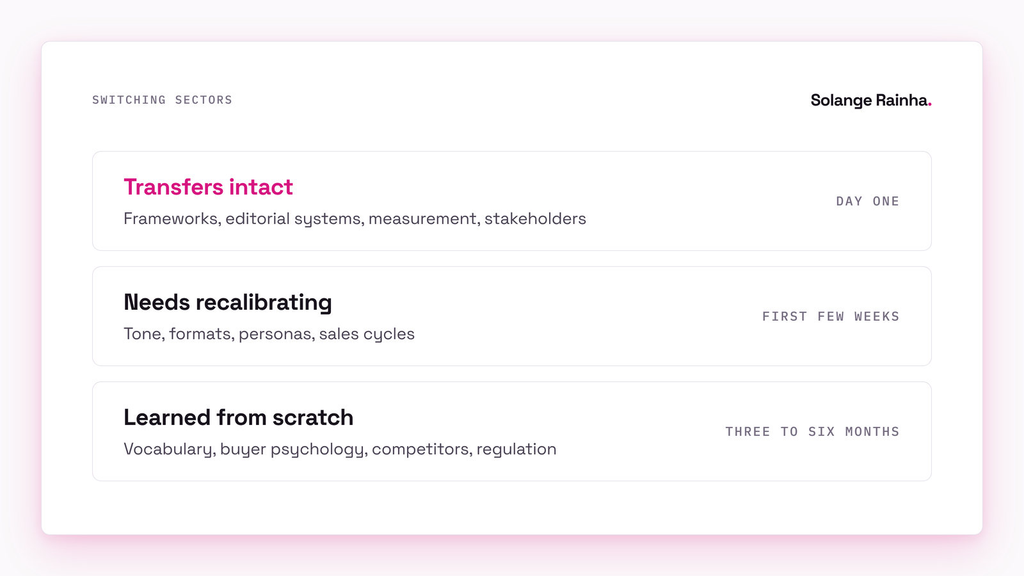
What transfers without modification in cross-industry content marketing?
The parts of the job that run on underlying logic rather than industry vocabulary transfer intact, and they’re most of senior content work: strategic frameworks, editorial systems, measurement and stakeholder management.
- Strategic frameworks. Full-funnel content strategy works the same way at a B2B SaaS company serving higher education institutions and at a renewable energy company selling to municipalities: map the buying process, find where content can move someone to the next stage, build it and measure whether it worked. The audiences, language and value propositions all change, while the mechanics stay the same.
- Editorial standards and processes travel too. Documented voice guidelines, evidence standards, banned phrases and competitive guardrails work in any sector, and I’ve written about building editorial standards from zero at a B2B SaaS company, an approach that worked just as well at an eMobility company with completely different content needs. The rules themselves look different in every sector, but the method for producing them doesn’t.
- Measurement. GA4, CRM attribution, KPI design and pipeline reporting don’t care what your product is. At the higher education SaaS company I set the KPIs and ran content reporting while our marketing manager ran the CRM attribution, and the content operation contributed to 48% of marketing-sourced pipeline in peak months; the same logic would have worked in eMobility or renewable energy, with different deal sizes and cycle lengths.
- Stakeholder management is the most portable of all. Every B2B company has sales, product, leadership and customer success, and every cross-functional content effort coordinates between them. The head of sales at the climate tech company had different worries from the head of sales at the IT consultancy, and the conversations I needed with both were structurally the same.
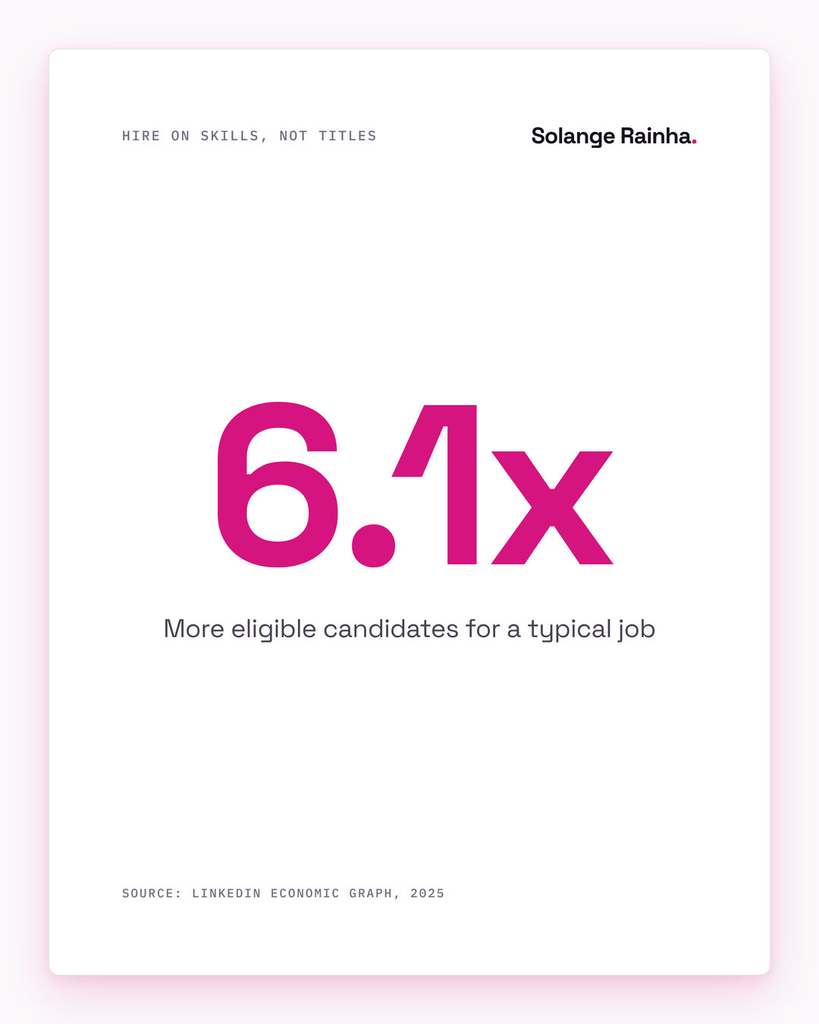
That’s the core of cross-industry content marketing: someone who’s mastered these in one B2B sector can use them in another straight away, which is a fact about how the work is built, not a line from a cover letter. It’s also what hiring data shows when you look past job titles: LinkedIn’s 2025 skills-based hiring report found that widening a search to people with the relevant skills, rather than the same previous job, increased the eligible talent pool by a median of 6.1 times.
What requires recalibration when you switch industries?
Tone, formats, persona complexity and sales cycle assumptions need recalibrating, which takes weeks rather than months, because the skill already exists and only the application has to be retuned. This is where most of the visible adjustment in cross-industry content marketing happens.
- Tone and register. Renewable energy content reads differently from sports content, which reads differently from enterprise IT, and even within EdTech, writing for universities is more formal than writing for schools. The voice has to match the audience’s professional culture, which comes from the industry. I had to move from the celebratory tone of competitive sports to the rigorous tone of B2B SaaS within a few weeks, and again from the climate-action tone of renewable energy to the operational precision of eMobility.
- Format preferences are industry conventions you have to respect. Enterprise IT audiences want long whitepapers and technical deep dives, EdTech audiences reach for toolkits and templates they can use on Monday, renewable energy buyers reward case studies and policy commentary, and sports audiences want short, image-heavy, emotionally direct social content. Push the wrong format at the right audience and engagement dies even when the content underneath is strong.
- Persona complexity. A five-persona buying committee in B2B SaaS is a different animal from sports marketing, where there’s effectively one persona (the participant) with audiences downstream of them (friends, employers, sponsors). I’ve written about running content for five buyer personas, and the framework holds, though the application changes a lot. Renewable energy had a B2B persona (municipalities) and a B2B2C one (residential communities), so I was holding economic-buyer logic and consumer emotion at the same time, which is a different load from five corporate personas in one committee.
- Sales cycle length changes how hard each piece has to work. A six-week cycle in eMobility leaves no room for the long nurture sequences a 14-month enterprise cycle needs, so content does more per piece and the calendar runs on a different rhythm. I had to shift from EdTech’s deliberate multi-touch pace to the higher-velocity output eMobility’s shorter cycle demanded.
The capability transfers and the calibration has to be redone, which an experienced content marketer can do, while an inexperienced one carries the old calibration into the new job and produces content that feels off without anyone being able to say why.
What do you have to learn from scratch?
Domain vocabulary, buyer psychology, competitive dynamics and regulation have to be learned like any new subject, and they take the longest, which is the part industry-first hiring managers are right to worry about.
Domain vocabulary. Every industry has terms insiders use and outsiders get wrong, plus loaded words that signal whose side you’re on. EdTech has “admissions” versus “enrolment” choices that show which audience you’re talking to. eMobility separates charge point operators (CPOs), e-mobility service providers (eMSPs) and charge point management systems (CPMS), and mixing them up marks you as an outsider instantly. Renewable energy has its own language for power purchase agreements (PPAs), feed-in tariffs and community energy structures. You pick this up in the first six to eight weeks by reading internal documentation, listening to sales calls and asking basic questions before they get embarrassing.
Buyer psychology is the second: what does this audience worry about, what gets them fired, what gets them promoted? Higher education leaders worry about falling enrolment and reputational risk; IT consultancy buyers worry about delivery risk and compliance; eMobility fleet managers obsess over uptime and operational complexity; renewable energy buyers care about cost predictability and regulatory shifts above almost anything. Buyers notice when you’ve done this work: in Edelman and LinkedIn’s 2025 B2B research, 85% of decision-makers named a demonstrated understanding of their specific challenges as a factor in the final decision, and you can’t fake knowing what someone fears.
Competitive dynamics means knowing who the main players are, who’s emerging and who’s about to be acquired, and which positioning claims hold up and which are inflated. Crunchbase and analyst reports get you partway; the rest comes from sales, customers and people who’ve been in the industry for years. When I rebuilt the content strategy for an ICP pivot at the higher education SaaS company, understanding the competitive field well enough to write credible positioning for IT buyers took months.
Regulation is the last, and in some industries it draws hard legal lines around what content can say. Healthcare and financial services have long had them, and energy and sustainability claims are joining the list: from 27 September 2026, the EU’s Empowering Consumers Directive bans generic environmental claims such as “environmentally friendly” or “green” unless the trader can show recognised excellent environmental performance. You have to learn these rules before you publish anything, then know them well enough that they stop slowing you down.
The realistic timeframe for learning a new industry is three to six months for someone who already has strong frameworks. Ramping faster shows in the work, and dragging it out past six months usually means you’ve stopped learning and started avoiding.
| Tier | What’s in it | How long it takes | How you get it |
|---|---|---|---|
| Transfers intact | Strategic frameworks, editorial systems, measurement, stakeholder management | Day one | Brought from previous roles |
| Needs recalibrating | Tone, formats, persona complexity, sales cycle assumptions | A few weeks | Test content and feedback from sales |
| Learned from scratch | Domain vocabulary, buyer psychology, competitive dynamics, regulation | Three to six months | Documentation, sales calls, customers, legal review |
How do I get up to speed in a new industry in the first 30 days?
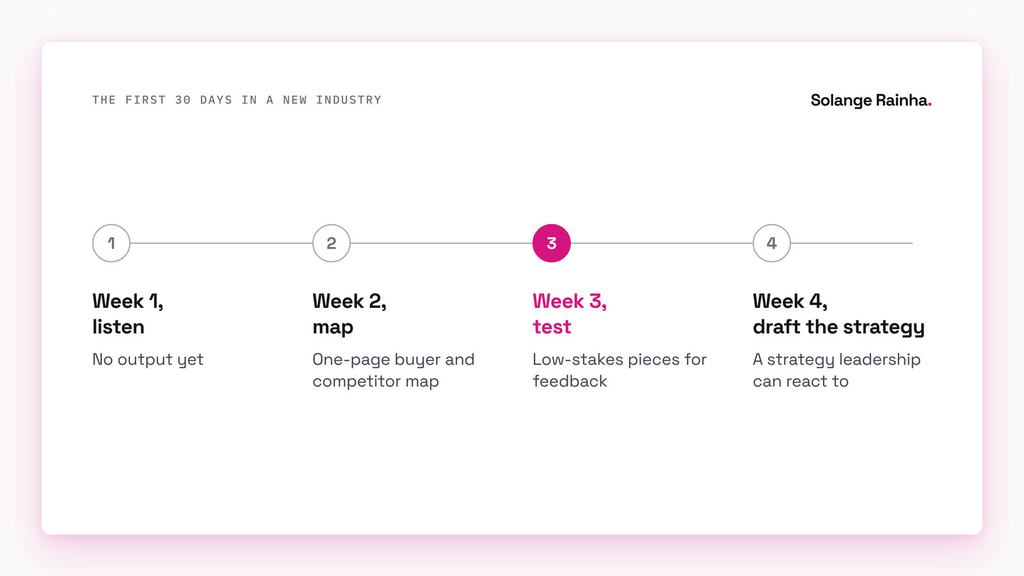
With a four-week routine that forces the mistakes early, while they’re still cheap. Six industries in, it’s not novel, but it works, and it runs alongside the operational setup I describe in my 90-day playbook for a new content function.
- Week one is listening, not writing. Sit on sales calls, read internal Slack channels and support tickets, and read the existing content critically, to absorb how people inside the company talk about the product, the customers and the competition, without producing any output yet.
- In week two I map it: a one-page summary of who the buyers are, what they care about, who the company competes with and what content already exists, shared with sales and leadership to mark up. Half of what I get wrong in week two gets corrected before it turns into a problem.
- Week three is test content. Short, low-stakes pieces deliberately exposed to scrutiny (internal newsletters, draft LinkedIn posts, blog outlines) to catch my voice calibration errors before they reach anything that counts.
- Week four is the strategy draft. By then I know enough to write a credible content strategy; it won’t be perfect, but it gives leadership something concrete to react to, which beats waiting until I know everything before committing to a direction.
The pace is deliberately uncomfortable, because content marketers in a new industry often want to wait until they “really understand” it before producing anything, but you don’t understand a new industry until you’ve produced enough to make some mistakes in it.
Why is cross-industry content marketing experience a strength?
Because it builds pattern recognition and lets ideas cross-pollinate, which a single sector can’t give you. The standard hiring framing treats industry range as a gap to fill or a risk to manage, and I’d argue the opposite.
After six industries of cross-industry content marketing, I’ve seen the same problems turn up in different forms, and I recognise the pattern underneath faster than someone who’s only seen one industry’s version of it. The “we need to change our ICP” conversation looks structurally identical at a sports organisation, a renewable energy company and a B2B SaaS EdTech business; only the specifics change.
Cross-pollination is the other half. A content workflow I developed at an IT consultancy fed into how I organised content across eight eMobility segments in 39 countries a few years later. A brand voice framework I built for a global ultra trail running championship ended up informing EdTech editorial standards a few roles on, and the source-verification habits I picked up from renewable energy compliance work became the spine of how I check AI-assisted content. None of those moves are available to someone who’s only worked in one industry. Research on problem-solving points the same way: in Harvard Business School research on broadcast search, where scientific problems were opened to outside solvers, solvers whose expertise sat at the edge of a problem’s field were the most likely to find answers, and to find them quickly. Karim Lakhani put it in one line:
“Innovations happen at the intersection of disciplines.”
This isn’t an argument for generalism over specialism, since the trade-off exists; the cross-industry side just gets undersold in hiring conversations. I’ve made a similar case about the experience people dismiss on CVs in what 14 years of freelance marketing taught me and the sports marketing lessons that carry into B2B.
When is deep industry expertise worth more?
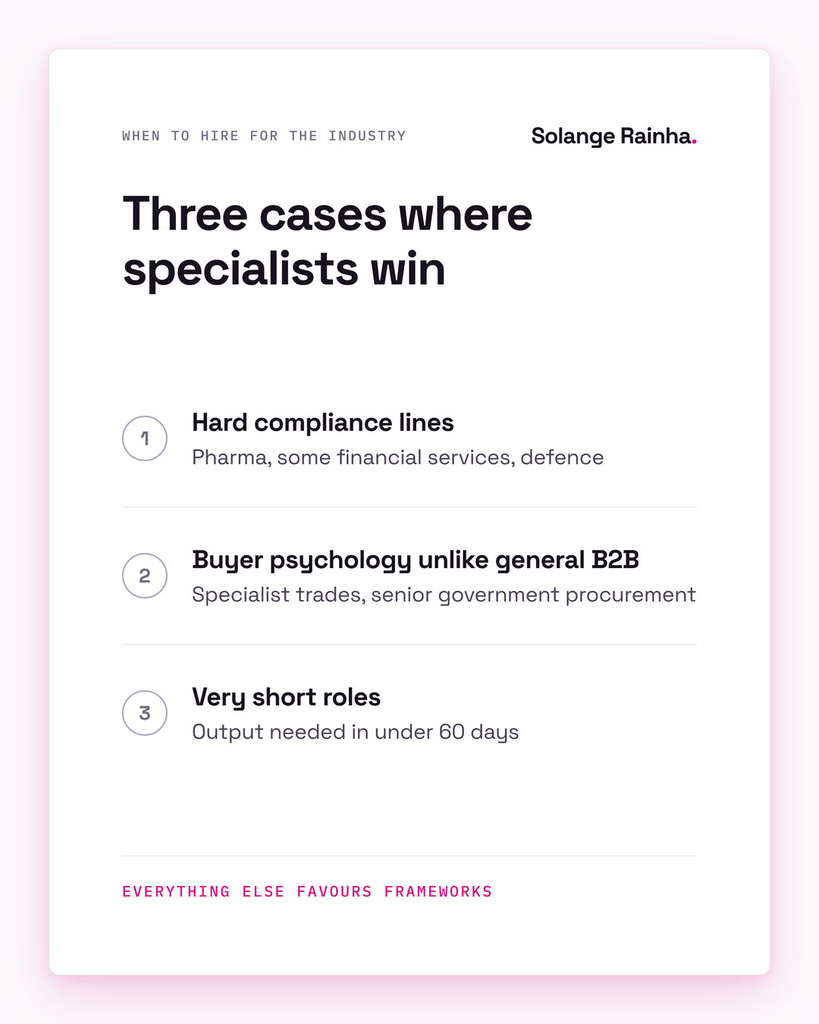
In three situations: hard compliance lines, buyer psychology that has little in common with general B2B, and roles too short to absorb a ramp. Leaving them out would weaken the rest of the argument.
Highly regulated industries with hard compliance lines, such as pharmaceutical content, parts of financial services and defence-adjacent IT consulting. Getting compliance wrong costs enough that a six-week learning curve isn’t acceptable, so hire for industry experience there.
Niches where the buyer psychology shares little with general B2B logic, such as specialist trades, some academic disciplines and senior government procurement, are the second case, because frameworks can’t shortcut domain knowledge that different.
Very short roles. If you need high-quality output within 60 days and then the person moves on, someone who needs three months to ramp won’t work however strong their skills are; industry experience counts for more here because of the time limit, not because it’s worth more in itself.
For most senior content marketing roles, none of those conditions hold, and cross-industry content marketing experience is the better bet, because the trade-off favours strong frameworks and adaptability over narrow domain depth. Hiring as if it went the other way produces predictable results: on-brand content that doesn’t drive pipeline, because nobody on the team had the strategic chops to make it do anything beyond fit in.
Frequently asked questions
Yes, with caveats. In cross-industry content marketing, strategic frameworks, editorial systems, measurement and stakeholder management transfer between B2B sectors unchanged, while tone, persona complexity, format preferences and sales cycle assumptions need recalibrating in the first few weeks. Domain vocabulary, buyer psychology, competitive dynamics and regulation have to be learned over three to six months. A senior content marketer with strong frameworks can be productive in a new B2B industry within 30 days and fully ramped within two quarters at most.
For most senior content marketing roles, transferable skills (frameworks, systems, measurement and stakeholder management) count for more than narrow industry experience, because they make up most of the work. Industry experience counts most in heavily regulated sectors, niches with unusual buyer psychology and short roles where a ramp period is unaffordable. LinkedIn’s 2025 research found that hiring on skills rather than previous job titles increased the eligible talent pool for a typical job by a median of 6.1 times, so screening on industry alone shuts out most qualified candidates.
A content marketer with strong frameworks can be productive in a new industry within 30 days and fully ramped within three to six months. The first 30 days cover listening (sales calls, support tickets, internal channels), mapping buyers and competitors for stakeholder feedback, low-stakes test content to catch calibration errors and a first content strategy draft. Domain vocabulary and competitive dynamics should be in place by month three, and regulation and buyer psychology fluent enough by month six that nothing about the industry slows the work.
The most common mistake is carrying the previous industry’s calibration into the new one: the wrong tone, the wrong formats, persona assumptions that don’t fit the new buying committee and sales cycle expectations that don’t match the new revenue model. The framework is right and the application is off, so the content feels subtly wrong without anyone being able to say why. The second mistake is the opposite, assuming nothing transfers and rebuilding from scratch, which throws away the pattern recognition that makes cross-industry experience valuable.