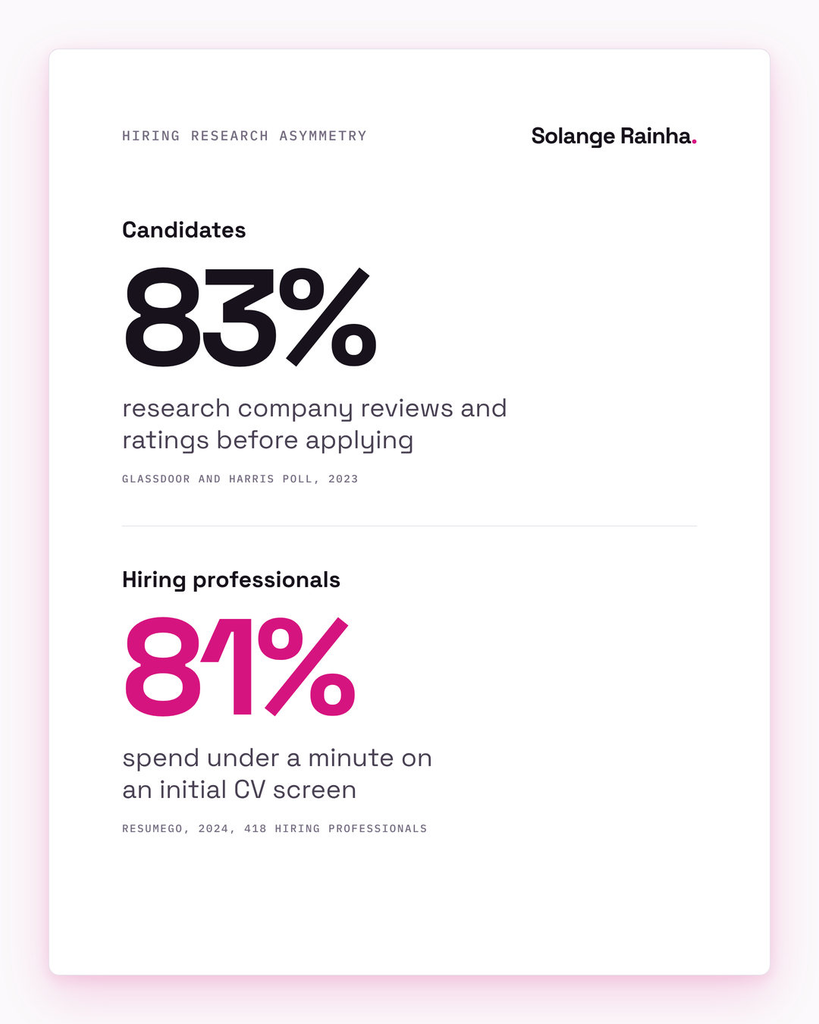
Hiring research asymmetry is the double standard in recruitment: candidates get screened out for not knowing enough about the company, while the people interviewing them often arrive having read nothing beyond a CV skim. The gap is easy to measure from both ends. In a Glassdoor and Harris Poll survey, 83% of US job seekers said they were likely to research company reviews and ratings before deciding where to apply, while 81% of hiring professionals in a ResumeGo survey spend under a minute on an initial CV screen. Volume excuses the screening stage, but once a company has shortlisted you and booked the hour it doesn’t, and an unprepared interviewer is telling you the truth about how that company works.
Job searching and hiring are the same activity viewed from opposite ends. Both sides are talking to several strangers at once, trying to work out from patchy evidence whether this match is worth committing to, and both are making a consequential decision without enough information to be sure. Only one side gets penalised for not doing the homework.
Show up to an interview without knowing the company’s product, market or recent funding round, and you’re finished. Mostly that’s fair, because it signals you don’t care much which job you get. Now flip it: how often does the person across the table open with a question that shows they looked into you beyond the CV they’re holding?
I’ve run into a specific version of this repeatedly. I have a website full of my thinking, which is fairly unusual for a content marketer to maintain, and I point to it often because it answers most of what a hiring manager would want to know about how I work. Most of the time I hear something like “I haven’t had a chance to look at that yet”, said by someone about to ask me whether I’ve read their latest product announcement.
What is hiring research asymmetry?
The gap between how much research a hiring process expects from candidates and how much the hiring side does in return, even at the stage where both are investing the same hour in the conversation.
The expectation on candidates is well documented. In Glassdoor’s Harris Poll survey from June 2023, 83% of US job seekers said they were likely to research company reviews and ratings when deciding where to apply, and that’s before the product pages and LinkedIn profiles, plus the funding news a good candidate works through ahead of an interview.
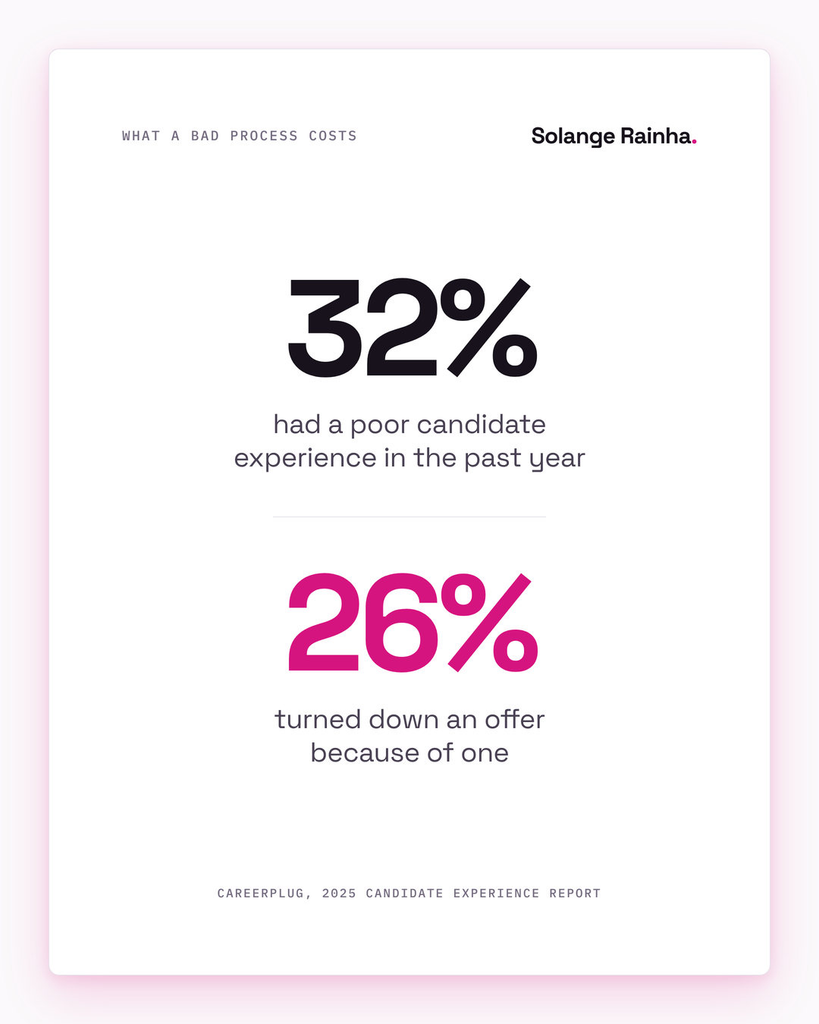
Going the other way, the experience is patchier. In CareerPlug’s 2025 Candidate Experience Report, 32% of job seekers said they’d had a poor candidate experience in the past year. CareerPlug sells recruiting software, so it has a stake in employers caring about this, but the figure matches what I’ve seen: unprepared interviewers show up in every account of a bad process I’ve heard.
Is application volume a fair excuse?
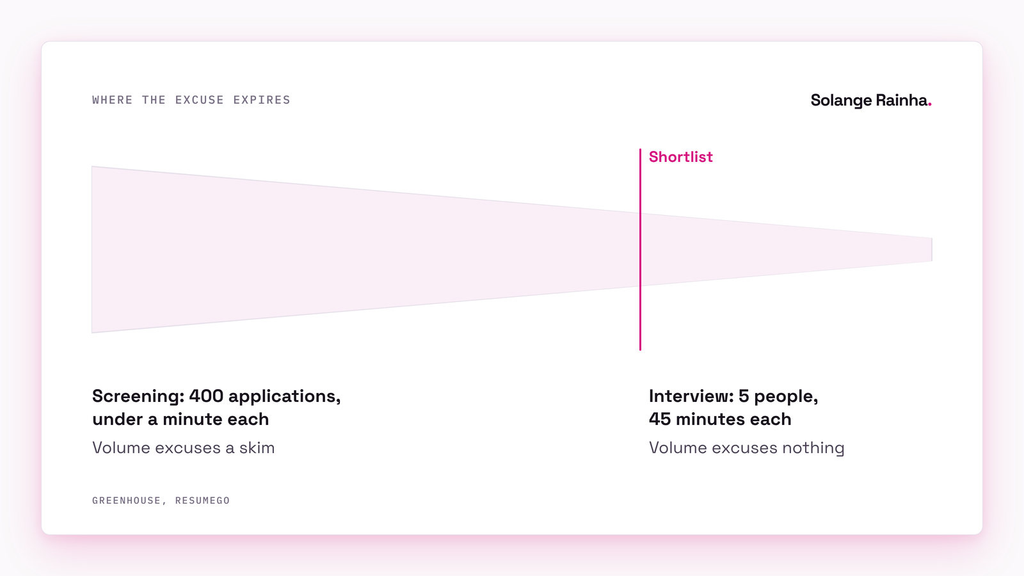
At the screening stage, yes, entirely. Volume at the top of the funnel is brutal, and it’s grown fast: Greenhouse reported that applications per job rose 102% from Q3 2022 to Q4 2024 across its customers, with AI-assisted mass applications part of the cause. Ariana Moon, who runs talent acquisition at Greenhouse, described the pressure plainly:
“there are so many inbound applications right now”
Against that, quick screening comes down to capacity more than laziness. Ladders’ 2018 eye-tracking study found recruiters can make up their minds about a candidate in 7.4 seconds, and ResumeGo’s 2024 survey of 418 hiring professionals found 81% spend under a minute on an initial screen. Nobody can deep-read 400 applications, and nobody should expect them to. If a recruiter didn’t read my website before deciding whether my CV clears the bar, that’s a reasonable use of finite attention.
The hiring research asymmetry I’m describing lives somewhere else: after selection, once a company has chosen five people out of four hundred and booked 45 minutes with each of them. At that point the volume argument has expired, because you’re preparing for one conversation with one person you’ve already chosen. The same ResumeGo survey shows the time appears when the interest does: 88% said how long they spend depends on how interested they are in the applicant, so when someone arrives unprepared to an interview they scheduled, you’ve just found out where you placed.
| Screening stage | Interview stage | |
|---|---|---|
| Volume | Hundreds of applications per role | A shortlist of a few people |
| Time per candidate | Seconds to a minute | An hour already booked |
| Reasonable to expect | A quick read of the CV | The CV read beforehand, plus anything the candidate published or sent |
| What no preparation means | Normal triage | The role, or the candidate, isn’t a priority |
What does an unprepared interviewer tell you?
How the company works, and where you sit in its priorities. How a company behaves during hiring is the best data you’ll get about how it behaves as an employer, because it’s the only period where you watch its internal habits directly instead of through a careers page. It’s the same logic I’ve applied to what contract negotiations reveal that interviews conceal, where behaviour under mild friction tells you more than any stated value.
An interviewer who hasn’t prepared is telling you several useful facts at once: what preparation standards look like internally, that this hire is one item on a crowded plate, and that decisions here may get made on thin information. Candidates act on it, too: in CareerPlug’s 2025 report, 26% of job seekers said they’d declined an offer because of a poor candidate experience.
I’d add a fairness caveat to my own argument. A hiring manager covering a vacancy while doing their whole job, with three interviews squeezed between other meetings, isn’t the bad guy, and I’ve been the overloaded person on the other side of that. The signal holds regardless of blame: a company that can’t give its own hiring fifteen minutes of preparation has told you the truth about its capacity, and you should factor that in before you sign, alongside the employer due diligence checks that tell you whether it’ll still exist in two years.
Does a personal website help if interviewers don’t read it?
Yes, before a process starts, and much less once you’re inside one. That’s the version of hiring research asymmetry I feel most directly, given the site I maintain.
Inside a live process it works less well than I expected, because being in the pipeline doesn’t mean anyone will click a link, and I’ve stopped assuming otherwise. Now I treat the site as a resource I bring into the conversation, never a document I expect to have been read: I reference a specific piece and explain the thinking myself, instead of saying “it’s on my site” and hoping.
Before a process starts, the picture’s completely different. The strongest opportunities I’ve had recently arrived as inbound approaches from people who’d found my work, read a couple of pieces and reached out already convinced. That’s the owned-platform argument working as advertised, and it inverts the asymmetry, because someone who arrives having read your thinking has done the research before the first conversation. It’s also the case I made for why this blog exists at all: visibility that follows the work.
What should candidates do about hiring research asymmetry?
Plan around it instead of resenting it. Build your answers so they work for someone seeing your material for the first time, and treat any recognition as a bonus.
Bring the evidence into the interview yourself. If you’ve written a piece that’s relevant, say what it argued and what you learned, because a 30-second verbal version beats a link nobody opens. That’s also why substance counts for more than volume in what you publish: a position beats a stack of posts saying nothing, and it’s what someone remembers if they do look.
Read the preparation as data, and let it steer your questions instead of your mood. “What made you want to speak to me specifically?” is a perfectly civil question that tells you a great deal about how the decision got made. Keep some perspective, too: an unprepared interviewer is a yellow flag rather than a red one, and I’ve been interviewed by people who clearly hadn’t looked and were still excellent to talk to once we started.
What should hiring managers do instead?
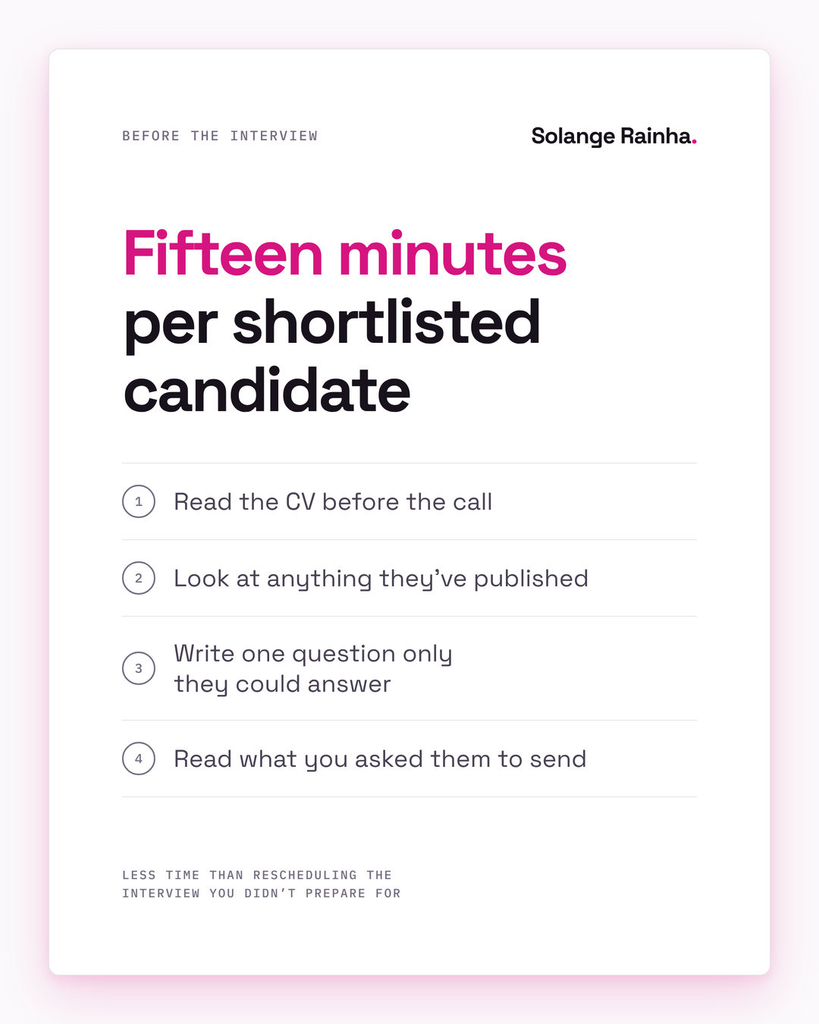
Spend fifteen minutes on each person you’ve decided to interview, which is less time than you’ll spend rescheduling the interview you didn’t prepare for. It closes most of the hiring research asymmetry from your side, and it buys you more than you’d think.
Read the CV before the meeting instead of during it. Look at whatever they’ve made public, because a portfolio, a repo or a blog will teach you more about how a person thinks than any competency question. Come with one question that could only be asked of this candidate, the cheapest way there is to show you noticed them. And if you asked them to send you material, either read it or stop asking.
Beyond the offers you lose to a poor experience, your best-prepared candidates are the ones most likely to notice the mismatch and price it in.
There’s a sneakier cost too: reading a CV badly is how you miss the candidate whose value doesn’t fit the usual template, which is the same failure behind treating an unconventional line on a CV as a defect instead of as information, dismissing a long freelance track as noise, or reading a short tenure as a flight risk without asking why it ended.
Frequently asked questions
Hiring research asymmetry is the imbalance between the research expected of candidates and the research hiring teams do. Candidates are expected to study a company’s product, market and reviews before an interview, and 83% of US job seekers research company reviews and ratings before applying, according to Glassdoor and the Harris Poll. Interviewers often arrive having only skimmed a CV. The imbalance is fair during high-volume screening and much harder to justify once a company has shortlisted candidates and booked equal time with each.
Often not during an active process, which is worth planning around instead of resenting. Personal sites and portfolios tend to work best before a process begins, by attracting inbound interest from people who’ve read the work and approach already convinced. Inside a live process, assume nothing has been read: reference specific pieces in the conversation and explain the thinking yourself instead of relying on a link.
It’s a yellow flag: a signal worth weighing, not an automatic disqualification. How a company runs its hiring is the clearest evidence you’ll get of how it operates internally, and an unprepared interviewer may point to thin decision-making standards or a team without capacity. Overload is a fair explanation, but it still tells you an accurate fact about the organisation, and 26% of job seekers in CareerPlug’s 2025 report had declined an offer over a poor candidate experience.
Around fifteen minutes per shortlisted candidate is enough to change the conversation. Read the CV before the call, look at any public work the candidate has published, and prepare one question that could only be asked of that person. Volume excuses a skim at the screening stage, when hiring professionals often spend under a minute per CV, but it doesn’t excuse arriving unprepared to an interview you scheduled.