A short tenure on a CV that ends in a company bankruptcy invites one question, and my answer is that I never saw it coming, and neither did my manager. I’d joined a B2B eMobility company sold as stable in a growing market, and two weeks before the announcement we were told we’d lost a major client and that the finances were fine. Eight months there produced two product launches, a content library across eight segments and 39 countries, an SEO programme and a rebuilt social presence. The way to handle it is to state the reason in one line next to the dates, lead with what you built, and keep a three-sentence answer ready. What it taught me is narrower than “do your homework”: keep your own record of the work, because the company’s systems won’t be there to prove it.
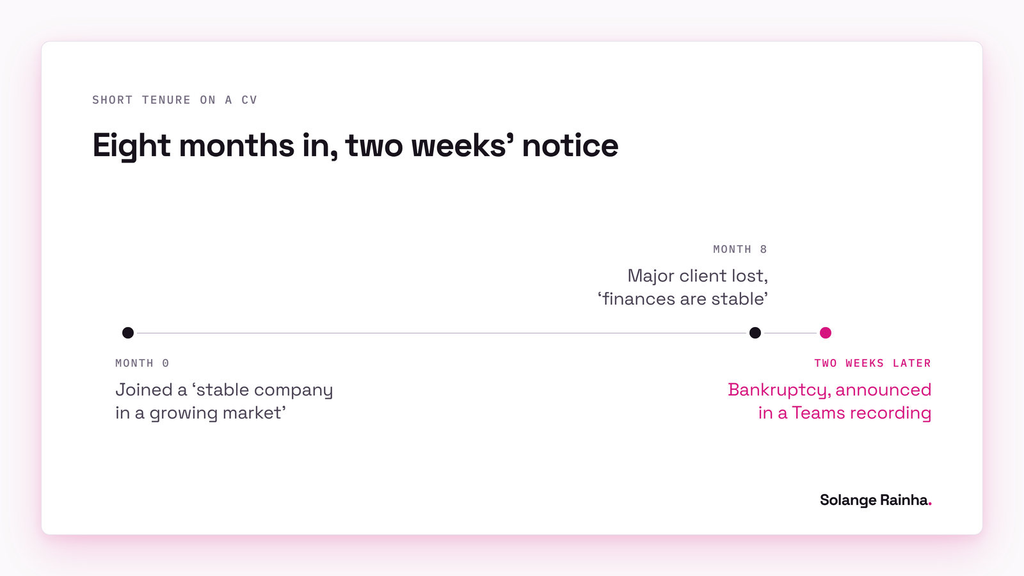
I had the day off. I was at the vet with one of my cats when a Teams notification came through about an emergency general meeting, and I watched the recording afterwards, which is how I learned the company was filing for bankruptcy.
I messaged my manager, and he was in shock too, which tells you most of what you need to know about how much anyone below the top of that company saw it coming.
Two weeks earlier we’d been told we’d lost a major client, with the reassurance that the finances were stable. I’d joined eight months before that on the strength of a stable company in a growing market, which is what I was sold and what I had no particular reason to doubt.
What did I build in eight months?
Two product launches, a content library, an SEO programme and a rebuilt social presence, all produced while I believed I was building for a company that would still be there in three years.
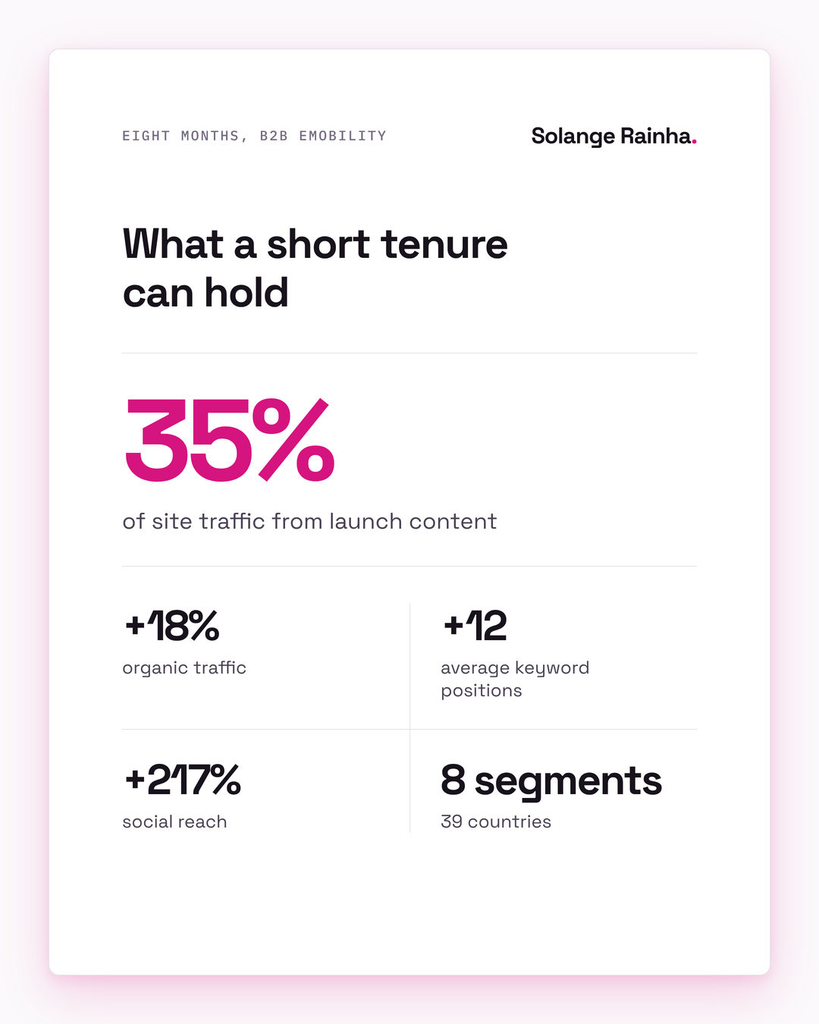
The launches ran end to end, with every marketing material across web and social, and launch content accounted for 35% of total website traffic during the campaign windows, which is the figure I’d keep if I could only keep one. I’ve written up how I build those in product launch content.
The content library came to 12+ articles, 15+ web pages, two whitepapers and a case study, aimed at eight eMobility segments across 39 countries, including energy, charger manufacturers, charge point operators, fleets, mobility service providers, retail and vehicle manufacturers. Organic traffic went up 18%, and SEO across all eight segments moved priority keywords up an average of 12 positions (the approach is the one in building SEO from scratch).
Then the brand: 40+ assets overhauled and the visual and tonal positioning rebuilt. I owned social end to end across three channels, with 70+ posts in five months, impressions up 24% and reach up 217%, and the detail of that one is in the social turnaround piece.
None of that is worth less for how it ended. The 217% reach increase happened and keywords moved 12 positions, which describes what the work did; the company’s balance sheet was never going to be decided by marketing.
Could due diligence have caught it?
Probably not, and the detail that settles it is that my own manager was as surprised as I was.
The obvious lesson from a story like this is that I should have checked harder, and I’ve heard that one and half believed it. I now run a fixed set of checks before I accept anything (filings, funding history, headcount trend, review patterns, a few pointed interview questions), and the whole process is in employer due diligence. I’d recommend it to anyone, but I still can’t tell you it would have caught this one, because the information that would have warned me wasn’t public or in any review, and the people I’d have asked didn’t know it either.
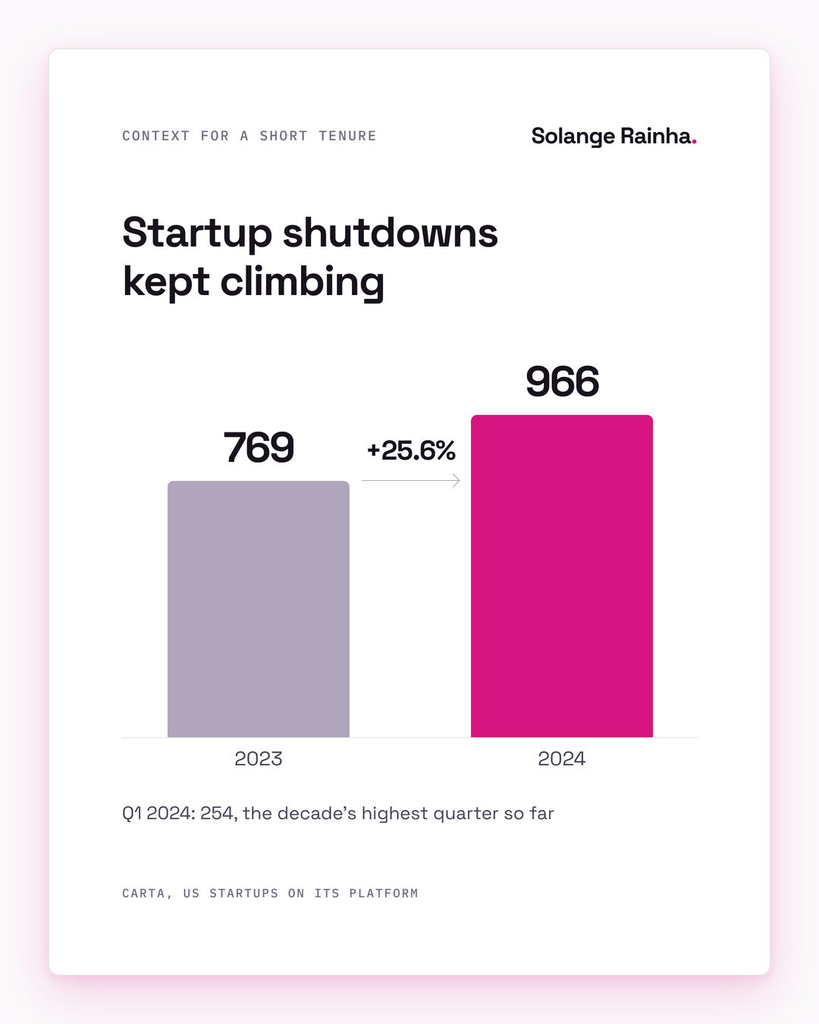
And companies fail far more often than candidates assume. Carta counted 966 US startups on its platform shutting down in 2024, up 25.6% on 2023, after a first quarter in which 254 went out of business, the highest quarterly total of the decade so far. Peter Walker, Carta’s head of insights, told TechCrunch what usually ends them:
“Running out of cash is typically the proximate cause.”
Cash is a board-level problem, so the lesson is narrower and more useful than “do your homework”. Some company risk can’t be seen from the candidate’s seat, and the right response to that is to stop treating a company’s survival as a reflection of your work, and to keep your own record as you go, so a short tenure on a CV still comes with proof attached. When a company folds, the evidence of what you did can disappear with it: the site gets taken down and the analytics access ends, and the people who could vouch for you scatter. Reconstructing it later from memory is a poor substitute for documenting it while it exists.
That’s most of why I now publish the reasoning behind my work instead of storing it in my own head. Freelancing taught me the same lesson slowly, which I wrote up in what fourteen years of freelance work taught me, and the argument for doing it in public is in why personal branding is overrated.
Does the work still count if the company fails?
Yes, and the view that says otherwise treats effort at a company that later fails as wasted, or worse, as evidence of poor judgement.
Two problems with that. The first is hindsight: the eight months were lived as a normal job at a company I expected to be at for years, not under a shadow, and the work was calibrated accordingly. Nobody makes different content decisions because of information they don’t have.
The second is that even where you can see it coming, coasting is the wrong answer, because the work is the only part you control: runway, funding and the client that walked don’t move because you tried harder, and the output does. The people watching you work through a difficult stretch are also the ones who write your references, and I’ve never heard of anyone getting hired or promoted for how gracefully they coasted.
What I did take from it is a sharper eye for useful work against busy work. Eight months is short enough that the filler is obvious in retrospect, and I can name exactly which pieces earned their place and which were made because the calendar had a gap.
How do you handle a short tenure on a CV without getting defensive?
You give the reason in one line, lead with the work, and resist explaining it away. Three of my last four companies went wrong somehow, one through a mass layoff, one through insolvency, another through restructuring, and that’s the pattern a hiring manager sees before anything else.
Don’t apologise for it, because the context is ordinary, and the people reading CVs mostly know it: in MyPerfectResume’s 2025 survey of 918 US HR professionals, 65% said they see candidates with several short-term roles as adaptable, even though 45% named too many job changes in a short time as their top CV red flag (CPA Practice Advisor). MyPerfectResume sells CV tools, so take the exact split loosely; the gap between those two readings is the reason you give.
I originally quoted US median tenure here as 4.1 years in 2024 and a two-decade low, and that was wrong: the Bureau of Labor Statistics puts it at 4.1 years in January 2026, up from 3.9 in 2024, with 3.0 years for workers aged 25 to 34, so short stints aren’t becoming more normal and the one-line reason on your CV is doing more work than I gave it credit for.
How I handle it in practice:
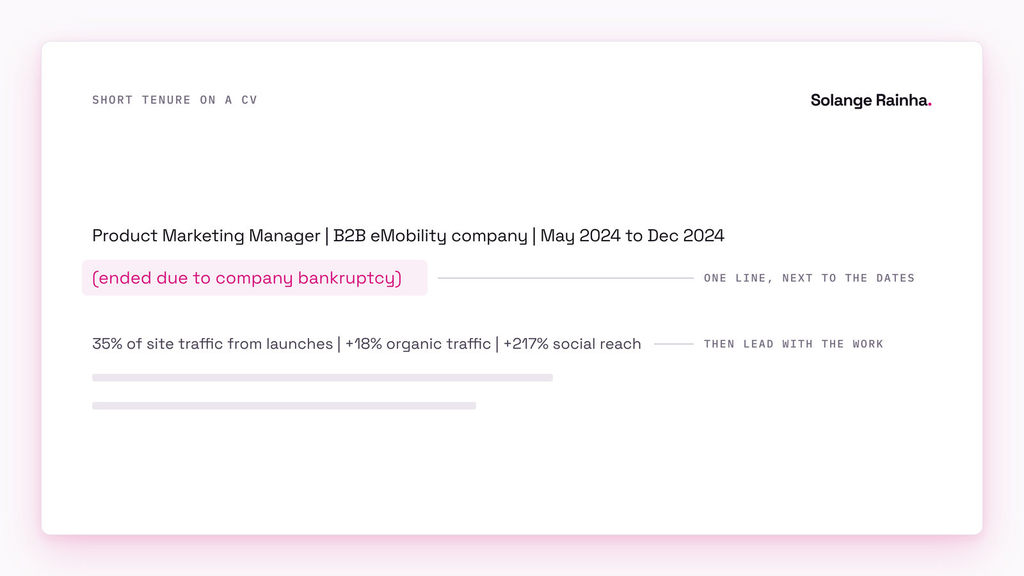
- State the reason openly. My CV says “ended due to X” next to the dates. One line, no drama, and it defuses a short tenure on a CV before anyone forms a theory about it.
- Lead with what was built. Eight months produced launches, a content library, an SEO programme and a rebuilt social presence. That’s the substance of the entry, and the ending is a footnote to it.
- Don’t badmouth them. The company failed, and most of the people there did good work in a situation they couldn’t see either. Describing it any other way tells an interviewer more about you than about them.
- Have the answer ready. Mine is three sentences: I didn’t know, my manager didn’t know, and here’s what we shipped anyway. It closes the topic faster than any careful framing.
The wider problem is that this puts the burden of proof on the candidate, who had almost no way to check the company’s health from outside in the first place. That asymmetry is the subject of what candidates can and can’t research, and a career break gets treated the same way, which I’ve covered in how to handle one on a CV.
What would I do differently?
Nothing about the marketing, and almost everything around it.
The prioritisation calls, building for the launches, keeping the standard where it was: given those eight months again I’d produce the same list, and the logic behind it is the one in my content prioritisation framework.
What’s changed: I research companies properly now, with no illusion that it makes me safe, and I keep my own documentation of what I built instead of trusting that the company’s systems will still be there to prove it. I’ve also stopped reading a company’s collapse as a verdict on the people inside it, including me, which took longer than it should have (more on that in why the receipts don’t cure imposter syndrome).
The cat was fine, incidentally, which is the part of the day I’d have predicted least accurately if you’d asked me that morning which of those two situations would turn out badly.
Frequently asked questions
State the reason plainly beside the dates, in one neutral line such as “ended due to company bankruptcy”, then let the entry lead with what you built and what it produced. Explaining the failure isn’t the CV’s job: Carta counted 966 US startup shutdowns in 2024, up 25.6% on the year before, and most recruiters read a wound-down employer as market conditions. In the interview, a short answer works better than a careful one, including “I didn’t see it coming”, which is the common case and not the embarrassing one.
No, if you did work there worth showing. Leaving it off creates an unexplained gap, which raises more questions than an eight-month entry with a one-line reason, and it throws away results you can still prove. Keep the entry, add “ended due to company bankruptcy” next to the dates, and put the strongest result first.
Not reliably from the candidate’s seat. Funding history, headcount trend over 12 months, restructuring signals in employee reviews, founder tenure and how a company describes its own runway are all worth checking before accepting a role. What those checks can’t reach is information that isn’t public, isn’t in a review, and often isn’t known to the people you’d ask inside the company, so treat them as a way to price the risk, since they won’t protect you from it.
No. Results describe what the work produced, and insolvency usually comes down to cash, client concentration, market timing and decisions taken well above the content function. The credibility question that counts is whether the figures are stated accurately, with clear boundaries around what you owned and what someone else owned, which is a discipline worth applying to every entry on a CV and not only the ones that ended badly.