Imposter syndrome in marketing is close to universal: 84.9% of the 2,350 marketers in Marketing Week’s 2026 Career & Salary Survey said they’d experienced it, up from 80.1% a year earlier, and seniority barely dents it. Content marketing makes it worse because of how the evidence for the work arrives: months late, spread across a buying group of 22 people, and usually reported by somebody else. What helped me was sorting the doubt into what can be checked and what can’t, then publishing my reasoning where other marketers can check it. After fifteen years the feeling still turns up most weeks, but it’s lost its authority, and if it’s affecting your health, it’s a job for a professional.
I don’t say this in interviews. I’ve got documented results, I can walk anyone through how each one was produced, and there’s still a running commentary in my head telling me I’m bluffing. It doesn’t argue with the figures; it says I got them without deserving them, and that the next brief will be the one where everybody finds out.
Pauline Clance and Suzanne Imes named this in 1978, describing the imposter phenomenon as “an internal experience of intellectual phoniness” in high-achieving women who put their success down to luck or charm. The “syndrome” version is the popular name for the same experience, and the research behind it is thinner than its popularity suggests.
I’ve read plenty about imposter syndrome in marketing, and none of it deals with how specific it is in content, where the evidence turns up late and belongs to several people at once. That gap between what I can prove and what I feel is what this piece is about.
Is imposter syndrome in marketing normal?
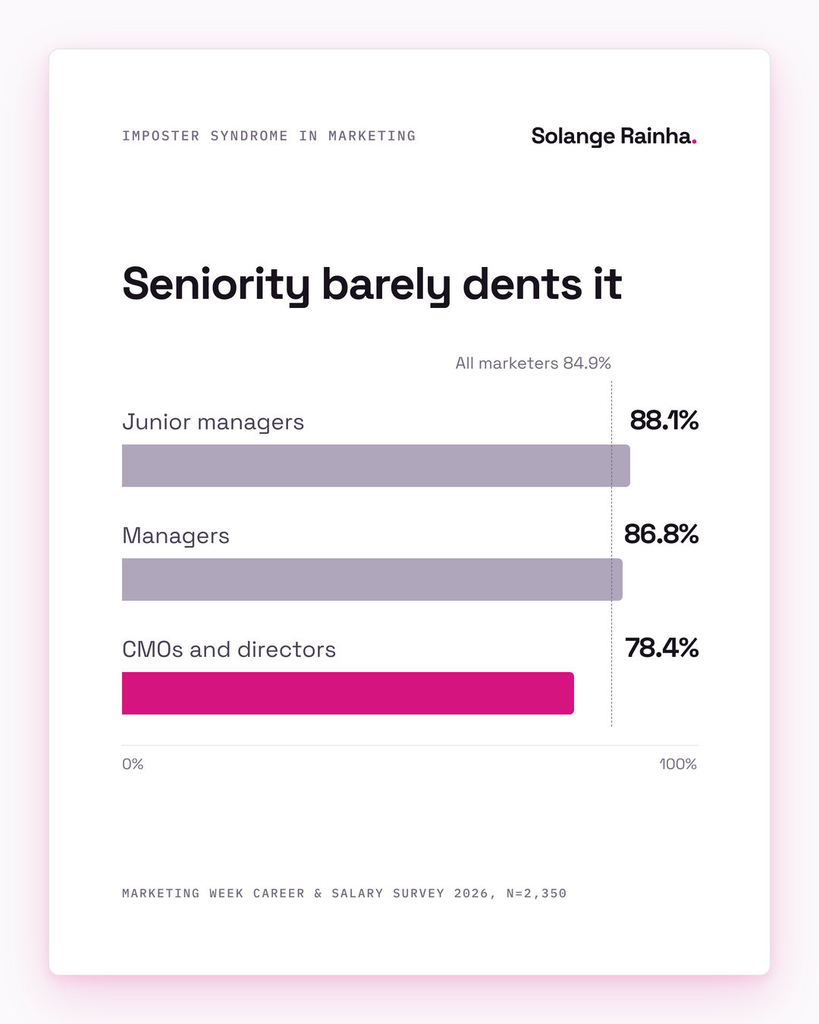
Statistically it’s the default setting, which is either comforting or depressing depending on the day. Marketing Week’s 2026 Career & Salary Survey found 84.9% of 2,350 marketers had experienced imposter syndrome, and half said it had intensified over the past year. In the 2025 edition the figure was 80.1% of more than 3,500 marketers, so it’s moving the wrong way. Seniority helps less than you’d hope: 78.4% of CMOs and marketing directors reported it, against 86.8% of managers and 88.1% of junior managers. Women reported it more often than men (86.7% against 80.3%), and the bigger gap is in who says it’s getting worse, at 53.7% of women and 37.9% of men.
A 2023 survey of 1,000 people, commissioned by the mentoring platform PushFar, which has an obvious interest in the answer, put the figure at 83.3% across marketing and PR. Promotion was the biggest trigger, for nearly two-thirds of them, ahead of stepping outside their comfort zone and starting a new job.
The academic picture is messier. A systematic review in the Journal of General Internal Medicine, covering 62 studies and 14,161 participants, found prevalence estimates ranging from 9% to 82%, largely depending on which screening tool and cutoff each study used. It found the feeling in men and women alike, and in every age group from adolescents to late-career professionals. So a lot of competent people feel like frauds, and nobody agrees how to count them.
None of which touches the feeling: knowing that 84.9% of your industry feels the same has roughly the effect of being told everyone finds the exam hard while you’re still sitting the exam. The statistics normalise it and leave it exactly where it was, because normalising a feeling and dislodging it are separate jobs, and reading an article only does the first.
Why does content marketing make imposter syndrome worse?
Content marketing makes it worse because the job has an attribution problem that would produce doubt in a person with no predisposition to it at all.
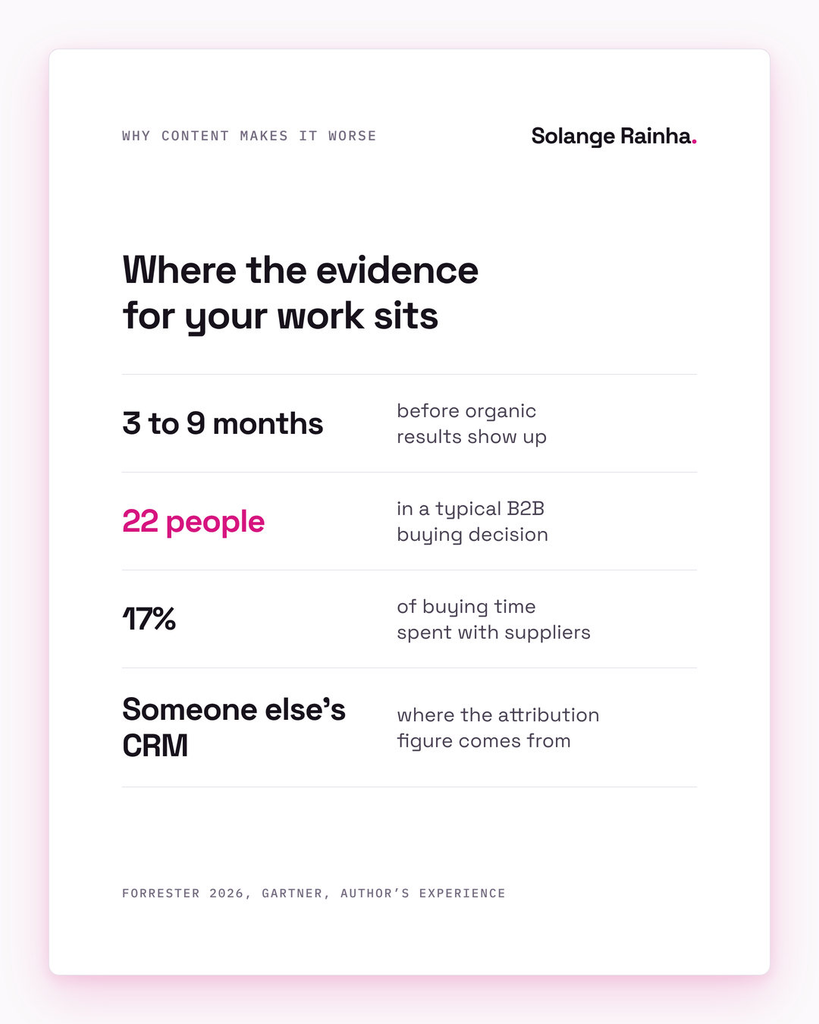
Think about what you get back from the work. In my experience, organic and authority results take three to nine months to show up. The purchase gets made by a crowd: Forrester’s 2026 State of Business Buying puts a typical B2B decision at 13 internal stakeholders plus nine external influencers, and Gartner found buyers spend only 17% of their buying time meeting potential suppliers, so most of what your content does happens where you can’t see it. The figure that says whether any of it worked comes out of a model built on assumptions, and in most companies somebody else pulls it from the CRM. A developer ships a feature and watches it work, while I publish a piece and wait two quarters for a signal that might not be mine.
Then there’s the caveat tax, which is the part of imposter syndrome in marketing nobody warns you about. My biggest single result is that the content operation at a B2B SaaS company serving 200+ higher education institutions contributed to 48% of marketing-sourced pipeline in peak months, and every time I state it I add the boundary: our marketing manager owned the CRM machinery and produced that figure, and what I owned was the judgement about which figure to be measured on and how to report it straight. That’s the correct thing to say, and I’d say it again, but it also means the strongest evidence I have comes with a caveat attached, and a mind looking for reasons to disbelieve you will take that caveat and run a marathon with it.
Three of my full-time roles ended under me, through a restructuring, an insolvency and a mass layoff, and none of the endings had anything to do with the quality of my work. I traced each one back to its cause in employer due diligence, and wrote about what the run does to a CV in short tenure on a CV. Try telling any of that to the part of your brain that pattern-matches.
What is the doubt measuring?
Asking what the doubt was actually measuring helped first, and it took me an embarrassingly long time to ask it.
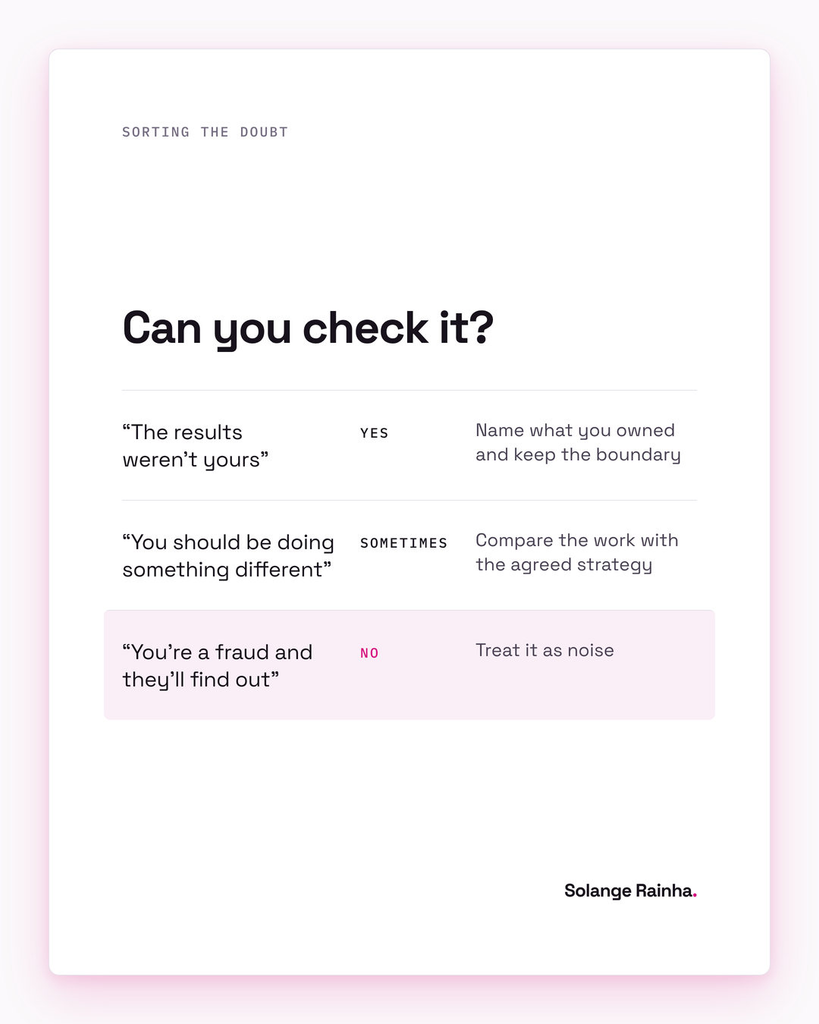
The doubt presents itself as information: you’re not good at this. If it’s information, it should be falsifiable, so I started sorting it on paper, because in my head it all blurs into one accusation.
| The doubt says | Can you check it? | What to do with it |
|---|---|---|
| “The results weren’t yours” | Yes. Name what you owned, what someone else owned, and what the evidence is. | Keep the boundary and stop relitigating it. |
| “You should be doing something different” | Sometimes. Compare what you’re producing against the strategy you agreed to. | If the comparison finds a gap, you’ve got a prioritisation problem with a fix. |
| “You’re a fraud and they’ll find out” | No. No evidence would ever satisfy it. | Treat it as noise, however familiar the voice sounds. |
Row three is where imposter syndrome in marketing does most of its damage: it arrives in the same voice as the other two, which is why it gets taken seriously, and it’s the only one with no test attached. A claim that can’t be falsified isn’t a finding, and I apply that standard rigorously to marketing claims while accepting the opposite uncritically about myself.
The second row deserves more respect than the third. “What I’m doing isn’t producing the right results” is occasionally true, and the investigation is unglamorous: work out what the content was supposed to move, find the baseline, check the measurement window, and see whether the answer is bad work, wrong measurement or a result that hasn’t shown up yet. Most times I’ve run that check properly, the problem was measurement, and the metrics that survive it are the ones in the content marketing metrics worth keeping.
Which practice helped most?
Writing my reasoning down where somebody else can check it helped more than anything else I tried.
I tried a gratitude journal and a wins list first, and my brain dismissed both as marketing copy about myself. What worked was publishing the reasoning: the frameworks, the methodology, the pieces explaining how a call got made and what I’d do differently. This site exists for hiring reasons, and it turned out to have a side effect I didn’t plan for: once the thinking is public and open to disagreement, the “you’re bluffing” claim gets harder to sustain, because a bluff doesn’t survive being written down at length in front of people who do the same job. I make the career version of that argument in why personal branding is overrated, where the visibility worth having is the kind that follows work somebody can check.
There’s a related move that costs nothing: state the limits of your own work in public. Every framework I’ve published closes with what it doesn’t cover, and every metric I report says what I can’t prove. That started as an integrity habit and has turned into the best evidence I have that I’m not overselling, which is the specific fear underneath most of the doubt.
The other correction was structural: I spent fourteen years doing freelance work alongside full-time roles and published almost none of it, so the only record lived in my own head, edited by an unreliable narrator; I’ve written about that in what fourteen years of freelance work taught me. Credentials work the same way. I came into marketing from two unrelated degrees, which I covered in building a marketing career without a marketing degree, and an unusual route is reliable fuel for this. So is the gap between what candidates can show and what employers can check, which I called the hiring research asymmetry.
Is imposter syndrome all in your head?
Some of it is, and some of it is manufactured by the job, and treating all of it as a personal flaw lets the job off the hook.
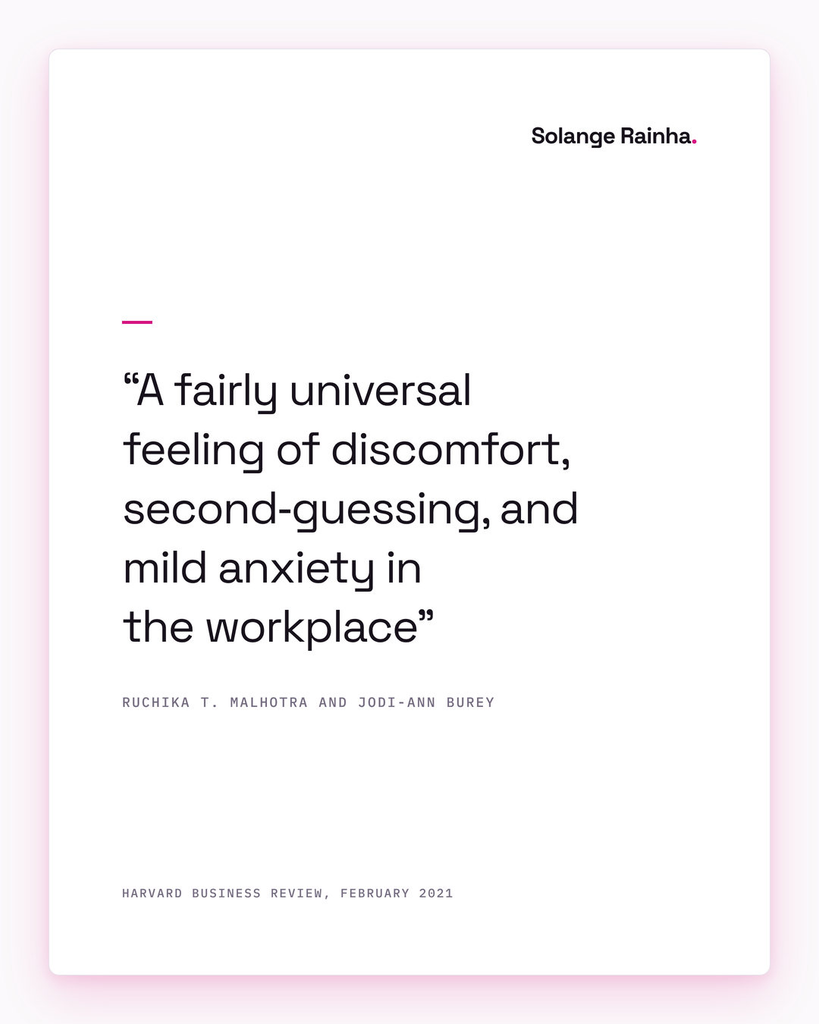
Ruchika T. Malhotra and Jodi-Ann Burey made the sharpest version of this case in Harvard Business Review, arguing that the label took “a fairly universal feeling of discomfort, second-guessing, and mild anxiety in the workplace” and pathologised it, especially for women, when a lot of it comes from bias and exclusion at work. Their fix is to change the workplace, which is the half of the problem most advice skips.
Imposter syndrome in marketing has its own set of those conditions: unclear expectations, results judged on 30-day windows when they take three to nine months, functions with no documented strategy where nobody can say what good looks like, and companies that keep restructuring under people who did nothing wrong. A career break has the same effect, which is why I wrote about how to handle one on a CV instead of pretending nobody ever takes one. Fixing the measurement fixes some of the feeling, and no amount of confidence work fixes a job where nobody defined success. The systems that make the work legible to other people are in my solo content marketing workflow, and they double as evidence you can point at later.
The evidence on what fixes the personal half is thin: when the JGIM review searched the literature up to 2018, it found no published study that had evaluated a treatment, so most of the advice in circulation, mine included, is practice that worked for someone, with no trial behind it.
What changes after fifteen years?
The feeling still turns up most weeks, but it’s lost its authority.
Fifteen years, several full-time roles, a solo content function at most of them, results I can document, and it’s still there. What’s changed is that I’ve stopped obeying it. It’s a reflex my brain has, like the specific dread of an unread Slack message from someone senior, and I no longer litigate it every time it shows up.
One limit on all of this: it’s a piece about a working-life feeling, written by a content marketer. The JGIM review found imposter feelings often come with depression and anxiety and are linked to burnout, and if it’s affecting your health, an article by a content marketer is the wrong tool; talk to your doctor or a therapist.
What I’d tell the version of me who’s convinced she’s fooling everyone: you’ve been checked, repeatedly, by people who had every commercial reason to notice if you were bluffing, and by figures other people pulled out of systems you didn’t control. The evidence has been in for years, the feeling just hasn’t read it, and it’s under no obligation to.
Frequently asked questions
Very common, and seniority barely reduces it. Marketing Week’s 2026 Career & Salary Survey of 2,350 marketers found 84.9% had experienced imposter syndrome, up from 80.1% in its 2025 survey, and half said it had intensified over the previous 12 months. Among CMOs and marketing directors the figure was 78.4%, against 88.1% for junior managers. A separate 2023 survey commissioned by the mentoring platform PushFar put it at 83.3% across marketing and PR, with promotion the most common trigger.
Content marketing triggers imposter feelings because its results arrive late, spread across a large buying group, and get reported by someone else. Organic results usually take months to show, Forrester puts a typical B2B purchase at 13 internal stakeholders and nine external influencers, and the attribution figure tends to come from a CRM model somebody else runs. That stretches the loop between doing good work and seeing evidence of it, and marketers who state their attribution boundaries plainly, which is the correct practice, end up with their strongest claims carrying a caveat.
Not reliably. A systematic review of 62 studies found imposter feelings in every age group from adolescents to late-career professionals, and Marketing Week’s data shows CMOs reporting it at rates close to junior staff. What tends to change with experience is how much authority the feeling carries. The practices that help with that are documenting your reasoning publicly, stating the limits of your own claims, and separating the doubts you can check from the ones you can’t.
Imposter syndrome started as a description of an experience: Pauline Clance and Suzanne Imes coined the “imposter phenomenon” in 1978 for high-achieving women who felt like intellectual frauds. Research since has linked it to depression, anxiety and burnout, and a 2020 systematic review found no published study, up to its 2018 search, that had evaluated a treatment. If it’s affecting your sleep, mood or health, talk to your doctor or a therapist.