Writing strong openings is the highest-return sentence-level skill in content marketing, because most readers decide almost at once whether to continue: Chartbeat found 55% of pageviews got fewer than 15 seconds of active attention across 2 billion visits. The same first lines now decide whether AI systems cite you, since Kevin Indig’s analysis of ChatGPT citations found 44.2% came from the first 30% of a page. A strong opening makes its claim first, cuts the throat-clearing, context and hedging that delay it, and puts a self-contained answer in the first 40 to 75 words. It filters readers more than it persuades them, so its job is to tell the right ones they’re in the right place.
More than half the people who land on your article will give it fewer than 15 seconds, which they spend on your opening, the only part of the piece most of your audience will ever read.
Why is the opening of an article so important?
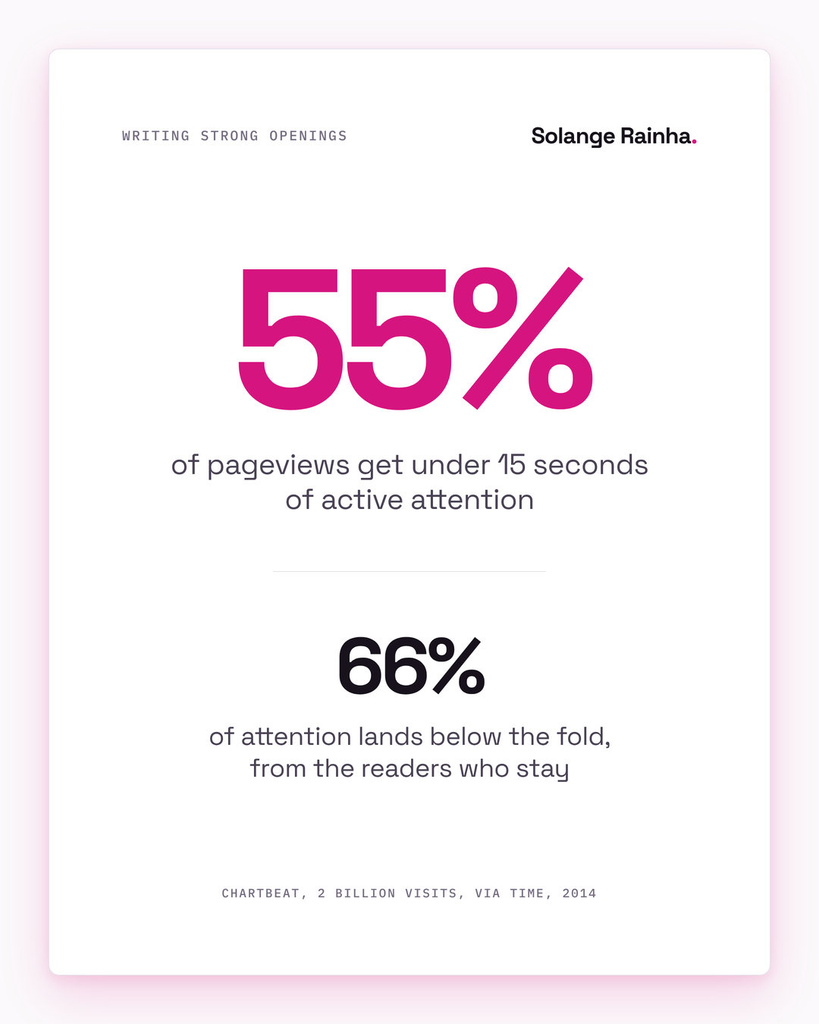
Because attention piles up at the top, and the opening decides who stays for the rest. Tony Haile, then Chartbeat’s chief executive, reported in TIME that across 2 billion visits, 55% of pageviews got fewer than 15 seconds of active attention.
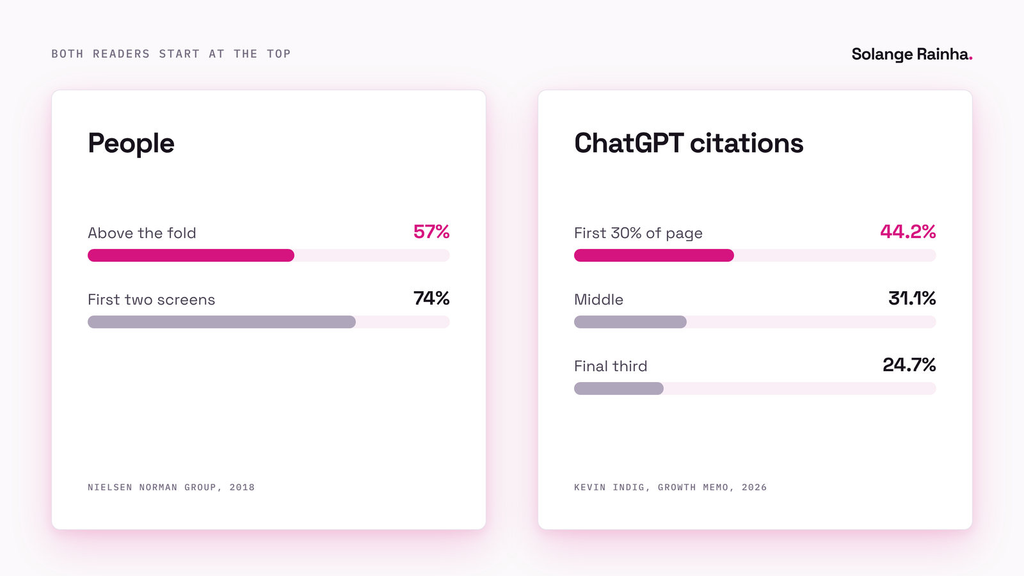
It’s tempting to conclude nobody scrolls, and that doesn’t hold either: the same Chartbeat data found 66% of attention on a normal media page was spent below the fold, because the people who commit go deep. Nielsen Norman Group’s eyetracking study, drawn from more than 130,000 fixations by 120 participants, puts the two findings together: 57% of page-viewing time went above the fold, and 74% went to the first two screenfuls.
So an opening works as a filter, and it pays to treat the first two lines as a separate job.
How do AI systems read your opening?
The same way a hurried person does: they take the top. Kevin Indig’s analysis of ChatGPT citations, covering 1.2 million AI answers and 18,012 verified citations, found 44.2% of citations came from the first 30% of the content, 31.1% from the middle and 24.7% from the final third. Cited passages were also nearly twice as likely to use clear definitions, such as “X is” and “X refers to”.
If the top of your page holds no answer, a model assembling one moves on to a page that has it. I’ve broken down the mechanics in my tactical guide to AI-citable content and how the engines differ in optimising for ChatGPT, Perplexity and AI Overviews, and openings are where most of it lives or dies.
What are the most common ways openings fail?
Throat-clearing, context-setting and hedging, and all three delay the claim. Writing strong openings is mostly a case of avoiding them.
Throat-clearing is the writer warming up in public, so the first proper sentence arrives in paragraph three.
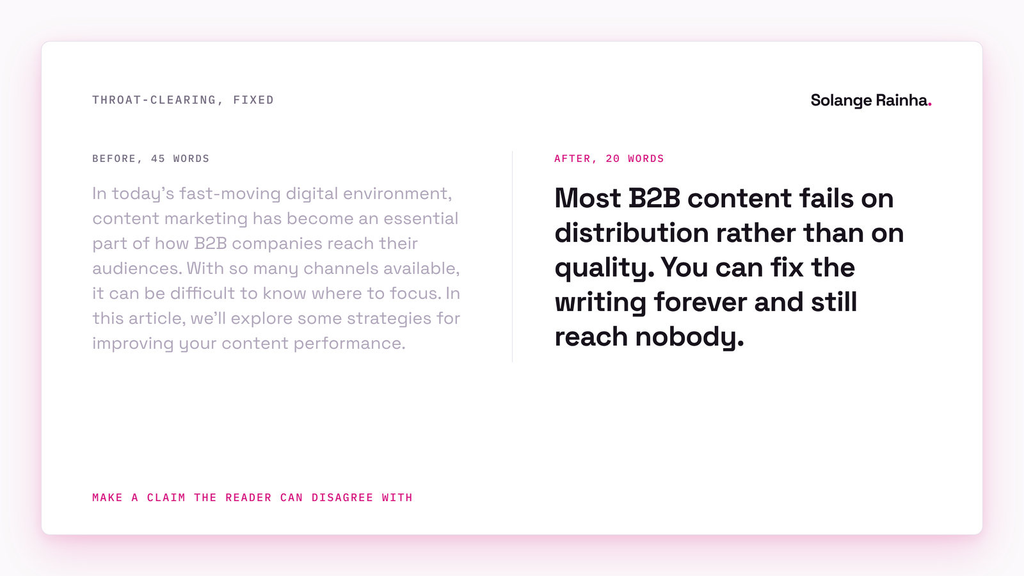
Before: In today’s fast-moving digital environment, content marketing has become an essential part of how B2B companies reach their audiences. With so many channels available, it can be difficult to know where to focus. In this article, we’ll explore some strategies for improving your content performance.
After: Most B2B content fails on distribution rather than on quality. You can fix the writing forever and still reach nobody.
The rewrite is 20 words against 45, and it makes a claim the reader can agree or disagree with, which is what buys the next sentence.
Context-setting is subtler, and it’s the one good writers fall into, because it feels responsible: you explain the background before making the point, on the theory that the reader needs grounding first. They don’t: they need a reason to care, and then they’ll take as much background as you want to give them.
Before: Answer Engine Optimisation, often abbreviated to AEO, emerged as a discipline in response to the growing use of large language models in search. To understand why it matters, it helps to first understand how traditional SEO worked.
After: AEO programs mostly fail for a boring reason: teams do the formatting first and the substance never. A green audit score on thin content is a well-formatted way to stay invisible.
Front-load the claim, then supply as much context as it requires, because the order is the whole trick.
And then hedging: qualifiers stacked in front of the argument, which reads as a writer arguing with themselves. “It could be argued that”, “in many cases”, “arguably”, “somewhat”. Every hedge in an opening tells the reader you might not mean it, and nobody stays for a position the author holds loosely. Keep the caveats, but move them below the claim, where they read as rigour instead of nerves.
| Failure | What it looks like | The fix |
|---|---|---|
| Throat-clearing | “In today’s fast-moving digital environment…” | Start at the first sentence that makes a claim |
| Context-setting | Background on what AEO is before saying why it fails | Claim first, then only the context it needs |
| Hedging | “It could be argued that, in many cases…” | State the position, then add caveats underneath |
What does writing strong openings look like in practice?
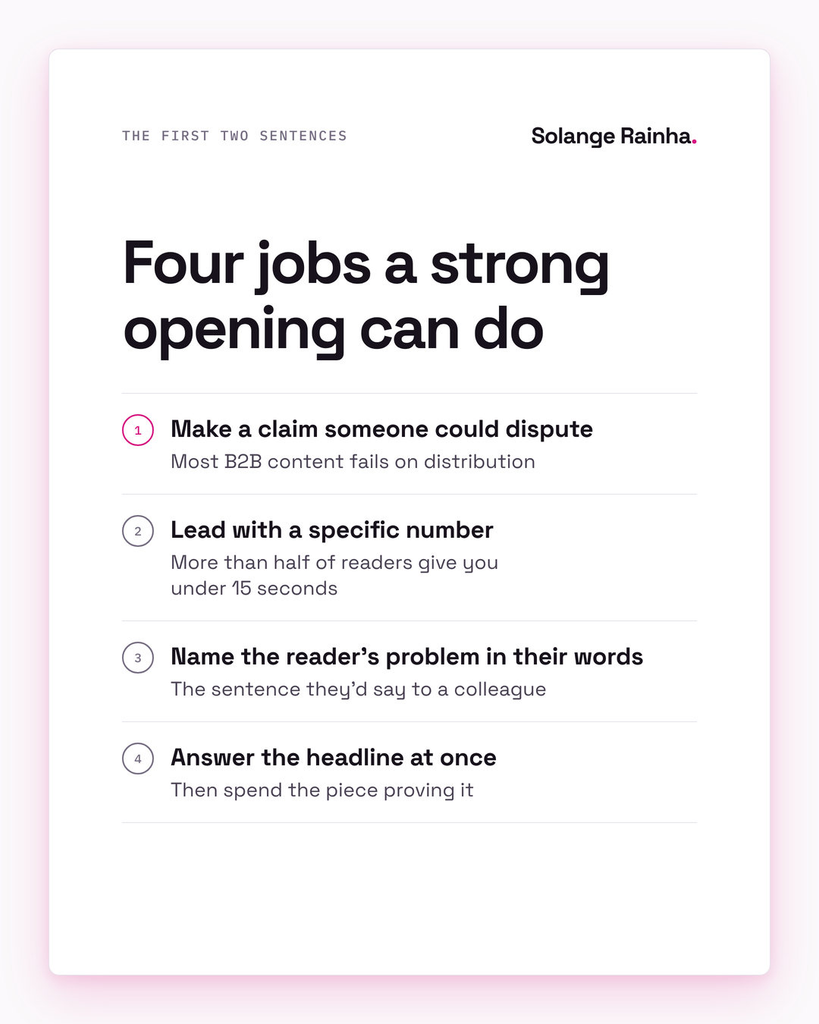
A strong opening does one of four jobs in its first two sentences. The strongest and rarest is making a claim someone could dispute, the same discipline behind having a point of view, because a sentence nobody could disagree with gives nobody a reason to keep reading.
The second is leading with a specific number. Concrete beats abstract every time, and a figure with a source attached signals the piece has done its homework: “more than half of readers give you under 15 seconds” outperforms “attention spans are short”.
Third, naming the reader’s problem in their own language: the sentence they’d use complaining about it to a colleague, which is rarely the problem you wish they had. And fourth, answering the question in the headline straight away, which feels counterintuitive since writers fear giving away the ending, but a reader who gets the answer up front stays to find out why it’s true. Nielsen Norman Group’s Amy Schade makes the same case for structure in her guide to the inverted pyramid, down to the paragraph:
“The first sentence of every paragraph should be the most important.”
How do you structure an opening so AI can lift it?
Make the first 40 to 75 words a self-contained answer to the question the headline implies, which is the part of the opening that machines reward most directly. Give the answer there, never a tease or a summary of what’s coming, and write it so it still makes sense if a model lifts it out with no surrounding context. Define any term the answer depends on, because an extracted paragraph carries none of the definitions sitting three screens below it, and Indig’s finding on definitions suggests models notice.
This is the front-loaded answer check I use when auditing a content library for AI readiness, and it’s the failure I find most often, including on my own site. When I scored my own pages, my portfolio opened with “Not everything. Just the highlights.”, a stylish non-answer sitting exactly where the answer should be. Pages that know the answer and make you wait for it do badly with both audiences, a rare case of human and machine incentives pointing the same way.
How do you edit your own openings?
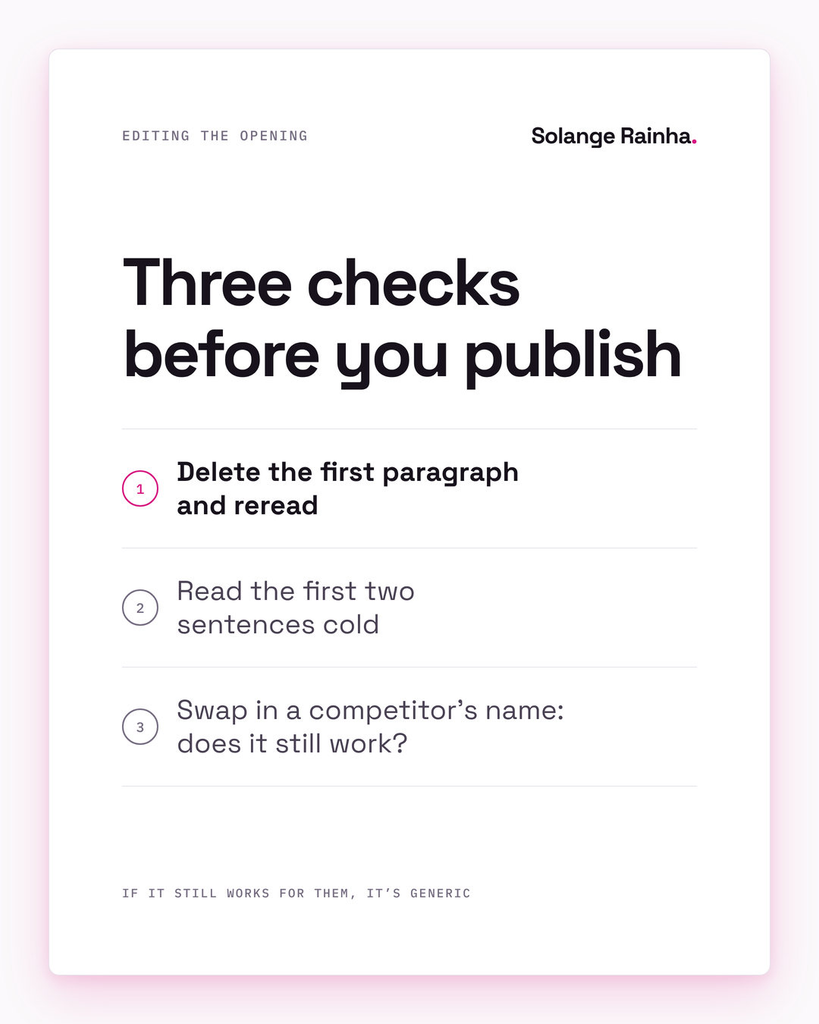
Without mercy, and the first habit does most of the work on its own: delete your first paragraph, then read what’s left. In my experience the piece starts better without it about seven times out of ten, because the opening paragraph was you working out what you thought.
Next, read only the first two sentences cold, and ask whether a stranger with no obligation to you would continue. The draft is probably competent; the question is whether it earns the next thirty seconds. Then check whether your opening could top a competitor’s article, and if it transfers cleanly, it’s generic, which is how every company blog ends up reading like every other company blog.
The reason to be ruthless here is proportion: the opening costs a small fraction of your words and decides a large share of the outcome, which makes it the best return on editing time anywhere in the piece. That’s also why the best content marketers edit before they write, and why writing quality still works as a moat in a market where producing words costs nothing.
Frequently asked questions
Because attention concentrates at the top and most readers never get past it. Chartbeat found 55% of pageviews got fewer than 15 seconds of active attention across 2 billion visits, and Nielsen Norman Group’s eyetracking found 57% of viewing time happens above the fold. The opening works as a filter: it decides who joins the smaller group that reads the whole piece, and those readers engage deeply.
When writing strong openings, aim for a self-contained answer within the first 40 to 75 words. That length suits people scanning the top of a page and AI systems lifting passages to cite, since Kevin Indig’s analysis found 44.2% of ChatGPT citations came from the first 30% of a page. If you can’t state your answer in 75 words, you probably haven’t decided what it is yet.
Three patterns cause most failures: throat-clearing, where the writer warms up for two paragraphs before the first proper sentence; context-setting, where background arrives before any reason to care about it; and hedging, where qualifiers stack in front of the argument and suggest the author doesn’t believe it. All three delay the claim, and delay is what loses readers.
Yes. Writers worry that answering early removes the reason to continue, and the opposite happens: a reader who gets the answer stays to learn why it’s true, while a reader made to wait usually leaves first. Front-loading also counts for AI visibility, since cited passages cluster in the first 30% of a page and are nearly twice as likely to contain clear definitions.