EU AI Act content labelling obligations have applied since 2 August 2026, and most of the coverage has gone to the companies that build AI models. The part that lands on marketing teams sits in Article 50(4), it applies to you as a deployer, and its scope is narrower and stranger than the panic suggests. AI-generated text needs a label only when it’s published to inform the public on a matter of public interest, and human editorial control can exempt even that. AI-generated images, audio and video that could pass as authentic need a label regardless of commercial context, and that’s where most marketing teams are exposed. I’m a content marketer, not a lawyer: take this to your legal team.
Let me put the disclaimer where you can’t miss it, because this is a compliance topic. What follows is my reading of the European Commission’s published guidance as someone who has to run EU AI Act content labelling inside a working content operation. Treat it as a starting point for the conversation with your legal team, never a replacement for it. Every source is linked so you can check my reading against the originals.
When did EU AI Act content labelling start, and what got delayed?
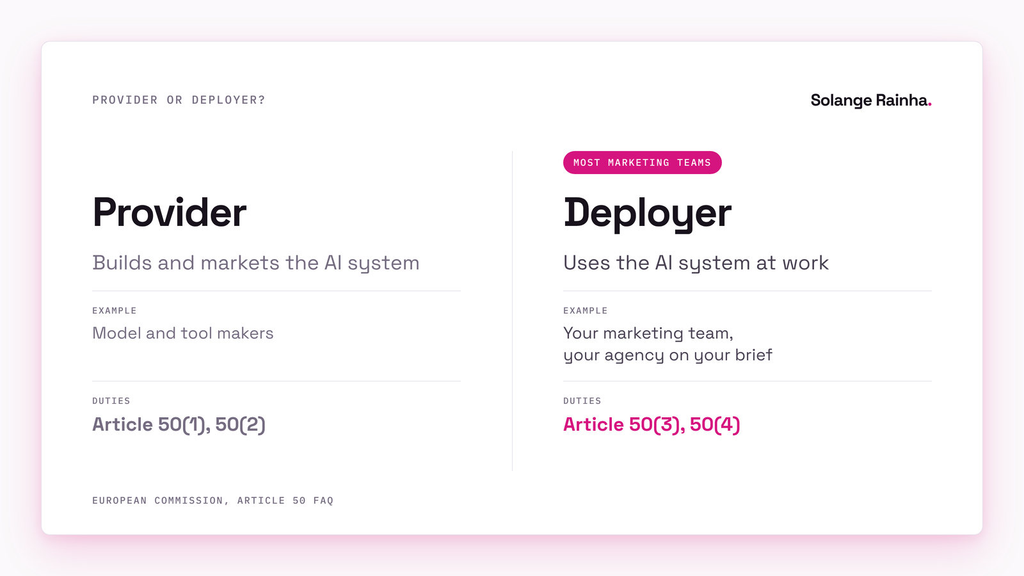
Article 50 of the AI Act, which sets out the transparency obligations, has applied since 2 August 2026. The Commission published its final Guidelines on how those obligations work on 20 July 2026, and the Commission and the AI Board confirmed that a voluntary Code of Practice on Transparency of AI-Generated Content is adequate for showing compliance. Deployers can sign its second section; signing helps, though it isn’t a safe harbour.
Plenty of teams saw headlines about the Digital Omnibus delaying parts of the AI Act and quietly stood down, which was a mistake: Sidley’s analysis was that the Article 50 obligations are generally not affected by the implementation delays, except for the Article 50(2) marking obligations on providers, and the Omnibus as published in the Official Journal on 24 July 2026 kept 2 August 2026 as the date Article 50 applies. The most broadly applicable section of the whole Act arrived on schedule.
Enforcement sits mainly with national market surveillance authorities, and fines can reach €15 million or 3% of total worldwide turnover for the preceding financial year, with proportionality available for SMEs and small mid-caps. It reaches you wherever you’re based, because the Act works on where content is placed on the market, so a company outside the EU publishing AI-generated content into the EU is in scope.
Is a marketing team a provider or a deployer?
Almost certainly a deployer, and the distinction decides which obligations are yours.
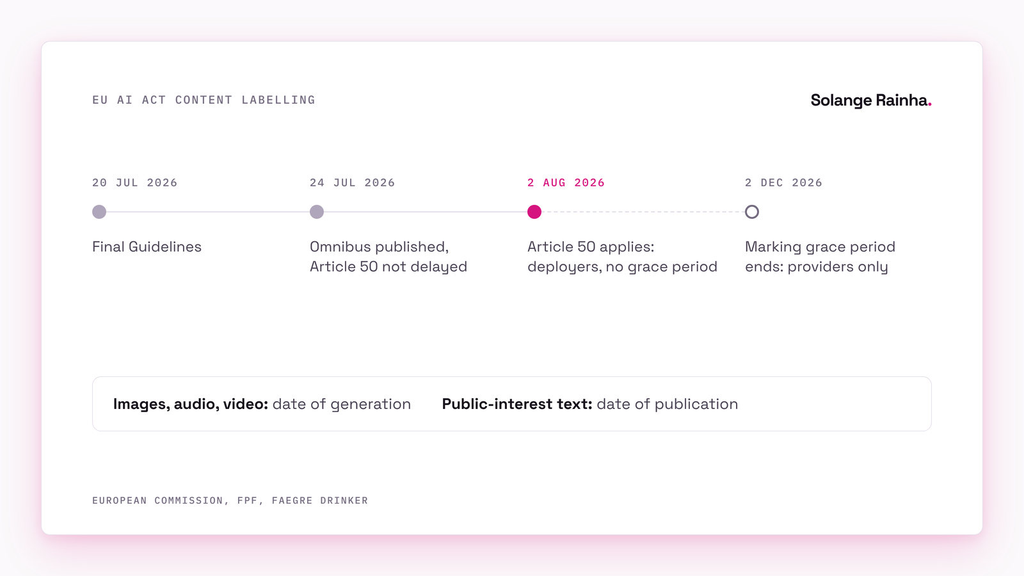
A provider develops an AI system, or has one developed, and places it on the EU market under its own name or trademark. That’s OpenAI, Anthropic, Google, or your company if you’ve built and shipped an AI product. Providers carry Article 50(1) and 50(2): designing systems that tell people they’re talking to AI, and marking generative outputs in a machine-readable format.
A deployer, by contrast, uses an AI system under its own authority in a professional context. That’s your marketing team using a chatbot to draft copy or an image model to produce visuals, and deployers carry Article 50(3) and 50(4). Article 50(5) then sets how any of these disclosures is made: clearly, distinguishably, and at the first interaction or exposure at the latest.
Two details in the Commission’s FAQ carry a lot of weight, and I haven’t seen either covered in the marketing press. Where the deployer is a company, employees acting under its control aren’t separate deployers, and the FAQ names web designers and content creators among its examples, so the obligation belongs to the organisation. And the company stays the deployer even when contractors or freelancers operate the system for it, so outsourcing production (your agency running Midjourney on your brief, say) doesn’t outsource the duty.
| Provider | Deployer | |
|---|---|---|
| Who | Builds an AI system and places it on the EU market under its own name | Uses an AI system under its own authority at work |
| Marketing example | Your company, only if it ships its own AI product | Your team drafting copy or making visuals with AI tools |
| Article 50 duties | 50(1) interaction disclosure, 50(2) machine-readable marking | 50(3) emotion recognition and biometric categorisation, 50(4) deepfakes and public-interest text |
| Grace period | Until 2 December 2026 for 50(2), on systems already on the market | None |
| Who’s responsible | The company | The company, including for employees and freelancers |
Which Article 50(4) obligations apply to marketing teams?
Two separate regimes, and conflating them is where most of the confusion starts.
The first is deepfakes: AI-generated or manipulated image, audio or video that meets three cumulative criteria: it resembles its subject to a high degree, the subject exists or could plausibly exist, and the content could falsely appear authentic or truthful. Note what’s missing from that test: there’s no public-interest filter, and no carve-out for marketing or commercial context.
The second covers text: AI-generated or manipulated text that’s published, informative to the public, and on a matter of public interest. The Commission’s list of qualifying subjects runs to politics and democratic processes, public administration and services, justice and law enforcement, fundamental rights, public security, public health, environmental protection, consumer safety, and economic, financial, scientific or cultural developments that could be the subject of public debate.
Both regimes require disclosure to the person exposed to the content, at first exposure at the latest, in a clear and distinguishable way.
Which marketing content does EU AI Act content labelling catch?
Mostly imagery, sometimes editorial text, and rarely promotional copy. This is my working read, and it’s the section to take to your legal team rather than treat as settled.
Promotional text usually sits outside the text obligation: advertising copy, product descriptions, landing pages, social posts and newsletters are published to sell, while the text limb targets content published to inform the public on matters of public interest. The Commission’s FAQ doesn’t spell out a marketing exclusion, though, so this is interpretation. If you write B2B SaaS product pages, most of your text output isn’t what this rule was written for.
Editorial-style content on a qualifying subject is where it gets interesting. Native advertising on health or financial topics is the standard example, and so is a lot of what the industry calls thought leadership when it’s published to inform on environmental impact, consumer safety, public health or economic developments. Given that most thought leadership takes no position anyway, the compliance question and the quality question point at the same content.
Imagery is what marketers underestimate: because the deepfake limb has no public-interest filter, AI-generated visuals that meet the three criteria are caught whatever the commercial context: a photorealistic AI image of a product in a real-looking setting, an AI-generated “customer”, a synthetic office scene presented as your office. Greenberg Traurig’s reading of the draft guidance was that organisations using synthetic media for creative or commercial purposes that depict realistic people, places, objects or events
“should generally assume that the labeling obligation applies”
Context still counts. The Commission says that if the intended audience in a specific deployment context doesn’t expect the content to be authentic, it may not falsely appear authentic, and the European Advertising Standards Alliance welcomed the Guidelines’ recognition that some creative or satirical ads can qualify for lighter disclosure, while warning that the Guidelines sometimes stretch the deepfake definition. EASA is now drafting advertising-specific guidance, and its line is that “transparency requirements must be practical, proportionate and effective”.
There’s a trap here too: deployers can’t rely on the machine-readable marking a provider embeds under Article 50(2) to meet their own disclosure duty. The invisible watermark your image tool applies satisfies the provider’s obligation and leaves yours untouched, because yours has to be perceivable by a person without special tools.
| Marketing content | Which limb | My working read |
|---|---|---|
| Ad copy, product pages, landing pages, social posts, newsletters | Text | Usually outside: published to sell, not to inform on public-interest matters |
| Thought leadership or native ads on health, finance, environment, consumer safety | Text | Possibly inside, unless it passes human review and editorial control |
| Photorealistic AI images, video or audio of real-looking people, places or products | Deepfake | Inside whenever it could pass as real, commercial or not |
| Obviously stylised or illustrative AI art | Deepfake | Likely outside if the audience wouldn’t expect it to be authentic |

What counts as editorial control under the AI Act?
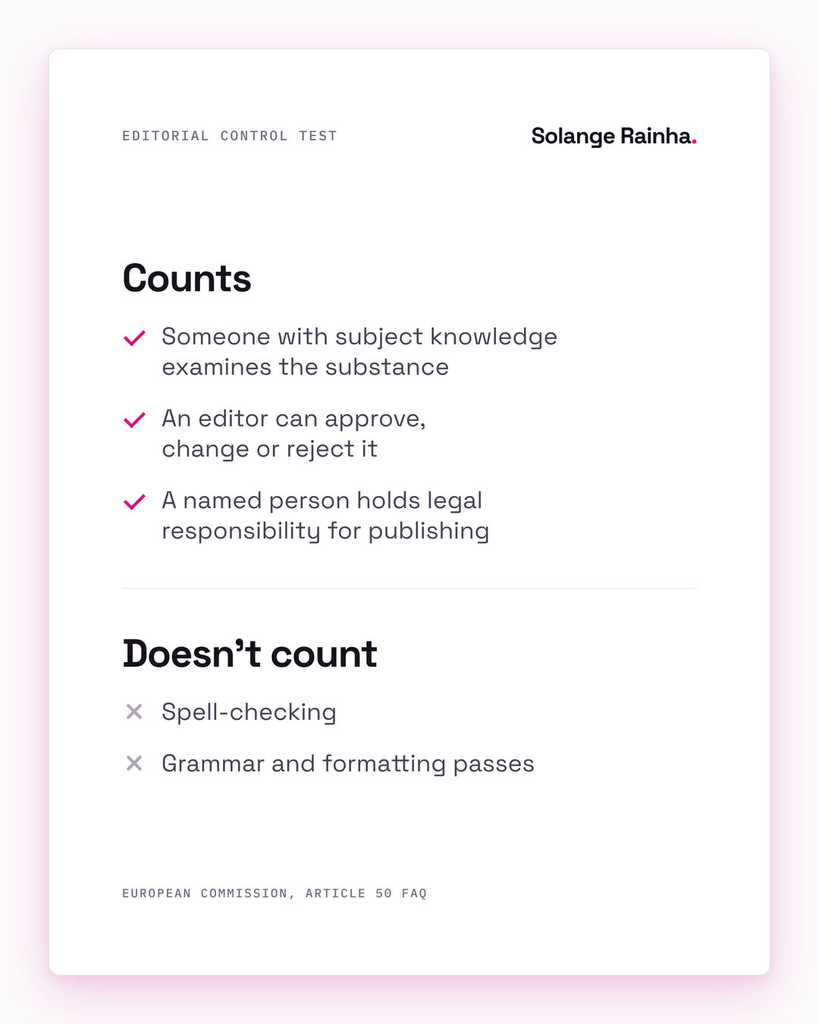
A named person with subject knowledge examining the substance, with the authority to change or reject it and the legal responsibility for publishing it. The whole text obligation hinges on this exemption, and it’s narrower than the summaries suggest.
Article 50(4)’s text obligation doesn’t apply where the content has gone through human review or editorial control and a person or organisation holds editorial responsibility for publication. Human review means the deliberate examination of the substance of the content by people with relevant knowledge and professional judgement. Editorial control means control exercised in practice by a responsible editorial entity, such as an editor-in-chief, with authority to approve, alter or reject the substance. Editorial responsibility means a person holds the ultimate legal responsibility for the publication.
Then comes the line that should worry plenty of content operations: superficial, purely formal or procedural checks, such as spell-checking or grammatical correction, don’t count. Greenberg Traurig read the draft guidance as interpreting this exception narrowly, and the final FAQ wording supports that.
Read that against how AI gets used in most content teams (a model drafts, a marketer skims for typos, the piece goes live) and the risk is obvious, because that workflow doesn’t meet the Commission’s definition of editorial control, which expects someone to check the claims and take responsibility for publishing them.
That’s the same standard I’ve argued for on quality grounds for years. Documented editorial standards and a substantive review pass were always what separated content worth publishing from content that merely existed, and good content marketers are editors first for the same reason. It’s also why final judgement is the one role I’d never hand to AI. What’s changed is that the editorial layer now has a regulatory function attached, and review that leaves no trace is worth much less when someone asks you to show it happened.
Does content made before 2 August need a label?
Images, audio and video made before 2 August 2026 don’t; text is judged by when you publish it. The Commission says content generated before 2 August doesn’t need labelling retroactively, though it encourages deployers to do it where they can.
The catch is an asymmetry Faegre Drinker spells out: for images, audio and video the relevant date is the date of generation, while for public-interest text it’s the date of publication. Text generated in July and published in September still needs a label unless the editorial control exemption applies, which is a problem for anyone sitting on a backlog of AI-assisted drafts.
The one grace period still running, until 2 December 2026, covers only the Article 50(2) marking and detection obligation, and only for AI systems placed on the market before 2 August 2026. That’s a provider obligation, so if you’re a marketing team, it isn’t yours.
What should a marketing team do now?
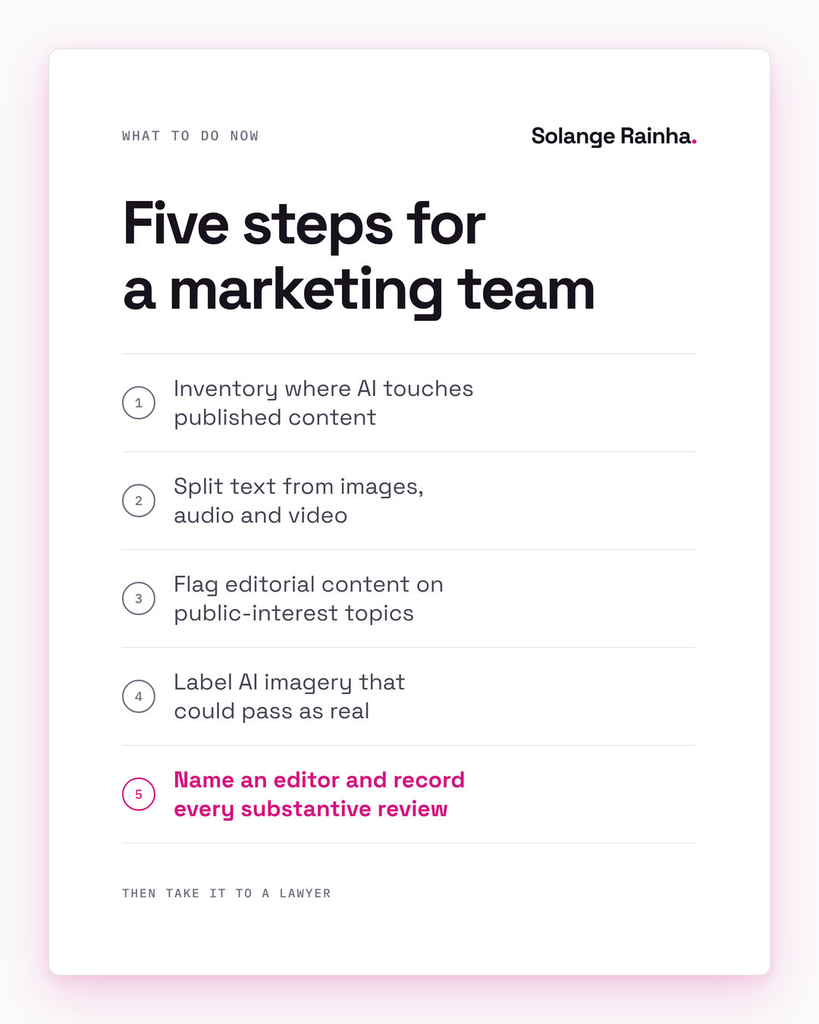
Inventory where AI touches published output, separating text from image, audio and video, because they follow different rules. Flag any content published to inform on a qualifying public-interest subject, including the thought leadership nobody thinks of as editorial. Look hardest at AI-generated imagery, since that’s the exposure with no public-interest filter protecting it.
Then fix the editorial layer, which is the highest-value move available. Name who holds editorial responsibility, define what substantive review means in your workflow, and record that it happened. If you use AI in production, and I use it heavily in specific parts of my own workflow, the review pass is the control point that protects quality and carries the compliance argument at once. In my own solo content workflow editing is a separate pass on a separate day, and that habit now has a second job. It’s another version of the argument that the bar for content marketing went up rather than down once production got cheap.
Take a separate look if you run any customer-facing automation. Article 50(1) puts a disclosure duty on systems that interact directly with people, and the Commission’s FAQ lists AI agents alongside chatbots and avatars as examples. If you’ve been building agentic workflows that talk to customers, that’s a different obligation from EU AI Act content labelling, and it applied from the same date.
And take it to a lawyer. I’ve linked the Commission’s FAQ, its Guidelines page and several law firm analyses throughout, because you should read the primary sources instead of trusting a marketer’s summary, including this one. The Guidelines aren’t binding law, EASA’s advertising guidance is still being written, and I’ve flagged where I’m reading interpretation instead of settled law.
This article reflects my reading of published guidance as a content practitioner. It isn’t legal advice, the Guidelines aren’t binding, and the regulatory picture is still moving. Check the primary sources linked above and take advice on your own situation.
Frequently asked questions
No. EU AI Act content labelling under Article 50(4) splits into two regimes. AI-generated text needs disclosure only when it’s published to inform the public on matters of public interest, which on most readings leaves out advertising copy, product descriptions, social posts and newsletters. AI-generated image, audio and video content is different: if it resembles an existing or plausible subject and could falsely appear authentic, it needs disclosure regardless of commercial context.
Almost always a deployer. Providers develop AI systems and place them on the EU market under their own name; deployers use those systems under their own authority in a professional context. The obligation sits with the organisation, not with individual employees, and it stays with the organisation even when freelancers or contractors operate the tools on its behalf.
It can exempt text published on matters of public interest, but the standard is demanding. The Commission requires deliberate examination of the substance by someone with relevant knowledge, editorial control by an entity with authority to approve, alter or reject the content, and a person holding ultimate legal responsibility for publication. Spell-checking and grammar correction don’t qualify, and the exemption doesn’t cover AI-generated images, audio or video.
Article 50 has applied since 2 August 2026, and the Digital Omnibus published in July 2026 didn’t postpone it. A grace period until 2 December 2026 covers only the Article 50(2) marking obligation, for AI systems placed on the market before 2 August 2026, which is a provider obligation. Images, audio and video generated before 2 August don’t need retroactive labelling, but public-interest text is judged by its publication date.