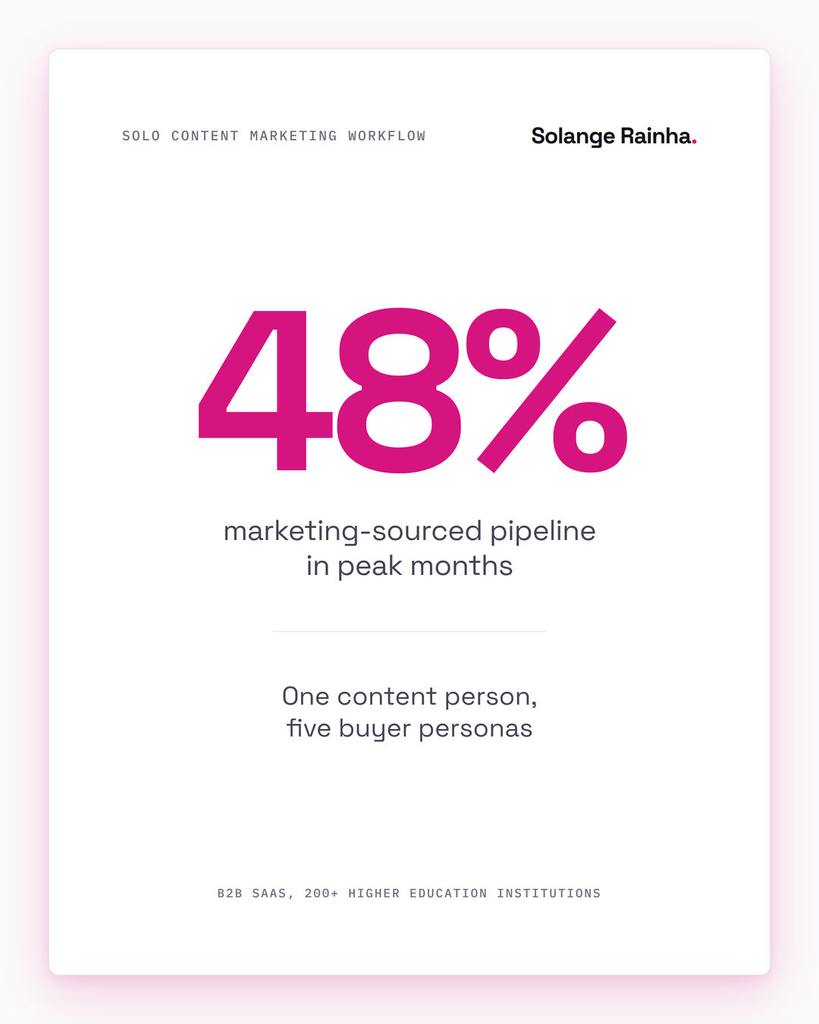
A solo content marketing workflow succeeds or fails on what you refuse to do, far more than on which tools you buy. This is the operating system behind a one-person content function that contributed to 48% marketing-sourced pipeline: the stack and why it stays small, the path from idea to published to measured, where AI earns its place and where it doesn’t, and the no-list that keeps the whole thing survivable.
The question I get asked most is some version of “how does one person do all that?” The answer disappoints people who want a tool recommendation, because the tools are the least interesting part. What actually makes it work is a short list of what I do, a much longer list of what I’ve decided not to do, and a system connecting the first list end to end.
Why should a solo content stack stay small?
Because every tool costs setup, maintenance, a mental slot and a new place for information to hide, and a team of one pays all of that personally. Marketing has a tooling problem that’s worse than most people admit: Gartner’s 2025 Marketing Technology Survey found martech utilisation down to 49%, so only about half the tools companies pay for get used, and just 15% of organisations qualified as high performers.
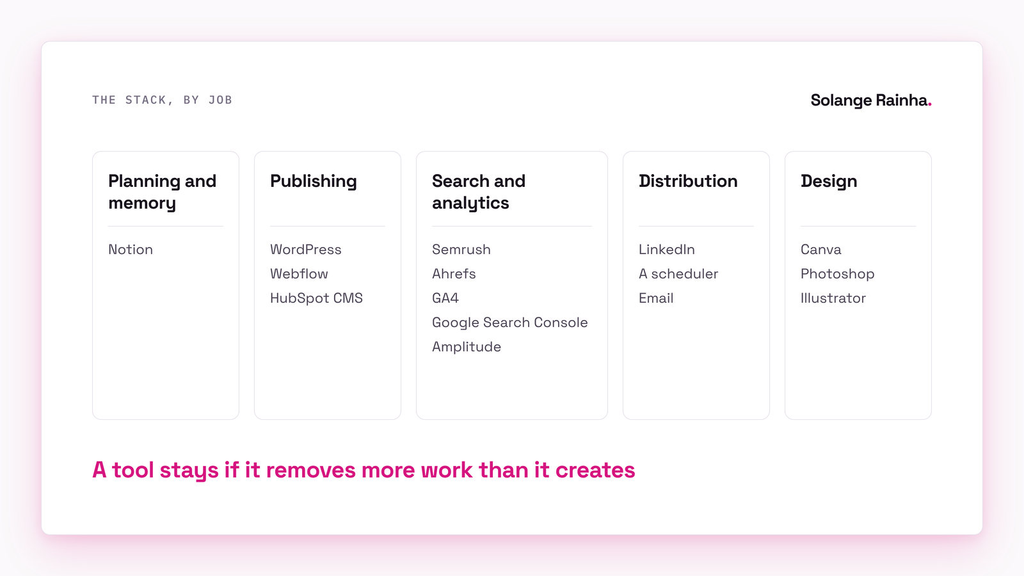
A well-staffed team can carry some of that waste, but I can’t, which makes me ruthless about it in a way they never have to be: a tool stays only if it removes more work than it creates, and most fail that test, the worst offenders usually with the best sales pages.
What survives, grouped by the job it does instead of by category:
- Planning and memory: Notion holds the calendar, the strategy docs, the persona definitions and the running list of ideas.
- Publishing runs on WordPress, Webflow or HubSpot CMS, depending on the company. Boring is a feature here, and working HTML and CSS means I can fix a layout problem without filing a ticket and waiting two weeks.
- For search and analytics, Semrush or Ahrefs for keyword and competitive work, GA4 and Google Search Console for what happened, and Amplitude where product data counts.
- Distribution is LinkedIn natively, a scheduler for the calendar, and email through whatever the company already runs.
- Design: Canva for speed, Photoshop and Illustrator when it needs to be right. Making my own graphics removes a whole dependency on someone else’s backlog.
That’s it, roughly a dozen tools, most of which I’d already know on day one at a new company.
What does a solo content marketing workflow look like from idea to measurement?
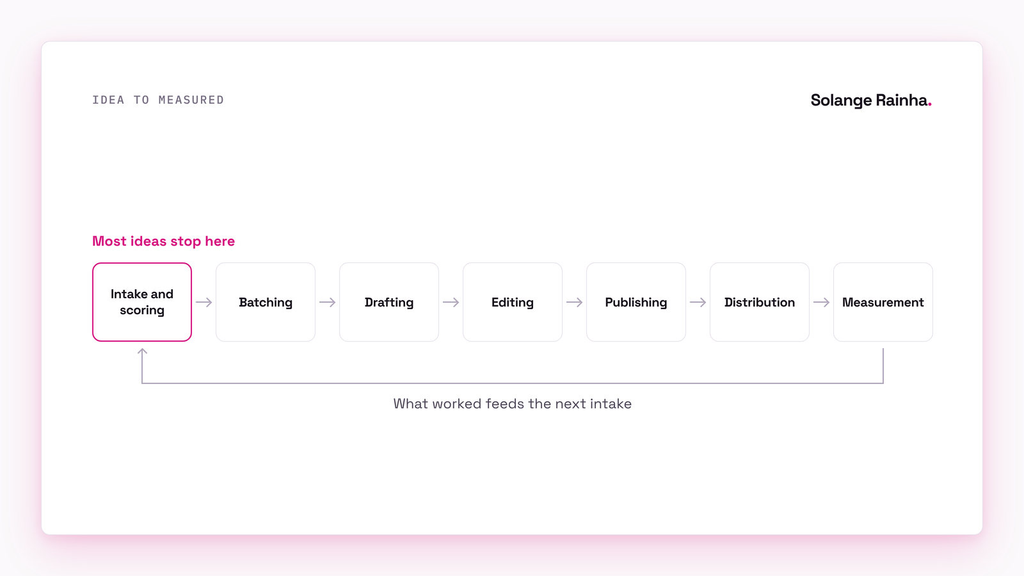
The same seven stages in the same order every time, which stops each piece turning into a fresh set of decisions.
Every idea, including the ones from senior stakeholders, starts at intake and goes through the same three questions before it touches the calendar: what business outcome does it serve, what does it cost to make, and does it fit the strategy we’re running right now. That’s my content prioritisation framework in one line, and it exists mostly so a “no” rests on strategy instead of my opinion.
| Stage | What happens | Why it saves time |
|---|---|---|
| Intake and scoring | Outcome, cost and fit, before anything reaches the calendar | Kills work before it’s made |
| Batching by mode | Research, drafting, editing and design in separate blocks | Cuts context-switching between personas |
| Drafting | Against documented voice, structure and evidence standards | No re-deciding basics on every piece |
| Editing | A separate pass, never on the drafting day | The gap is what makes the edit useful |
| Publishing | The midpoint of the job | Keeps distribution from becoming an afterthought |
| Distribution | Social posts, a newsletter section, sales material | One piece does several jobs |
| Measurement | A short list of metrics that answer whether it worked | Fewer metrics, faster decisions |
Batching is the stage people underrate: I group work by the type of thinking it needs, so I never switch between five personas and four content types in one afternoon, which is why running a multi-persona strategy solo depends on batching more than on working longer. Cal Newport makes the same point in his Big Think class on slow productivity, where his first principle is about cutting how much you take on, and he clarifies it straight away:
“What I really mean is do fewer things at once.”
Documented editorial standards do enormous work at the drafting stage, because a written voice, structure and evidence bar means I’m not re-deciding basics on every piece. Building those standards from zero was the highest-return week I’ve spent, and it’s why quality holds when volume rises. I plan distribution alongside the piece, the same way I get twelve assets out of one idea, and measurement stays narrow, which took me an embarrassingly long time to learn after a period of tracking 17+ KPIs a quarter that mostly couldn’t tell me whether anything worked.
Where does AI fit in a solo content workflow?
Around the writing, and out of the argument. I use AI heavily for research synthesis, pulling structure out of a messy brief, stress-testing an argument, first-pass QA against my own editorial rules and reformatting for different channels.
The differentiation stays with me: the original argument and point of view, and the specific claim nobody else can make. A model recombines what already exists, and the whole value of good content is being the source instead of the summary. I’ve mapped exactly what I hand over and what I keep in my AI org chart for a solo content function, and the longer view is in the breakdown after a year of using AI in content marketing. The short version: AI raised my throughput without touching my judgement.
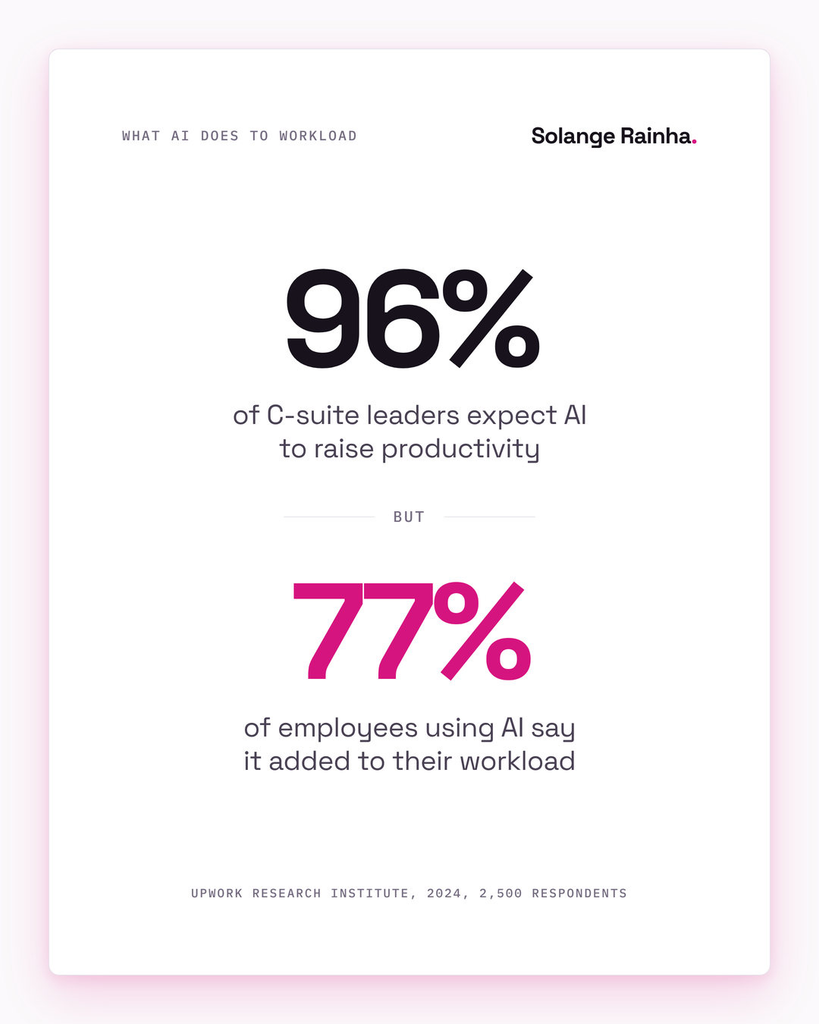
One caution, because the workload data keeps finding it: tools that promise to reduce work often raise the expected output instead. In the Upwork Research Institute’s 2024 study of 2,500 workers and executives, 96% of C-suite leaders expected AI to raise productivity, while 77% of employees using AI said it had added to their workload. Time saved has to go into better work or into stopping earlier, or it turns into more volume at the same quality.
What does a solo content marketer refuse to do?
Anything outside the content job or without an outcome, plus anything a simpler tool already solves.
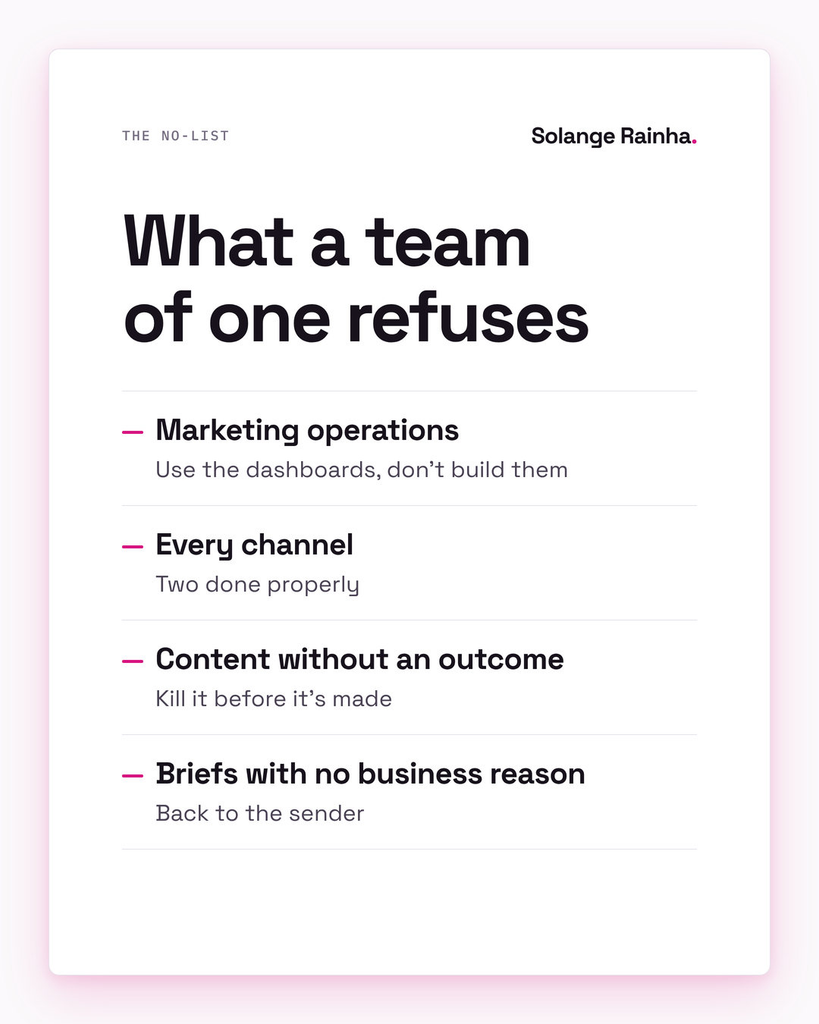
- I don’t run marketing operations, so automation building, lead scoring, CRM configuration and attribution modelling stay with someone else. I use the dashboards other people maintain, and when I report a pipeline contribution I say where it came from, which is why I publish the methodology alongside the 48% figure instead of presenting it as my own calculation.
- Chasing every channel is out too, because two channels done properly beat five done badly, and picking which two is a strategy decision, separate from a capacity one.
- I don’t produce content without a defined outcome, because the biggest saving on a solo workload is killing work before it’s made, since an idea you killed costs nothing and a piece you half-made costs a week.
- Nothing bespoke gets built for a problem a spreadsheet already solves, and a brief that arrives without a business reason attached doesn’t get accepted, because that’s how a calendar fills with other people’s impulses.
Every one of those refusals buys back hours, and together they’re why the output looks like a team’s: nothing in the week goes on work that was never going to count.
How do you avoid burnout running content solo?
By designing out the decisions, because willpower won’t hold. The figures are grim: in Marketing Week’s 2026 Career and Salary Survey of 2,350 marketers, 65.3% had felt overwhelmed in their role over the past year and 55.1% reported emotional exhaustion. The World Health Organization defines burnout as resulting from chronic workplace stress that has not been successfully managed, which makes it a problem of how the work is set up as much as of the person doing it.
The system above protects against it in specific ways: predictable batching removes the constant context-switching that makes a day feel twice as long as it was, and documented standards remove decision fatigue, since most small choices are already settled and don’t need relitigating at 4pm. The prioritisation framework takes the emotional weight out of saying no, because the no comes from the strategy, which turns an argument into a trade-off conversation. I learned that the hard way building social from scratch on top of everything else.
How did this produce 48% marketing-sourced pipeline?
Through concentration. When I worked this way at a B2B SaaS company serving 200+ higher education institutions, the content operation contributed to 48% marketing-sourced pipeline in peak months, and here’s what did the work:
- The no-list removed a large amount of low-value work, so the remaining hours went into a small number of pieces aimed squarely at buyer questions at specific funnel stages.
- Documented standards made those pieces consistently good instead of occasionally good.
- Distribution was built into the workflow, so each piece reached the people it was written for.
- Narrow measurement let me tell quickly which bets were working and move effort toward them.
That’s the argument I keep making for a content system rather than a content team: the system is what turns one person’s hours into output that reads like a department’s.
Where does a solo content workflow break down?
At scale and at breadth: a solo content marketing workflow can’t cover simultaneous major launches across several regions, sustained video production or a full demand-gen programme, and pretending otherwise is how solo marketers end up in the burnout figures above. Name the ceiling early, ideally before someone hands you all three in the same quarter.
Frequently asked questions
Fewer than the industry sells you. A workable solo stack covers five jobs: planning and memory (Notion), publishing (WordPress or your company’s CMS), search and analytics (Semrush, GA4, Google Search Console), distribution (LinkedIn plus a scheduler and email), and design (Canva, with Photoshop or Illustrator when needed). That’s roughly a dozen tools, and the discipline is refusing any tool that creates more work than it removes, since enterprises actively use fewer than 40% of the tools they buy.
Through prioritisation and systemisation rather than working longer hours. Every idea gets scored against business outcome, cost, and strategic fit before it reaches the calendar, work is batched by type of thinking rather than by project, and documented editorial standards remove the need to re-decide basics on every piece. The output looks like a team’s because none of the available hours are spent on work that was never going to matter.
AI works well on the work around the writing: research synthesis, structuring messy briefs, stress-testing arguments, QA against your own editorial rules, and reformatting for different channels. It shouldn’t produce the original argument or point of view, because a model recombines what already exists and the differentiating value of content is being the source rather than the summary. Reinvest the time saved deliberately, since tools that promise less workload often just raise expected output.
Design the workflow to remove decisions rather than relying on willpower. Batch work by type to cut context-switching, document editorial standards so small choices are settled once, and use a transparent prioritisation framework so saying no is a strategy conversation rather than a personal one. Be explicit about the ceiling too: a one-person function can’t cover simultaneous launches, sustained video, and demand generation, and naming that limit early prevents the overload that burns people out.