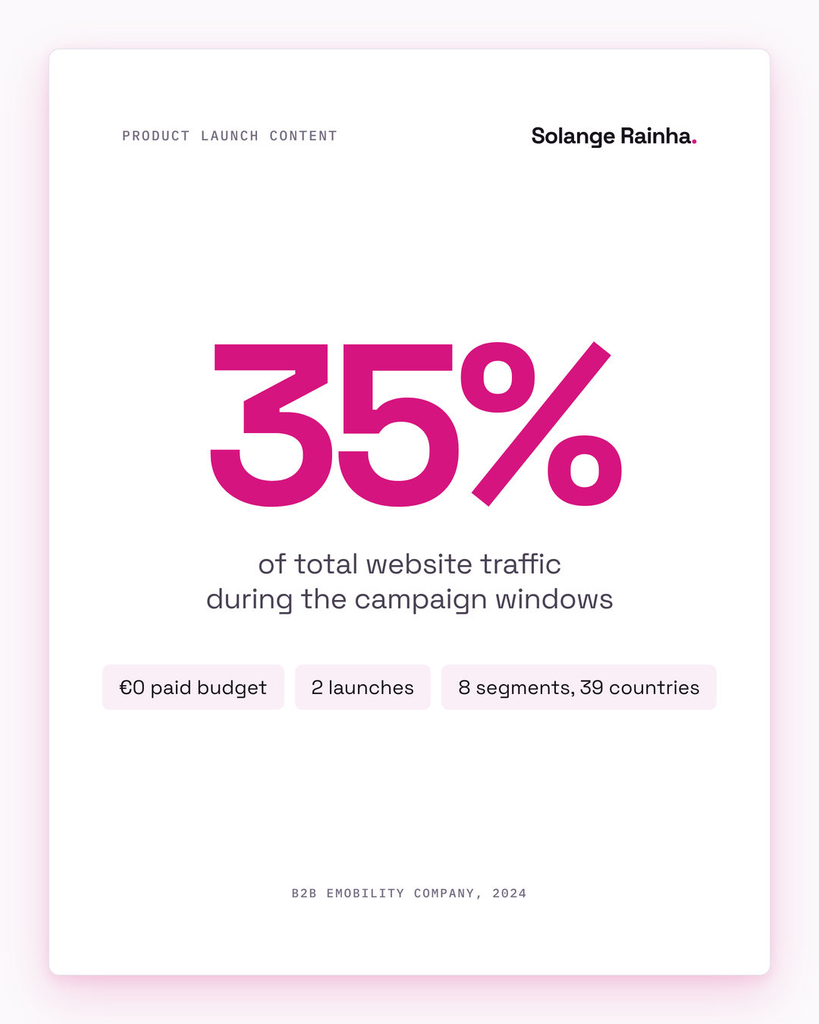
Product launch content usually gets treated as the layer you add once the real launch plan exists, which is backwards when there’s no ad spend to hide behind. At an eMobility company, I led content and positioning for two launches with no paid budget, no events, and no PR agency, and the launch content accounted for 35% of total website traffic during the campaign windows.
Most launch advice assumes a budget: book the paid campaign, brief the agency, sponsor the industry event, run the webinar with a media partner. I had none of that, just a computer, an eMobility company selling into 8 segments across 39 countries, two products going live inside the same short window, and roughly 5 months on the clock.
That constraint is less unusual than the advice suggests, and launches go wrong even with money behind them. In Gartner’s survey of 205 product managers, 45% of launches were delayed by at least a month, and of those, 20% on average missed their internal targets. Adrian Lee, the Gartner senior research director behind it, didn’t soften it:
“A product launch that meets all internal targets is seldom achieved.”
So product launch content is what you have left when the budget line is empty, and it’s more capable than its reputation. The launch content pulled 35% of total site traffic while those campaigns ran, all of it organic, and since that’s the headline, I’ll spend a section on what it does and doesn’t mean, because pipeline and traffic claims deserve their methodology attached.
Why does positioning have to come before launch content?
Because launch content amplifies whatever clarity it’s given, and I didn’t have much. I inherited a company with no positioning document: 40+ brand assets, each describing a subtly different business, no agreed messaging hierarchy, and no line on who we served or why anyone should care. Launching two products on top of that would have produced two more variations of the confusion, so the first job was building the positioning that didn’t exist.
That sequencing was the highest-return decision in this whole case study. April Dunford, author of Obviously Awesome, draws the line plainly in her positioning exercise: positioning is a separate job from messaging, and once it’s settled, “this becomes a set of inputs to your messaging”. Skip it and you write every launch asset against a guess, then distribute the fuzziness faster and to more people, which is worse than staying quiet.
With eight segments to serve, the positioning work came down to what each product meant to a charge point operator, a fleet manager and a vehicle OEM, because those buyers want different outcomes from identical technology.
What order should product launch content go in?
Messaging, then web, then social, then depth, and the order counts for more than any individual piece. Once I’d settled positioning, I ran the same sequence for both launches.
The messaging architecture came first: one document holding the core claim, the segment-specific variants, the proof points and the language we refused to use. I wrote everything else from it, which is why the assets stayed consistent without a review committee flattening them.
Web went second: product pages, landing pages and the supporting site copy were live before the noise started, because there’s no point driving attention to a page that isn’t ready to convert. The search work paid off here too, since I built the pages around the terms buyers search instead of internal product names.
Only once the destination existed did I write the social campaign posts, each with a single idea and a route back to the relevant page. The supporting content came last: the whitepaper, the case study and the segment articles, all the depth a serious evaluator wants once the initial claim has landed.
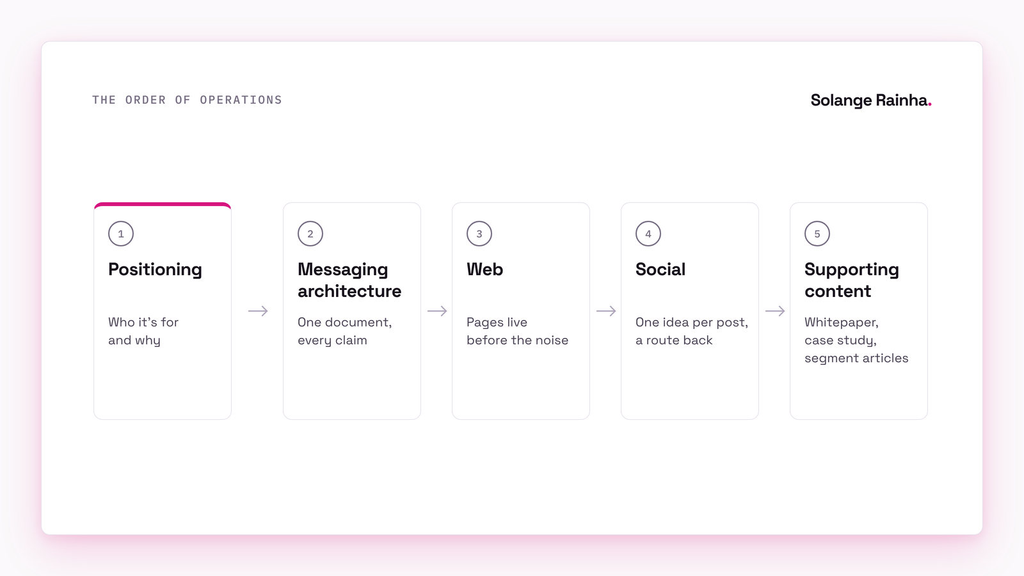
The discipline is refusing to write social copy before the messaging exists, which is how launch content usually goes wrong at companies whose launch date arrived before the strategy did.
What does the 35% figure measure?
The share of total website traffic that landed on launch-related pages during the campaign windows, measured in analytics against the site as a whole, with no paid traffic in the mix because there was no paid spend to attribute.
Some caveats belong with it. The campaign windows were short and intense, so this measures peak concentration, not a sustained annual average. Baseline site traffic was modest, which makes a large percentage easier to reach than it would be at a high-traffic incumbent. And the launch content benefited from the SEO groundwork running in parallel, where priority keywords climbed an average of 12 positions across all eight segments, so the split between “launch content” and “general organic improvement” holds in direction but wouldn’t survive a precise audit.
What the figure does show is that owned-channel launch content can carry a launch: about a third of everyone arriving at that site during those weeks came to read about the new products, with nobody paying for a click. Organic traffic grew 18% over my time there too, which fits the launch pages bringing in new visitors, though I can’t separate the two cleanly.
How do you distribute launch content with no budget?
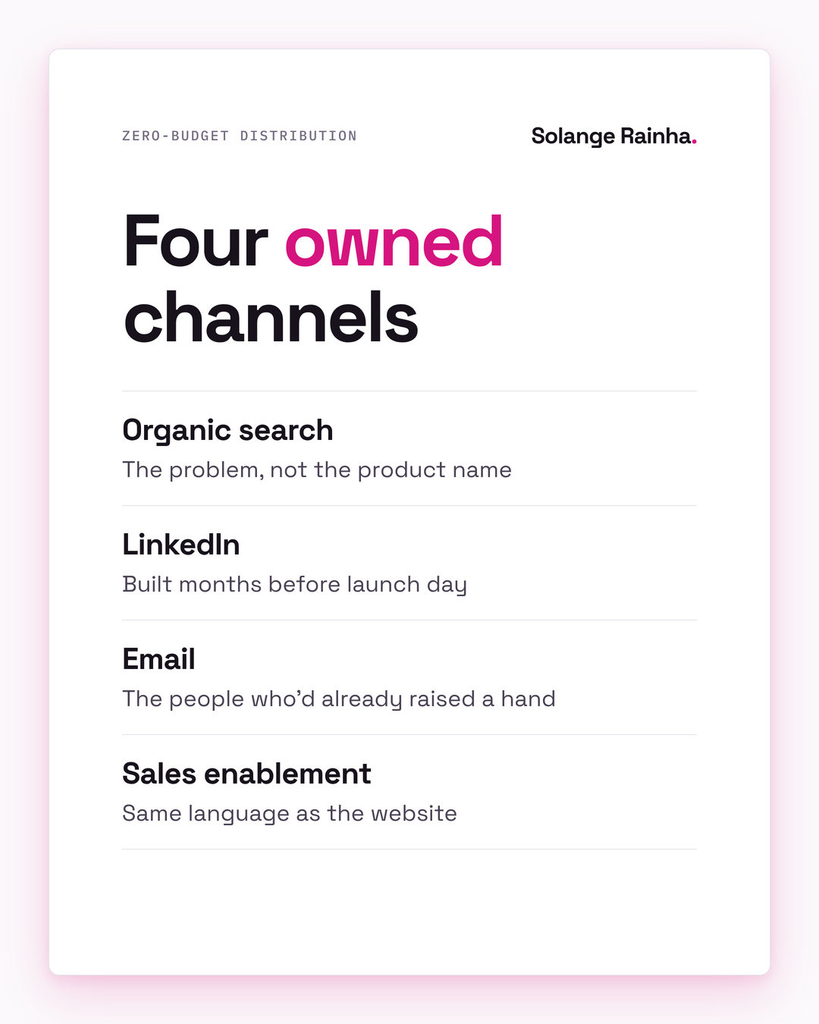
Through owned channels you’ve built in the weeks before, because distribution is where most content dies, and with no media budget the whole plan for this product launch content ran through four of them.
- Organic search, aimed at launch-adjacent queries. Nobody was searching the product name before launch, so targeting it would have been vanity. The pages went after the problems the products solved, the terms each segment used, and the comparison queries buyers run while evaluating options.
- LinkedIn, run as a proper channel. The company’s social presence was close to dead when I arrived, and rebuilding it produced 217% reach growth over five months across 70+ posts.
- Email to the existing list: small, unglamorous and the highest-intent audience available, since these were people who’d already flagged interest.
- Sales enablement, with one-pagers and prospect-facing collateral so the sales conversations used the same language as the website.
Each piece fed the next: the whitepaper gave the social calendar three weeks of material, the segment articles gave search pages to rank, and the messaging document made all of it sound like one company, which is the same planning I now use to get twelve assets out of one idea.
Owned content also does the selling earlier than most teams expect. In 6sense’s 2025 Buyer Experience Report, built on nearly 4,000 B2B buyers, buyers first contacted a seller 61% of the way through their buying process, so for most of a launch, your pages are all a buyer sees of you.
How far ahead should launch content work start?
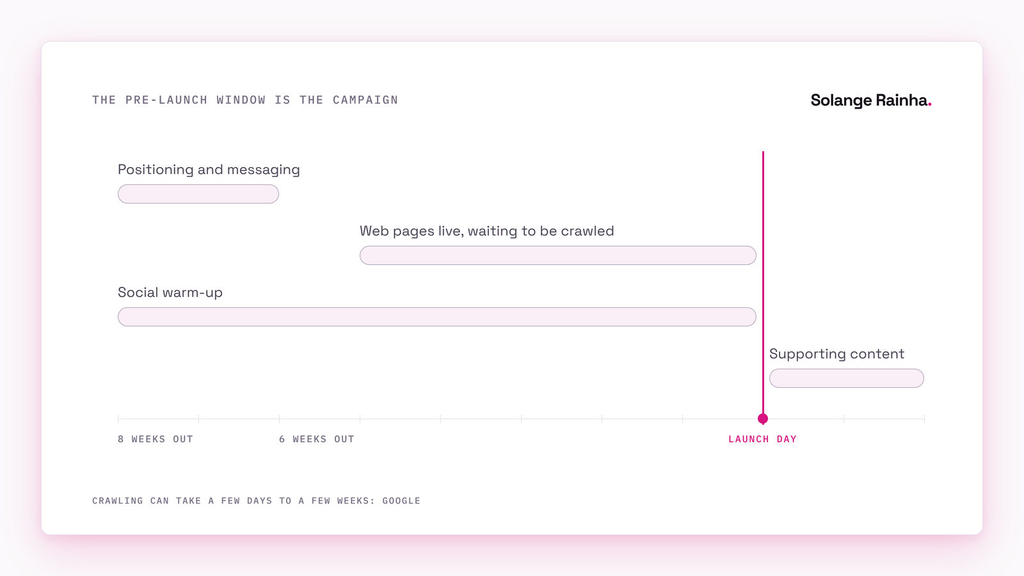
Six to eight weeks before launch day, which felt excessive to everyone waiting on visible output and turned out to be the minimum workable runway, and it’s when the positioning work began for the first launch.
Messaging needs stakeholder input and revision cycles and web copy needs building and reviewing, on top of which a cold social channel won’t carry an announcement. New pages also take time to reach search at all: Google’s own guidance on asking it to recrawl a page says crawling can take anywhere from a few days to a few weeks. Content published on launch day has no chance to rank by launch day, so the pages that would carry organic traffic had to exist and be crawlable well before the announcement.
The pre-launch window is the campaign, and launch day is a milestone inside it. Treating launch day as the start is how teams end up buying ads to compensate for the audience they never built.
| Launch with a paid budget | Zero-budget launch | |
|---|---|---|
| Where attention comes from | Ads, events, PR bought for the day | Search, LinkedIn, email and sales, built beforehand |
| When the work starts | Weeks before, mostly on the campaign | Six to eight weeks before, on positioning and pages |
| What carries launch day | The media spend | Pages already indexed and an audience already warm |
| What a weak positioning costs | Wasted spend | Wasted weeks, with nothing to buy them back |
What worked, and what would I change?
The sequence worked, and I’d run it the same way again, with everything traceable back to one document. Building distribution months before it was needed worked too, since a channel with an audience behaves completely differently from one that’s just a logo.
What I’d change is the measurement design: I’d set up cleaner event tracking and a defined pre-launch baseline before writing a word, so the attribution story afterwards could be surgical instead of directional. That’s a lesson I carried into how I now think about which metrics prove content is working, and it’s the difference between a figure that holds up in a board meeting and one that only holds up in a blog post.
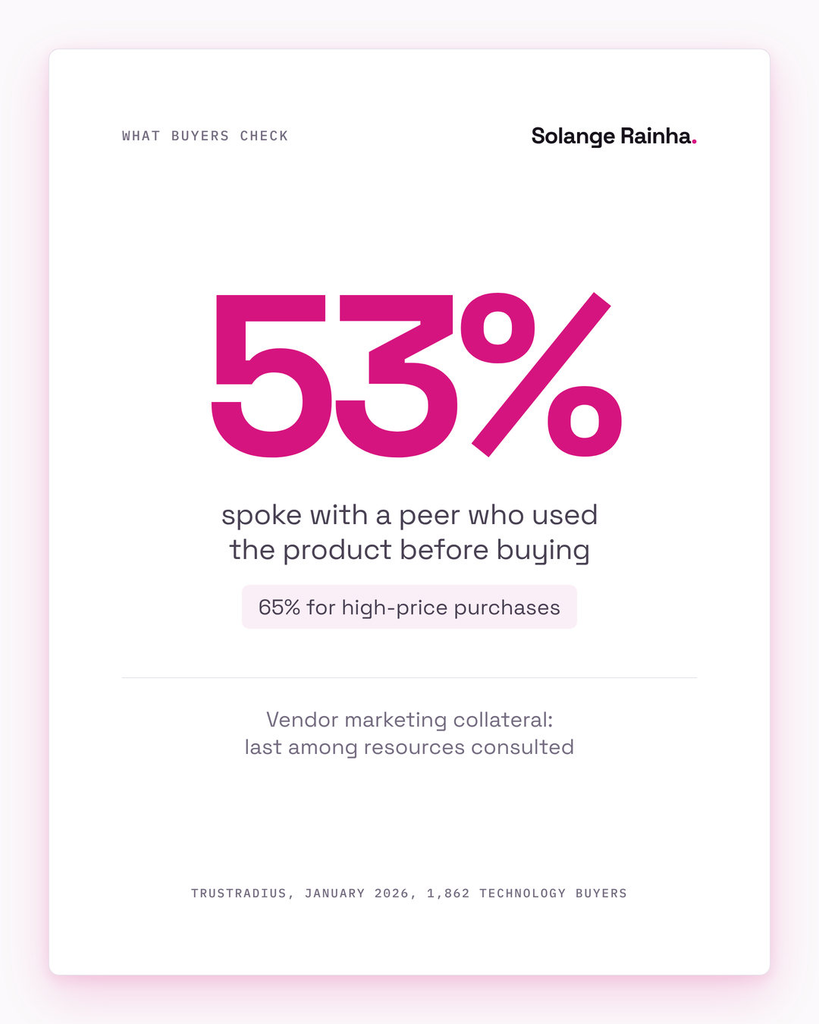
I’d also push for customer proof earlier, because the case study arrived late in the cycle, and evidence from a live deployment persuades a fleet operator far more than any claim we could write about ourselves. Buyers say so: in TrustRadius’s January 2026 survey of 1,862 technology buyers, 53% spoke with a peer who used the product before buying, and vendor marketing collateral ranked last among the resources they consulted. TrustRadius runs a review site, so it has a stake in that answer, and it matches what I saw. On a product that takes explaining, and eMobility infrastructure does, a customer describing the outcome in their own words does work no amount of positioning polish replaces.
Frequently asked questions
Run it through owned channels, in a fixed order. Settle positioning and a messaging architecture first, then build the web pages the campaign will point at, then warm up your social channel and publish launch content into it, then add depth with whitepapers and case studies. Target search queries around the problem your product solves, since nobody’s searching the product name yet, and start six to eight weeks before launch day so pages have time to get crawled and the audience has time to build.
Product launch content should include a messaging document defining the core claim and its segment variants, product and landing pages built around the terms buyers search, social posts carrying one idea each with a route back to the site, sales enablement collateral so sales and marketing describe the product the same way, and evaluation content such as a whitepaper or customer case study. The messaging document comes first, because you write everything else from it.
Because launch content amplifies whatever clarity it’s given, so unclear positioning gets distributed faster and wider. Positioning decides who the product is for and why it’s better for them; you write messaging and every launch asset from those decisions. Fixing positioning after the assets exist means rewriting all of them, which costs far more than settling it first.
Six to eight weeks before launch day is a realistic minimum for a small team. Messaging needs revision cycles and web copy needs building and review, while a cold social audience won’t carry an announcement. Google says crawling a new page can take anywhere from a few days to a few weeks, so content published on launch day can’t rank by launch day, and anything expected to drive organic traffic has to be live and crawlable well beforehand.