A content prioritisation framework is a fast, repeatable way to score every content idea so you make the ones that move a business outcome and kill the rest before they cost you a week. Mine scores each idea on impact first (the gate), then effort, then alignment with the current strategy, and treats opportunity cost as the question behind all three. The harder half is making the no stick with people who outrank you, which takes a trade-off conversation instead of a refusal, and a curated backlog for the ideas that are good but badly timed.
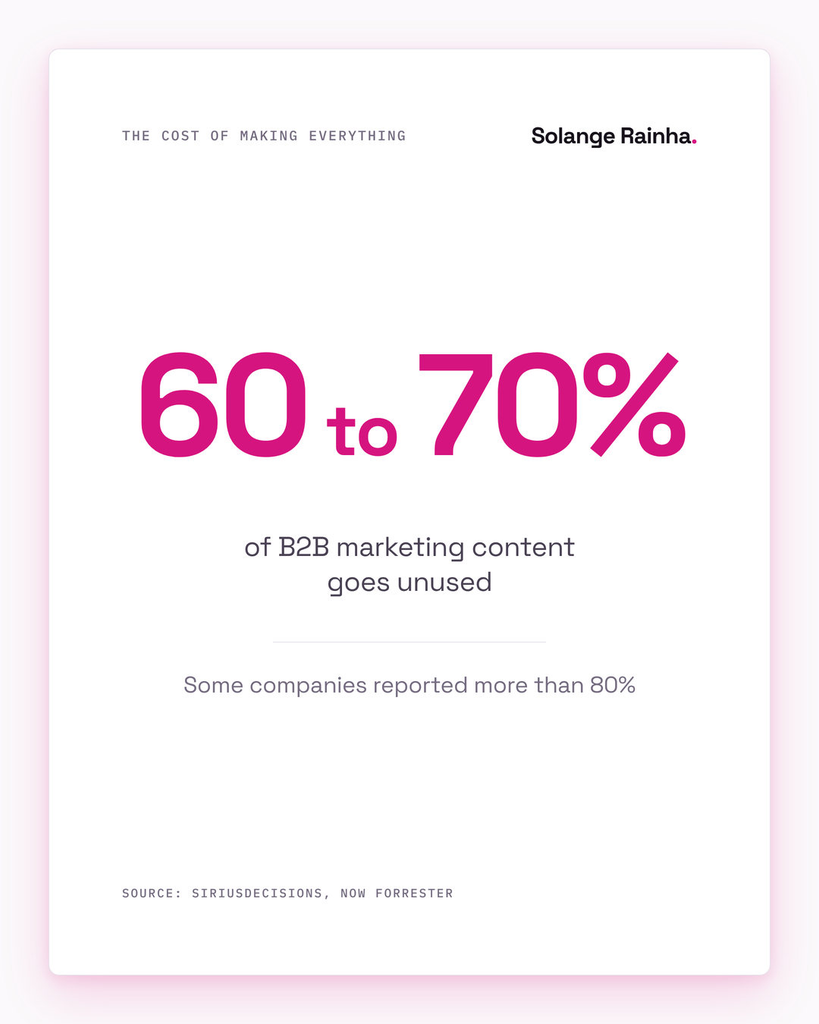
A content prioritisation framework is how you decide what not to write, and it’s the most useful skill I’ve built as the only content person on a small marketing team. The case for it starts with an ugly stat: SiriusDecisions, now part of Forrester, estimated that 60 to 70% of the content B2B marketing organisations produce goes unused, sitting on sales portals and website shelves, and some companies told them more than 80% of theirs did, so those teams were never short of content; they made far too much of the wrong kind.
When there’s nobody to absorb wasted effort, that statistic turns into a survival problem. Every hour on a piece nobody needs is an hour not spent on something that moves pipeline, and most content teams are short-handed too: lack of resources was the most cited challenge for B2B content marketers in the Content Marketing Institute’s 2025 research, at 54%. So I score every idea before it gets near the calendar, and I’ve written the method up as a standalone content prioritisation framework. This article is the longer story behind it: the matrix, how I say no to people who outrank me, what I’ve killed, and how the backlog works.
What is a content prioritisation framework?
A content prioritisation framework is a repeatable system for scoring content ideas so you decide, consistently and without ego, which ones you make and which ones you kill. It stops you defaulting to whoever pushed hardest or outranks you, or whatever landed in your inbox most recently. Without one, the content calendar becomes a record of other people’s impulses instead of a plan tied to business outcomes.
Product teams worked this out years ago: when Intercom’s Sean McBride introduced the RICE scoring model (reach, impact, confidence and effort, with effort dividing the total), he answered the “isn’t this too much process?” objection in one line:
“But remember the alternative: a tangled mess of gut feeling.”
RICE is built for product roadmaps measured in person-months, though, and content needs a faster method. Here’s how the common options compare for a content calendar:
| Method | What it scores | Speed per idea | Where it breaks for content |
|---|---|---|---|
| Whoever pushes hardest wins | Nothing; whoever asks gets it | Instant | The calendar fills with other people’s impulses and most of it goes unused |
| Impact vs effort 2×2 | Two axes, plotted | Fast | Ignores timing, so a good idea for a deprioritised persona still gets made |
| RICE (Intercom) | Reach, impact, confidence, effort | Slow | Built for product work; reach and confidence are hard to estimate for a single piece |
| My three-axis matrix | Impact as a gate, then effort, then alignment, with opportunity cost behind all three | Minutes | Too loose for anyone who wants a ranked queue from a formula |
Mine runs on three quick questions applied to every idea before it touches the calendar, so I make the call in minutes instead of building a scoring ritual that takes longer than writing the piece would have.
How does the three-axis matrix score impact, effort and alignment?
Each idea gets a high, medium or low on three axes, asked in order, because a no on the first one ends the conversation. I keep it directional on purpose; the value is in naming why I’m hesitating, and decimals would only fake precision.
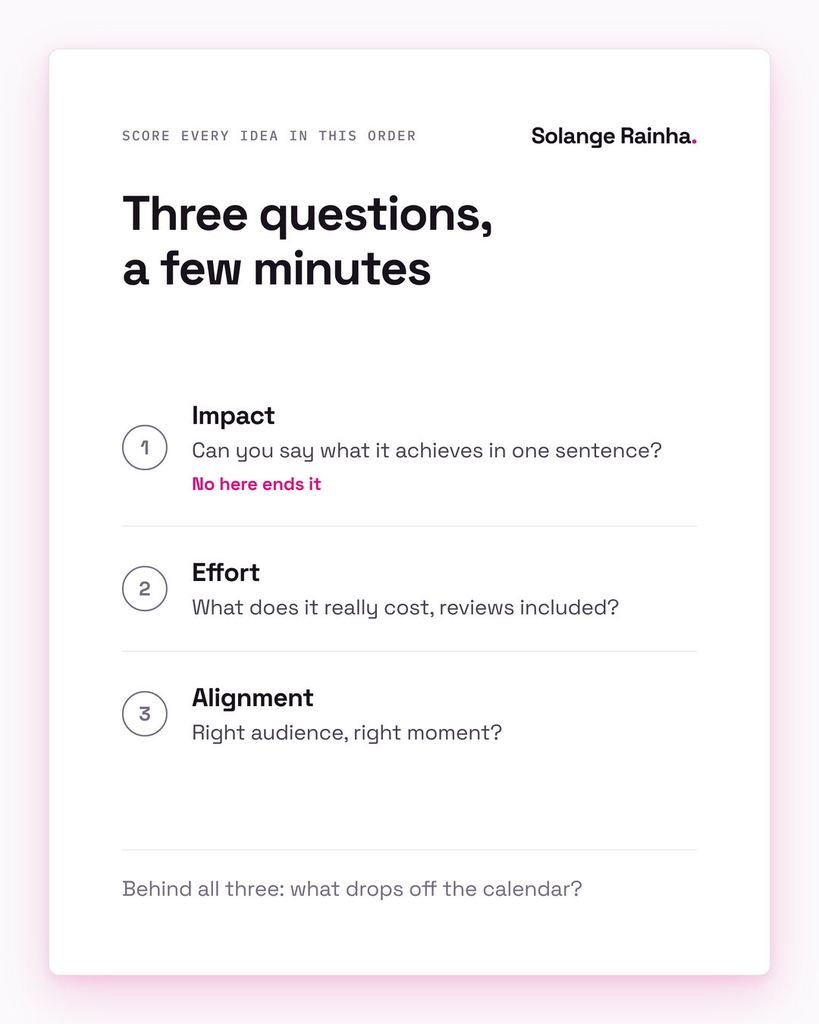
- Impact: will this do something? It’s the business-outcome question: will the piece generate pipeline, support a deal already moving, rank for a query buyers search, or build authority on a topic our positioning depends on? A piece mapped to a buyer question at a defined funnel stage scores high, and one that exists because “we should probably have something on this” scores low. If I can’t say what it’s supposed to achieve in one sentence, that’s my answer.
- Effort, or what this will cost. Writing time is the smallest part of it: research, stakeholder interviews, design dependencies, review cycles and the SME who takes three weeks to answer one question all count. A 2,000-word technical piece needing four interviews and two rounds of engineering review is a different bet from a sharp opinion piece I can draft in an afternoon. High effort raises the bar on impact without disqualifying the idea.
- Then alignment, which kills good ideas. A piece can be high-impact and low-effort and still be wrong if it pulls against current positioning or speaks to a persona we’ve deprioritised. When a B2B SaaS company I worked at pivoted its ICP mid-quarter, a stack of perfectly good ideas failed the alignment test overnight, because they spoke to the audience we were moving away from. Good idea, wrong moment, killed.
High impact, low-to-medium effort and strong alignment earns an immediate yes, and the reverse earns an immediate no. Most ideas land in the messy middle, which is where judgement comes in, and the axes force me to put a reason on the hesitation instead of vibing my way to a decision. Behind all three sits opportunity cost: nothing gets made in a vacuum, so for any maybe, the deciding question is what drops off the calendar to make room.
How do you say no to a pet project without torching the relationship?
Let the framework carry the no, and turn it into a trade-off the requester gets to make. Most frameworks skip this part, and it’s the one that counts when you report to people who outrank you, because the matrix tells you what to kill and says nothing about how to kill it without making an enemy.
Pet projects are their own category: the CEO wants a thought leadership piece on a topic they’re personally obsessed with, sales wants a one-pager for a single prospect, or someone read an article over the weekend and now we “need a point of view on this”. These requests almost always fail the impact test, and they almost always come from someone you can’t ignore. Plenty of people just swallow them: in Frances Milliken and colleagues’ study of employee silence, 85% of the employees interviewed said they’d felt unable to raise an issue with a supervisor, most often for fear of being seen negatively.
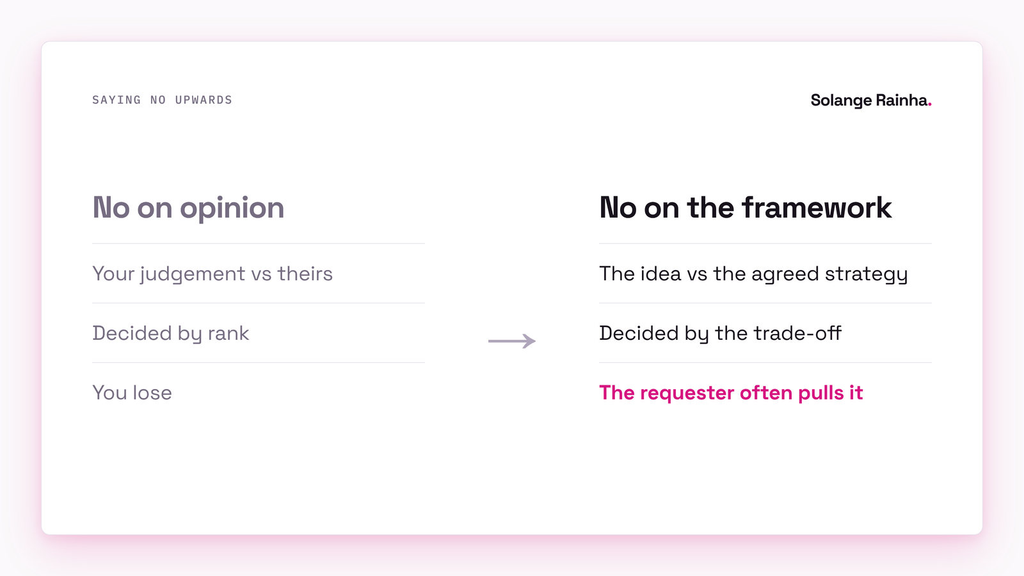
Say no on personal opinion and you’ve started an argument between your judgement and theirs, which you lose on rank, but put the no on a scoring system tied to outcomes you both already agreed on, and the idea is up against the strategy, with you out of the firing line. The script I use goes like this:
“I’ve scored this against what we’re trying to hit this quarter, and here’s where it lands. If we make it, here’s what drops off the calendar to make room. Which one moves the needle more?”
That reframe takes the person’s idea seriously and forces a trade-off conversation instead of a yes-or-no fight. Half the time they pull the request themselves once I spell out the opportunity cost, and the rest of the time they argue the impact is higher than I scored it, which it sometimes is, so I update. Either way, strategy makes the decision instead of whoever shouted most.
What’s the difference between a strategic no and a lazy no?
A strategic no explains itself and offers a path, while a lazy no is a reflex, and the difference decides whether people keep trusting you with ideas.
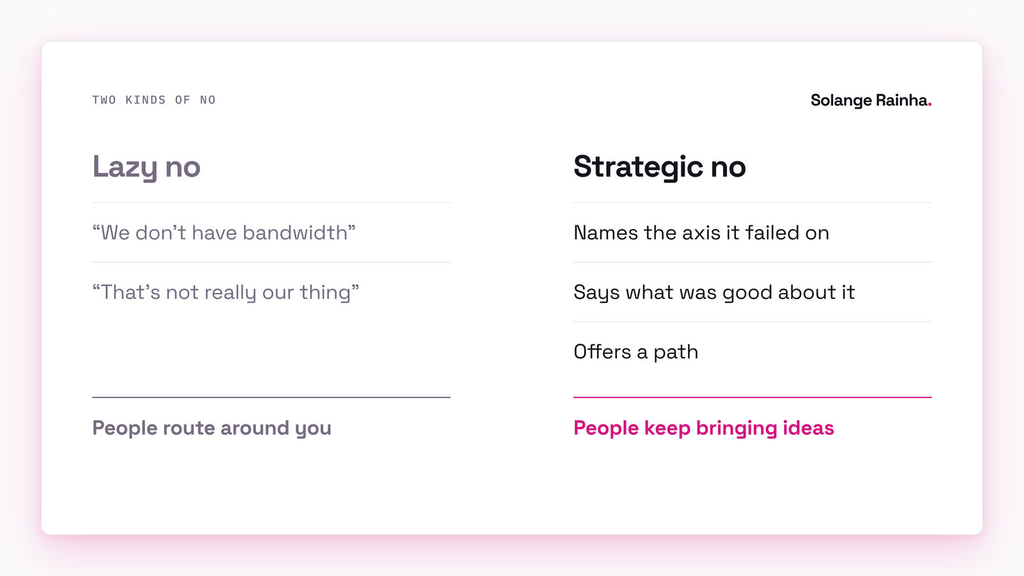
A lazy no is “we don’t have bandwidth” or “that’s not really our thing” with nothing behind it. It explains nothing, and it teaches people you’re a bottleneck to route around. The fastest way to lose your seat at the strategy table is to become the person who says no to everything without ever showing the reasoning.
A strategic no names the axis the idea failed on, acknowledges what was good about it, and usually offers a way forward. Something like: this scores low on impact because it targets a persona we’ve deprioritised, but the insight underneath is strong, so let’s hold it and revisit if that persona comes back. Or: this is high impact but the effort is huge right now, so let’s do a smaller version first and earn the investment in the full piece.
People accept a no they understand, and they keep bringing you ideas because they trust the process. It’s the same principle as owning the calls you make: saying no is part of owning the function, but only when the no is reasoned.
What content have I killed, and why?
Here’s the version with actual decisions in it, because abstract frameworks are easy to nod along to.
The exhaustive glossary nobody asked for. I scoped a huge terminology glossary for the industry, the kind of project that feels productive to build. It was high effort, weeks of work, and when I scored it the impact was low: the terms were well covered elsewhere, it mapped to no active buyer question, and it would have ranked for nothing. I killed it before I wrote a word, which saved me two weeks.
Then there was the executive’s passion piece. A senior stakeholder wanted a long opinion piece on a macro trend they found fascinating and nobody in our buying cycle cared about. Instead of the 2,000-word essay, I proposed a short social post to test whether the topic drew any interest at all. It got modest engagement, we learned the appetite wasn’t there, and we’d spent an hour finding out instead of a week. (Executive passion pieces are a whole genre, which I’ve taken apart in most thought leadership has no thought.)
The competitor-chasing content went the same way. A competitor ran a big content push on a theme, and the team’s instinct was to respond in kind. The alignment test killed it, because chasing their narrative meant playing on their turf and reinforcing their framing, so we spent the same hours on our own differentiator.
None of these died because the ideas were stupid: two of the three were good ideas that lost to better ones, which is the whole point of scoring ideas at all.
How do you build a content backlog that’s useful?
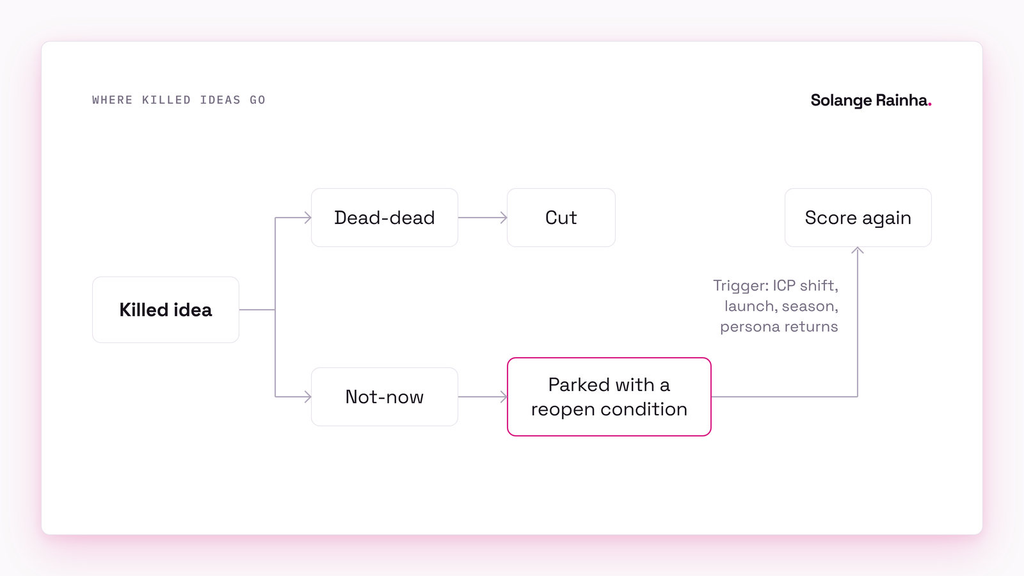
Curate it: sort every kill into dead-dead or not-now on the spot, cut the dead, and park the not-nows with a note on what would revive them. A killed idea doesn’t always stay dead, and this is where most systems fall apart, because people either lose every rejected idea or dump everything into a list nobody ever opens again.
Cutting the dead-dead ideas stops a backlog full of permanently bad ones from burying the good ones, and the reopen condition on each not-now (a strategy shift, a product launch, a seasonal moment, or a persona coming back into focus) is the difference between a backlog and a junk drawer. When the ICP shifts or a launch lands, I can pull up the parked ideas that now pass the alignment test and move fast, because the thinking is already done. It’s part of treating content as a system instead of a pile of one-off requests.
The backlog doubles as evidence, too: when someone asks why we’re not making more content, I can show a list of deliberately deprioritised ideas with the reasoning attached, which turns “why aren’t you producing more?” into “here’s everything I chose not to make so I could focus on what’s working”. That’s a much stronger place to argue from, and plenty of teams can’t make that case at all: a third of B2B marketers name measuring content effectiveness as one of their top challenges in CMI’s 2026 research. If you can’t show what’s working, you can’t justify what you killed, which is why the impact axis should point at the same metrics you report on.
Where does this content prioritisation framework break?
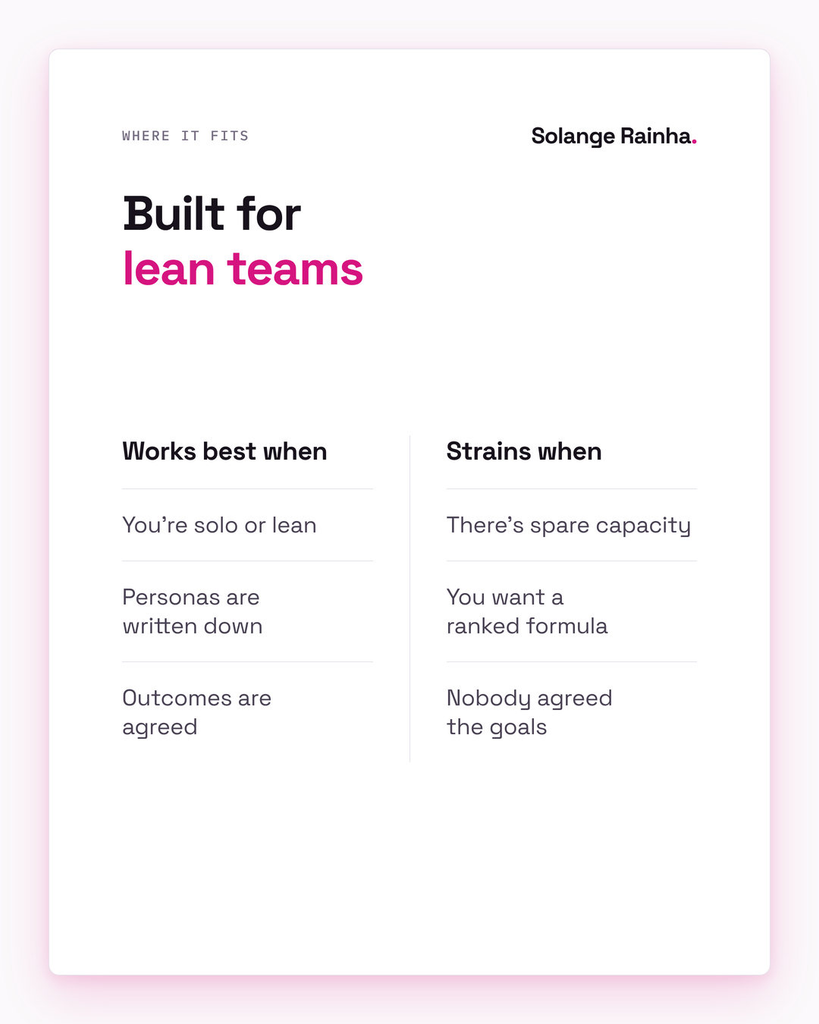
On bigger teams, and with anyone who wants a formula. It’s built for a solo or lean-team reality, where saying no is survival and there’s nobody to hand the overflow to. On a team with spare capacity the calculus shifts, and some of the ruthlessness can soften. The scoring is also deliberately directional, so it’ll feel too loose for anyone who wants a ranked queue spat out of a spreadsheet; that looseness is the feature, because the moment scoring takes longer than writing, you’ve rebuilt the bureaucracy it was meant to kill.
It also assumes you know your personas well enough to judge alignment in seconds. When I was planning for five buyer personas at once, the alignment call only stayed fast because each persona’s priorities were written down. And the method sits inside a wider set of rules about what I refuse to do as a team of one, which is in my solo content marketing workflow.
Frequently asked questions
A content prioritisation framework is a repeatable system for scoring content ideas against impact, effort, and strategic alignment so you can decide what to make and what to kill. Solo marketers need one more than anyone because they have no team to absorb wasted effort, and with 60 to 70% of B2B content typically going unused, every misallocated hour is an hour stolen from work that drives pipeline. The framework also makes your decisions defensible, so when someone questions why their idea didn’t make the calendar, you have a transparent rationale rather than a gut feeling.
The key to saying no to senior stakeholders is to let the prioritisation framework carry the decision instead of pitting your judgment against theirs. Score the request against business outcomes, show where it lands, and frame it as a trade-off: if we make this, here’s what drops off the calendar, so which one drives more impact? This shifts the conversation from a personal yes/no fight you’ll lose on rank to a strategic discussion about opportunity cost, and stakeholders often withdraw the request themselves once the cost is visible.
A strategic no names the specific axis an idea failed on, acknowledges what was good about it, and usually offers an alternative path, while a lazy no is a reflexive “no bandwidth” with no reasoning behind it. The distinction matters because a strategic no preserves your credibility and keeps people bringing you ideas, whereas a lazy no teaches people you’re a bottleneck to route around. A good content prioritisation framework forces every no to be the strategic kind by making you articulate the reason the idea didn’t clear the bar.