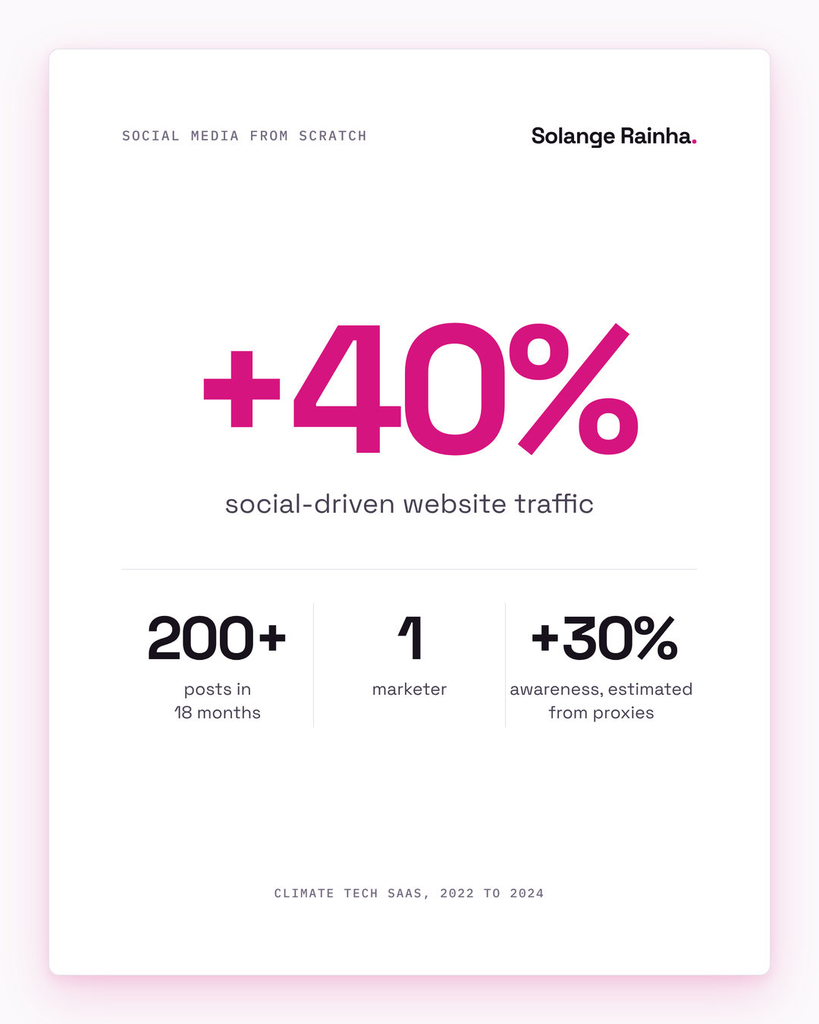
Building social media from scratch means inventing the voice, the visual identity, the pillars, the posting rhythm and the audience at the same time, with no archive to draw on and no baseline to beat. I did it solo for 18 months at a climate tech SaaS company: 200+ posts across LinkedIn, Instagram and Facebook, social-driven website traffic up 40%, and brand awareness up an estimated 30%, read from proxies because there was no budget for a survey. The decisions that counted most came first and compounded: platforms chosen by exclusion, pillars before formats, a written voice, and a cadence set by the hours you have. The data then undid most of my starting post mix.
Building social media from scratch is a different job from running an existing channel, because every early decision depends on data you won’t have for months. People hear “starting from zero” and picture the empty calendar, but the calendar was the least of it. What made the first six months miserable was picking a voice, a platform mix and a cadence on judgement alone, publishing on those choices for a quarter, and then correcting myself in front of everyone. I did this as the only marketer at a climate tech SaaS company, on top of the rest of the content function, and it produced 200+ posts over 18 months and a 40% lift in social-driven website traffic.
Reviving a dead channel is a different job again, because it hands you an archive to audit, historical data to read, an audience whose preferences you can look up, and a benchmark to beat. I did that later at a B2B eMobility company and wrote it up in the social turnaround that lifted reach 217%.
What are the first decisions when you’re building social media from scratch?
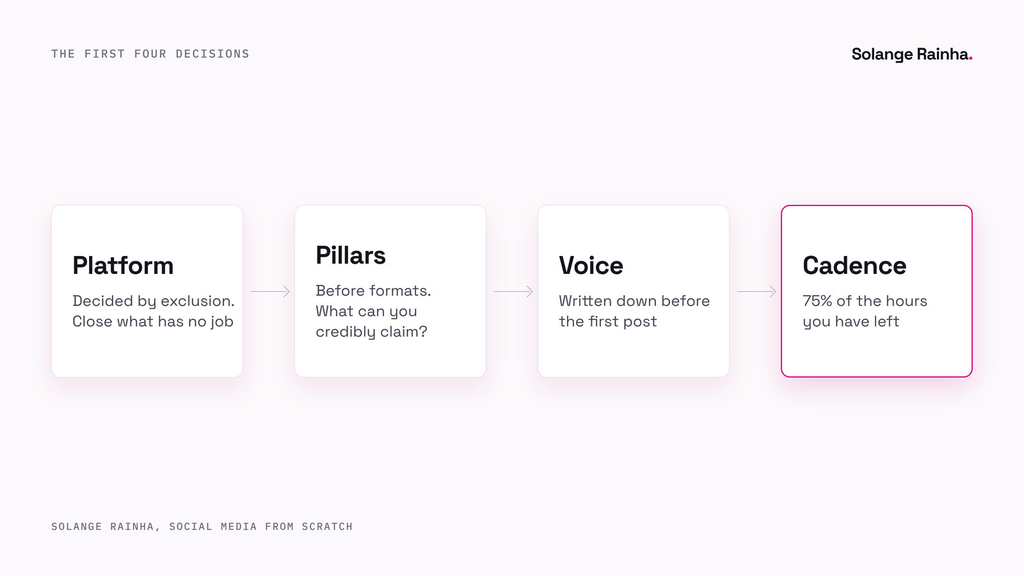
The first decisions are platform, pillars, voice and cadence, and they compound, so the order counts for more than getting any one of them perfect. Salesforce’s social team sequences it the same way: before you post anything, define “why you’re doing it, where you’re doing it” and “who you’re doing it for”. Obvious on paper, less obvious when you’re the only one running it and the pressure is to have posted something this week.
- Platform, decided by exclusion. The company sold energy management software to businesses and consumers across Portugal, Europe and Brazil, which is exactly the kind of spread that tempts you onto five platforms at once. Standard advice says one to three platforms, and when you’re solo the ceiling sits lower than that. LinkedIn ran as the B2B channel, Instagram and Facebook took the consumer and community side, and everything else stayed shut. If you can’t say what a channel is for, close it.
- Next come pillars, before formats, which sounds like the sort of thing you put in a strategy deck and ignore. Decide you’re making videos before you’ve decided what you’re the authority on, and you end up with a channel and no argument. The pillars came out of what the company could credibly claim, crossed with what buyers were visibly confused about, which in climate tech is most of it: how energy communities work, what the regulation meant in practice, and what the product did that a spreadsheet couldn’t.
- Voice, written down on day one. With no archive, the voice becomes whatever the first thirty posts happened to be, and by then everything else has been built on top of it, so I wrote the rules before publishing anything, the same discipline as building brand consistency from scratch and writing editorial standards from zero.
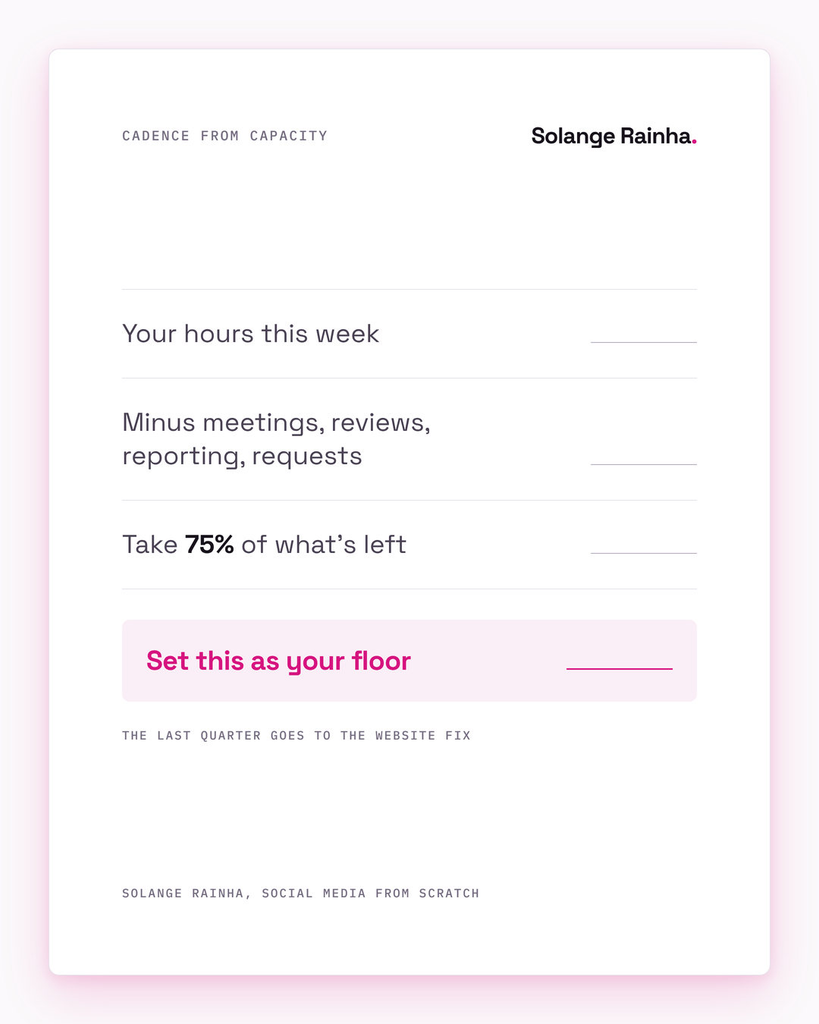
- The last is cadence from capacity, and this is where solo social dies. Count your available hours, subtract meetings, reviews, reporting and requests, then take 75% of what’s left, because the last quarter always goes to the website fix and the urgent sales request, and the cadence that works is the one you can hold for a year. Every team I’ve watched launch at seven to ten posts a week burned out the person running it inside a quarter and ended up at zero, which is why even the US Chamber of Commerce’s guide tells small teams to “prioritize quality over quantity”.
How do you build a visual identity alongside the posts?
You build the visual identity and the posts as one job, because a company with no social presence usually doesn’t have a finished brand system sitting there waiting for you either. I made the creative myself in Photoshop and Illustrator, working off decisions that were being made about the wider brand at the same time, so the two firmed up together.
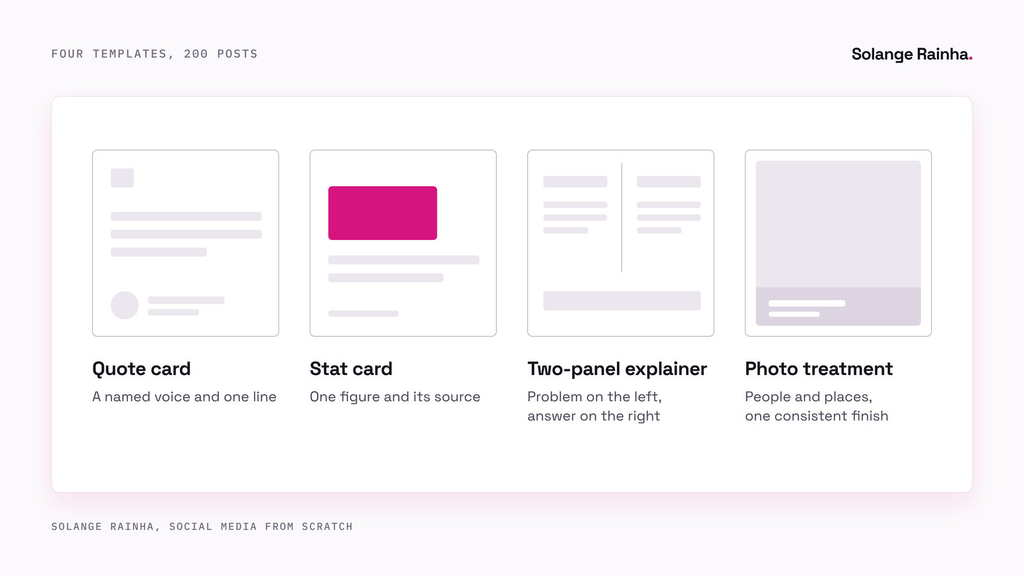
In practice that meant four templates: a quote card, a stat card, a two-panel explainer and a photo treatment, each taking about twenty minutes to fill once it existed. Apply a decent template 200 times and people start recognising you.
What did 200+ posts consist of, and how did the mix change?
The 200+ posts started from a guessed mix, and almost none of it survived 18 months of data.
| What I started with | Where it ended up | Why |
|---|---|---|
| Heavy product and feature content | Cut back sharply | Lowest engagement of anything I published, and it teaches people to scroll past the page. |
| Company news and announcements | Kept, reduced | Nobody outside the company cares as much as the company does. |
| Educational explainers on energy and regulation | Expanded into the backbone | The clearest gap: buyers were confused and nobody was explaining it. |
| Occasional people and culture posts | Increased | Kept outperforming what I expected, and colleagues shared them, which no branded post ever managed. |
| Almost no commentary on live industry questions | Added | Riskier, most shared, brought most of the new followers. |
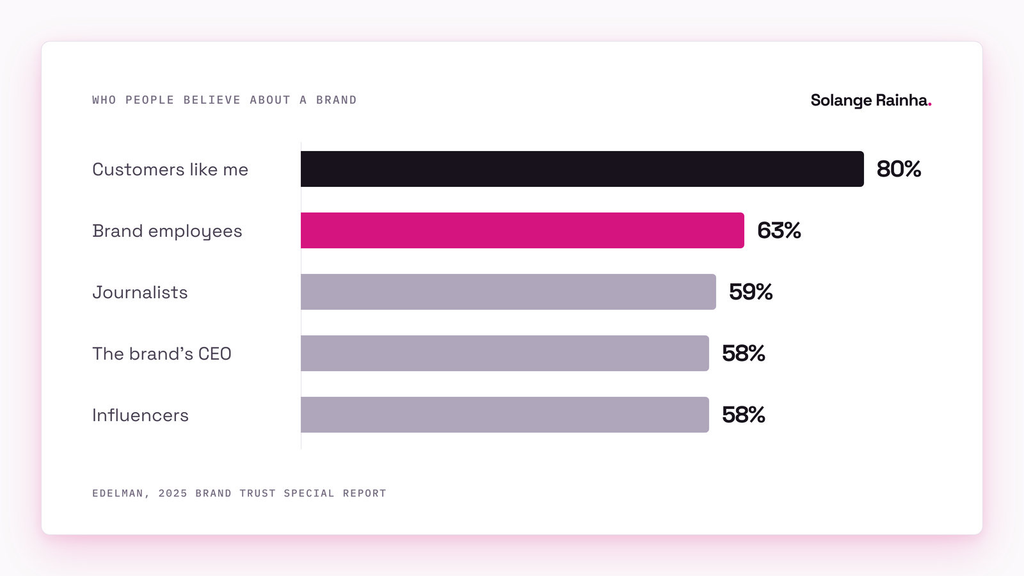
The employee-sharing effect is the one I underestimated most, and I kept underestimating it long after the data said otherwise. Reshares from colleagues travelled much further than anything the company page put out, and the trust data points the same way: Edelman’s 2025 special report on brand trust found 63% of people trust a brand’s employees for accurate information about it, ahead of its CEO, journalists and influencers at 58% to 59%. Asking people to post identical copy fails, because they hate doing it and their networks can smell it, so what worked was writing three or four suggested angles per piece so each person could pick the one that sounded like them.
Across the same 18 months I was also producing the rest of the content function, 60+ pieces including articles, case studies and press releases, which I’ve broken down in running a solo digital marketing function, and that’s why the cadence had to survive all of it.
How do you measure brand awareness for a company nobody has heard of?
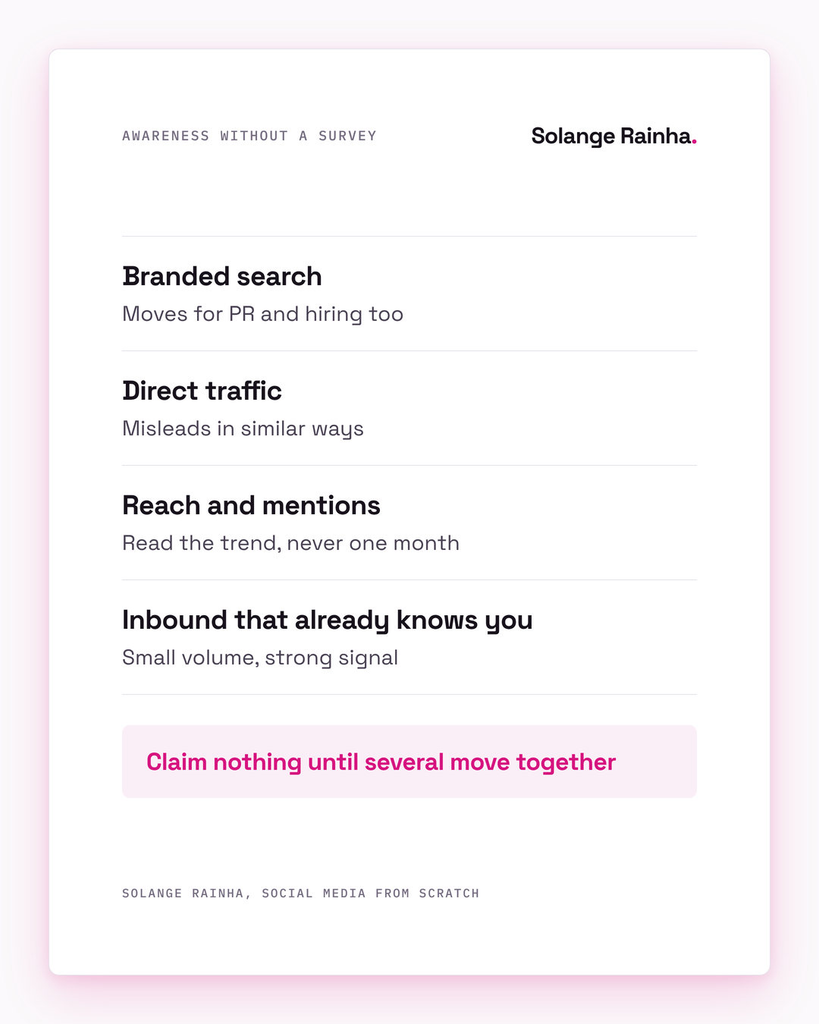
You measure it through several proxies that have to move together, and you say how you did it, because “brand awareness up 30%” sounds far more precise than any awareness figure has a right to. There was no budget for a brand tracking survey, which is the only instrument that reads awareness directly, so I worked from these:
- Branded search volume, meaning people typing the company name instead of the category.
- Direct traffic, which behaves similarly and misleads in similar ways.
- Reach and mentions across the three channels, read as a trend and never month to month.
- Inbound enquiries that turned up already knowing what the company did.
None of those is awareness on its own, but together, pointing the same way over 18 months, they support a directional claim and nothing tighter, which is the same triangulation I use for AI visibility in measuring AI visibility without analytics. Sprout Social’s Kiran Shahid puts the reporting side bluntly: “Vanity metrics don’t get you budget”, so the metric has to connect to a result the business already tracks. CMI’s Robert Rose made the same point in the 2026 B2B research: “If you can’t measure, you can’t prove value.” Say what you can’t prove, too, which I’ve argued at more length in the content metrics worth keeping.
How did social drive 40% more website traffic?
Social drove 40% more website traffic because I decided, post by post, whether the click was the point. Posts built to send people somewhere carried a complete thought plus one specific reason to go deeper, never a teaser and a link. The reach posts worked the other way around, with the whole insight sitting in the post and no ask attached, because a feed that only points elsewhere trains people to scroll past it. The split ran roughly weekly, adjusted by whatever was going on that week.
The pages I was sending people to were ones I’d already rebuilt, with bounce rate down 18% and session duration up 25% after I restructured the site’s product messaging and user flow, and that’s what made the arriving traffic worth having.
What kept 18 months of solo social from burning out?
What kept it going was boring on purpose. I batched by mode and not by project, so research sat in one block, writing in another and design in a third; a fixed template set meant nothing started from a blank canvas; the cadence was a floor I could always hit, never a target I’d hit two thirds of the time; and I held about a month of buffer content for the weeks when something else caught fire, which in a solo function is most weeks. There’s more on the systems side in my solo content marketing workflow, and on which parts of it I’d now hand to AI in delegating to AI as a solo marketer.
What would I do differently?
I’d start commenting on other people’s posts from week one, and I’d open with far less product content. The commenting one still annoys me: I treated it as a nice-to-have for far too long, which is months of the cheapest reach available to me, sitting there, costing fifteen minutes a day that I spent instead on another post nobody had asked for.
The product content is the mistake I’d forgive myself for: it cost me most of the first quarter’s engagement, but you can’t know that before you’ve published enough to see it. The guessing period happens whatever you do, and what you control is how cheap the guesses are and how fast you notice.
Frequently asked questions
Building social media from scratch removes four inputs a normal social role assumes: an archive to audit, historical performance data, an audience with known preferences, and a baseline to measure against. Every early call on platform, voice, pillars and cadence gets made on judgement, then corrected publicly once data arrives. Managing an existing presence is optimisation work with a benchmark attached, while a zero start is a run of cheap bets you’re planning to be wrong about.
A solo marketer should start with two or three platforms at most, fewer if the audiences differ sharply, since each channel carries its own register, format and cadence and can’t just take the same posts reposted. Choose by exclusion: name what each channel is for and who it serves, and close anything you can’t answer for. Your ceiling comes from carefully counted available hours, minus meetings, reviews and reporting, and one channel run properly returns more than four kept on life support.
Without a brand tracking study, measure awareness through proxies read together and never alone: branded search volume, direct traffic, reach and mentions as a trend, and inbound enquiries that arrive already understanding what the company does. Each of those moves for reasons unrelated to social, so require several pointing the same way before making a claim, and report the result as directional. Stating that method in the report is what lets the figure survive the first sceptical question.