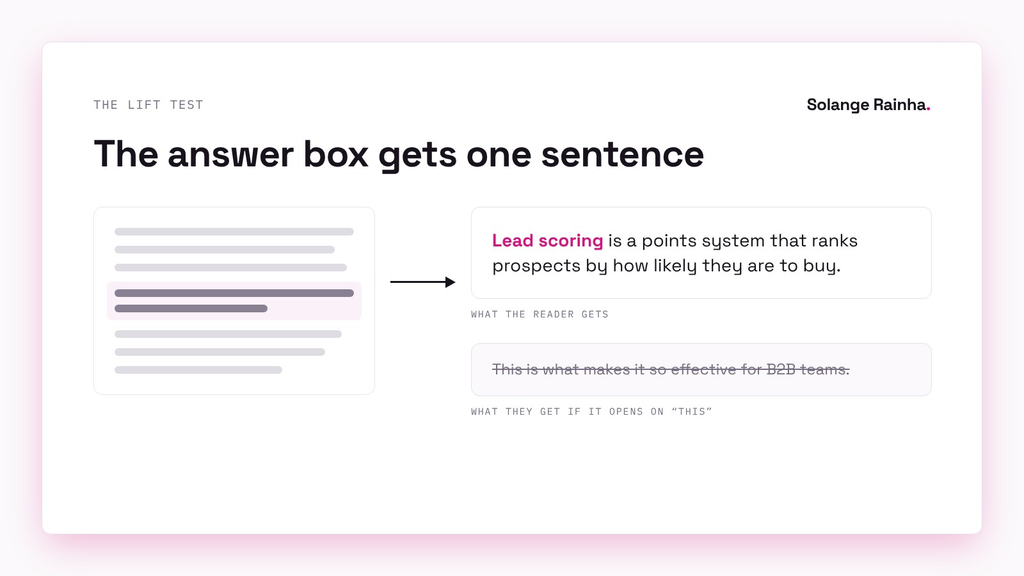
How to write definitions people can quote out of context: open with the term as the subject, cut every pronoun that points backwards, drop anything that assumes the reader has your page, keep it to one or two sentences that don’t reuse the term’s own words, and put the qualifier last. Then read the sentence with nothing around it, the way an answer box shows it.
Of everything on a B2B page, people lift the definition most, at least in my experience. It ends up in featured snippets and ChatGPT answers (or in Slack, when a buyer pastes it in to settle an argument), and the reader sees it without the rest of the page. Most B2B definitions don’t make sense on their own because they depend on their paragraph. Knowing how to write definitions that stand alone is a sentence-level skill, and I rarely find it in anyone’s editorial guidelines.
Why do answer engines quote definitions so often?
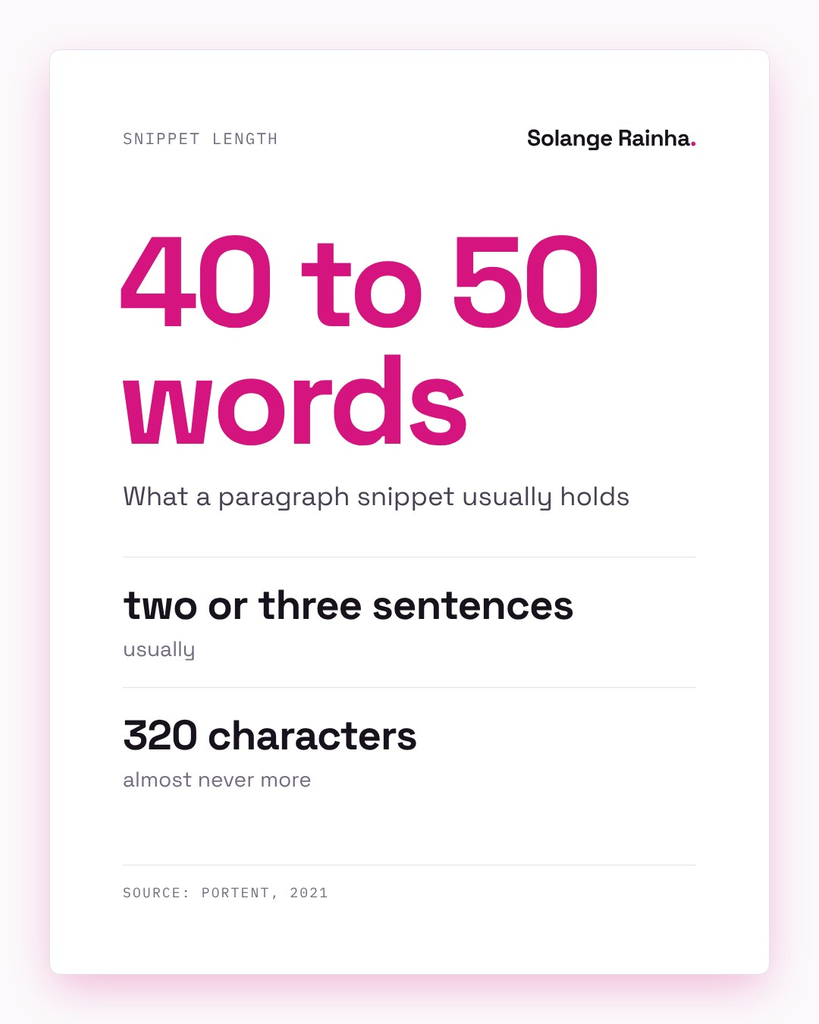
Kevin Indig analysed ChatGPT citations, and Search Engine Land reported that the passages it picked were nearly twice as likely to use clear definitional phrasing such as “X is”, and 24.5% of them came from a paragraph’s first sentence. Google shows a featured snippet when a short piece of a page answers the query, and Portent’s study of 7,854 of them found the paragraph type usually holds 40 to 50 words (two or three sentences) and almost never goes past 320 characters.
That leaves room for a definition plus one line of scope, and the first part has to work without the second. I covered how a page should open in writing strong openings and how to define terms at first use in optimising content for ChatGPT, and this piece looks only at the definition sentence itself.
How to write definitions that stand alone
Cut every pronoun that points backwards. “It” and “this” (or “that approach”) only make sense next to the paragraph above, and once someone lifts the sentence out, they mean nothing, so name the term again even if it feels clunky.
Drop the context the reader doesn’t have. “Here”, “above”, “our platform” and “in this case” all assume someone can see the rest of your page. Acronyms count too, so spell them out inside the definition (“An ideal customer profile (ICP) is…”) even if you already did two sections earlier.
Then keep it to one or two sentences, where the first carries the definition alone and the second adds scope or a caveat. Needing a third usually means you’re defining two terms at once or explaining the term instead of saying what it is.
None of this is controversial: of the 15 guides on writing definitions I read before finishing this one (the bulk of them cover AI search), nearly all put the term first and most set a word limit. At least four of them also tell you to cut pronouns that point backwards.
How do you define a term without repeating it?
A circular definition uses the term to explain itself (“content decay is when content decays”), which tells the one reader who needed it nothing. My rule is that the term appears once, as the subject, and none of its words come back after “is”. Wikipedia’s guideline on lead sections warns against first sentences that just repeat the title, and it bans the “refers to” opening for a reason I agree with:
“the article is about the subject, not a term for the subject”
Several AEO guides recommend “refers to” (GenRank lists it among its templates), and Indig counts it as definitional, so it won’t stop extraction. The one guide I found that bans it, from Avakata, doesn’t say why. My reason is Wikipedia’s: it defines the label instead of the idea. What works is older than SEO: give the category first and then what separates the term from the rest of it, as in “A zero-click search is a query (category) that ends on the results page because the answer was already shown there (difference).”
Where does the qualifier go in a definition?
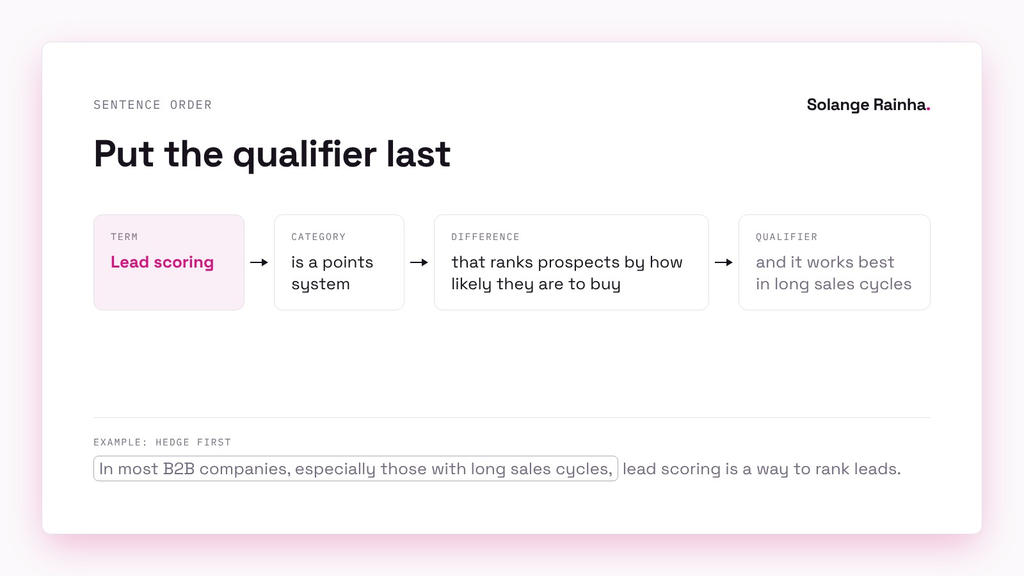
The qualifier goes after the definition: a sentence like “In most B2B companies, especially those with long sales cycles, lead scoring is a way to rank leads” makes the reader get through 10 words of hedging before the term, and a paraphrase can keep that opening and drop the definition. The fix looks like this: “Lead scoring is a points system that ranks prospects by how likely they are to buy, and it works best in long sales cycles.”
Wikipedia opens some definitions with the field (“In cryptography, a trusted third party is…”), and that’s fine, because naming the subject area in two words makes the meaning clear without weakening anything. Several of the 15 guides I read already move nuance into a later sentence, though none separate scope from hedging, and Stackmatix’s contextual pattern opens with a context phrase, which is where writers usually soften a definition.
How do you test a definition before it goes live?
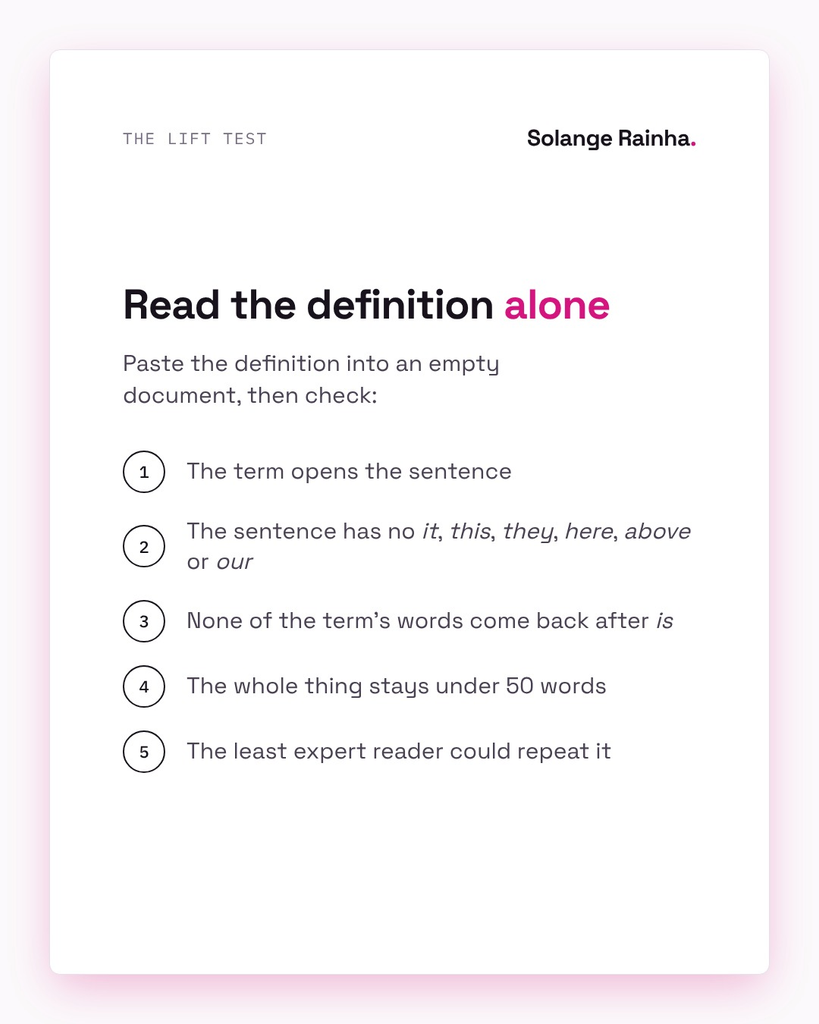
I call this check the lift test (Oli Guei at GenRank uses the name extraction test), and it means pasting the sentence into an empty document and reading it as someone who’s never seen your site:
- Does it open with the term it defines?
- Is there any “it”, “this”, “they”, “here”, “above” or “our” left in?
- Do any of the term’s words reappear after “is”?
- Does it fit in 50 words?
- Could the person on the buying committee who knows least about the topic, often the CFO, repeat it back to you?
For a second opinion, ask a model with no context which term the sentence defines. Standalone definitions are the first structure check in my AEO/LLMO content optimisation framework, and a definition that fails the lift test makes every later fix in that section pointless.
How do you define a term nobody agrees on?
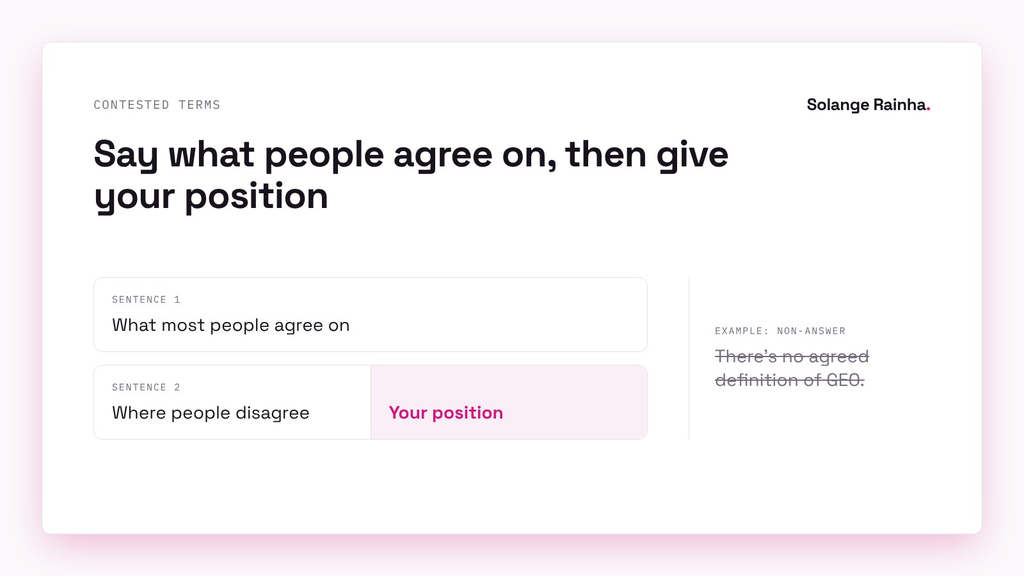
Use sentence one for what most people agree on and sentence two for the disagreement and your own position. Writing only “There’s no agreed definition of X” gives answer engines a non-answer to quote, and faking consensus loses the reader who knows the debate. None of the 15 guides gave a method for this; the closest, from LSEO, warns against both overclaiming and over-hedging and stops there.
Even a long-argued term can get a standalone line: the Content Marketing Institute’s definition of content marketing needs nothing around it in its 32 words, and it starts by calling the practice:
“a strategic marketing approach focused on creating and distributing valuable, relevant”
Search terms are messier, though: Wikipedia’s article on generative engine optimisation notes that people use GEO interchangeably with AEO and LLMO, and that academics hadn’t agreed on what separates them as of early 2026. I split AEO and LLMO in my SEO vs AEO vs LLMO piece, so my own definition takes a position:
Generative engine optimisation (GEO) is the work of getting content cited in answers written by AI systems such as ChatGPT, Perplexity and Google’s AI Overviews. Practitioners don’t agree where GEO ends and AEO begins; many use the two as synonyms, and I split the search-results work (AEO) from the work inside model conversations (LLMO).
Eight more before-and-after rewrites
| # | Before | After | What broke |
|---|---|---|---|
| 1 | “This is the company that gets the most from what we sell.” | “An ideal customer profile (ICP) is a description of the company most likely to buy and stay, built from deal data.” | The pronoun points backwards, and “we” means nothing off the page. |
| 2 | “Content decay is when your content decays over time.” | “Content decay is the slow loss of traffic on a page that used to perform, usually to fresher competitor pages.” | It’s circular. |
| 3 | “As mentioned above, they’re the people who sign off.” | “A buying committee is the group of people inside a company who each have to approve a purchase.” | It opens on “as mentioned above” and a pronoun. |
| 4 | “SOC 2 is basically the security checkbox enterprise buyers care about.” | “SOC 2 is an AICPA audit standard that checks how a vendor protects customer data.” | The category is too broad. |
| 5 | “Dark social is a fascinating, often misunderstood idea.” | “Dark social is content sharing that analytics can’t trace, such as links sent by private message or email.” | It never says what dark social is. |
| 6 | “Pipeline velocity is a metric. It measures speed. It uses four inputs.” | “Pipeline velocity is the revenue a sales team closes per day on average, worked out from deal count, deal size, win rate and cycle length.” | The definition breaks into fragments. |
| 7 | “Attribution, covered above, is how you give credit.” | “Marketing attribution is the method a company uses to credit a sale to the channels a buyer saw before buying.” | It assumes context, and the verb is vague. |
| 8 | “There’s no agreed definition of GEO.” | “Generative engine optimisation (GEO) is the work of getting content cited in AI-written answers; where it ends and AEO begins is still argued.” | The sentence gives a non-answer. |
What would I do differently, and how far does the evidence go?
No study I’ve found isolates definition quality as a cause of citation. Indig’s data shows what the passages ChatGPT picked have in common, which is correlation, so I won’t call the lift test a ranking factor.
My own results have the same limit: after I updated a whole blog library for AEO/LLMO at my current job, search CTR rose 54% on the Q3 average, but that refresh rewrote plenty besides definitions, so they don’t get the credit. My citation tracking there started from a baseline where AI tools cited us in 37% of answers to 20 buyer prompts, and that’s where I’ll see whether sentence-level work changes anything.
What I’d change is the timing, because how to write definitions belongs in the guidelines before anyone drafts. I’d put the lift test into the editorial standards from the start and log every definition we approve in a claims register so a term reads the same on every page.
Frequently asked questions
A definition works out of context when it opens with the term it defines and points at nothing else on the page, all in one or two sentences that don’t reuse the term’s own words. Anyone learning how to write definitions can check it with the lift test: paste the sentence into an empty document and read it as a stranger would.
For featured snippets and AI answers, a definition should fit in about 50 words, with one optional extra line for scope. Portent’s data puts paragraph snippets at 40 to 50 words, and Kevin Indig’s analysis showed 24.5% of ChatGPT citations came from the opening line.
A contested term gets two sentences: the first covers the meaning most people share, and the second names the split and states your own position.