Being laid off multiple times through no fault of your own leaves a particular mark. Three times in four years I did some of my best work and lost the job anyway: 18 months at Cleanwatts, 8 at EVA Global and 15 at Full Fabric, ended by a restructure, a bankruptcy and a mass layoff. Each one was about the company’s money and never about my performance or my choice. This is what that does to a person and to a CV, and what I hold on to. There’s no neat lesson at the end, because I haven’t found one.
I’ve been laid off multiple times, and none of it was my call. Three jobs in four years ended because the companies ran out of room for the plan they’d hired me into: Cleanwatts restructured after 18 months, EVA Global went bankrupt eight months in, and Full Fabric let a big chunk of the company go after I’d been there 15.
Every time, the results were climbing when it ended, and I’d still take every one of those jobs again, which is part of what makes this hard to write about.
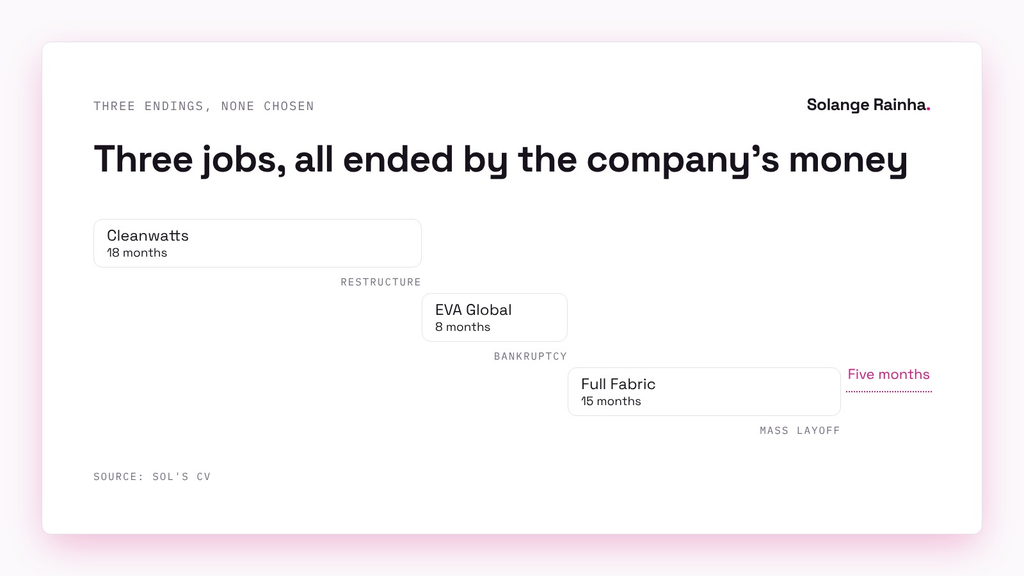
What happened at each one?
At Cleanwatts I was the whole digital marketing function for a climate tech company working across Portugal, Europe and Brazil. I built social and email from nothing, rebuilt the website’s messaging, and wrote my way through 60-odd pieces in 18 months. Qualified leads were up 15% and organic traffic up 22% when the company restructured and my role went with it.
EVA Global was eMobility, eight segments across 39 countries, and two product launches I ran end to end. Launch content drove 35% of the site’s traffic during the campaign windows, which I wrote up in the launch content piece, and eight months in, the company went bankrupt.
Full Fabric was, in a way, the hardest. I built content for five buyer personas, rebuilt the whole strategy when the company pivoted to IT buyers, and the content operation contributed to 48% marketing-sourced pipeline in peak months. Then a mass layoff took my role at the 15-month mark.
What do you lose when the job ends before the work pays off?
The plans go first. Every one of those roles had a next quarter mapped out, and the next quarter was always the one where the groundwork turned into results you could put on a slide. I’ve left behind content calendars half filled, programmes that were finally finding their rhythm, and systems I’d documented carefully for whoever came after me, and nobody did.
Then you lose the people: you spend a year and a bit learning how someone thinks, what makes a product lead laugh and who’ll actually answer at 6pm, and then it’s a goodbye message and a login that stops working.
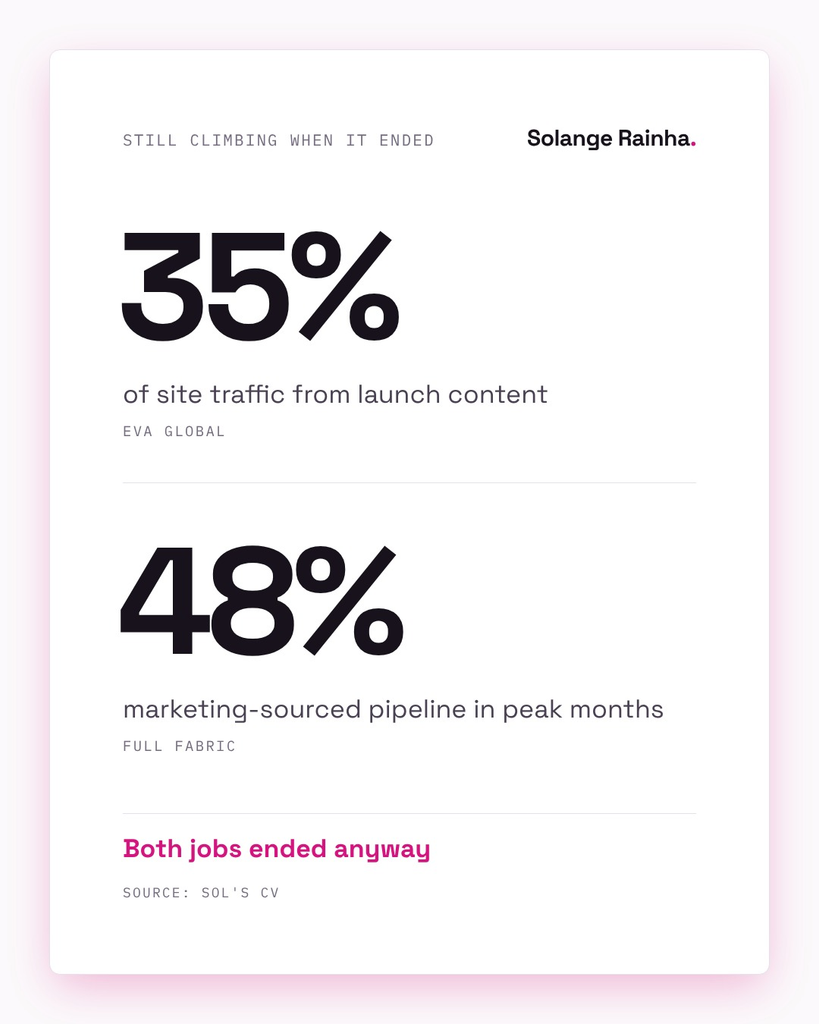
The worst part is leaving at your best. People who get laid off from a job that wasn’t working get some relief mixed in with the panic, and I didn’t get that. At EVA and at Full Fabric the results were going up when it stopped, so the grief came with a “but it was working” attached, and you never get to see what it would’ve become.
What does it cost to start over every time?
Every new start means a new product to learn from scratch, new buyers to understand, new people to win over, and the same quiet pressure to prove yourself from zero, because nobody at the new place saw the last result. Your track record shrinks to a line on a CV, so whatever you ship in the first 90 days is all the credibility you’ve got.
And sometimes there’s a gap: after Full Fabric it was five months before I started again, five months of applications, interviews and explaining. I’ve written about why I list my career break on my CV; a gap you didn’t choose is a different version of the same problem.
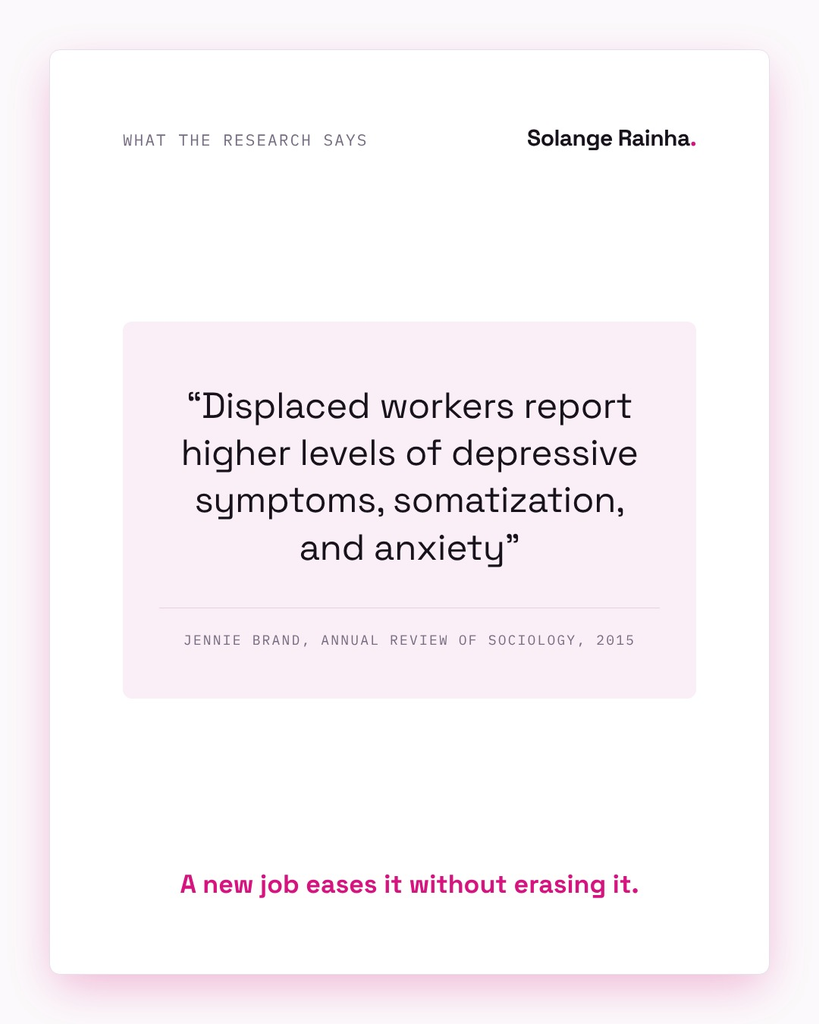
The research on this is grim and pretty consistent. Jennie Brand’s review of the job loss literature in the Annual Review of Sociology found that:
“Displaced workers suffer substantial earnings losses, which are generally more persistent than unemployment effects”
The same review reports that displaced workers have higher levels of depressive symptoms, somatisation and anxiety, and that getting a new job eases some of that without erasing it. That last part matched my experience more closely than I’d like.
How does being laid off multiple times follow you into the next job?
You start bracing, not consciously at first. You catch yourself reading a quiet week as a warning and scanning an all-hands invite for what it isn’t saying, or working out runway nobody asked you to look at. Silence from a manager used to mean “they’re busy”, and now it means “something’s coming”.
I’m not the only one: Employee Benefit News called it layoff whiplash, when people find a new job after a layoff, lose that one too, and start the next with one foot already out. Nick Corcodilos put the blunt version to Dice: “Over the long term, there really are no safe companies or jobs” (Dice).
What I find hardest to admit is that committing fully gets more difficult each time. I still do it: I build the systems and write the documentation, and I plan the next quarter as if there’ll be one. There’s a small voice, though, that asks whether it’s worth getting attached, and every time I have to decide not to listen to it.
Why do short tenures look like a choice on a CV?
Because a CV only shows dates, and three short tenures in a row look exactly like someone who leaves when it gets hard. Hays surveyed UK employers in 2025 and found 42% would be less likely to hire someone who’d switched roles regularly. Nobody asks why the roles ended before they’ve already decided.
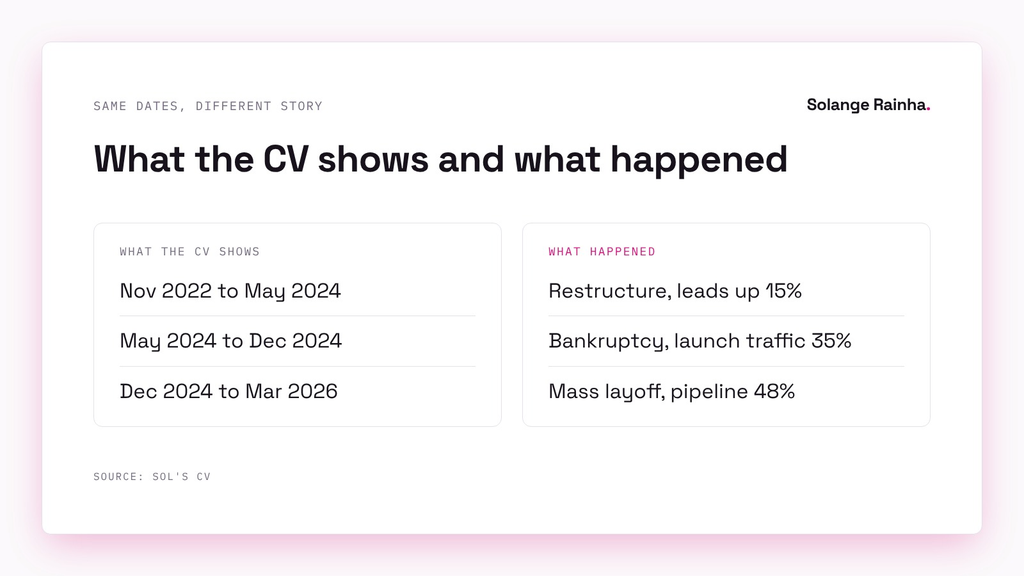
So in every first interview, before you’ve talked about the work, you explain a decision you didn’t make. I covered the practical side in how to handle short tenure on a CV and the checks I now run before saying yes in employer due diligence. This piece is the part those leave out: it’s tiring to keep apologising for other people’s balance sheets.
What do I hold on to?
The work happened: the leads went up, the launches drove traffic, and the pipeline was money a sales team could close. Nobody can take back what I built, and the skills behind it came with me every time, a little sharper.
It’s also why I write things down here. A layoff wipes the Slack history and the shared drive, but it can’t touch a write-up with the results in it.
Where does this story stop short?
This isn’t a story about bad employers. Restructures, bankruptcies and layoffs hit a lot of companies at once; TechCrunch counted more than 150,000 tech job cuts across 549 companies in 2024, per Layoffs.fyi. People at all three companies lost their jobs alongside me, some with far more at stake. Whoever made the calls was dealing with money that wasn’t there, and I don’t think any of them enjoyed it.
And there’s no lesson here. I’d love to end this with “and here’s how to make sure it never happens again”, but the checks I run now only lower the odds, and the companies that let me go were full of people who’d done their homework too.
Frequently asked questions
Being laid off multiple times can look like a red flag on a CV, because a CV shows dates and not reasons. A 2025 Hays survey found 42% of UK employers would be less likely to hire someone who’d switched roles regularly. Layoffs caused by restructures, bankruptcies or mass cuts are the company’s decision, though, and a short line on the CV explaining each one usually settles it.
Explain short tenures caused by layoffs briefly and factually: what the company was, how it ended (restructure, bankruptcy, mass layoff) and one result you delivered before it did. Put the reason on the CV itself so a recruiter doesn’t have to guess. In interviews, say it once without apologising and move on to the work.
Job loss affects people after they find new work because the effects outlast the unemployment itself. Jennie Brand’s 2015 review in the Annual Review of Sociology found displaced workers face lasting earnings losses and higher rates of depressive symptoms and anxiety, which a new job eases without erasing. People laid off more than once often describe bracing for the next ending in every new role.