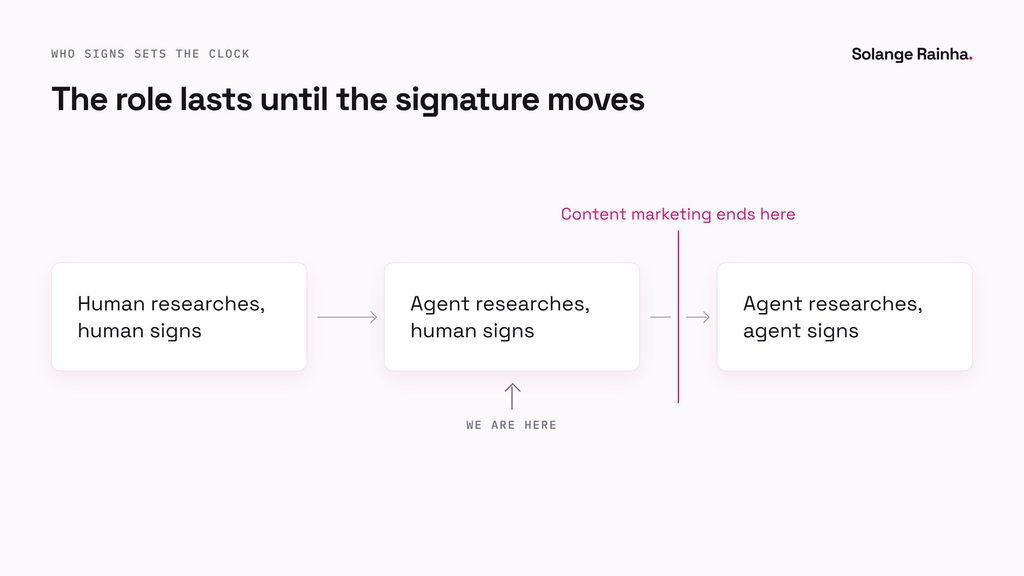
Will AI replace content marketers? Yes, but the people deciding it are your buyers, and AI’s writing ability has little to do with it. Content marketing exists to reach a human who signs the contract, and that human still wants a human on the other side. Once AI agents hold the budget and make the purchase, persuasion stops working and the role turns into data maintenance. Small repeat purchases will flip first; complex B2B deals last. This is my read on where the clock sits and the signs it’s moving.
Will AI replace content marketers? It already replaces a lot of what we do, and the exposure data says marketing sits near the top of the list, but the role holds as long as a person signs the purchase order, because that person wants to hear from people before they buy. The job ends when an AI agent holds the budget and does the buying, since then you’re selling to software, and software doesn’t care who wrote the case study.
Is AI already replacing marketing jobs?
Yes, and marketing gets hit early. Anthropic’s March 2026 labour market report measured “observed exposure”, meaning tasks people already hand to AI in day-to-day work, and market research analysts and marketing specialists came fifth of the occupations it ranked, at 64.8%. Microsoft’s 2025 study of which jobs AI applies to most put writers and authors fifth and public relations specialists 23rd out of its top 40.
The damage so far lands on hiring more than on layoffs. Anthropic’s own report found no systematic rise in unemployment for highly exposed workers, but a 14% drop in the job-finding rate for 22 to 25 year olds in exposed fields compared with 2022. Stanford’s Digital Economy Lab found the same pattern in payroll data: a 13% relative decline in employment for 22 to 25 year olds in the most exposed jobs, while older workers in the same jobs held steady.
So the junior content writer job is shrinking first, since it’s the role that used to turn a brief into 1,200 words, and a model now does that part in a minute.
What’s already automated in content production?
First drafts, rewrites, summaries, metadata, transcripts and most of the repurposing are automated already, at least in my workflow. I wrote up what a year of daily AI use changed in my work and which tasks I hand to AI as a solo marketer.
What still needs a person is the part a buyer trusts: deciding what’s worth saying, getting a customer or an engineer to tell you something true, cutting the claims that won’t survive a sales call, and putting a name and a face behind the argument. That list got shorter in two years, while the bar on what’s left went up, which I argued in why the bar went up in the AI era.
Why does a human buyer keep content marketing alive?
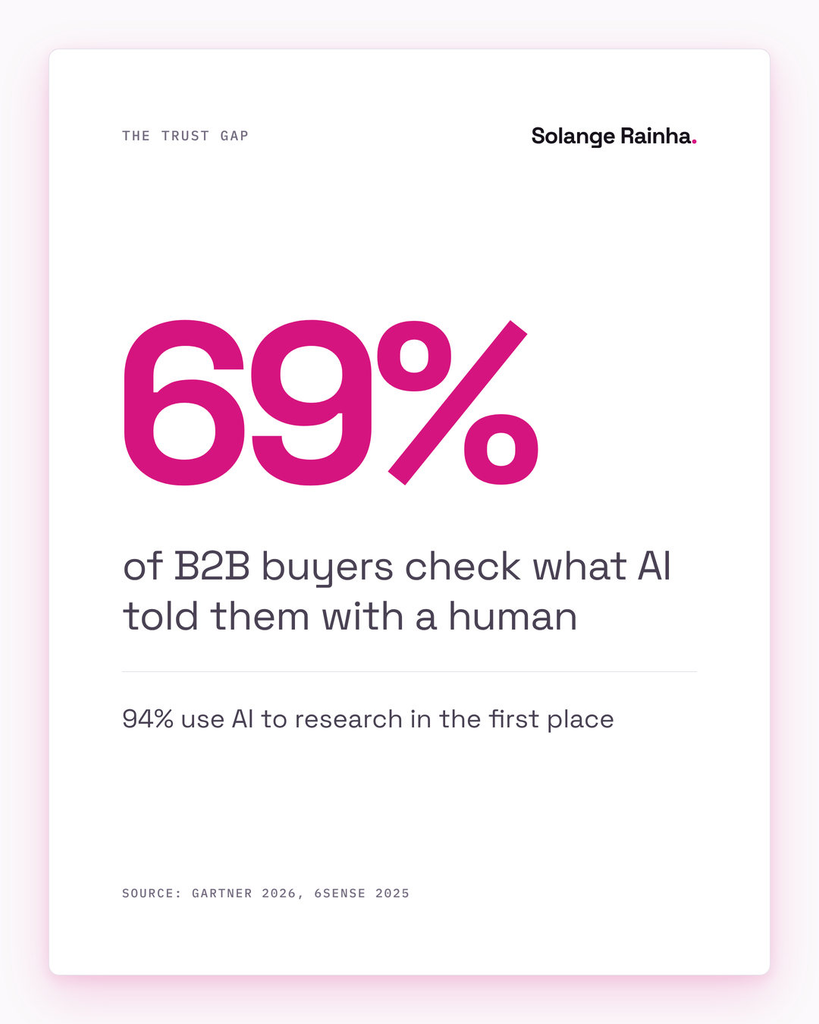
Because the person who signs wants to hear from a person, and content is where they meet you before sales does. Buyers use AI everywhere in the research: 6sense’s 2025 study found 94% of B2B buyers use LLMs during their buying process, and they still don’t trust the answer on its own.
Gartner surveyed 645 B2B buyers and found 69% check AI-generated insights with a sales rep. Robert Blaisdell, who runs research for Gartner’s sales practice, put it plainly:
“Buyers still turn to sales reps to validate AI-generated insights.”
The same release says 67% of buyers would rather buy without a rep at all. Put those together and you get a buyer who avoids sales calls, trusts AI only partly and fills the gap with material written by people they can check. That’s content marketing’s job description, more or less.
What does sales see when buyers research with AI first?
Buyers who’ve mostly decided: a colleague who talks to prospects at a B2B SaaS market research platform sees them arrive at first calls already informed by AI tools.
6sense’s data matches that: in its 2025 study of nearly 4,000 buyers, they were 61% of the way through their buying process at first contact, 94% had ranked their shortlist before talking to any vendor, and the vendor ranked first won 77% of the time. Most of the selling happens before anyone in sales knows the deal exists.
That’s the strongest case for content marketing right now: whatever the buyer read in that first 61% decided the shortlist, and a chunk of it came from AI answers built on pages like yours. At my current employer, our first AI citation baseline had us named in 38% of answers across 20 buyer prompts, which I set up the way I describe in how I track AI citations.
When will AI replace content marketers completely?
When the agent signs, which in most of complex B2B is later than the forecasts suggest. Gartner predicts that by 2028, 90% of B2B buying will be AI agent intermediated, pushing over $15 trillion of B2B spend through AI agent exchanges.
Read the word “intermediated” closely: an agent that researches, compares and drafts a shortlist for a human is intermediating, and we’re already there for most buyers. The role survives that, because a human still reads the shortlist and picks, but not the next step, where the agent holds a budget, applies the company’s rules and places the order with nobody reading anything.
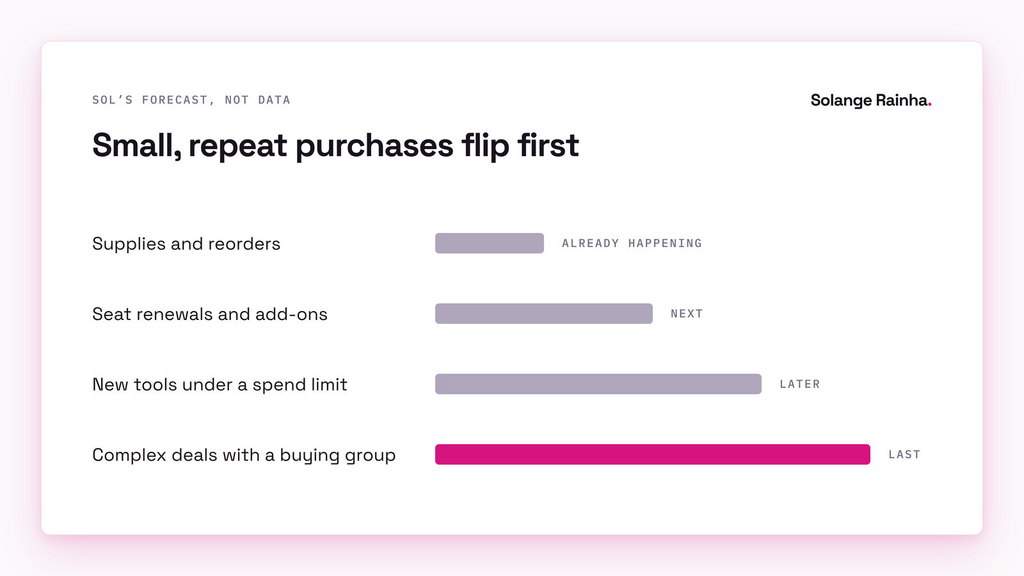
Small repeat purchases flip first: reorders, seat renewals, standard tools under a spend limit, anything with a clear spec and a known price. Those buyers barely read content anyway, while complex deals with a buying group, a security review and a contract negotiation flip last, because someone’s career is on the line if it goes wrong, and nobody wants to explain to a board that a bot picked the vendor.
What does content look like when the buyer is an agent?
It turns into structured data: an agent needs specs, prices, terms, integrations, limits and proof it can check, laid out so software can read and compare them, and no story, hook or brand voice. Gartner’s prediction says as much: search marketing gives way to what it calls agent engine optimisation, with product information structured for software agents.
| What the content does | Human buyer | Agent buyer |
|---|---|---|
| Gets you on the shortlist | Point of view, proof, a name they trust | Matching the spec on the first pass |
| Wins the comparison | Comparison pages, case studies, demos | Clean pricing, limits and terms in a readable format |
| Answers objections | Sales enablement, FAQs, a call | Documentation and policies an agent can check |
| Closes | A person vouching for it | Contract terms that fit the buyer’s rules |
| Who maintains it | A content marketer | Product, ops and whoever owns the data |
I covered the early version of this in writing content for AI agents, and it’s why product documentation is already beating blogs in AI answers. Accuracy and structure carry over to that market, and persuasion gets left behind.
What are the signs the switch is happening in your category?
Watch for these, roughly in this order:
- Your pricing page gets more bot traffic than human traffic, and the bots come back for the same fields.
- Procurement starts asking for machine-readable terms: a feed, an API, a standard form, anything their system can ingest without a person.
- Deals close without a first call. Self-serve was always this; the new part is self-serve on contracts that used to need a rep.
- Buyers stop asking “why you” and only ask “do you support X”. At that point they’ve delegated the judgement.
- Your competitors publish specs instead of stories, and win.
One of these on its own is noise, but three at once in your category means the clock is moving faster than mine.
What would I do as a content marketer now?
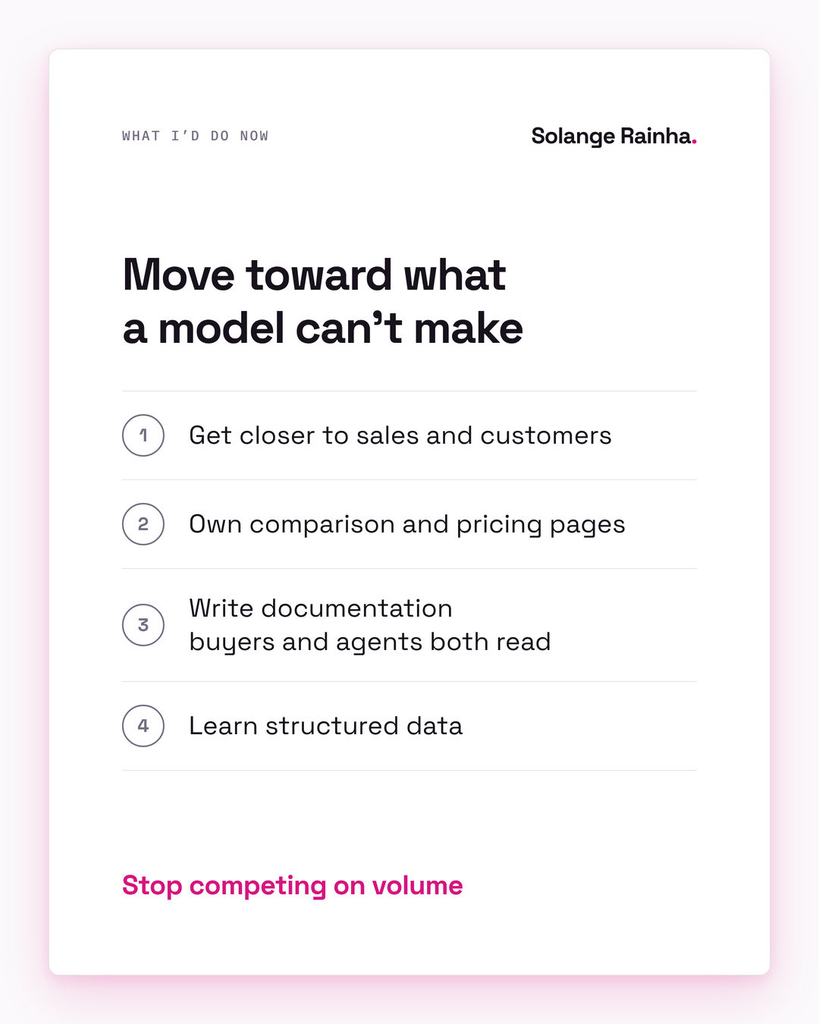
Move toward the parts a buyer can’t get from a model. Get closer to sales and customers, because first-hand material is the one input AI can’t produce. Own the comparison page, the pricing explainer and the documentation, since those are the assets both a human and an agent read. I made the case for owning the comparison page before G2 writes it for you.
And learn the structured side (schema, feeds, clean product data), because when the signature does move, someone still has to keep that data true, and I’d rather it was me than a script nobody checks.
Where could I be wrong?
On timing, mostly. If agents get trusted with spend limits faster than I expect, mid-size SaaS purchases could flip within a couple of years, and my “complex deals last” buffer gets thin. Gartner’s 2028 date is aggressive by my read, but Gartner has the bigger dataset.
I could also be wrong about how much buyers value the human on the other side. The 67% who’d skip the rep entirely are a warning sign, and the generation that grew up asking a chatbot first may trust a well-built agent more than a vendor’s blog. If that happens, the human touch I’m betting on becomes a nice extra, and the clock speeds up.
What would change my mind fast is a large buying group in my category letting an agent pick the vendor and sign. I haven’t seen that yet, and when I do, I’ll write the follow-up.
Frequently asked questions
AI will replace content marketers once AI agents make B2B purchases on their own, because content marketing exists to persuade a human buyer. Until then, the role shrinks at the junior end and shifts toward work buyers trust: first-hand material, comparison and pricing pages, documentation. Anthropic’s 2026 report already ranks marketing specialists among the most exposed occupations, at 64.8% observed exposure.
Entry-level writing and production roles are going first. Stanford’s Digital Economy Lab found a 13% relative employment decline for 22 to 25 year olds in the most AI-exposed jobs, and Anthropic found a 14% drop in job-finding rates for the same age group in exposed fields. Drafting, rewriting and repurposing are the content tasks most automated today.
Gartner predicts that by 2028, 90% of B2B buying will be AI agent intermediated, pushing over $15 trillion of spend through AI agent exchanges. Intermediated means an agent takes part in the purchase, which already covers AI-assisted research. Content marketing roles survive intermediation as long as a human still makes the final decision and signs.
Content marketers should build skills that serve both human and machine buyers: accurate product documentation, clear comparison and pricing pages, and structured data such as schema and product feeds. They should also get closer to sales and customers, since first-hand material is the input AI can’t produce. Volume writing is the weakest position to hold.