Annual performance reviews promise measurement and deliver horoscopes: confident, vague verdicts that say more about the person reading the chart than about you. The research behind that claim is brutal, with over 60% of a rating reflecting the rater rather than the ratee, and a third of feedback interventions actively making performance worse.
Astrology takes a measurable input, the position of planets, and generates confident statements about your personality that are vague enough to feel true and specific enough to feel personal. Annual performance reviews run the same trick on a year of your work: “meets expectations”, “should demonstrate more leadership”, “a 3.7 out of 5”. Mercury is in retrograde and your visibility with senior stakeholders could improve.
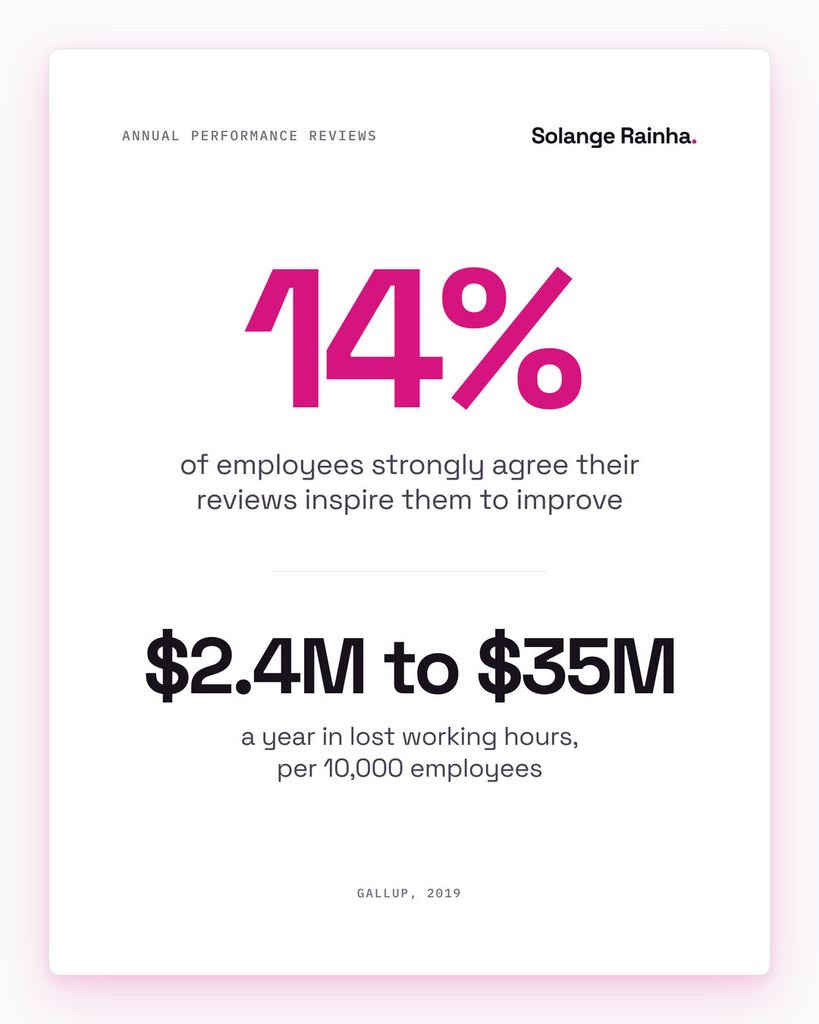
Employees can tell: in Gallup’s research on performance reviews, only 14% strongly agreed their reviews inspire them to improve, and Gallup put the cost of taking part at $2.4 million to $35 million a year in lost working hours for an organisation of 10,000 people.
What do annual performance reviews measure?
Mostly the last few weeks, filtered through office politics and one person’s mood. The official answer is twelve months of performance, but nobody can hold a year of someone’s work in their head, so the review quietly becomes an assessment of the last quarter. The colleague who shipped a big win in November will outscore the one who carried the team through a miserable spring.
Everyone who’s sat through review season knows the choreography this produces: the strategic October project and the sudden burst of December visibility, then the achievements doc updated in a panic the night before. None of it is performance, and the review rewards every bit of it.
Then there’s the politics. Ratings pass through calibration meetings where managers negotiate on behalf of their people, and the outcome tracks who argues well and has capital to spend, and whose team the budget favours this cycle. I wrote about the quiet-quitting panic and who never had to justify themselves in that framing; reviews do the same, putting the worker’s output under scrutiny while nobody looks at the process around it.
Why is a 3.7 out of 5 closer to numerology than measurement?
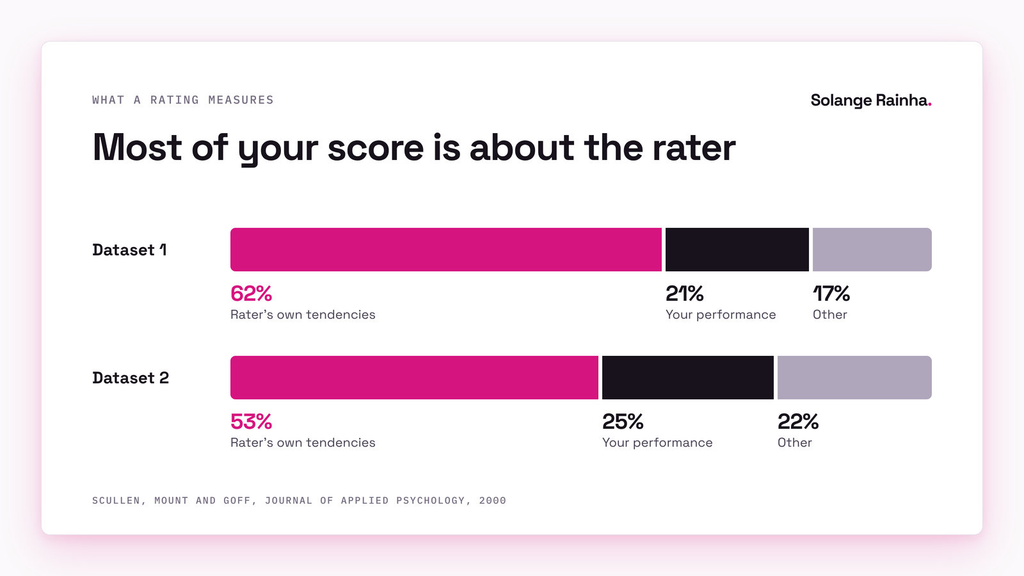
Because most of the score describes the person giving it. In a study published in the Journal of Applied Psychology in 2000, Steven Scullen, Michael Mount and Maynard Goff broke down the ratings of more than 4,400 managers, each rated by two bosses, two peers, two subordinates and themselves. The raters’ own idiosyncratic tendencies explained 62% and 53% of the variance in the two datasets, while the managers’ performance explained 21% and 25%.
Deloitte found the same in its own system. Marcus Buckingham and Ashley Goodall wrote in Harvard Business Review that the firm’s research turned up idiosyncratic rater effects, producing:
“ratings that revealed more about team leaders than about the people they were rating”
So your review score is mostly a read on your manager: how harsh a grader they are, what they personally count as “leadership”, which of your traits remind them of themselves. Companies then attach decimal points to this and call it measurement. A 3.7 against a 3.4 presents itself as precision, and it’s the precision of a birth chart, a confident score from a process that can’t support the confidence.
I’ve seen the same mistake outside HR, in my own dashboards when I was tracking 17+ KPIs a quarter, most of which couldn’t tell me if anything was working, and it’s why I show my methodology whenever I claim a pipeline figure: the existence of a figure does all the persuading, whether or not the figure measures anything. Content work has a version of this problem built in, since its results arrive late and usually get reported by somebody else, which is a big part of why imposter syndrome hits marketers so hard.
Deloitte looked at its system, which was eating close to 2 million hours a year, and in 2015 it rebuilt performance management without the annual ratings. When a Big Four firm decides its own ritual measures the wrong person, the rest of us can stop pretending ours works.
Does feedback improve performance?
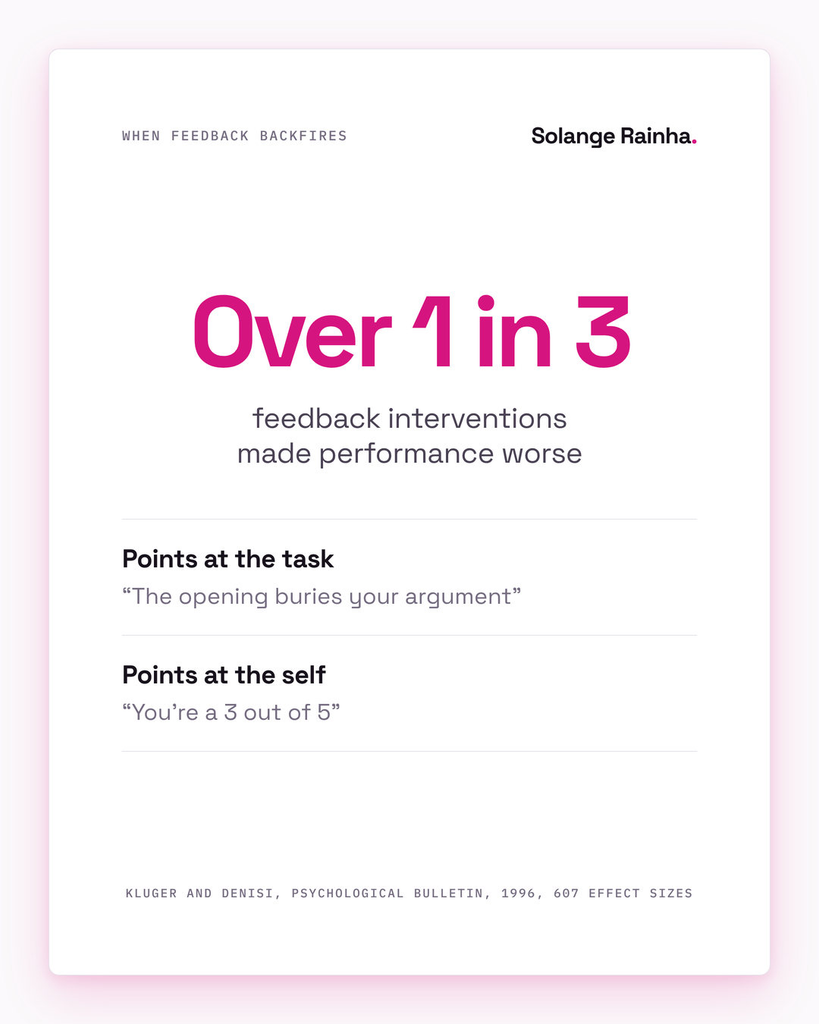
On average, yes, but the ritual never quotes the rest of the finding. Avraham Kluger and Angelo DeNisi’s meta-analysis in Psychological Bulletin covered 607 effect sizes and 23,663 observations: feedback helped overall, but in over a third of cases it lowered performance, and HR still puts the whole company through it every December.
The same paper explains which third backfires: feedback works less well as it moves attention away from the task and toward the self. “This section buried the answer” and “this campaign targeted the wrong segment” point at the work and come with a fix. “You’re a 3” is about you as a person, with no task in sight, so the recipient spends their energy protecting their identity instead of improving their work, and that’s exactly the format the annual review uses: self-focused, high-stakes and tied to pay.
What feedback works instead of annual performance reviews?
The boring kind: specific, close to the work in time, aimed at the task, and low-stakes enough that nobody’s cortisol spikes when the calendar invite lands. In practice that’s a 15-minute conversation this week about the draft, where you say “the opening buries your argument, move the claim up”, instead of a verdict in March about the year that says “your written communication could be stronger”.
When I was coordinating four freelance specialists across four countries, this was the entire system: clear standards agreed upfront, then small, frequent corrections on the task itself, written down with the reason attached, and no scores anywhere.
| Annual performance review | Feedback that works | |
|---|---|---|
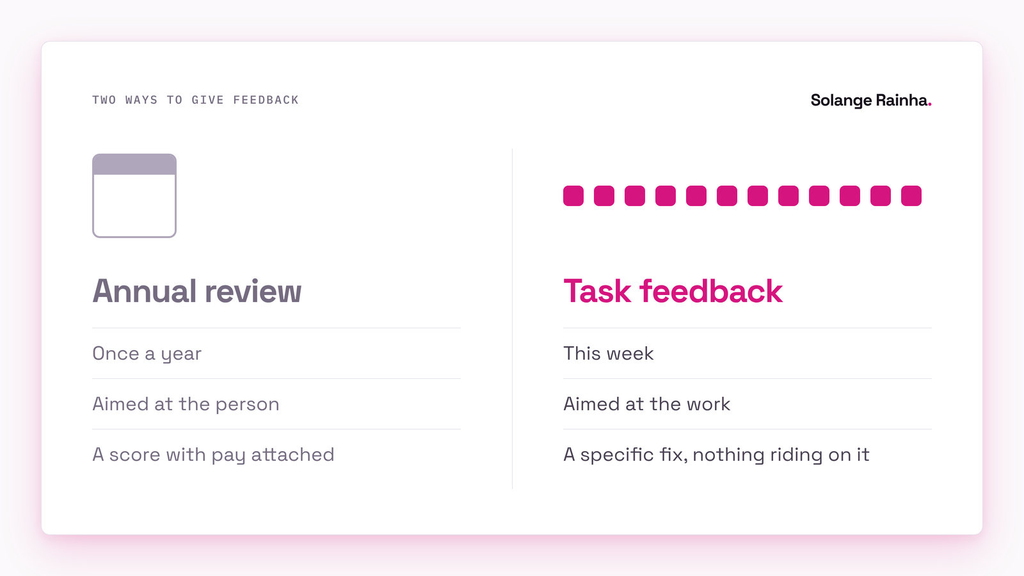
| Timing | Once a year, months after the work | This week, while the work is fresh |
| Aimed at | The person (“you’re a 3”) | The task (“move the claim up”) |
| Stakes | Pay, promotion and ranking attached | Low, nothing riding on it |
| Output | A score | A specific fix |
| Who it describes | Mostly the rater | The work |
More feedback is a lazy fix too, because what helps is specificity and task focus, and a company that swaps the annual ritual for weekly rating-flavoured micro-verdicts has just made the astrology more frequent.
What’s worth keeping from the annual review?
The career conversation, the written record and an open pay decision, once you stop pretending any of them is measurement. Torching the ceremony doesn’t mean torching everything inside it, and this is where I’ll stick up for the managers stuck running a process they don’t believe in.
A protected hour once or twice a year on where someone’s career is going (what they want more and less of, what the next role looks like) gives you something weekly check-ins never replace. Keep the conversation and delete the scorecard, because the scorecard is what turns a career discussion into an argument about a verdict.
Keep the written record too: documented examples of what someone shipped and what it produced protect both sides far better than a score does. It’s the kind of ownership evidence I’ve argued people should be keeping anyway, and the same receipts I’d put ahead of building a personal brand. Then there’s the compensation decision itself, which has to happen on some cadence, so make the pay call openly as a judgement, informed by documented work, without laundering it through a pseudo-scientific rating first.
What dies in this version is only the astrology: the scale, the decimal, the ranking, and the annual pretence that one person’s memory of your year, filtered through their own tendencies, counts as data. Companies find that piece surprisingly hard to give up, because the score feels like control. Gartner found in 2019 that 81% of HR leaders were still changing or experimenting with performance management, so plenty of them suspect it isn’t working.
Frequently asked questions
Annual performance reviews fail on two documented fronts. Ratings mostly measure the rater: in Scullen, Mount and Goff’s 2000 study of more than 4,400 managers, the raters’ own tendencies explained 62% and 53% of rating variance, against 21% and 25% for performance. And the format is the kind of feedback most likely to backfire, since self-focused, high-stakes feedback lowered performance in over a third of cases in Kluger and DeNisi’s meta-analysis. Recency bias and calibration politics push the score further from the year’s work.
The best replacement for annual performance reviews is specific, task-focused feedback given close to the work, in low-stakes settings with no scores attached. Feedback backfires when it pulls attention off the task and onto the person, so short, concrete conversations about the work beat annual verdicts about the employee. Keep a separate career conversation once or twice a year, keep a written record of what people shipped, and make pay decisions openly on documented work.
Yes. Scullen, Mount and Goff, in the Journal of Applied Psychology in 2000, found the raters’ idiosyncratic tendencies explained more than half the variance in ratings across two samples of over 2,000 managers each, more than double the share explained by the managers’ performance. Deloitte reported the same effect in its own system, as Marcus Buckingham and Ashley Goodall described in Harvard Business Review in 2015, and rebuilt its performance management without annual ratings.
No. Feedback helps on average; the problem is the format. Kluger and DeNisi’s meta-analysis found feedback works worst when it points at the person, which is exactly what scores and rankings do. Managers should give more of the boring kind, concrete and close to the work, and stop delivering a theatrical version once a year with money riding on it. Aim for useful frequency, since constant commentary that rates people weekly repeats the same mistake more often.