Prompt research is the process of collecting the questions your buyers ask AI models, running them across engines on a fixed schedule, logging who gets cited, and turning the gaps into briefs. It runs alongside keyword research and answers a different question: what a model tells your buyer about your category when nobody from your company is part of the conversation. A lean function can run it with 30 to 60 prompts across four engines, in about two working days for the first pass and half a day a month after that. The output is a record of what models say, who they credit, and which of your positions never make it into the answer, not a volume forecast, because reliable prompt volume data doesn’t exist.
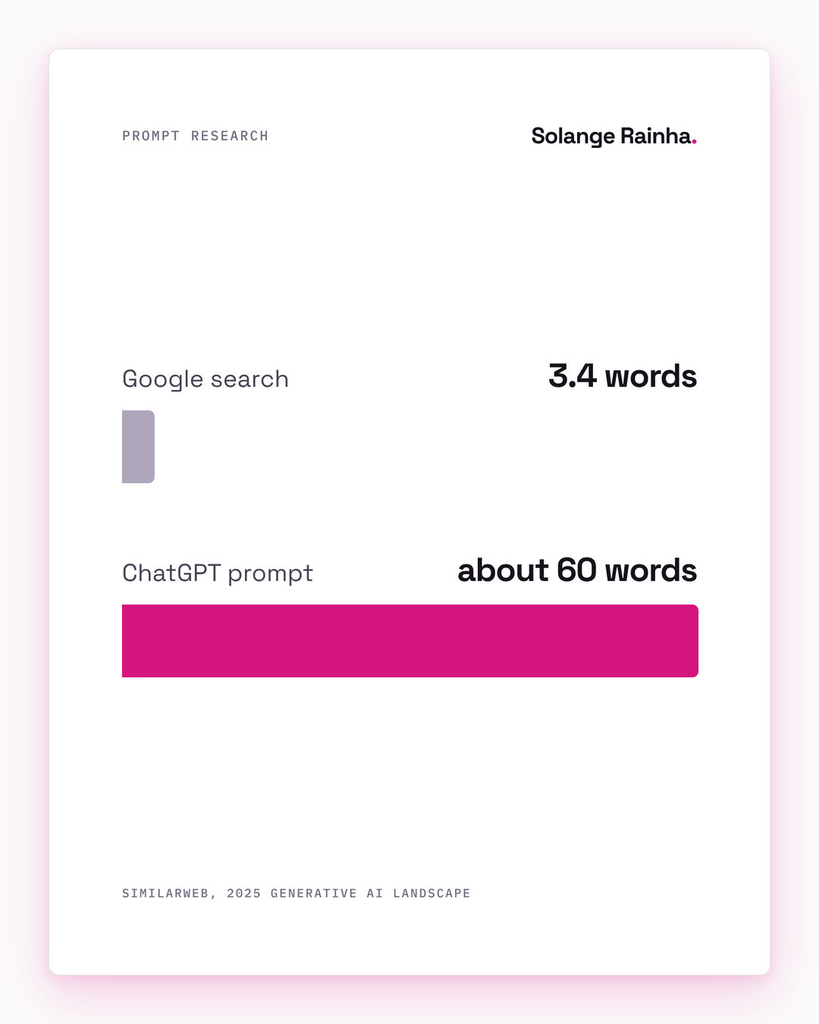
Prompt research starts from the fact that a prompt carries far more than a search query does. Similarweb’s 2025 Generative AI Landscape report puts the average ChatGPT prompt at about 60 words against 3.4 for a Google search, so it arrives with context, constraints and a decision the person is trying to make. That’s why you can’t borrow the method from keyword research wholesale, and why what comes out of it looks different.
What most published guides skip is that the output isn’t a volume estimate: nobody has years of prompt volume data, and Sistrix’s analysis of more than 62 million user questions found most of these prompts “appear only once”. Answers also move between platforms and between reruns of the same prompt. What you get instead is a picture of what a model tells your buyer today, who it credits, and where your positions go missing.
Where do the prompts come from?
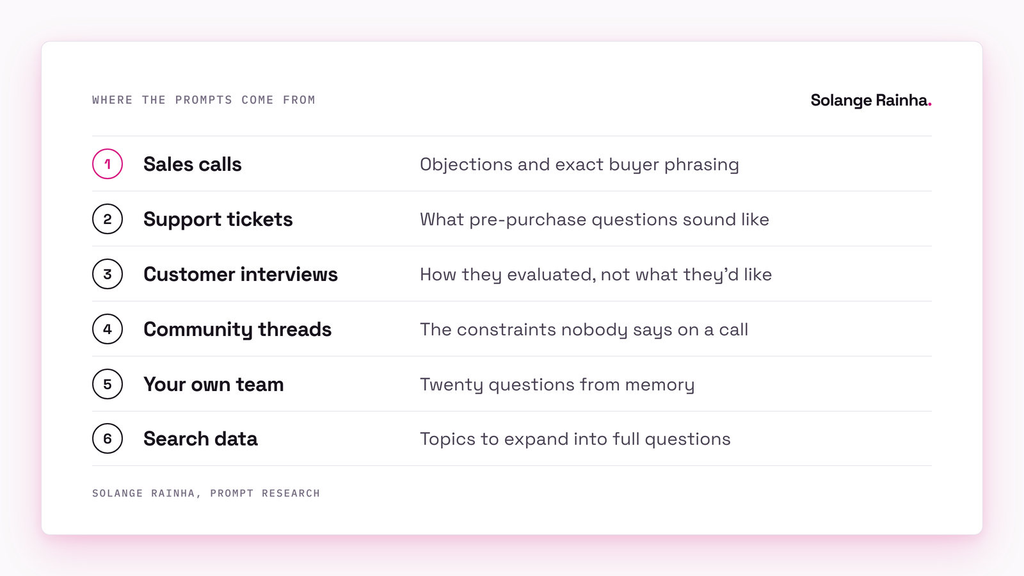
The prompts come from your buyers’ own words, ranked by how close the source sits to a buying decision, and never from a keyword tool with question marks bolted on, because that produces prompts nobody types, and the whole method collapses if the inventory is fictional.
- Recorded sales calls. The best source available and the one almost nobody uses. Twenty calls give you the objections, the trigger language and the exact phrasing buyers use, which is what you paste into the model word for word.
- Next, support tickets and CS notes, which carry post-purchase pain and tell you what the pre-purchase prompts sound like.
- Customer interviews, six to eight per persona, asking about the last time they evaluated a product like this. Don’t ask what content they’d like to see: people are unreliable narrators of their preferences and excellent narrators of their own history.
- Community threads on Reddit, Slack groups and industry forums give you the unfiltered question with all the constraints people won’t say on a sales call.
- Your own team. Sales and CS answer these questions daily and can list twenty from memory in one meeting.
- Last, search data as raw material. Search Console queries and People Also Ask boxes give you topics, not prompts, so expand each one into the full question a person would ask with their context attached.
The test for anything entering the inventory: would a buyer type this sentence, in these words, at some point in their evaluation?
What goes in a prompt inventory?
A prompt inventory holds the prompt plus the context you’ll need to read a result six months later, because it’s a tracking document as much as a list.
| Field | What it holds |
|---|---|
| Prompt | The full question, verbatim, as a buyer would phrase it with their context included. |
| Source | Sales call, ticket, interview, community, team, or expanded from search data. |
| Persona | Who asks it, and where they sit on the buying committee. |
| Stage | Awareness, consideration, or decision. |
| Prompt type | Explanation, comparison, or recommendation. |
| Our target | Whether the ideal answer cites us, mentions us, or reflects our framing without naming us. |
| Owner | Which pillar and which piece is supposed to win this. |
| Status | Cited, mentioned, absent, or misrepresented, updated each pass. |
The prompt type column carries most of the strategic weight. Explanation prompts (“what is X”) produce definitions and rarely a shortlist, while comparison and recommendation prompts are where a model weighs alternatives and starts naming brands. Semrush’s Sergei Rogulin puts it plainly: “In AI SEO, visibility only matters when AI is evaluating choices.” It’s also why the asset that closes most comparison gaps is the B2B comparison page.
Thirty to 60 prompts is the working range for a lean function, weighted toward comparison and recommendation, covering every persona and stage. Below 30 you’re reading noise as signal, and above 60 the monthly rerun eventually stops happening, which is why an inventory you rerun every month at 40 prompts beats one you built at 200 and abandoned in week six.
How do you run the inventory across engines?
Run the same prompts in the same order across four engines, and log them in one place every time, because a consistent method is all that makes month-to-month comparison mean anything. The answers are volatile: SparkToro and Gumshoe ran 2,961 prompts and found less than a 1 in 100 chance that ChatGPT or Google’s AI returned the same list of brands for the same prompt twice.
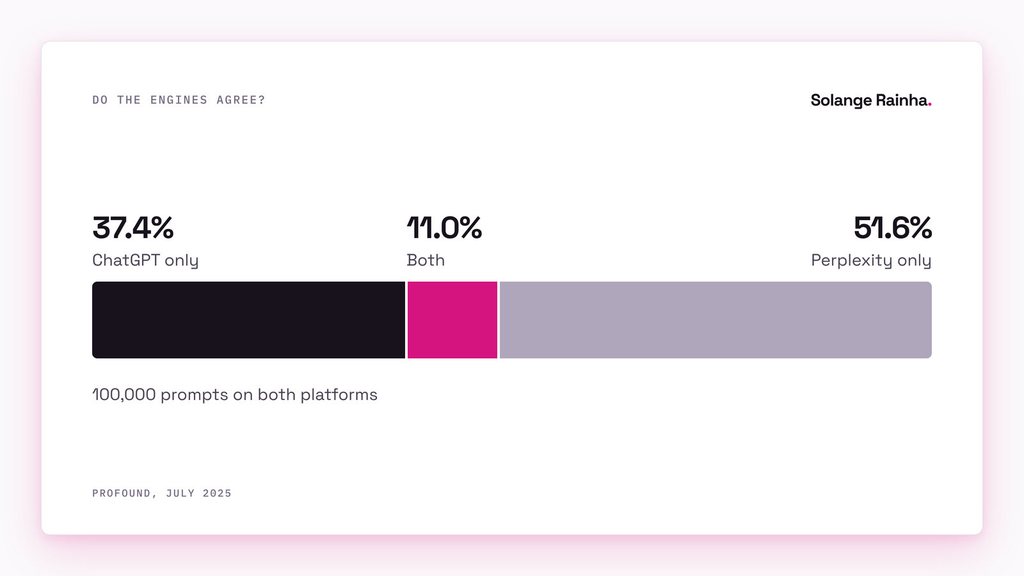
- ChatGPT, Claude, Perplexity and Gemini as the standing set. Cross-platform overlap is poor: Profound ran 100,000 prompts on both ChatGPT and Perplexity and found only 11% of cited domains appeared on both, so a single-engine read tells you nothing about the others. How the engines differ in what they cite is in optimising content for ChatGPT, Perplexity and AI Overviews.
- Logged out, fresh session, memory and personalisation off. Otherwise you’re measuring what the model learned about you.
- Keep to one prompt per session, since follow-ups in the same thread inherit context and stop being the prompt you’re testing.
- Log the whole answer, beyond whether you appear. The text of the answer is the research output, which the next section is about.
- Same day of the month, every month. Answers move week to week for reasons you can’t see, so a fixed cadence at least keeps the noise consistent.
For each prompt and engine, log four things: were we cited, who else was cited, what did the answer claim, and how many of the cited sources were third-party aggregators instead of vendors. That last one tells you whether the category is being narrated by review sites, which is a strategic problem more than a content one. The tracking side of this, once the inventory exists, is in how I track AI citations, and the wider measurement picture is in measuring AI visibility when analytics won’t show it.
How do you read the gap between the answer and what you’d have said?
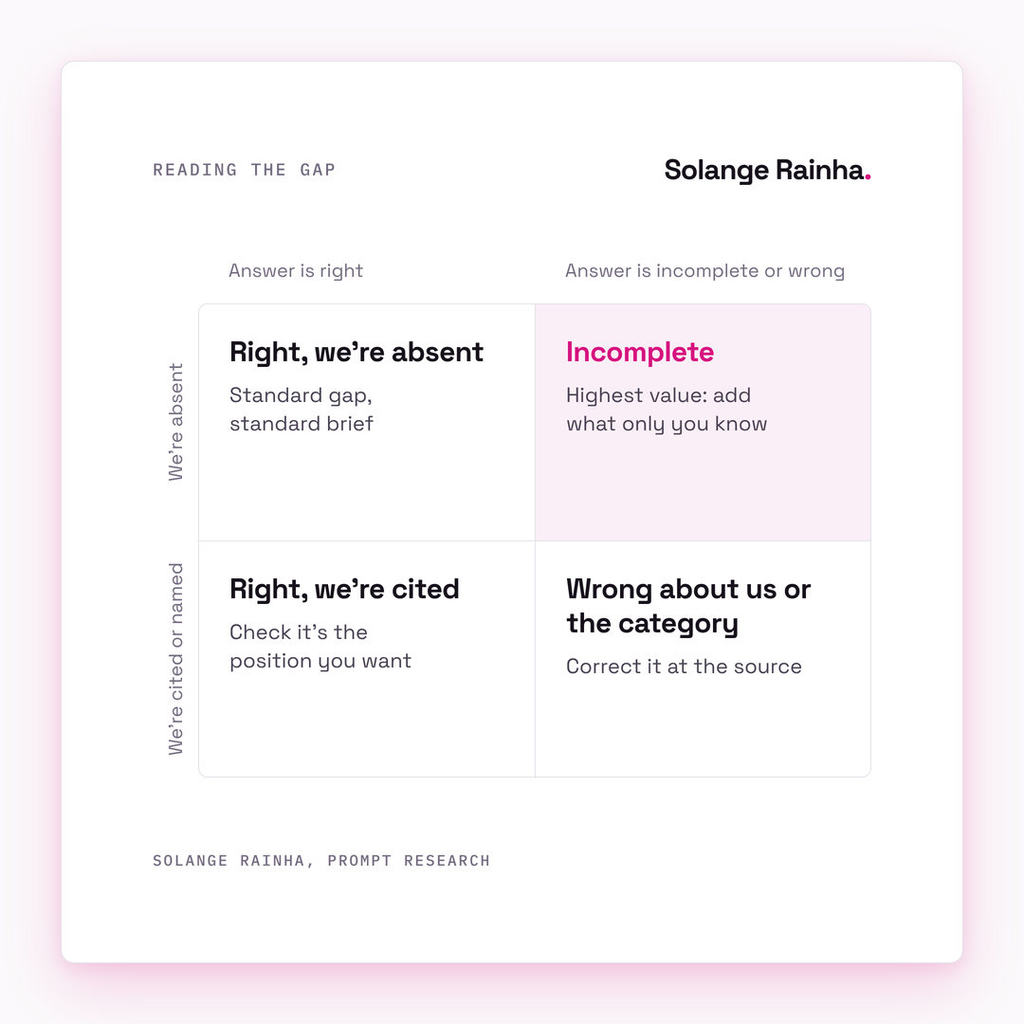
You read the gap by asking what you’d have said if the buyer had asked you directly, and how much of it is missing. This is the step that produces content, and it’s the one tool-led guides skip entirely, because a tool can tell you whether you were cited but can’t tell you whether the answer was any good. Read each logged answer and mark it against four types:
- Right, and we’re absent. The most common result and the least interesting: the substance exists elsewhere and we’ve published nothing a model needs, so it’s a standard gap and a standard brief.
- Next is the answer that’s right, and cites us. Log what got cited and why, then work out whether it reflects the position you want to hold or a stray fact you happened to publish two years ago.
- Incomplete, meaning it covers the obvious considerations and misses the one that counts most in practice, usually the constraint that only shows up during implementation. This is the highest-value gap in the process, because you know what the consensus doesn’t, and no model can reconstruct it from public sources.
- Last, wrong about us or about the category: wrong pricing, outdated capability, a competitor’s framing applied to your product.
The distance between the model’s answer and yours is your content plan. Where the distance is zero, the model already says what you’d say, so publishing it again earns you nothing, which I’ve argued at more length in why AEO won’t save a weak content strategy. Check which of your own URLs get cited too, because it’s often documentation and not the blog, which I covered in why product docs outrank the blog in AI answers.
How do you convert findings into briefs?
Treat each gap as a candidate and not a commitment, and run it through the same gate as every other idea. Each gap becomes a one-line proposition (this prompt, this persona, this missing substance) and then goes through impact, effort and alignment, the content prioritisation framework I run on everything. Prompt research generates far more candidates than a lean function can make, and a research process with no kill step just produces a bigger backlog.
The briefs that survive carry three extra fields the standard template doesn’t have:
- The prompt itself, so the writer knows the exact question the piece has to answer in its first 150 words.
- The substance that closes the gap: the original claim, the data, the named source, the comparison table. Structure alone won’t earn the citation, which is the argument of my AEO/LLMO content optimisation framework, and the Princeton GEO study behind it found quotations, statistics and cited sources all lifted visibility in AI answers while keyword stuffing fell below the unmodified page.
- The competing source currently cited, so the writer knows what they’re displacing and what that page fails to say.
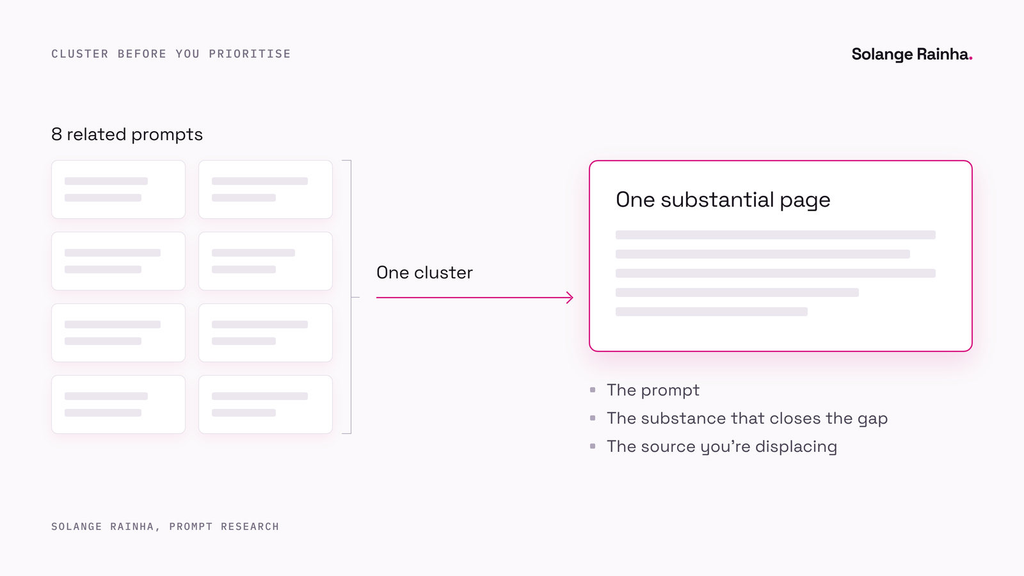
One warning from watching this go wrong: a gap list read literally produces a hundred thin pages, one per prompt, but prompts cluster, and eight related ones usually resolve into a single substantial page that answers all of them, which extracts better than eight shallow ones anyway. So cluster before you prioritise, and where the gap is an information hole nobody has filled, the answer is often original research instead of another synthesis piece.
How long does a prompt research pass take, and how often should you rerun it?
A first pass takes around two working days and a monthly rerun about half a day, from running this solo, with nothing rounded down to make it sound easier:
| Stage | First pass | Monthly rerun |
|---|---|---|
| Sourcing prompts | 6 to 10 hours across calls, tickets, interviews and team input | 30 minutes, adding new prompts as they show up |
| Building the inventory | 2 to 3 hours | Negligible |
| Running 40 prompts across 4 engines | 4 to 6 hours, since you’re reading answers and not skimming them | 3 to 4 hours |
| Reading gaps and clustering | 3 to 4 hours | 1 to 2 hours |
| Converting to briefs | 2 to 3 hours | 1 hour |
| Total | Around two working days | Half a day |
Run it monthly for the test pass and the log, and quarterly for a proper review of the trend and a refresh of the inventory itself. Read the trend across three months and ignore any single month. Anything faster than monthly burns the time without adding signal, and anything slower than quarterly means you find out about a wrong answer a season late.
Does prompt research replace keyword research?
Prompt research doesn’t replace keyword research; it sits alongside it. Sistrix’s Johannes Beus takes the opposite line, arguing that “Keyword research no longer works in AI Search”, and inside AI search he has a point, but outside it, bottom-funnel search still converts.
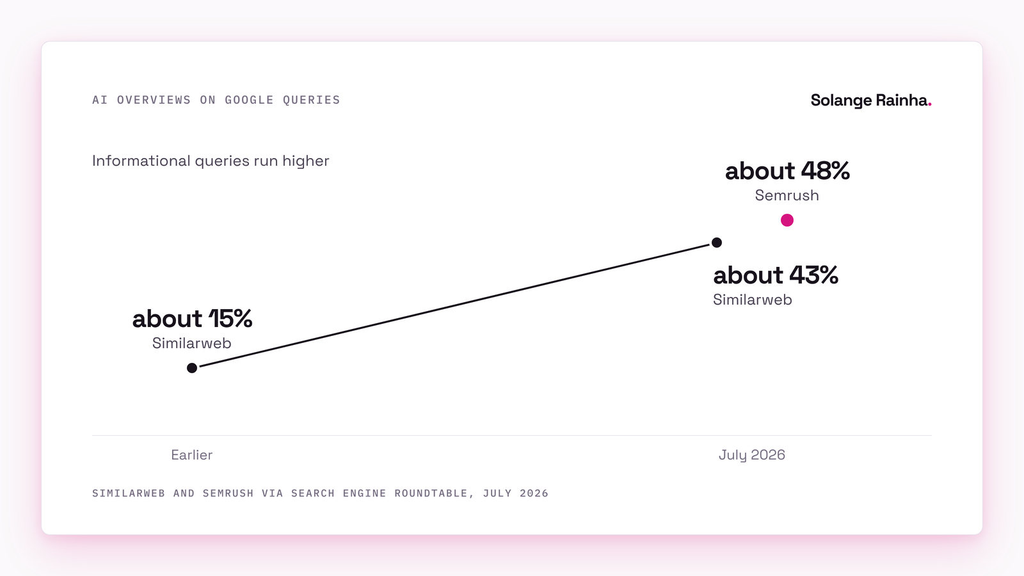
AI Overviews have spread fast, with Similarweb and Semrush reporting them on about 43% and 48% of Google queries by July 2026 and informational queries running higher, so the commercial pages nearest the purchase are where search clicks still turn into pipeline. Walking away from those pages to chase citations trades pipeline you can measure for a metric you can barely see, which I’ve covered in the organic traffic decline. The distinction between the three disciplines is in SEO versus AEO versus LLMO, and the implementation errors are catalogued in the AEO mistakes playbook.
Frequently asked questions
Prompt research is the process of collecting the questions buyers ask AI models, running them across engines on a fixed schedule, logging whether you’re cited and who else is, and converting the gaps into content briefs. It differs from keyword research in both unit and output: prompts are long, contextual questions instead of short phrases, and the result is a record of what models currently say about your category rather than a volume forecast. There’s no reliable historical volume data for prompts, and most appear only once, so the method reads direction and pattern.
A prompt inventory for a lean content function works best at 30 to 60 prompts, weighted toward comparison and recommendation prompts over explanation prompts, and covering every persona and funnel stage. Below 30 you’re reading noise as signal, and above 60 the monthly rerun quietly stops happening, which is what kills the process. Each row should carry the prompt verbatim plus its source, persona, stage, prompt type, target outcome, owning pillar and current status.
Run the prompt research inventory monthly and review the trend quarterly, reading movement across three months instead of reacting to any single month, since AI answers change between platforms and between reruns of the same prompt. A first pass takes roughly two working days for sourcing, building the inventory, testing and converting gaps to briefs; the monthly rerun takes about half a day. Each quarter, refresh the inventory by adding prompts from new sales calls and retiring ones that no longer match how buyers ask.
Prompt research doesn’t replace keyword research; it answers a different question and runs alongside it. Keyword data still governs the commercial and transactional queries nearest a purchase, while prompt research covers what models tell buyers during anonymous evaluation. AI Overviews now appear on close to half of Google queries, with informational ones running higher, so abandoning search work entirely trades measurable pipeline for a channel that undercounts itself badly in analytics.