Most B2B awareness stage content is filler nobody asked for and nobody remembers, and the traffic it pulls in can cost more than it earns, because it’s often a buyer’s first impression of you and 94% of B2B buyers have ranked their shortlist before they speak to a seller. The fix starts with one test before you publish: would you send this piece to one specific person who has the problem, with a note saying it’s worth their time? If you wouldn’t, it’s filler. This piece covers why awareness content gets graded on a curve, what the filler costs you, and what works at each funnel stage in B2B SaaS, from a stranger’s first read to the comparison that closes the deal.
Awareness stage content is the top-of-funnel material a buyer meets before they know they need you, and on most B2B blogs it’s where the quota goes to get hit. The strategy doc says “top of funnel”, someone reads that as “publish more”, and six months later you’ve got forty posts that rank for nothing anyone buys on and read like they were written to fill a word count. I’ve built content operations where awareness content carried weight in the pipeline, and I’ve inherited blogs where it was pure filler. The difference came down to one question every time: was the piece worth a stranger’s four minutes?
Awareness content gets a pass that no other part of the funnel would survive. Nobody ships a sloppy pricing page or a half-thought-out case study, because the stakes are obvious, but top-of-funnel work gets graded on volume, so the bar drops until “we published twelve posts this quarter” becomes the win, whether or not any of them did anything, and most B2B blogs are stuck there right now.
Why did awareness stage content become a dumping ground?
Because it’s the easiest part of the funnel to fake. A bottom-of-funnel comparison page has to be accurate or sales will notice, and a case study has to be true or the customer will object. Awareness stage content has no such guardrail: you can write “5 Trends Shaping the Industry in 2026”, fill it with the same five trends every competitor listed, and nobody downstream will catch you, because the post was never connected to anything that converts.
Volume targets make it worse: when you measure a content plan by output instead of outcome, the incentive only ever points toward more and cheaper, and the top of the funnel absorbs that pressure because it’s where the cheap ideas live. You end up with a blog full of definitions nobody needed and listicles that exist because a keyword tool showed search volume, while nobody on the team had a view on the topic worth publishing.
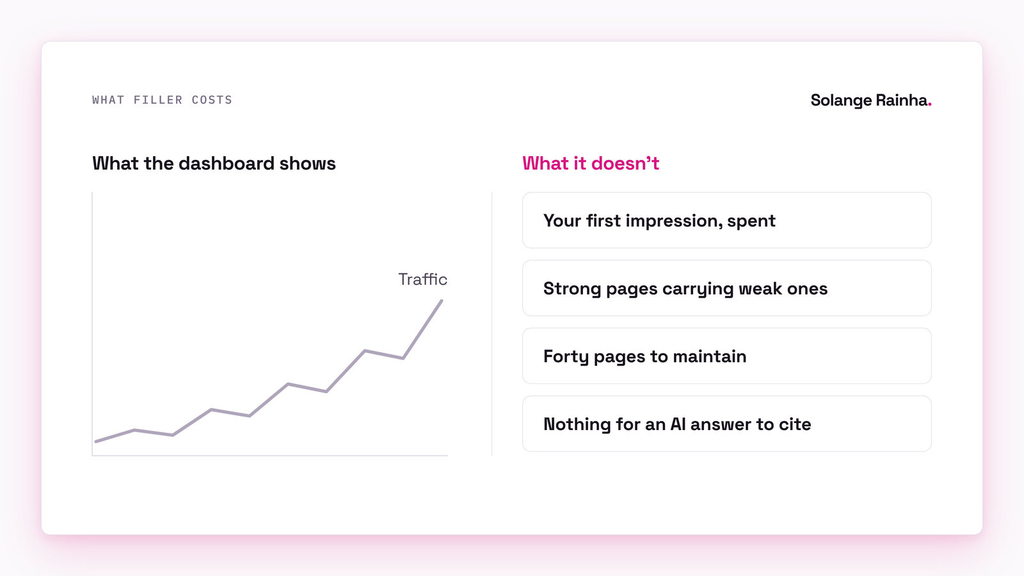
Underneath it all sits a measurement problem: awareness content is supposed to build familiarity and trust over time, which is hard to attribute, so teams reach for the metric they can see, which is traffic, and traffic rewards exactly the wrong behaviour. A thin post built for a high-volume keyword can pull respectable traffic while doing nothing for the business, and the dashboard will call it a success. I’ve written about which content marketing metrics to track at each stage instead, and about how the gap between “got traffic” and “influenced a deal” distorts marketing-sourced pipeline claims, because that gap is where most content credibility gets lost.
Why is traffic from bad awareness content worse than none?
Because the damage lands where a traffic chart can’t see it, and it lands in several places at once.
- It spends your first impression. The top of the funnel is often someone’s first contact with your company. If the first post a buyer reads from you is a generic post obviously written for Google, you’ve used your one first impression teaching them your content isn’t worth reading, and they won’t come back to check whether the rest is better.
- Thin pages drag on the good ones: Google’s guidance on core updates asks you to judge your site as a whole, beyond individual pages, and says plainly that “deleting the unhelpful content can help the good content on your site perform better.” A pile of thin awareness posts makes your strong pages carry the weak ones.
- Upkeep. I originally listed wasted crawl budget here, but Google’s own documentation says crawl budget is a concern for sites with 10,000+ fast-changing pages or a million-plus pages, so on a typical B2B blog the cost is maintenance instead: forty filler posts are forty pages someone has to keep current, redirect or prune.
- The AI problem sits on top of all of it: in Gartner’s 2026 buyer survey, 45% of B2B buyers had used AI during a recent purchase, and the researchers behind the generative engine optimisation study found that adding statistics to a page lifted its visibility in AI answers by about 31%, and adding quotations by about 41%. Models reach for claims they can check, so generic awareness content gives them nothing to pull, and they cite a competitor who made a claim instead. I broke down why formatting tricks can’t fix this in why AEO won’t save your content strategy.
That’s why it goes unnoticed until the blog has a reputation problem and nobody can point to the cause.
How do you spot filler awareness stage content before you publish?
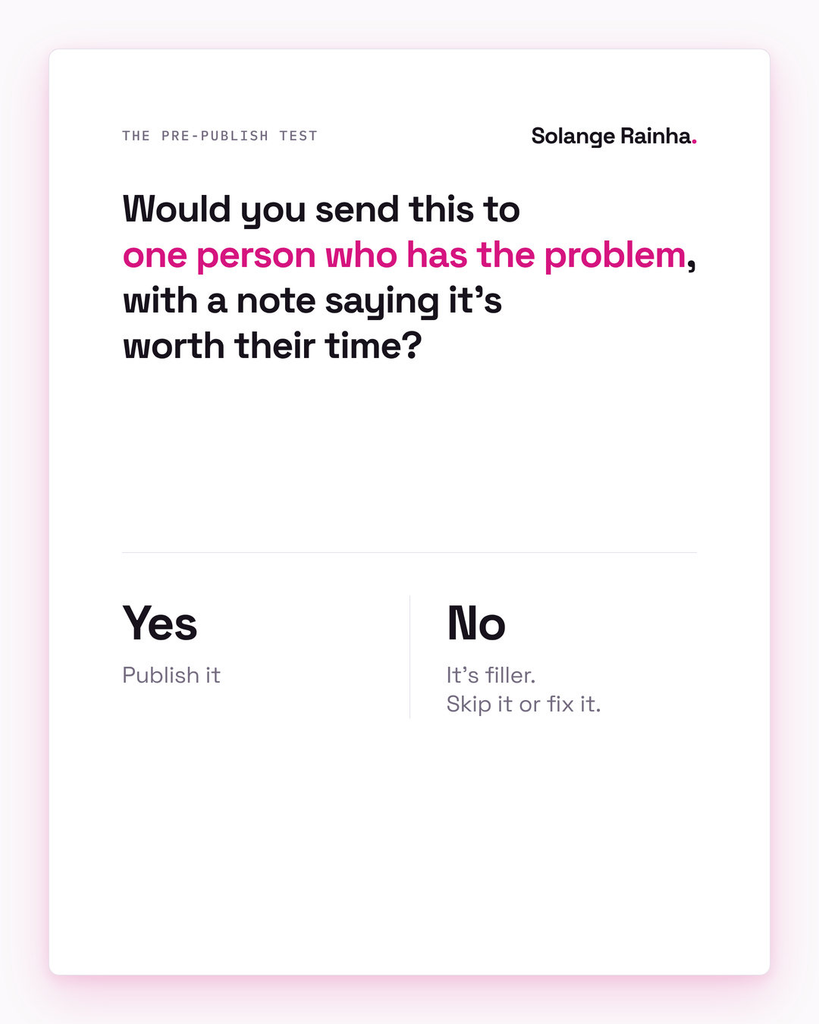
Ask yourself: would I send this to one specific person who has the problem it deals with, with a note saying “this is worth your time”? Forget whether it would rank or get clicks for a second. Would you put your name on it in a message to someone whose opinion of you you care about? If the answer’s no, you’ve got filler, and publishing it costs you more than skipping it would.
“Would I share this with someone I respect?” is a brutal filter because it collapses every vague quality debate into a gut check you can’t argue your way around: either you’d send it or you’d be slightly embarrassed to, with no third option.
Google lands in the same place: its self-assessment for helpful content asks whether a page is the sort you’d bookmark, share with a friend or recommend, and warns against pages made mainly to attract search visits. The test works because it smuggles in everything that makes awareness content worth reading: nobody forwards a post that restates what the reader already knew, or one with no point of view; what gets shared has a point and respects the reader’s time, so sharing and quality turn out to be the same test. I made the longer version of this argument on revenue grounds in why good writing is a competitive moat in B2B.
What does useful awareness stage content look like?
Useful awareness stage content teaches the reader a skill or fact they can act on, or reframes a problem they’re stuck on so it reads more clearly, and the strongest pieces take a position on a contested question in the reader’s world and argue it. Any of those gives a stranger a reason to keep reading and to remember where they read it.
The reframe that helps most is to treat awareness content as reputation-building and drop the lead-generation brief, because you’re closing nobody at the top of the funnel, and the job is to build the impression that your company knows what it’s talking about, so that when the buyer is ready to evaluate, you’re already on the shortlist they trust. That changes what you make, because reputation-building content takes a position and says what a competitor wouldn’t, which is the part lead bait always skips, and the part most of what gets sold as thought leadership skips too.
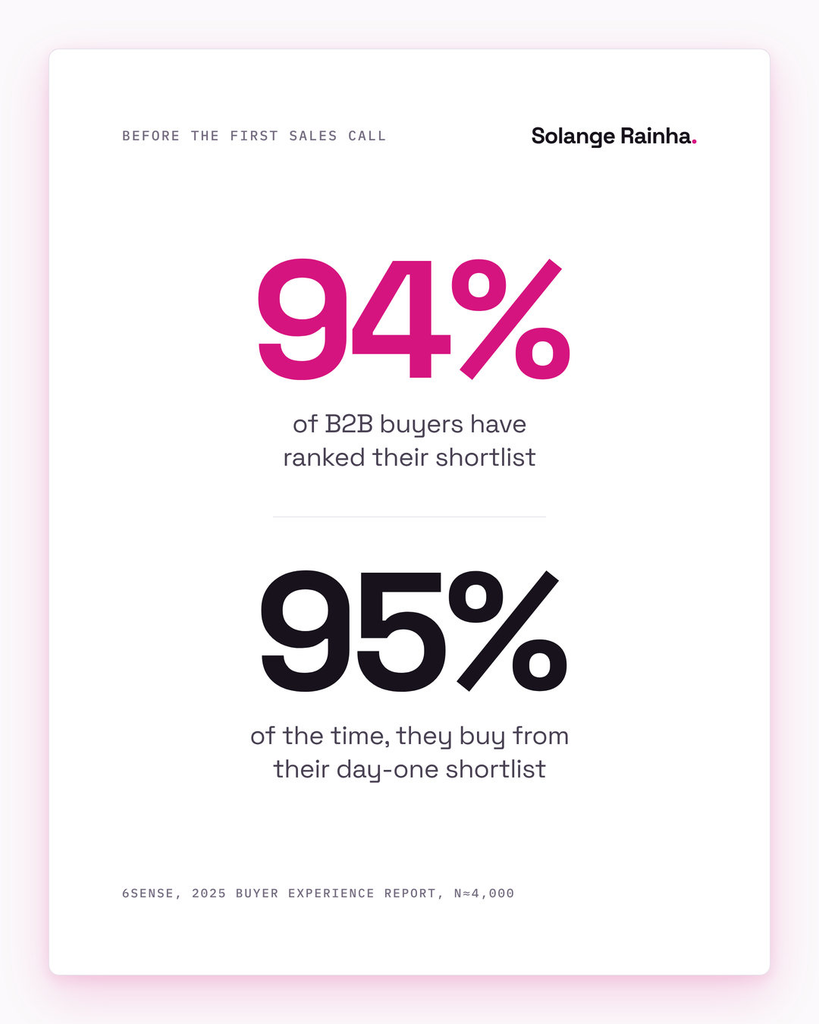
Buyer behaviour backs this up hard: Gartner’s research found that B2B buyers spend only about 17% of their buying time meeting potential suppliers, so most of the decision happens while they’re reading, comparing and forming opinions on their own. Its 2026 survey of 646 B2B buyers found 67% prefer a rep-free experience, and Gartner’s Alyssa Cruz summed it up: “B2B buyers are progressing through critical buying tasks in more autonomous ways.” By the time they talk to anyone, the shortlist is set: the 6sense 2025 Buyer Experience Report, from nearly 4,000 buyers, found 94% had ranked their shortlist by preference before engaging a seller, and buyers picked from their day-one shortlist 95% of the time. Your content does the selling in that window, so if the awareness content they hit first is filler, the filler is what they judge you on.
What works at each funnel stage in B2B SaaS?
Whatever answers the question the buyer is asking at that stage, which means format follows the job and never the stage label. Most stage-specific advice assigns formats mechanically (blog post for awareness, webinar for consideration, demo for decision) and calls it strategy. Here’s how I map it:
| Stage | The buyer’s question | The job | What fits | What to measure |
|---|---|---|---|---|
| Awareness | Do I have this problem? | Earn the right to be remembered | Opinion, original research, framing pieces | Engaged reach, AI citations, return visits |
| Consideration | What are my options? | Help them get the problem right | Category comparisons, frameworks, evaluation guides | Multi-page sessions, returning visitors |
| Decision | Why you, and not the other three? | Remove the reasons not to buy | Vendor comparisons, case studies, ROI reasoning, security and integration docs | Pipeline contribution, sales usage |
At the top, the buyer may not know they have the problem you solve, or they know the problem but not that solutions like yours exist. The job is education and authority, so what earns attention gives the reader a method they can use, takes a stance on a live industry question, or puts original research in front of them that they can’t get from ten identical pages. Anything that rushes to pitch your product fails here, because the buyer hasn’t asked yet and the sell reads as noise.
In the middle, the buyer knows the problem and is working out how to solve it, so you’re helping them understand the range of approaches, the trade-offs between them and what to look for. Content about when your category is and isn’t the right fit does enormous work here, because it makes you the guide they trust while the pushier vendors are still pitching. Deep how-to content, frameworks for evaluating options and pieces that name the hidden costs of the status quo all fit too. The buyer is building a mental model of the solution space, and you want your thinking baked into it before they start comparing named vendors.
The decision stage is where my own best evidence sits. The buyer is comparing named options, including yours, and looking for reasons to feel confident or to rule you out, so the job is buying confidence: vendor comparison pages, detailed case studies with outcomes, ROI reasoning, security and integration documentation, and anything that answers the objection a buyer raises right before they commit. It has to be accurate to the decimal, because sales is on the hook for it.
When a B2B SaaS company serving higher education institutions pivoted from admissions-led to IT-first positioning, I rebuilt its content strategy, and the work that moved deals was the technical decision-stage material I built from scratch for CIOs and CTOs. The order was integration blueprints, then security documentation, then architecture guides, because that was the order in which sales was getting stuck. I covered how I wrote for that audience without an engineering background in writing for technical buyers.
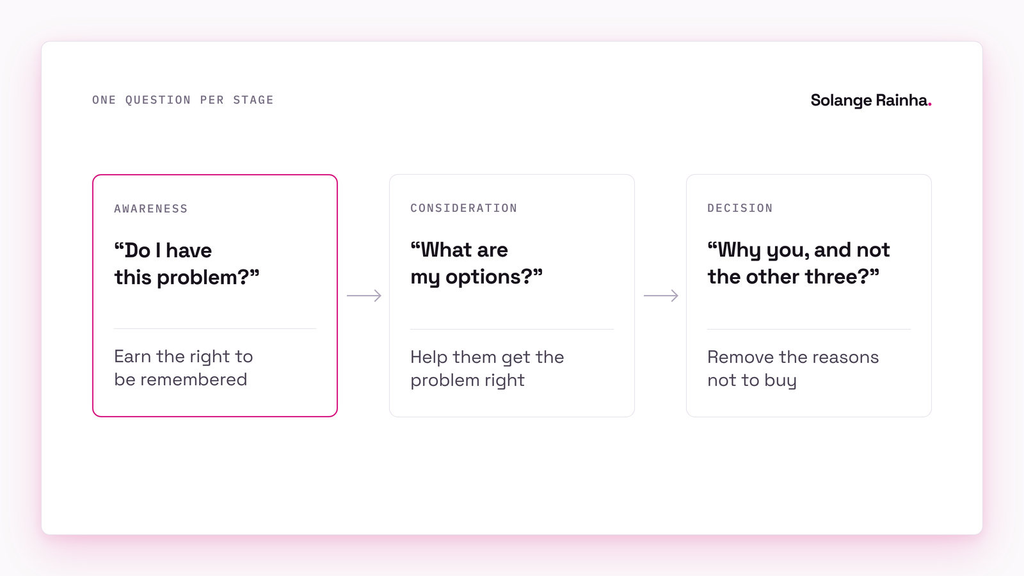
The same piece rarely works across all three stages because the buyer’s question is different at each one. A first-touch reader asking “what is this even about?” needs a different piece from a decision-stage reader asking “why you and not the other three?”, and a post trying to serve both ends up too salesy for the top and too vague for the bottom. The stages also have to set each other up, which is the argument behind a full-funnel content strategy that survives past 90 days. Running all this across several personas, each at different stages, is its own logistical problem, and I wrote up how I handled it solo in five buyer personas, one content marketer.
Why can’t a pageview chart tell good awareness content from bad?
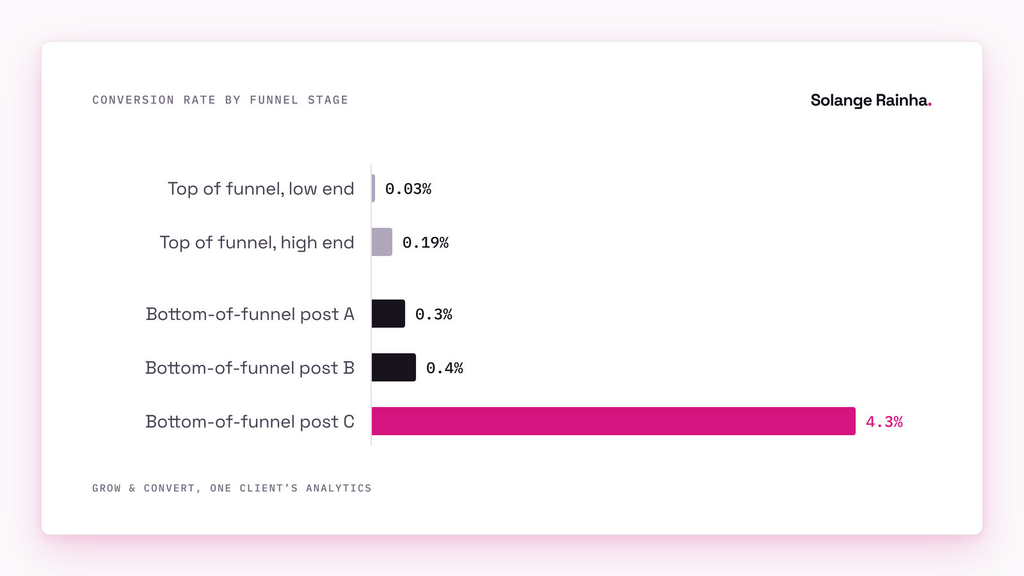
Because traffic and buying intent sit at opposite ends of the funnel. Grow & Convert’s Benji Hyam published one client’s analytics where the top-of-funnel posts converted at between 0.03% and 0.19%, while three bottom-of-funnel posts converted at 0.3%, 0.4% and 4.3%. It’s one client’s data from an agency that sells bottom-of-funnel content, so read it as a pattern, but it’s the pattern I’ve seen every time: top-of-funnel content pulls far more traffic and converts at a rate that makes the traffic gap look irrelevant.
A high-traffic awareness post that nobody remembers and that never feeds a downstream decision is a vanity result, while a lower-traffic post that teaches a buyer a new idea, gets shared inside their company and plants your name as the people who understand the problem can look worse on the same dashboard. The pageview chart can’t tell the two apart, which is precisely why you can’t run a content strategy off it.
How much B2B content goes unused?
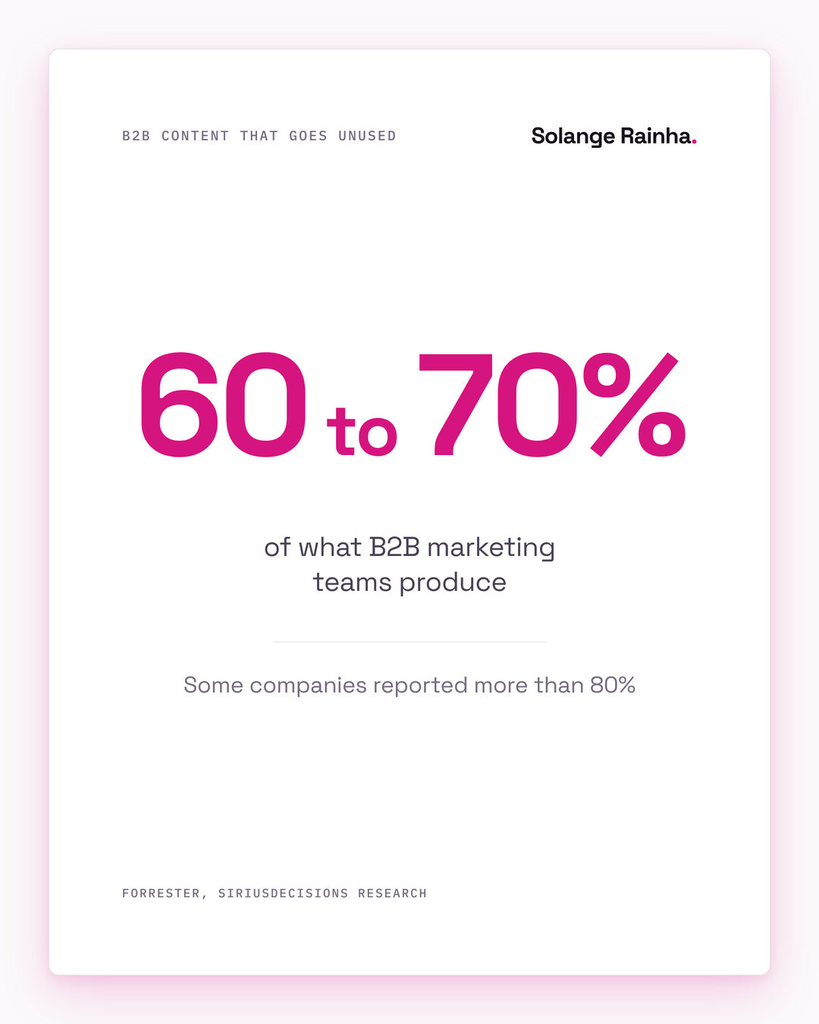
Most of it. Forrester has reported that 60% to 70% of content produced by B2B marketing organisations goes unused, and some companies put their own figure above 80%. It’s an old finding, first presented at a SiriusDecisions summit in 2013, but it matches what I find in audits: when I tag a library by funnel stage, it almost always comes out heavily awareness-weighted, because top-of-funnel content is more enjoyable to write and easier to get approved. The waste comes from overproducing the wrong work, with no system for deciding what was worth making in the first place.
Deciding what not to write is half the job, and it’s the half nobody trains you on. I built a whole prioritisation system around it, and the habit it enforces that helps most is gating every awareness idea on impact before it touches the calendar, because a top-of-funnel idea that can’t say in one sentence what it’s supposed to achieve is almost always filler.
What would I do differently, and where does this argument break down?
I’ve been the person publishing filler: early in a few roles I shipped awareness content I wouldn’t have sent to anyone, because the calendar demanded a post and I didn’t have a better idea ready; some of it ranked, and none of it did anything for the business. If I were starting over, I’d publish less and cut the dead weight harder, because a smaller blog of pieces that each make a point beats a large one where the good work is buried under the filler.
The argument has limits: useful, opinionated awareness content is slower and more expensive to make than listicles, and not every company has the appetite for that trade. If leadership measures content purely on volume and traffic, this is a hard sell, and you may have to win it one quarter at a time by showing that the few strong pieces outperform the pile of weak ones on the metrics that connect to revenue.
The “would I send this” test is a judgement call too, so it works best when the person applying it has the taste and the domain knowledge to know what a good answer to the reader’s question looks like. On a junior team without that calibration, you still need editorial standards doing the work the gut check can’t. And the funnel isn’t a straight line: plenty of buyers now land on a decision-stage page from an AI answer having never seen your awareness content, so your late-stage pages have to stand on their own whatever the top of the funnel is doing.
Frequently asked questions
Awareness stage content is top-of-funnel material aimed at buyers who are either just realising they have a problem or learning that solutions like yours exist. In B2B that usually means educational guides, opinion pieces, original research, and framing content that helps a reader understand their own situation. Its job is to build familiarity and authority, not to convert, so it should be measured on whether it earns attention and trust rather than on immediate leads. The common failure is treating it as cheap lead bait, which is how it becomes filler.
Yes, and the research is the reason it matters more, not less. Gartner found B2B buyers spend only about 17% of their buying time with suppliers and most prefer a rep-free experience, which means your awareness stage content is doing the work a salesperson used to do during that long self-directed research window. If that first content is useful and credible, you’re on the shortlist before a conversation ever happens. If it’s filler, you’ve taught the buyer to ignore you at the exact moment they were forming their opinion.
Because the buyer is asking a different question at each stage. A top-of-funnel reader wants to understand a problem, a middle-of-funnel reader wants to understand the options for solving it, and a bottom-of-funnel reader wants reasons to choose you specifically over named competitors. A single piece trying to serve all three ends up too promotional for early-stage readers and too vague for late-stage ones. Matching the content’s job to the buyer’s actual question at that stage is what makes funnel-stage content work, rather than mechanically assigning a format to each stage.