Writing technical content for CIOs and CTOs without an engineering background is possible when you’re rigorous about research, stakeholder verification, and knowing the limits of your own understanding. This article covers the research methods, stakeholder interview techniques, and verification processes I used to build integration blueprints, security documentation, and architecture guides from scratch during a GTM pivot at a B2B SaaS company serving 200+ higher education institutions.
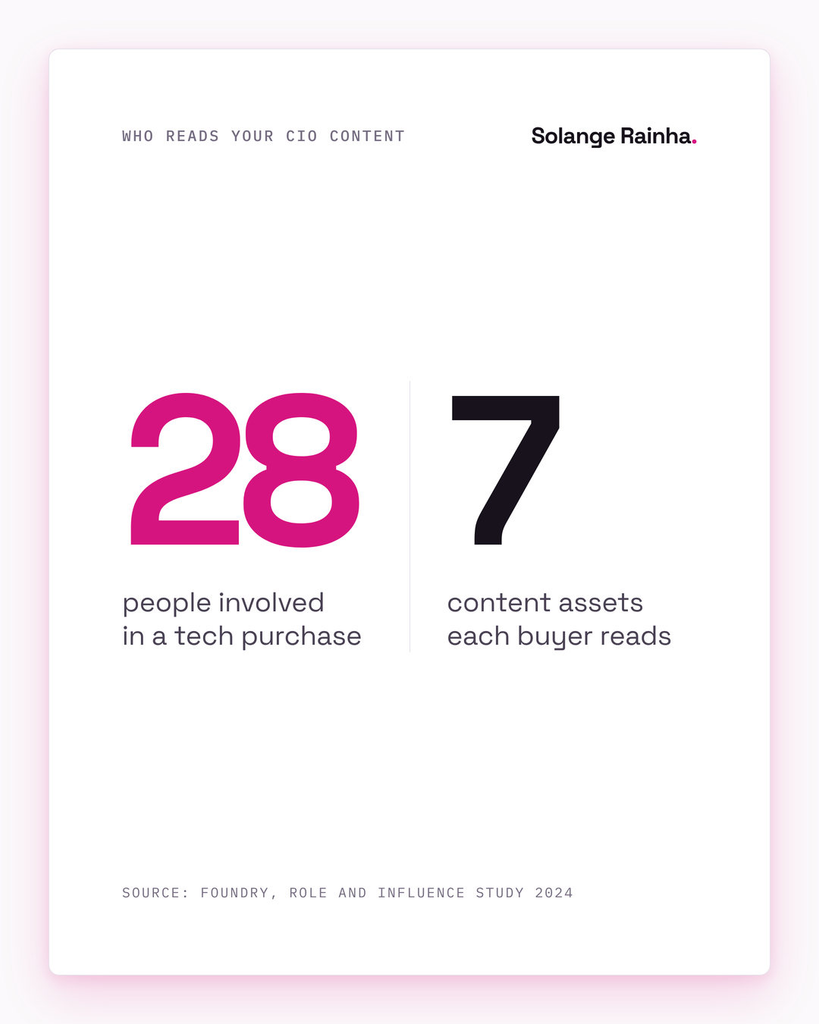
Technical content for CIOs doesn’t need an engineer to write it; it needs a writer who researches like one, checks every claim with someone who knows, and leaves out anything nobody can confirm. CIOs read vendor content to decide whether you’re worth a demo, and they do it alongside a lot of colleagues: Foundry’s 2024 Role and Influence of the Technology Decision-Maker study found an average of 28 people involved in a technology purchase, each consuming around seven pieces of content. I built that content from nothing during a pivot to IT buyers, and the trade-off is that rigour is slower: you publish less, and you publish only what’s been checked.
I have a content marketing background: blog posts, whitepapers, case studies, landing pages, social campaigns, and writing for five buyer personas at once. I’d written for technical readers before, covering defence, aerospace and healthcare at an IT consultancy, which I wrote up in how to write for technical audiences. What I’ve never had is an engineering degree, and I’d never had to explain a SaaS platform’s integrations to the CIOs deciding whether to buy it.
So when the company shifted its go-to-market from admissions to IT buyers, and the content we needed for CIOs and CTOs didn’t exist (no integration documentation, security content or architecture guides), I had a choice: wait for someone more qualified to be hired, which wasn’t on the roadmap, or figure it out. I figured it out, and it taught me more about the core skill of content marketing than almost anything else I’ve done.
What does “good enough” technical understanding look like for technical content for CIOs?
Good enough means understanding a system well enough to describe it correctly and knowing exactly where that understanding stops. I was never going to become a technical expert, and any CIO reading the content would have spotted me pretending, so the goal was narrower: content accurate enough to be credible and specific enough that a CIO could use it to decide whether the platform was worth their time.
A lot of content marketers freeze when they’re asked to write outside their field, because they think they need to master the subject first. You don’t, and the data agrees that depth isn’t the gap: in the Content Marketing Institute’s 2026 B2B research, only 11% of B2B marketers rated their thought leadership advanced or leading, a problem of process far more than of expertise. You need to get good at research and build working relationships with the people who have the expertise, and the editorial rigour you already have does the rest, as long as you actually apply it.
The expertise almost always exists inside the company; the problem is getting it out. In the Content Marketing Institute’s 2026 research on technology marketers, 77% said fewer than 15% of the employees with specialised knowledge contribute to their thought leadership. The same research found 66% of tech marketers rated their marketing effective against 59% of all B2B marketers, and CMI put that edge down to alignment and maturity, which comes down to process rather than technical depth.
Where does the technical knowledge come from?
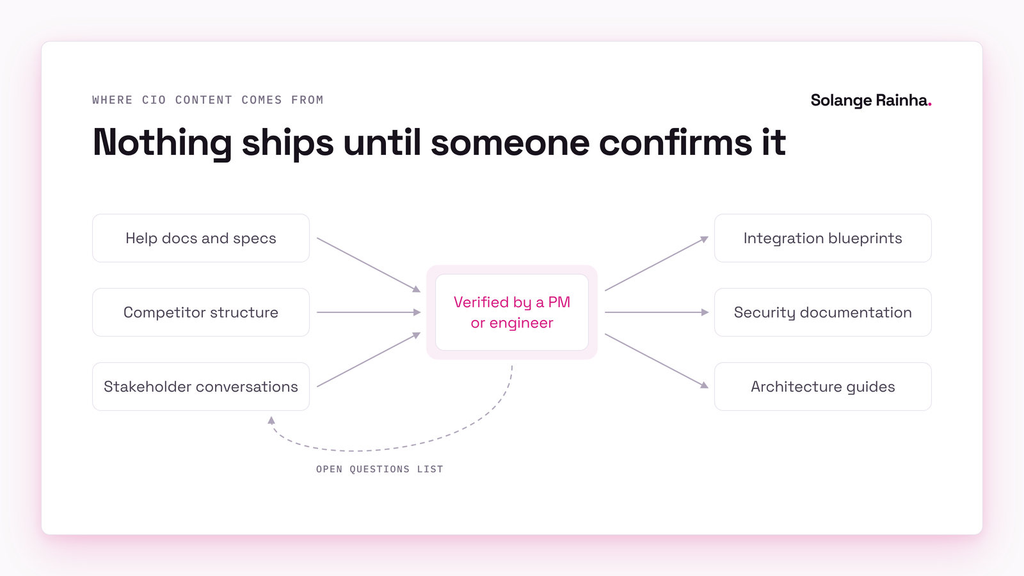
The technical knowledge comes from three places: the documentation the company already has, the people who built the product, and the way comparable companies structure the same content. None of it came from my head.
Help documentation and internal product specs were the foundation. The company had detailed help articles and internal docs on how integrations worked, what data flowed where and which security protocols were in place. Most of what I needed already existed, buried in engineering-facing documents no prospect would ever read, so my job was to turn it into a page a CIO could scan in five minutes and come away knowing what they needed.
Stakeholder conversations filled the gaps, because some features weren’t documented, or the docs had gone stale or contradicted each other. I talked to product managers, engineers and the CTO, and learned fast that specific questions get specific answers: “Tell me about our integrations” gets a twenty-minute monologue that’s interesting and hard to write from, while “The help docs say we support [System X] via REST API: is that still accurate, what’s the typical setup time, and are there limitations the docs don’t mention?” gets an answer you can use. I’ve written up the full interview approach in how to get knowledge out of a subject-matter expert.
Competitor content gave me a structure to start from. I didn’t copy anyone, but I studied how SaaS companies in adjacent spaces structured technical content for IT buyers: the headings, the level of detail and what they assumed the reader already knew. That gave me a format, so I wasn’t inventing the structure while also learning the subject.
How do you write integration documentation for CIOs?
You write integration documentation for CIOs by answering the business questions a buyer has about each integration, leaving implementation detail to the engineers’ docs, and by structuring every blueprint identically. Integration content came first, because prospects were asking “does your platform connect to our student information system?” and sales had nothing to send.
The technical detail was never the hard part; the hard part was knowing what a CIO needs against what an implementation engineer needs, because they’re different documents:
| What a CIO evaluating vendors needs | What an implementation engineer needs | |
|---|---|---|
| The question | Is this worth a demo, and what will it cost us to run? | How do I set this up without breaking anything? |
| Systems | Which named systems it connects to, and how deeply | Endpoints, authentication, field mappings |
| Effort | Realistic setup time, and whether custom development is needed | Step-by-step configuration |
| Data | What moves where, and how it’s protected in transit | Payload formats, error handling, retry logic |
| Limits | Known limitations, stated plainly | Workarounds and edge cases |
| Format | A document they can scan in five minutes and forward | A reference they’ll come back to during setup |
Those CIO questions are business questions dressed in technical clothing, and a content marketer is well placed to answer them, because the whole job is thinking from the reader’s side. Foundry’s study makes the same ask of vendors: clear, credible and accessible content for each role in the buying group. Every integration blueprint I wrote followed the same structure:
- What the integration does, in plain terms
- Which specific systems are supported, named rather than “a wide range of partners”
- Realistic setup timeframes
- Whether custom development is required
- How data flows and how it’s protected
- Known limitations
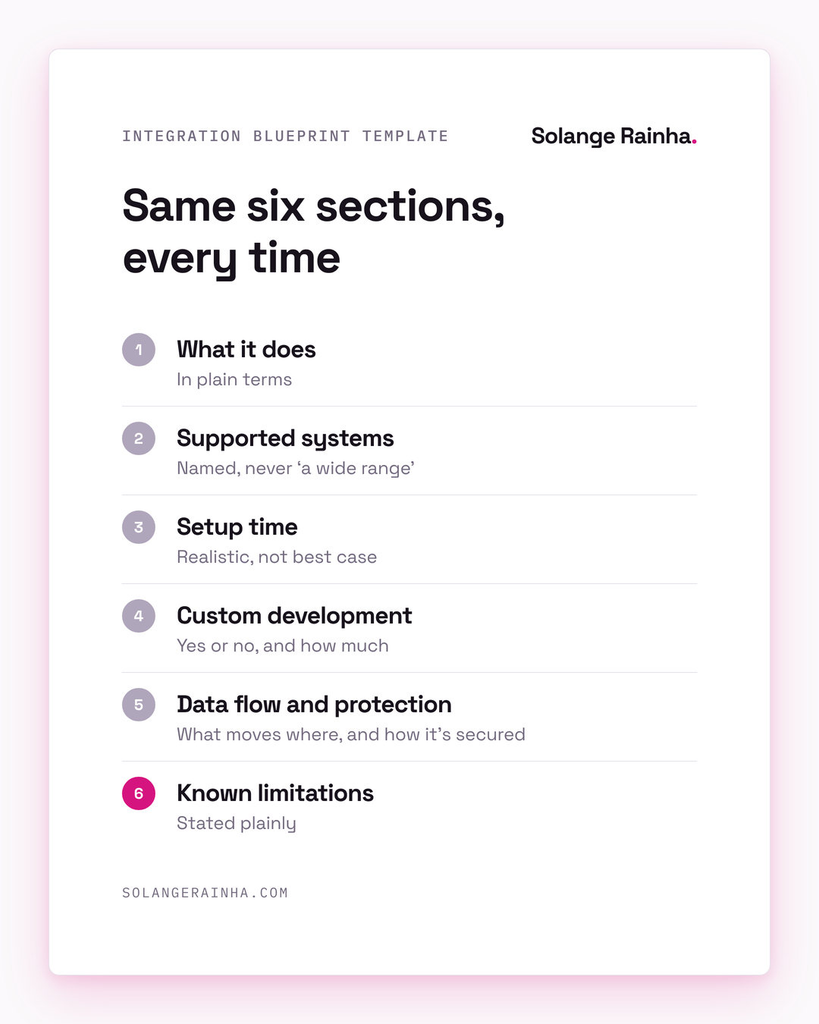
The consistency meant CIOs comparing several integrations found the same information in the same place every time. I checked each section against help documentation and had a product manager or engineer confirm it before publication, and if a detail wasn’t documented and nobody could confirm it, it didn’t go in. I’d rather publish a shorter document that’s completely accurate than a longer one with a guess buried on page three.
How do you write security content for CIOs when the stakes are this high?
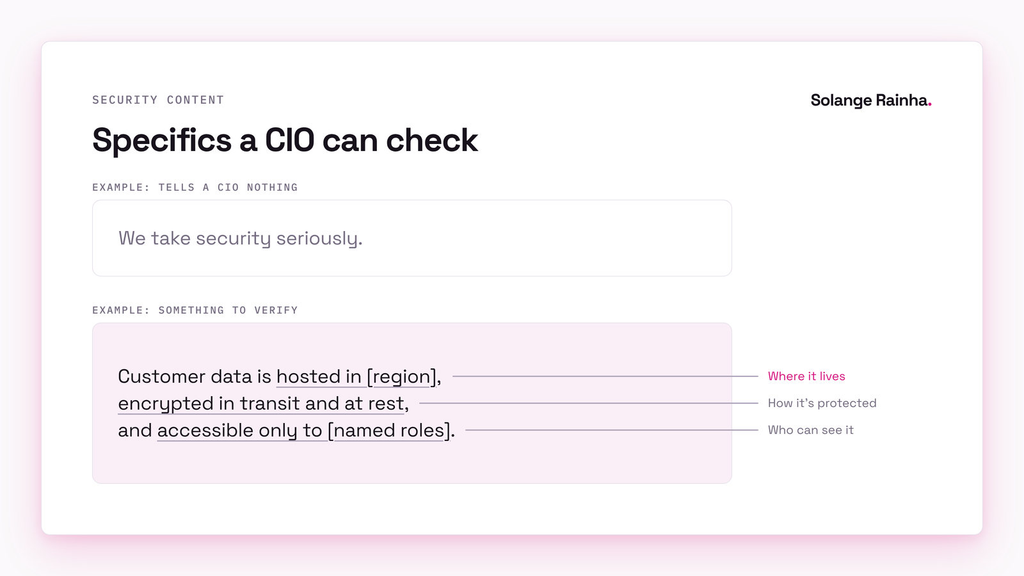
You write security content for CIOs by starting from what’s already documented and verified and adding nothing that someone with authority hasn’t confirmed. It was the most nerve-racking content to write: get a blog post slightly wrong and you lose some credibility, but get security documentation wrong and you’re looking at legal problems, lost deals and trust damage that’s hard to come back from.
So I kept the approach conservative: I didn’t extrapolate, and I didn’t fill gaps with reasonable assumptions. Security review is also where deals stall without anyone telling you: Forrester’s 2026 State of Business Buying found procurement acting as a decision-maker in 53% of buying cycles. CIOs needed compliance and certifications (which standards the platform actually met, with evidence), data handling (where data lives, how it’s encrypted, who has access, what the breach protocol is), hosting and disaster recovery, and access control, and while not all of it was hard to write, all of it had to be exactly right. Where data lives is getting more scrutiny, not less, as Gartner’s CIO Agenda 2026 put it:
“Think beyond cybersecurity. Risk-readiness now includes tariffs, sovereignty laws and vendor nations.”
The tone rule was to be confident about anything we could prove and say nothing about anything we couldn’t. I never wrote “we take security seriously”, because that phrase tells a CIO nothing; either you can describe your security posture in specifics or you can’t, and CIOs spot the difference immediately. The people reviewing it are often ones the content marketer never meets, which is exactly why the document has to work without anyone there to explain it.
One practice turned out to be surprisingly valuable: I kept a running list of questions I couldn’t answer from the existing docs and took it to my next conversation with a product manager or engineer. Some of those questions exposed documentation gaps, features we had but had never written down, while others flagged things we needed to build or fix, so writing the content caught product and documentation problems nobody had spotted. That’s one of the strongest arguments for involving content marketers in technical documentation: we ask the naive questions engineers skip because the answers seem obvious, and sometimes the obvious answer turns out to be undocumented, inconsistent or wrong.
How do you write architecture guides without a technical background?
You write architecture guides by working backwards from the one question a CIO is asking, “how does this fit into what we already have?”, and building outward from the simplest accurate description. Architecture was the most conceptually demanding format: you’re writing about system relationships, data flows, deployment models and hosting, and getting it wrong goes beyond embarrassing into actively misleading.
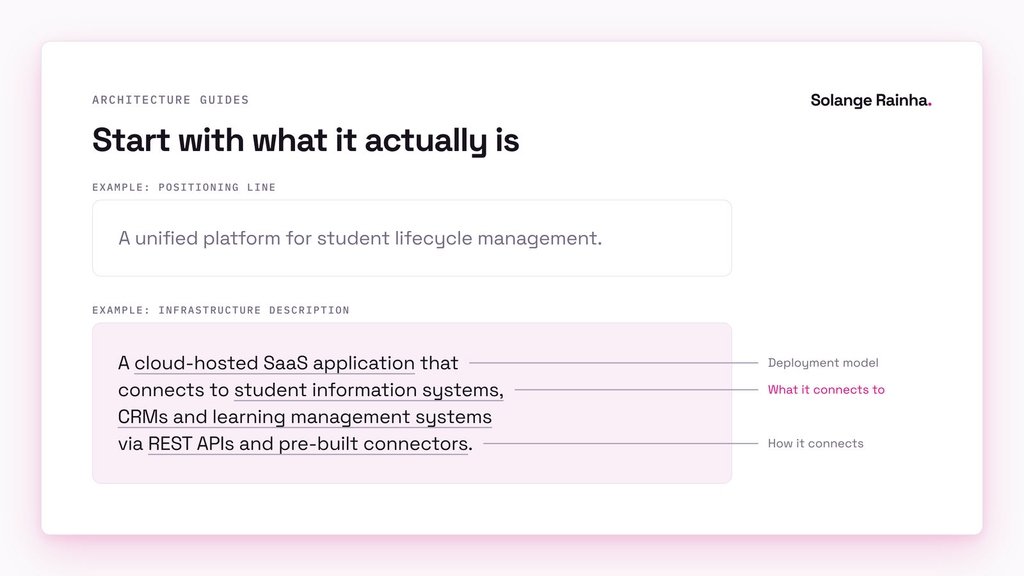
Every guide started with the platform at infrastructure level. Instead of “a unified platform for student lifecycle management”, I’d write something like:
“A cloud-hosted SaaS application that connects to existing student information systems, CRMs and learning management systems via REST APIs and pre-built connectors.”
From there I mapped the typical integration points, walked through how data moves between systems, and got specific about what the customer’s team handles and what the vendor takes care of.
The biggest lesson was that CIOs want it made clear, which is a different job from dumbing it down. Simplifying until you hide complexity that exists is worse than being hard to read, because CIOs know their environments are complicated, and they trust the vendors who admit that and can explain how their product works inside it, while vendors who pretend everything is easy don’t get taken seriously. I make that argument at length in why simplifying complex B2B products backfires.
What did writing technical content for CIOs teach me about content marketing?
Writing technical content for CIOs taught me that the core skill of content marketing is research and verification, and that everything before the first sentence decides whether the piece is worth reading. The writing counts, obviously, but it’s the research that makes it credible.
Credible technical content tends to come from companies whose content people do the research, build the stakeholder relationships and keep the verification process that makes accuracy non-negotiable, whatever the size of their engineering team, which is the wider argument in why writing quality is a competitive moat. The editorial standards I’d already built were what let me write technical content at speed, because every claim needed a documented source before it went live.
If you’ve been asked to write outside your comfort zone, whether that’s technical, financial or legal content for readers who know more than you, you can do it by being a very good researcher who writes well rather than a fake expert. At the higher education SaaS company, the CIO content was part of the pivot to IT buyers and of a content operation that contributed to 48% of marketing-sourced pipeline in peak months. The bar for most technical content is low (be accurate and clear, and don’t make anything up), and since most content doesn’t clear even that, the content marketer who does the research stands out for being rigorous, no brilliance required. I also structured all the CIO content with my AEO/LLMO framework, because technical buyers increasingly research with AI tools, and content built for extraction reaches them where search alone doesn’t.
Frequently asked questions
Yes, a content marketer can write credible technical content for CIOs if they’re rigorous about research, verify every claim with someone who knows, and stay inside the limits of their own understanding. CIOs evaluating vendors need business-level technical information: which systems integrate and how deeply, how long setup takes, whether custom development is needed and what happens to their data. Those are business questions in technical clothing, and the research and reader-first habits content marketers already have carry over directly.
You verify technical content without subject expertise by tracing every claim to a documented source (help documentation, internal product specs or direct confirmation from a product manager or engineer) and keeping a source log for each piece. Treat anything undocumented as a question for a stakeholder, not a gap to fill with an assumption. Specific questions like “is the REST API integration with System X still accurate, and what are its limitations?” get far more usable answers than “tell me about our integrations”. If you can’t trace a claim, remove it rather than hedging it.
CIOs need business-level technical detail in vendor content rather than implementation specifications. That means the specific systems that integrate (named, not “a wide range of partners”), realistic setup timeframes, whether custom development is required, how data flows and is protected, compliance and certification evidence, and known limitations. Foundry’s 2024 research found an average of 28 people involved in a technology purchase, so the content has to give each of them enough to decide whether the platform is worth evaluating further.
Content for a CIO answers whether a platform is worth a demo and what it’ll cost the organisation to run, while content for an implementation engineer explains how to set it up. A CIO needs the named systems it connects to, realistic setup time, whether custom development is needed, how data is protected and the known limitations, in a document they can scan in five minutes and forward. An implementation engineer needs endpoints, authentication, field mappings and step-by-step configuration, in a reference they’ll keep open during setup.