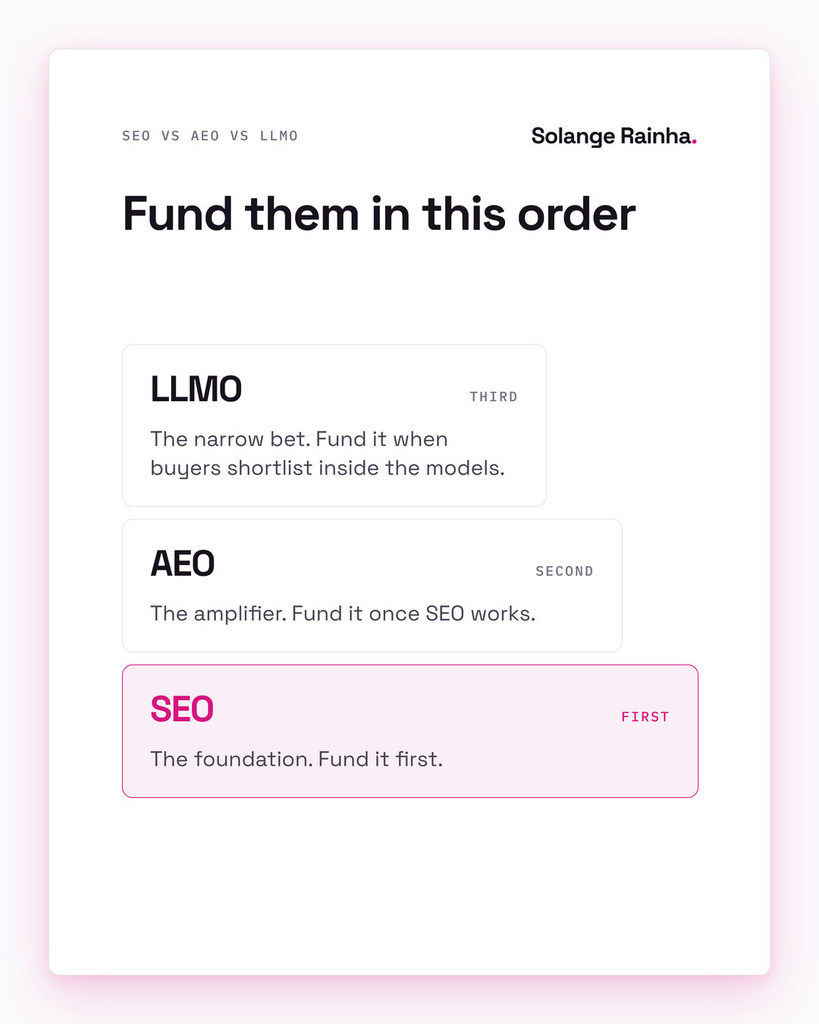
SEO vs AEO vs LLMO is a question of order. For most B2B SaaS teams the order is: keep the search engine optimisation (SEO) foundation compounding, add answer engine optimisation (AEO) once that foundation ranks and your category is full of AI answers, and treat large language model optimisation (LLMO) as a narrow bet for buyers who shortlist inside ChatGPT or Claude. The data backs the boring answer: 95.3% of ChatGPT users still visit Google, AI assistants send around 1% of site traffic, and yet an AI Overview cuts the top result’s click-through rate by 58% where it appears. The order changes with your audience, sales cycle, product complexity and competition, so the framework below runs those four checks before you spend.
Every week another tool launches promising to make you visible in ChatGPT, and another LinkedIn post declares SEO dead. The pitch is always the same: the ground has shifted, AI is eating search, and if you haven’t rebuilt your content operation around answer engines by Friday, you’re already invisible. It’s a good pitch and it sells software, but it’s the wrong frame for anyone deciding where a limited content budget goes this quarter.
The three disciplines optimise for different surfaces. SEO is the work of ranking pages in search results so people click them. AEO is the work of getting your content extracted into the answers search engines now show on the page, such as Google’s AI Overviews. LLMO goes a layer further: being the source a language model reaches for inside a ChatGPT, Claude or Perplexity conversation, often with no search and no click at all. So SEO vs AEO vs LLMO is a sequencing problem, and the smart move is ordering them against your own constraints instead of betting the budget on whichever acronym is trending this month.
| SEO | AEO | LLMO | |
|---|---|---|---|
| Where you show up | Search results pages | AI answers on search pages (AI Overviews, featured snippets) | Inside conversations in ChatGPT, Claude, Perplexity |
| What you’re after | The click | The citation, plus the clicks citations recover | Being the source the model names |
| How you measure it | Rankings, clicks, conversions | Citations in AI answers, CTR on AI-heavy queries | Mentions and citations on a fixed prompt set |
| When it pays first | Almost always, as the foundation | Once SEO works and AI answers cover your queries | When buyers shortlist inside the models |
Is the push to go all-in on AEO a panic?
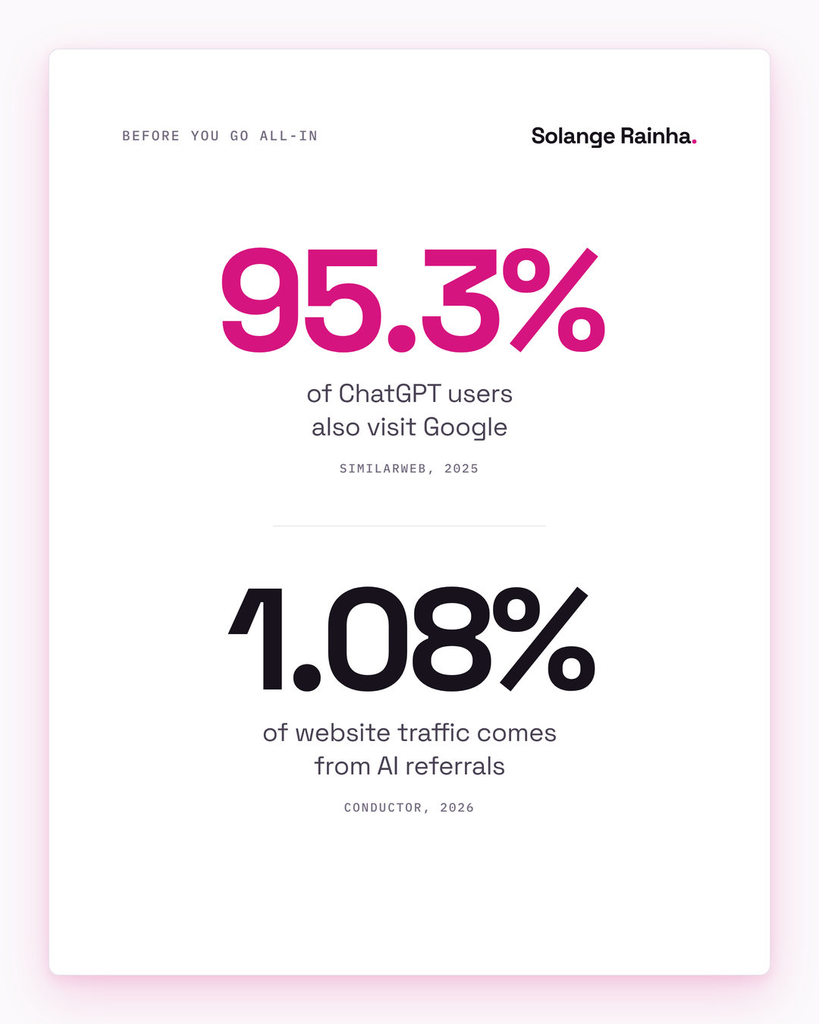
Mostly, yes. The most-repeated advice pushes every team toward AEO at once, and its volume tracks how much money is chasing the category, while the traffic data says search still carries the load. Similarweb data reported by Search Engine Land found 95.3% of ChatGPT users also visited Google in August 2025, and Conductor’s 2026 benchmark across 13,770 domains put AI referrals at 1.08% of website traffic. SE Ranking’s analysis of 101,574 sites found AI traffic grew 16 times between 2024 and 2026, from 0.02% to 0.32% of visits, which is fast growth from a very small base.
For most SaaS companies, the traffic and the pipeline still come from search as it has worked for a decade, so a team that abandons a working SEO engine to chase 1% of traffic has confused where the puck is going with where it is right now. I’ve made the fuller version of this argument in why AEO won’t save a weak content strategy, and the short version is that AEO amplifies a foundation and can’t replace one, so buying the amplifier before you’ve built the foundation gets you silence with better formatting.
Is SEO’s ROI diminishing, and where?
Yes, but unevenly, and the unevenness is the strategic point. Where an AI Overview appears, the click collapses: Ahrefs found the presence of one correlates with a 58% lower click-through rate for the top-ranking page, comparing December 2025 against a forecast, and Pew Research found people who saw an AI summary clicked a traditional result 8% of the time, against 15% for those who didn’t. I’ve dug into what that looks like in your own Search Console in impressions but no clicks and organic traffic decline.
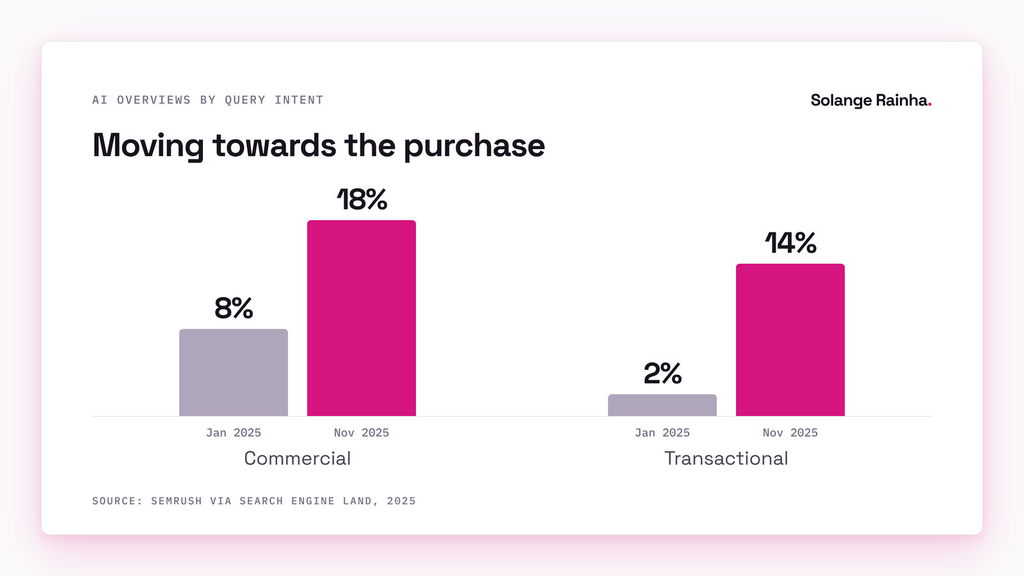
The erosion still concentrates on informational queries, the definitions and how-tos answer engines resolve on the page, but I originally wrote that Google had been pulling AI Overviews back from commercial searches, and the data now says the opposite. Semrush’s analysis of more than 10 million keywords found overall AI Overview coverage fell from just under 25% of queries in July 2025 to under 16% in November, while the share of AI Overviews on commercial queries rose from 8% to 18% and on transactional queries from 2% to 14%, so bottom-funnel pages are less exposed than awareness content, and they’re losing that protection.
If your SEO investment already skews to the converting end, as it should, the erosion is slower than the headlines suggest, but it’s no longer a reason to ignore AEO on those pages. That’s also why building SEO foundations still comes first for teams that don’t have them.
What does AEO buy you, and where?
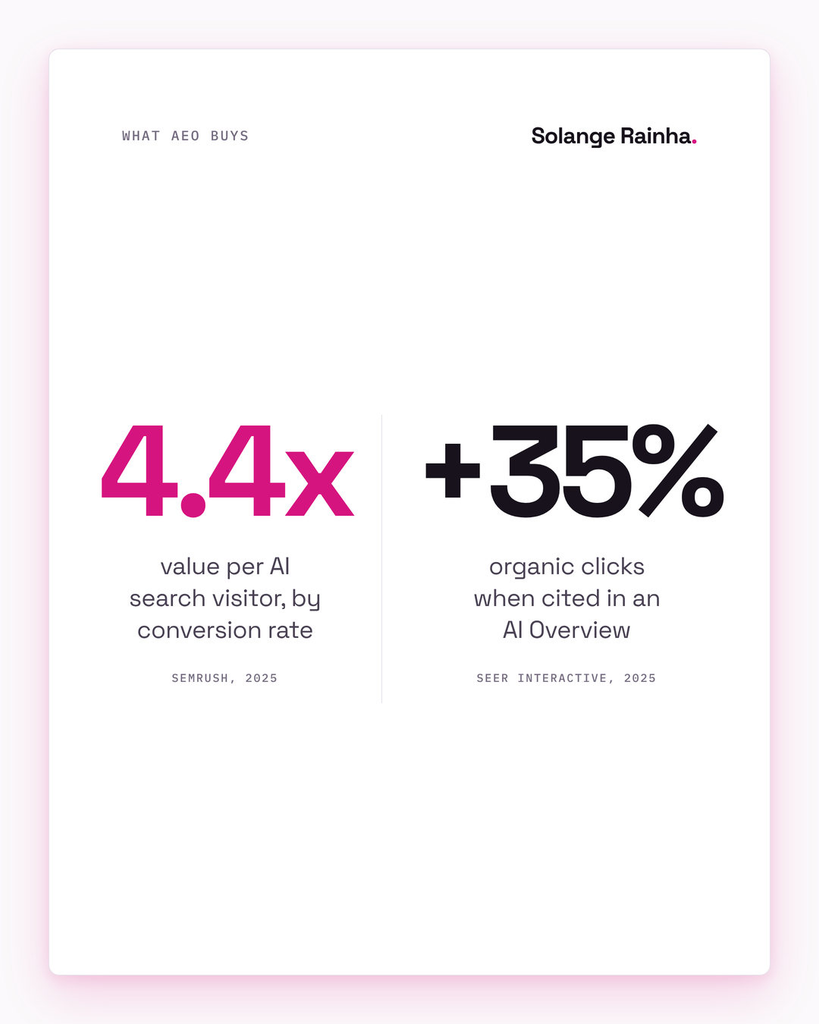
Better visitors and protection against the AI Overview, judged on quality and citations, never on volume. Semrush’s AI search study found the average visitor from an AI search source was 4.4 times as valuable as a traditional organic visitor, based on conversion rate, because someone arriving from a considered AI answer is further along than someone who clicked one blue link out of ten. Judging AEO on traffic volume is the fastest way to conclude, wrongly, that it isn’t working, which is why you need to track AI traffic in GA4 alongside its conversion rate.
The defensive half pays off wherever AI Overviews sit on your buyers’ queries: Seer Interactive’s study of 3,119 informational queries found brands cited in an AI Overview earned 35% more organic clicks than brands that weren’t (a 0.70% CTR against 0.52%), though Seer notes citation may partly reflect brand authority. The categories most saturated by AI Overviews in Semrush’s data were science (25.96% of keywords), computers and electronics (17.92%) and people and society (17.29%), so if your buyers search in those spaces, AEO stops being optional. The mechanics live in my AEO/LLMO content optimisation framework, and the first step is an AI readiness audit to see where you stand before spending a euro.
Where does LLMO-first content pay off?
Where buyers research directly inside language models, and almost nowhere else yet. LLMO is the newest of the three, which is where both the upside and the wasted money live: developer tools, technical products whose evaluators ask Claude to compare options, and long, complex B2B sales where a single AI recommendation can decide the shortlist before a human visits your site.
In a world where your next buyer might be a bot, being the cited source in that conversation is a strong edge; the catch is that the tooling is immature and much of the popular tactical advice is noise. When I checked whether adding an llms.txt file does anything for AI visibility, the citation data said no. The platform-specific tactics that do hold up are in how to optimise content for ChatGPT, Perplexity and AI Overviews. LLMO-first content is a bet worth placing only when you can name the specific buyer who decides this way, and it belongs last in the funding order.
How do you decide between SEO vs AEO vs LLMO?
To settle SEO vs AEO vs LLMO for your team, score your situation on four variables, in order, because the order changes the answer.
Audience comes first. Are your buyers’ informational queries already covered by AI Overviews, and do they research inside ChatGPT? Your category is the fastest proxy; if your buyers are there, AEO moves up the list, and if they’re not, there’s no fire and SEO keeps compounding quietly.
The sales cycle is next: a long, multi-stakeholder B2B cycle means an AI recommendation early in the research can seat you on the shortlist or leave you off it, without a click, so longer, more complex cycles push AEO and LLMO up the list, while short transactional ones keep the weight on the bottom-funnel SEO that converts.
Product complexity counts because a product that takes three meetings and a diagram to explain benefits most from being the source AI cites when someone asks it to make sense of the category. If explaining your product is hard, being the clear, citable explainer is worth more than another keyword page.
Competition settles it: if competitors already own the traditional results, AEO can be an empty lane where a smaller player gets into the answer first; if the results for your terms are already full of AI Overviews, citation is close to the only game left, and protecting it gets urgent.
| Step | Question | If no | If yes |
|---|---|---|---|
| 1 | Do you have SEO foundations that rank and convert? | Build SEO first; AEO on nothing is wasted effort | Continue |
| 2 | Are your buyers’ queries covered by AI Overviews or researched in ChatGPT? | Keep compounding SEO, add light AEO | Fund AEO now to protect CTR and win citations |
| 3 | Do buyers shortlist directly inside language models? | AEO on top of SEO is enough | Add LLMO-first content as a targeted bet |
| 4 | Are you measuring citations instead of audit scores? | Fix measurement before scaling spend | You’re allocating on evidence |
Almost every team that thinks it has an AEO problem actually has a step-one problem.
What mistakes waste the investment?
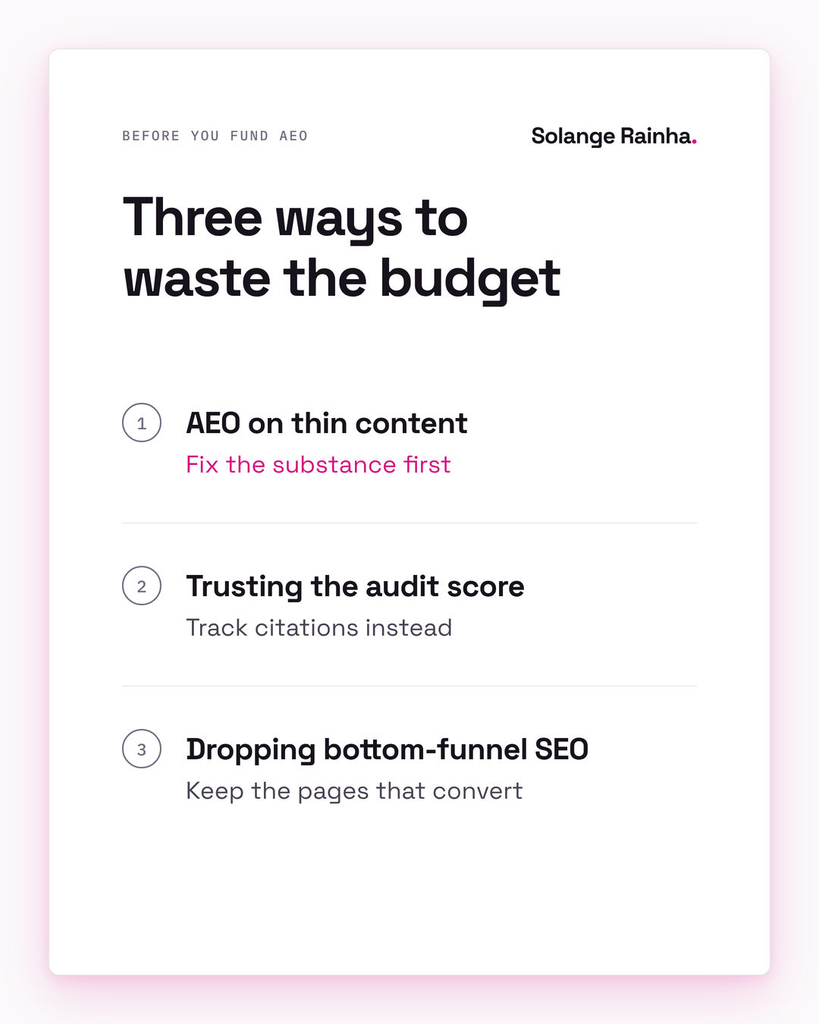
Pouring money into AEO before the SEO foundation exists is the most common and the most expensive. Schema, FAQ blocks and question-format headings bolted onto thin content produce a page that audits beautifully and gets cited by nobody, which is the failure I broke down in why most teams run the AEO playbook backwards. The Princeton GEO study (Aggarwal et al., KDD 2024) found the changes that lift visibility in AI answers are substance: quoting named sources lifted it by about 41%, adding statistics by about 31% and citing sources by about 28%, while keyword stuffing came in below baseline.
Measuring the wrong metric is the second: a green AEO audit score tells you the formatting is tidy and nothing about whether a model pulls from you, so teams stay proud of a score that doesn’t move revenue. The scoreboard is whether AI systems cite you, which means tracking citations directly and measuring AI visibility beyond the referral report.
And then there’s the mirror image of the panic: abandoning the bottom-funnel SEO that still converts because a conference talk said search was over. The pages nearest the purchase are the ones AI has touched least, so walking away from them to chase citations trades pipeline for a vanity metric.
How does my take differ from the consensus?
I think both camps are lazy: one says AEO is the new SEO and everyone should go all-in now, the other says it’s all hype, and both skip the sequencing question that decides it.
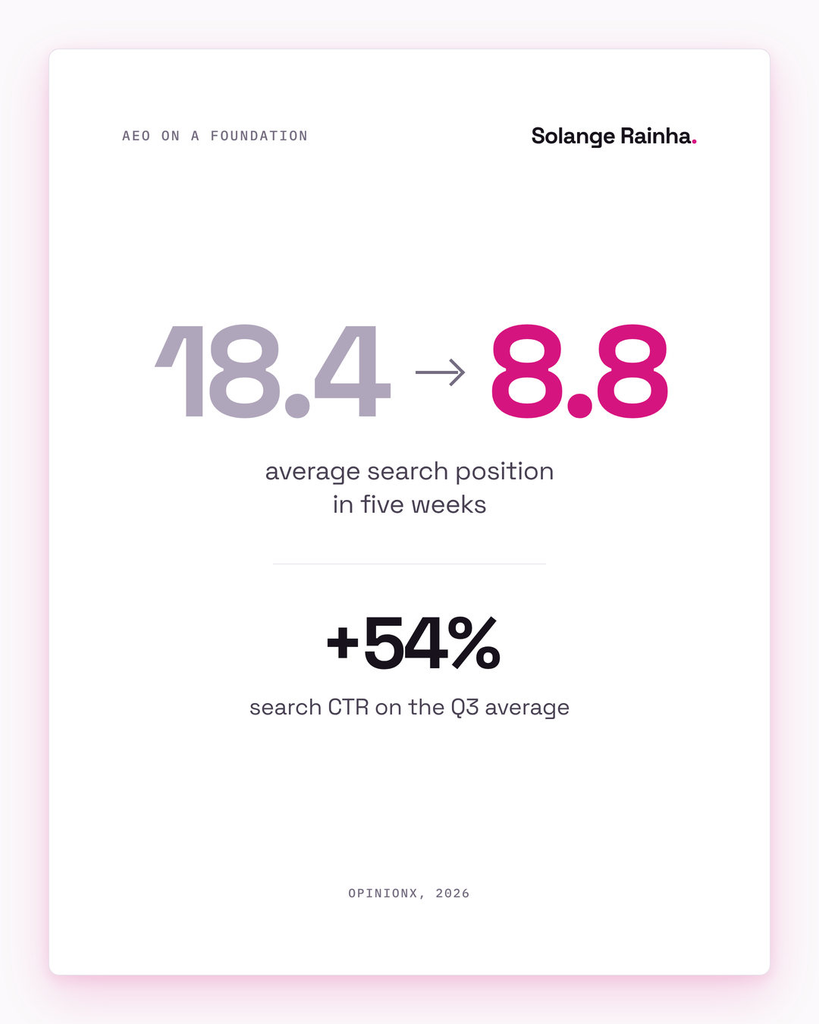
My evidence for sequencing comes from doing it: at OpinionX, I audited and updated the whole blog library for AEO/LLMO, and average Google search position moved from 18.4 to 8.8 in five weeks, with search CTR up 54% on the Q3 average. The same work that makes a page extractable for AI answers made it rank better, which is what you’d expect if AEO amplifies an SEO foundation. I also set up AI citation tracking on 20 buyer prompts, and the first baseline had OpinionX named in 38% of answers, which is the figure I watch to see whether the amplifier is working.
The answer for a pre-revenue startup looks nothing like the answer for a mature platform in a category saturated with AI Overviews, and a strategist’s job is to work out which one you are; vendors skip that step and sell you the whole stack.
Frequently asked questions
For most B2B SaaS, SEO comes first, because that’s still where the traffic and pipeline are: Similarweb found 95.3% of ChatGPT users also visit Google, and Conductor’s 2026 benchmark put AI referrals at 1.08% of website traffic. AEO becomes the priority once your SEO foundation ranks and AI Overviews cover your buyers’ queries, as they increasingly do in science and technology categories. LLMO-first content is the last and narrowest investment, worth it only when buyers shortlist directly inside language models.
No, but its returns are uneven. AI Overviews cut clicks hard on informational queries, with Ahrefs finding a 58% lower click-through rate for the top result where one appears. Commercial and transactional queries still carry fewer AI Overviews, but Semrush data shows that’s changing: AI Overviews on commercial queries rose from 8% to 18% during 2025 and on transactional queries from 2% to 14%. Bottom-funnel SEO still converts, and it’s no longer safe from AI answers.
Check whether your buyers’ queries reliably show an AI Overview, which depends heavily on your category, and whether AI-referred visitors convert well for you, since Semrush found the average AI search visitor was 4.4 times as valuable as an organic one by conversion rate. If AI Overviews cover your category and you have an SEO foundation to build on, AEO protects click-through and wins citations. If your foundation is weak, fix that first, because AEO on thin content gets cited by nobody.
Answer engine optimisation (AEO) aims to be the extracted answer on a search results page, such as a Google AI Overview or a featured snippet. Large language model optimisation (LLMO) aims one layer deeper: to be the source a model reaches for inside a conversation in ChatGPT, Claude or Perplexity, often with no search and no click. AEO pays off wherever AI Overviews sit on your buyers’ queries; LLMO pays off only where buyers make decisions inside the models themselves.