Every interview went well, the take-home assignment got called exceptional, the offer came through, then the contract negotiation started, and the company quietly showed me who it actually was. This is what a contract negotiation reveals that no interview can, the specific red flags that stacked up until walking away was the obvious call, and how to tell the difference between sloppy admin and a company testing how much you’ll let slide.
Contract negotiation red flags are the most accurate preview of an employer you’ll get before you sign, and I learned that from an offer I turned down. Every interview went well, properly well, not the kind of well you talk yourself into afterwards. The conversations were sharp, the people seemed switched on, and the hiring manager called my take-home assignment exceptional (their word, not mine). The offer came through, and on paper this was the part where you exhale, feel a bit smug and start telling people the good news.
Then the contract arrived, and within two rounds of back-and-forth I was quietly working out how I’d resign from a job I hadn’t started yet. That instinct turned out to be the most accurate read I had on the entire company, and it came from the one stage of the process nobody tells you to watch.
Why can’t interviews tell you what a company is like to work for?
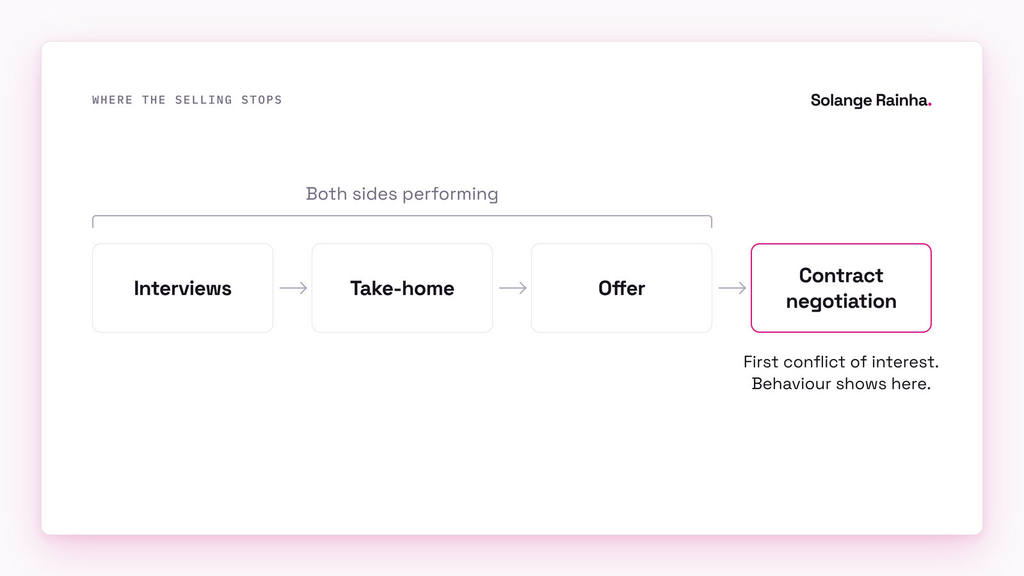
Because interviews are a performance on both sides, and everyone knows it. You rehearse your stories, they rehearse their pitch, and both of you spend an hour or two showing the most flattering version of yourselves. The company is selling the role as hard as you’re selling yourself into it, and nobody reveals their worst habits while they’re still trying to win you over.
That’s why interviews predict so little about what working somewhere feels like. In The Muse’s 2022 survey of more than 2,500 people, 72% said a new job had turned out different from what they’d been led to believe, and 48% said they’d try to get their old job back if it happened at a new company. Those are people who sat through interviews that went fine and still ended up somewhere wrong, because the interview told them what the company wanted them to believe. Interviews are lopsided in other ways too: candidates are expected to know everything about a company whose interviewers skimmed their CV, which I wrote up as hiring research asymmetry.
Broken promises from the hiring stage aren’t rare either: in Sandra Robinson and Denise Rousseau’s study of graduate management alumni, surveyed at graduation, after recruiting and again two years later, 54.8% said their employer had broken the promises it made to them, and those breaches went with lower trust and higher turnover. The title of the paper says it plainly: violating the psychological contract is “not the exception but the norm”. The negotiation is where the selling stops, and that move from courtship to behaviour is the most useful signal you’ll get before you’re stuck inside the job.
What does a contract negotiation reveal that interviews hide?
How the company handles a conflict of interest. A contract negotiation is the first time you and the employer want slightly different things at the same moment: you want protections and what you were promised, they want you signed on terms that suit them. It’s a small, low-stakes conflict, and how someone handles a small conflict tells you a lot about how they’ll handle a big one.
The company drops the performance and starts transacting with you: the recruiter who was warm and responsive goes quiet, the hiring manager who praised your work now wants to talk you out of a clause, and the friendly process turns into a series of documents, which flatter nobody. It calls for the same backbone I wrote about needing on the job in every company wants ownership until you take it: holding a line the second your interests stop lining up with theirs.
Which contract negotiation red flags should you take seriously?
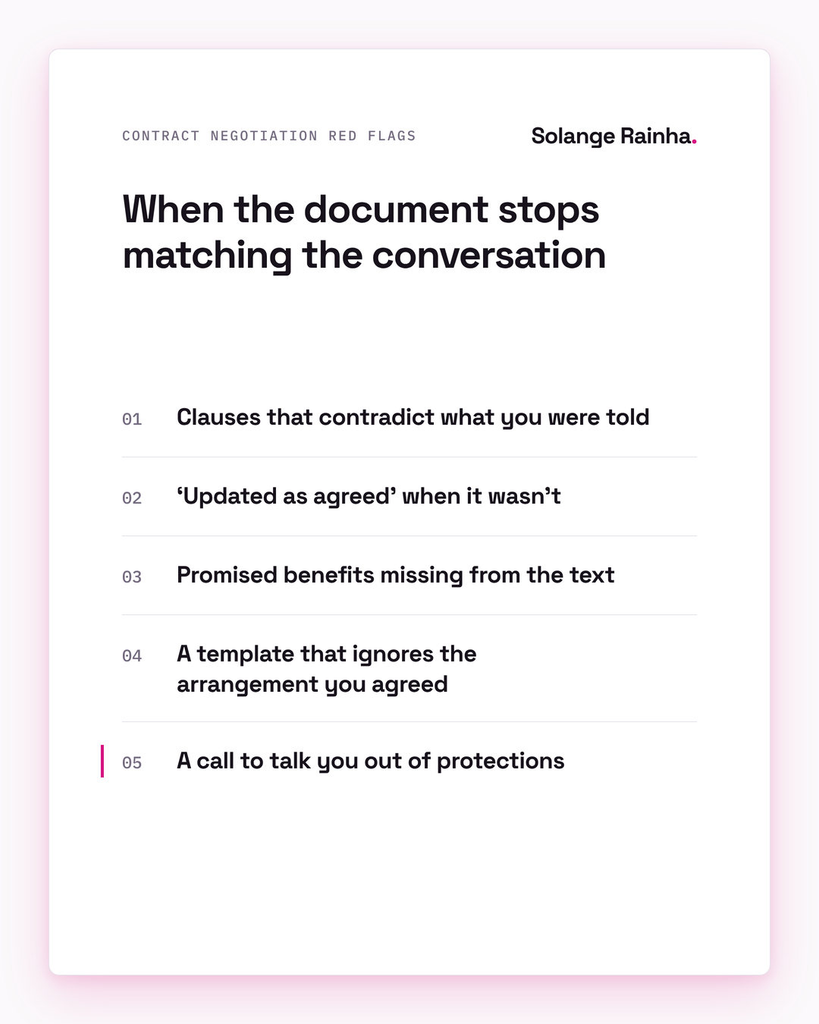
The ones where the document stops matching the conversation. Here are the contract negotiation red flags that stacked up in my case, stripped of anything identifying, because the patterns are what you want to recognise when they turn up in yours.
Clauses that contradicted what I’d been told in conversation. Things agreed verbally, and warmly, arrived in the document saying something different or quietly missing. Getting every promise in writing exists as advice precisely because verbal commitments evaporate between the call and the contract, and in the EU it’s close to a legal baseline: Directive 2019/1152 requires employers to set out essential terms, pay and paid leave among them, “in the form of one or more documents”, with the core items due within a week of your first day. Asking to see those terms before you sign is asking for what you’d be owed anyway. (I’m not a lawyer, and national rules vary, so check your own country’s version.)
A version came back marked “updated as agreed” that hadn’t been updated as agreed. This one is worse than a missing clause, because it’s a claim about reality that’s checkably false: either nobody read the changes before sending, or somebody hoped I wouldn’t. Both are a problem, and I’ll come back to why.
Then the benefits: things that were present in the offer conversation were absent from the contract text, never negotiated away or even discussed, just gone, as if the conversation where we’d agreed them hadn’t happened.
A template that hadn’t been adapted to the working arrangement we’d agreed. The contract described a set-up we’d explicitly moved away from in the interviews, which meant either the agreement hadn’t registered or it wasn’t going to be honoured.
And the one that sealed it: a call from the hiring manager whose purpose was talking me out of protections I’d asked for. There was none of the “here’s why this clause works differently than you think” reasoning a fair negotiation involves, just pressure dressed up as a friendly chat. The person who’d been selling me the role was now working to get me to accept less, and doing it personally.
How do you tell sloppy HR from deliberate boundary-testing?
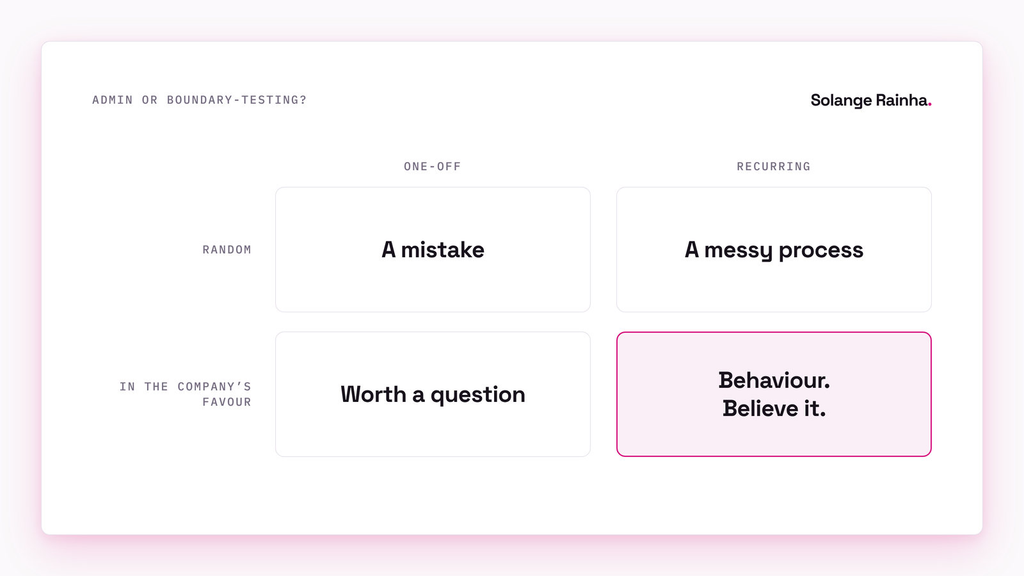
By repetition and direction. One mistake is a mistake, but the same kind of mistake happening again across versions of the document is behaviour, and if every slip lands in the company’s favour, carelessness stops being the likely explanation. This takes discipline, because the generous reading is always available and always tempting: maybe HR is overworked, maybe the template is old, maybe the missing benefit was an oversight. People want the offer to be good, so they’ll narrate almost anything as a harmless mistake.
When agreed terms keep going missing, getting contradicted or quietly reversed across several rounds, the company is showing you its operating standard, and “updated as agreed” on a version that wasn’t is the tell that tips it from incompetence toward something you don’t want to sign up for.
| Signal | Sloppy admin | Boundary-testing |
|---|---|---|
| Errors | One-off, and fixed fast once you point them out | Recurring across versions, and slow to fix |
| Direction | Random, sometimes in your favour | Always in the company’s favour |
| When you push back | They explain, correct and apologise | They go vague or apply pressure |
| Who handles it | HR or legal, as admin | The hiring manager, personally |
There’s a cleaner signal underneath, which is good faith: a company explaining its reasoning, holding firm where it needs to and being straight about what it can and can’t do, while boundary-testing looks like pressure, vagueness and a bet that you want the job badly enough to stop pushing. The hiring manager’s call was the moment the second pattern became impossible to misread, because good-faith negotiators don’t need to talk you out of protecting yourself.
You can’t always tell from the outside whether you’re looking at malice or a shambolic process, but for the decision in front of you the distinction barely counts. A company chaotic enough to keep mishandling your contract will be chaotic with you once you’re inside, and a company that’s testing you will keep testing you, so you’re choosing whether to live inside the pattern either way. Boundaries you can’t hold before you sign get harder to hold after, which is the whole fight behind what quiet quitting described. If you’re weighing whether the company will even be around in two years, that’s a separate check, which I cover in employer due diligence.
When your gut says walk, is that data or just nerves?
It’s data when you can point to the moments that caused it. Somewhere in the second round I noticed I was mentally drafting my resignation, not in a dramatic way, just idly planning how long I’d give it and how I’d leave cleanly, and that cut through everything else: if you’re already planning your exit before you’ve signed, the question answers itself.
People are quick to dismiss this as nerves, and sometimes it is, which is where the research on intuition helps, because it says when a gut feeling deserves trust. Daniel Kahneman and Gary Klein, who’d spent years on opposite sides of the argument, concluded in a joint paper that intuition can be trusted when the environment is predictable and you’ve had the chance to learn its patterns, and that how sure you feel isn’t a reliable sign you’re right. As Klein put it in an interview with McKinsey: “If those criteria aren’t met, then intuitions aren’t going to be trustworthy.”
Hiring processes are predictable enough, and after 15 years in marketing I’ve seen plenty of them and know what normal looks like. So I treat the feeling as a prompt to go looking and the concrete contract negotiation red flags I turn up as the evidence; when both point the same way, I trust them. If you’re early in your career, lean harder on the evidence, because the pattern-matching hasn’t had the reps yet.
Walking away is also a strategic no, the same discipline I apply to content decisions in how I decide what not to write. A good no names what it’s rejecting and why, and you make it against your own standards instead of your fear of missing out. Declining an offer because the contract negotiation showed you a pattern is exactly that kind of no.
How do you walk away from an offer without burning the bridge?
Keep it short, factual and warm, and don’t itemise their failings, because a parting lecture has no upside. I thanked them for their time and the offer, said I’d decided the fit wasn’t right for me at this stage, and wished them well with the search. The industry is small and people move around, and the version of you that stays professional in a disappointing moment is the one they remember when your paths cross again.
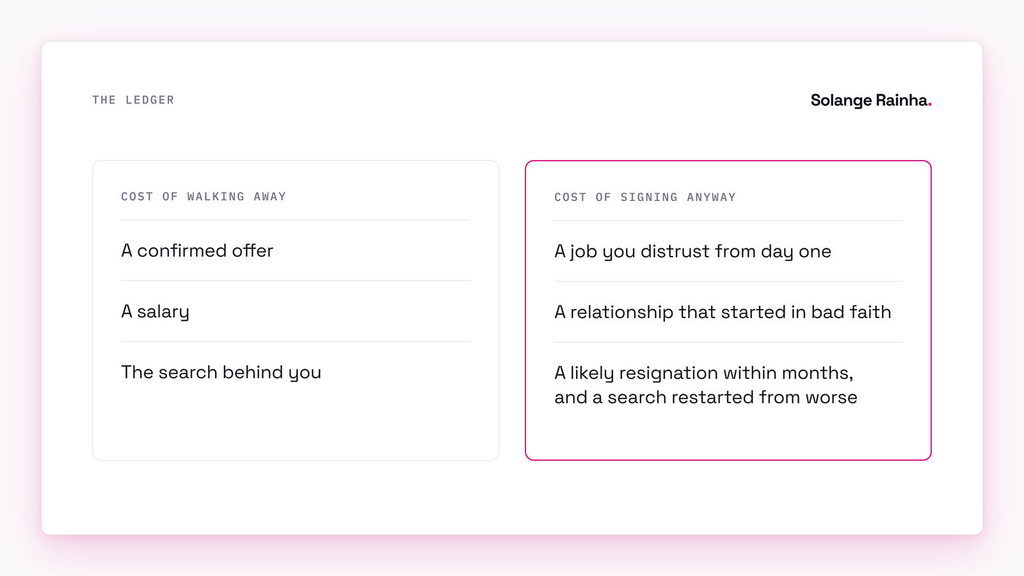
Walking away isn’t free, and pretending it is leads people to rationalise the wrong choice. It cost me a confirmed offer, a salary and the certainty of having the search behind me. If your runway is thin enough, those costs can outweigh the red flags, which is a legitimate call to make with your eyes open. The other side of the ledger is the one people discount: staying would have cost me the slow grind of a job I distrusted before day one, the energy of managing a relationship that started in bad faith, and most likely a resignation a few months later anyway, with the search restarted from a worse position. I’ve had to explain a short tenure on a CV for reasons outside my control, and I wasn’t going to sign up for one I could see coming.
When should you sign despite contract negotiation red flags?
When the red flags are one-offs that get fixed fast, or when you can’t afford to walk. Not every messy contract means a bad employer: a single error corrected within a day, with an apology and no pressure, is admin. And if your savings won’t cover another few months of searching, signing a flawed contract with your eyes open can be the right call, as long as you document what you were promised, keep the emails, and start your own due diligence on the employer from day one.
The limit of my own story is that it’s one negotiation. I’ve seen enough hiring processes to trust the pattern, but I can’t prove the company would have treated me the way the contract suggested, because I never worked there. What I can say is that the contract negotiation was the only part of the process where the company wasn’t trying to impress me, and that’s the company I’d have been working for.
Frequently asked questions
The contract negotiation red flags worth taking seriously are clauses that contradict what you were told verbally, promised benefits that vanish from the written contract, a document returned as “updated as agreed” when it wasn’t, a template that ignores the working arrangement you agreed, and a hiring manager who calls to pressure you out of protections instead of negotiating in good faith. Any one of these can be an honest mistake. Appearing together, or repeating across versions of the contract, they show how the company operates.
Largely, yes. The negotiation is the first point where your interests and the employer’s don’t line up, so it’s the first clear look at how the company handles friction. Promises made during hiring often don’t survive: in Robinson and Rousseau’s study of graduate management alumni, 54.8% said their employer had broken the promises it made them within two years, and those breaches went with lower trust and higher turnover. A company that’s evasive or pressuring during the negotiation rarely changes once you’ve signed.
Look at repetition and direction. One error is a mistake, while the same kind of error recurring across versions, always in the company’s favour, is behaviour. Good-faith negotiators explain their reasoning and are straight about constraints, while boundary-testers apply pressure and rely on you wanting the job too much to push back. Often you can’t be certain which you’re facing, but you’ll live inside the same pattern once you’re hired, so the pattern counts for more than the cause.
It depends on your runway and on what staying would cost. Walking away has an immediate price: a confirmed offer, a salary and the relief of ending the search, and if your finances are precarious that can outweigh the warning signs. Accepting a role you already distrust carries its own cost: a job you’re likely to leave within months, a search restarted from a weaker position, and the daily drain of working somewhere you joined against your own judgement. If you’re planning your exit before signing, that’s usually your answer.