An employer of record in Portugal is your legal employer on paper, but when it gets your pay wrong, you do the chasing. Mine paid my first salary with the meal allowance in the wrong place and no payslip. Help-centre promises didn’t hold, but one dated email that quoted my contract and the labour code and named the labour authority got the payslip out the same evening. If you’re hired through an EOR, nobody owns your pay unless you make them, and a written record is the only thing they respond to. Timeline, figures and a checklist below.
An employer of record in Portugal handles your contract, payroll and taxes, and legally it’s your employer. In practice, when your pay goes wrong, nobody there owns the fix until you make them.
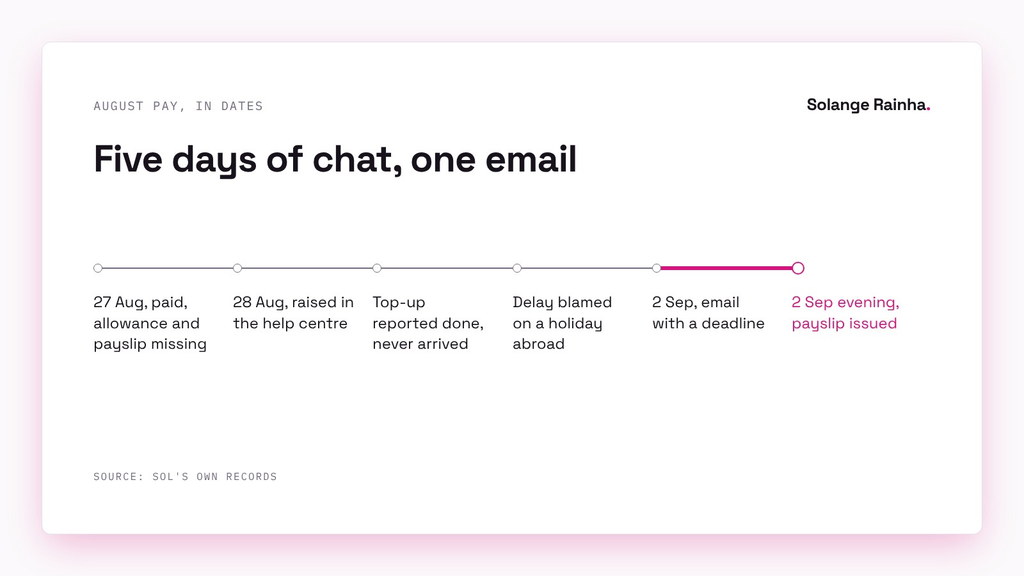
My first salary through one arrived on 27 August without the meal allowance on my meal card and without a payslip. I spent five days on help-centre messages and got promises, then sent one email on 2 September that quoted the clause in my contract, cited article 276.º of the Código do Trabalho and set a Friday deadline before I’d go to the labour authority. The payslip turned up that evening. So with an EOR, the dated written record is what gets you anywhere.
I’m writing as an employee who reads her contract, not as a lawyer, so treat the legal bits as my reading of the rules and check your own case.
What is an employer of record, and why use one in Portugal?
An employer of record (EOR) is a company that legally employs someone in a country on behalf of another company that has no entity there. Rippling defines it as “a third-party service provider that allows companies to legally hire and collaborate with employees overseas without establishing their own local entity in that country” (Rippling). The EOR signs your employment contract, runs payroll, withholds IRS and Social Security, and carries the local compliance.
Small companies use one to hire in Portugal because setting up a local entity costs time and money they don’t have for one hire. EOR providers’ own Portugal guides pitch exactly that: hire a full employee under Portuguese law without opening an entity. I’d done my research on the company I’d actually be working for (I wrote about employer due diligence after three job losses), but I’d never looked closely at who’d be paying me.
The part people skim: the EOR’s Portuguese entity is your legal employer. Your contract and payslip come from them, and so do the labour code’s obligations, while the company you do the work for is just their client.
What went wrong with my first pay?
The salary landed on 27 August, but the meal allowance never made it to my meal card and there was no payslip, so I raised it in the EOR’s help centre the next day.
Then came the promises. First they said it’d be sorted within two business days. Then they reported a top-up as done, and nothing arrived. After that they blamed the delay on a public holiday in another country, which might explain a slow reply but doesn’t explain a missing Portuguese payslip. Five days in, I had a ticket history full of reassurance and still no document saying what I’d been paid or what they’d deducted.
What finally moved my employer of record in Portugal?
An email I sent on 2 September, outside the help centre, that said what was missing, which clause of my contract that broke, and what I’d do, and by when, if they didn’t fix it. The contract clause says where the meal allowance gets paid. For the payslip, I quoted article 276.º, n.º 3, of the Código do Trabalho, which opens like this:
“Até ao pagamento da retribuição, o empregador deve entregar ao trabalhador documento…”
That’s “by the time pay is made, the employer must give the worker a document”, which then lists what it has to show: identity, Social Security number, category, base pay and other payments, the period, deductions and the net amount (Código do Trabalho, art. 276.º). I gave them until Friday, and after that I’d file a complaint with ACT, the Autoridade para as Condições do Trabalho, Portugal’s labour authority, which takes complaints about employers not following the law.
I wrote it flat, with no adjectives, and put ACT in as a dated step I was entitled to take, nothing more. The payslip arrived that evening.
| What I tried | Channel | Result |
|---|---|---|
| Asked where the allowance and payslip were | Help centre | Promise of two business days |
| Followed up after the deadline passed | Help centre | Top-up reported done, never arrived |
| Asked again | Help centre | Delay put down to a holiday in another country |
| Asked who owns my payroll and how it’s set up | Help centre | No named owner, no answer on my settings |
| Quoted the contract clause and art. 276.º, set a Friday deadline, named ACT | Payslip issued the same evening |
What did the payslip show?
They’d paid the whole meal allowance, €115.06 for 11 working days, as cash with my salary, and the card line said €0. That’s a problem in Portugal, because the tax rules treat cash and card differently.
In 2026, meal allowance paid in cash is tax-free up to €6.15 a day, and on a meal card it’s tax-free up to €10.455 a day (Dinheiro Vivo, with the €6.15 cash figure set by Portaria n.º 51-B/2026). Anything above the limit gets taxed as salary.
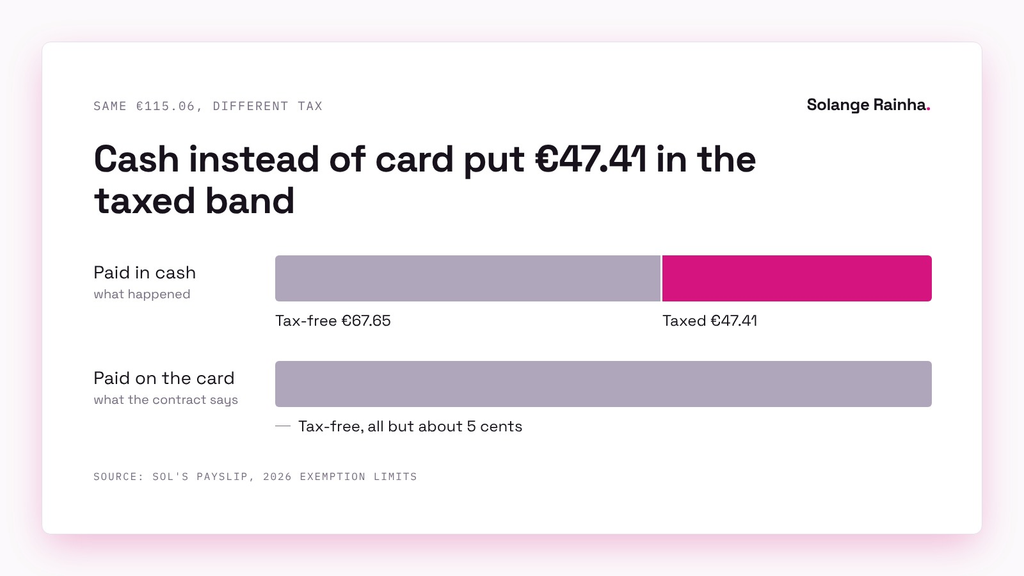
So 11 days at €6.15 left €67.65 tax-free, and €47.41 went into the taxed band. On the card, 11 days at €10.455 comes to about €115.01, which would’ve covered all of it except roughly five cents. Working it out from the payslip, the mistake cost me about €11 in extra tax and Social Security.
Eleven euros, I know. What bothers me is the contract: the clause says where the allowance goes, the EOR paid it somewhere else, and it never refunded the difference. If a vendor at work billed me wrong by €11 and shrugged, I’d still want the invoice fixed, because the shrug tells you how the next, bigger mistake will go.
Has my employer of record in Portugal fixed it since?
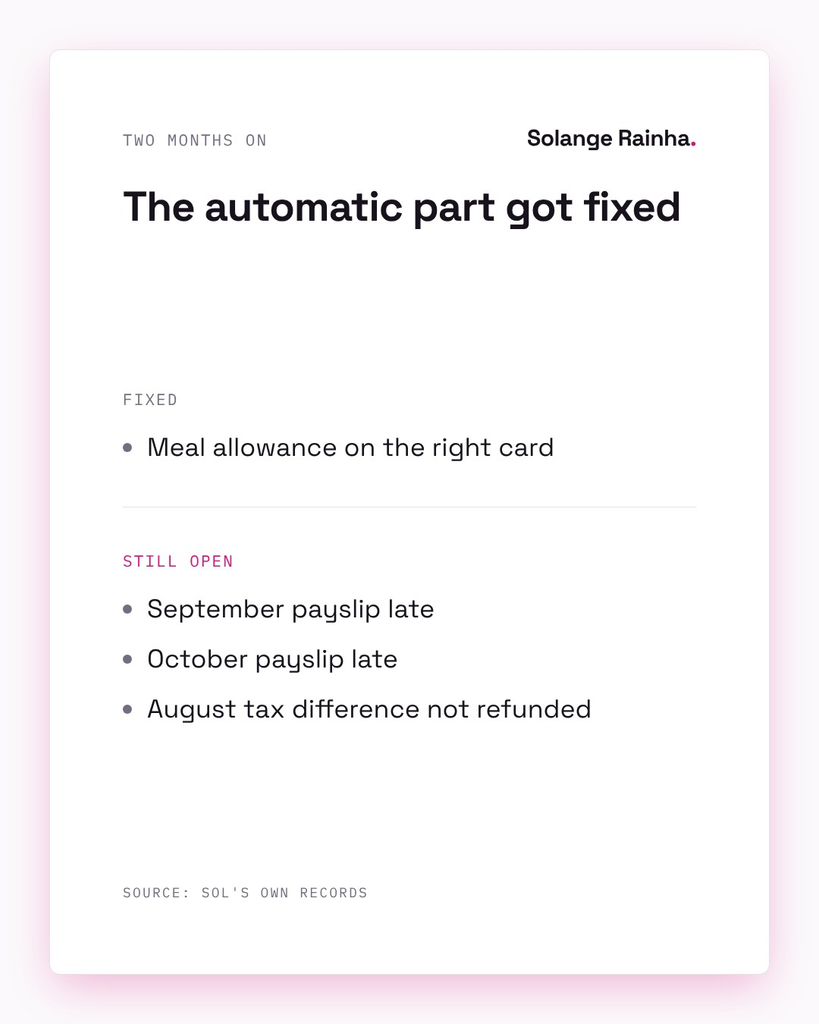
Partly. The meal allowance has landed on the card every month since, but September’s and October’s payslips both arrived after payday, which article 276.º doesn’t allow, and they still haven’t refunded the August tax difference.
The pattern’s clear enough: anything a system does automatically got fixed once someone set it up properly, but jobs that need a person to own them, like issuing a document on time or correcting their own error, still don’t happen unless I chase in writing.
What worked, and what didn’t?
What worked was boring. I used email instead of chat, because an email has a timestamp, sits outside their platform and can be forwarded to a labour inspector. I also quoted the exact clause and article and set a dated deadline with a named consequence, written calmly, since “where’s my payslip?” gets you a promise while “article 276.º says it was due on payday” gets someone to fix it.
The approaches that failed all assumed someone was already responsible. I never got a named owner for my payroll or an answer about how they’d set up my meal allowance in their system. Help-centre agents answered the message in front of them and closed the ticket. I’d bet that’s normal, and it’s why I’d treat the help centre as a log and email as the channel. It’s the same instinct behind the deal tracker I keep at work: if it isn’t written down with a date, it didn’t happen.
What should you check when you start with an employer of record?
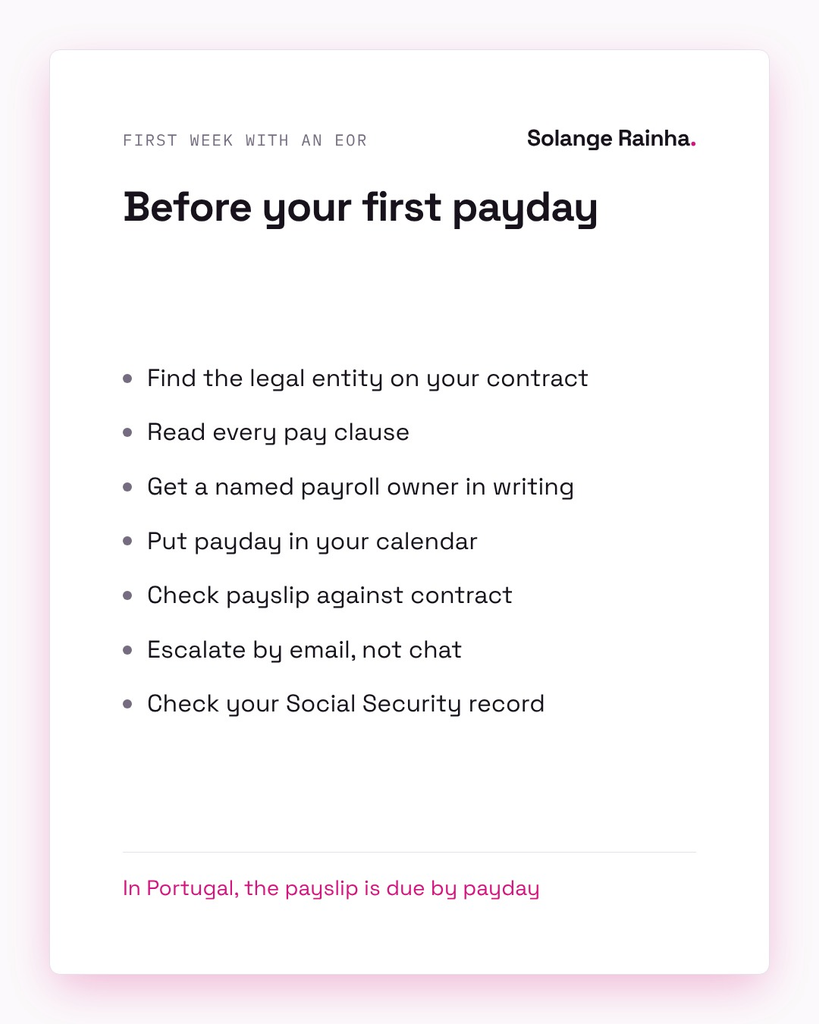
Do these in your first week, before your first payday, so you’re not learning them in a panic:
- Find the legal entity’s name on your contract. That’s who owes you the payslip, and who you’d name in an ACT complaint.
- Read the pay clauses line by line, including how each allowance is paid (card or cash) and when. Screenshot or save the PDF somewhere that isn’t their platform.
- Ask, in writing, who owns your payroll. You want a name and an email, not a help-centre link.
- Know your payslip deadline: in Portugal it’s by payday, under art. 276.º. Put payday in your calendar with a reminder to check the payslip arrived.
- Check the first payslip against the contract, line by line, the day it lands.
- Escalate by email, not chat, once a promise slips. Quote the clause and the law, and give a date.
- Check Segurança Social Direta a month in to see your contributions are declared.
If you’re the founder or Head of People choosing an EOR, ask them before you sign who your hire contacts when pay is wrong, and how fast they fix their own errors. I covered the questions candidates should ask in contract negotiation red flags, and the gap between what companies research and what candidates can find out in hiring research asymmetry, and an EOR sits right in that gap.
What would I do differently?
I’d have sent the email on day two, not day six. I gave the help centre three rounds because I didn’t want to be the new hire who escalates in her first month, and that politeness bought me nothing except four more days without a payslip. I’d also have asked who owns my payroll before the first payday, not after it went wrong. I argued for setting expectations in writing on day one in the timeline I give leadership on day one, and the same goes for your own pay.
Frequently asked questions
If you’re hired through an employer of record in Portugal, the EOR’s Portuguese entity is your legal employer. It signs your contract, runs payroll, withholds IRS and Social Security, and owes you obligations under the Código do Trabalho, including your payslip. The company you work for day to day is the EOR’s client. Check your contract for the entity’s exact legal name.
Under article 276.º, n.º 3, of the Código do Trabalho, an employer in Portugal must give you a payslip by the time your pay is made. It has to show your identity, Social Security number, professional category, base pay and other payments, the period covered, deductions and the net amount. That applies to an employer of record’s Portuguese entity just as it does to any other employer. If it keeps arriving late, you can raise it with ACT.
Yes. In 2026, the meal allowance in Portugal is tax-free up to €6.15 a day in cash and up to €10.455 a day on a meal card. Anything above the limit gets taxed as salary. If your contract says the allowance goes on a card and it’s paid in cash, part of it can move into the taxed band, which costs you money.
Escalate a payroll problem with an employer of record by email instead of the help-centre chat, so you have a timestamped record outside their platform. Say what’s missing, quote the contract clause and the relevant article of the Código do Trabalho, and give a dated deadline. In Portugal, you can name ACT, the labour authority, as the next step if it isn’t fixed. Keep the tone flat and factual.