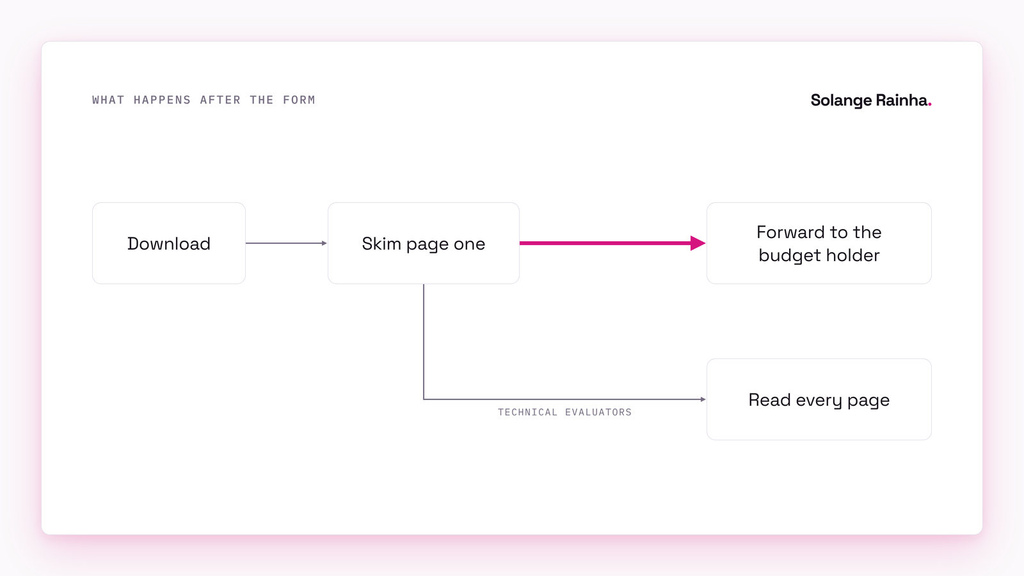
Do people read whitepapers? Mostly not the way marketers picture it: most buyers skim the first page, pull out a stat and forward the PDF to whoever controls the budget, while technical evaluators are the minority who read every page. This piece is for content marketers and demand gen leads whose gated whitepapers get downloads and no engagement. It covers what the data says about how buyers use whitepapers, why download counts hide it, how to build one for the forward instead of the form, and when the format is still worth the three to four weeks it takes.
I’ve written whitepapers for CFOs and IT buyers at a B2B SaaS company serving 200+ higher education institutions, and across eight segments in 39 countries at an eMobility company. So when people ask me whether anyone reads them, I tell them a small, specific group does, and for most readers the download is the most attention the paper ever gets. My problem is with how teams build them: most make a 20-page PDF designed around a form fill, when the people who receive it want one page they can lift a stat from and send to whoever signs off.
Do people read whitepapers at all?
Short version: nobody knows, and that’s the first problem. Look for whitepaper reading-time benchmarks and you’ll find download counts, usage rates and satisfaction surveys, but almost nothing on how far anyone gets into the PDF. The Content Marketing Institute’s 2025 B2B research found 51% of B2B marketers used e-books or white papers in the previous year, and 56% struggle to attribute content performance to business outcomes. So we make whitepapers all the time and only ever measure the download.
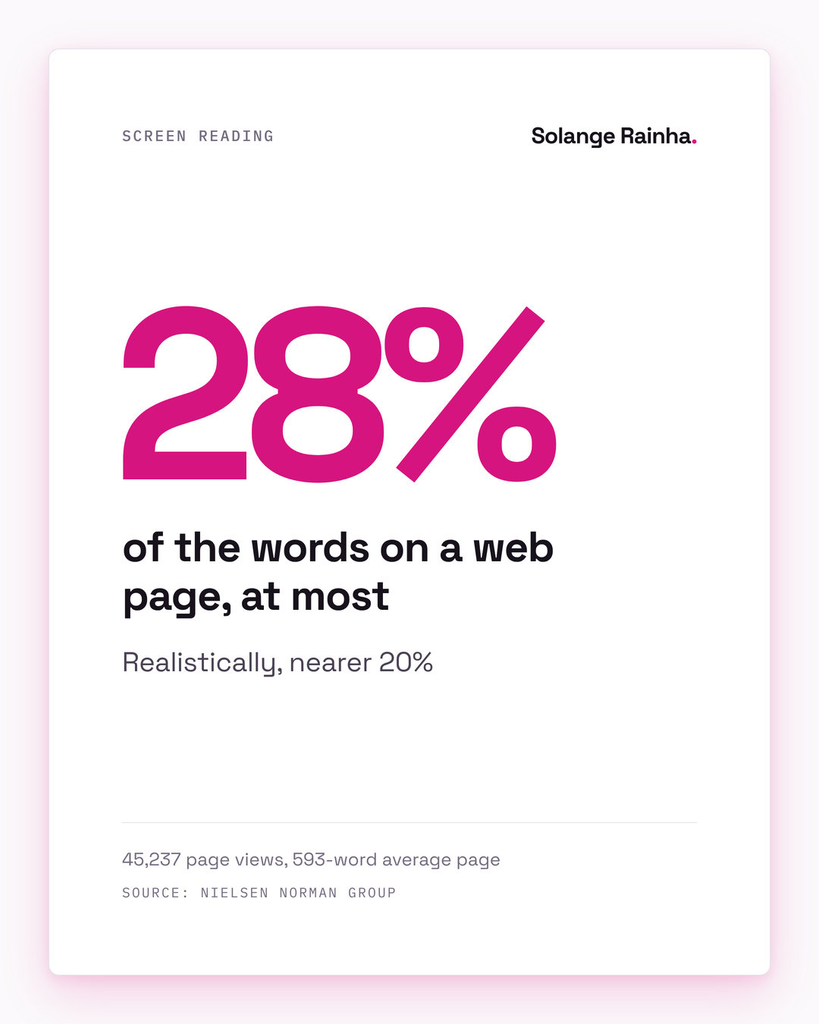
What we know about screen reading isn’t encouraging either. Jakob Nielsen’s analysis of 45,237 page views found visitors had time to read at most 28% of the words on an average page, and he put the realistic figure nearer 20%. That’s on a 593-word web page, so a 20-page PDF fares worse. Nielsen Norman Group has spent two decades watching people skip and abandon PDFs, and the dread kicks in before they’ve even opened one, as a B2B customer in its usability testing put it:
“It looks like I’m going to have to go to PDF, which I’m dreading.” (Nielsen Norman Group, 2020)
Vendor research points the same way, with an obvious catch: a 2021 eye-tracking study by Lumen Research, commissioned by Turtl (who sell an alternative to PDFs), found readers spent 815% more time actively looking at an interactive version of the same content than at the PDF. Even if you discount it for who paid, it still lines up with everything else.
There’s one stubborn exception: Russell Willerton’s case study of engineering professionals, published in Technical Communication, found they often read white papers start to finish. So the technical evaluator reads, while pretty much everyone else on the buying committee skims and passes it on. Hold onto that split, because it decides when the format is worth making.
Why doesn’t a whitepaper download mean anyone read it?
A download measures one moment of intent: someone wanted the PDF enough to type in an email address, and it tells you nothing about page two. Downloads are still the metric most teams judge their whitepaper programmes on, mostly because the marketing automation platform hands it over for free.
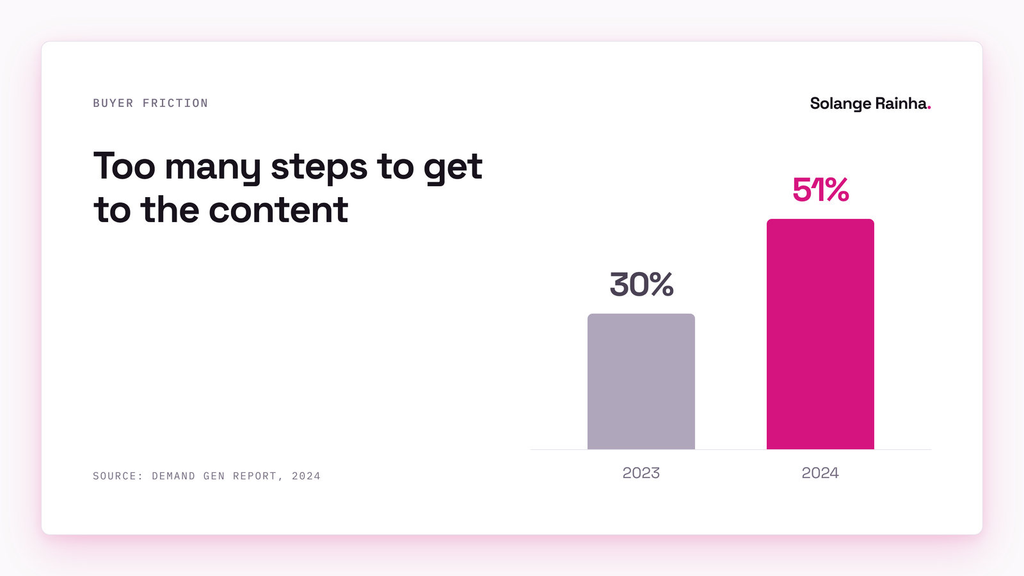
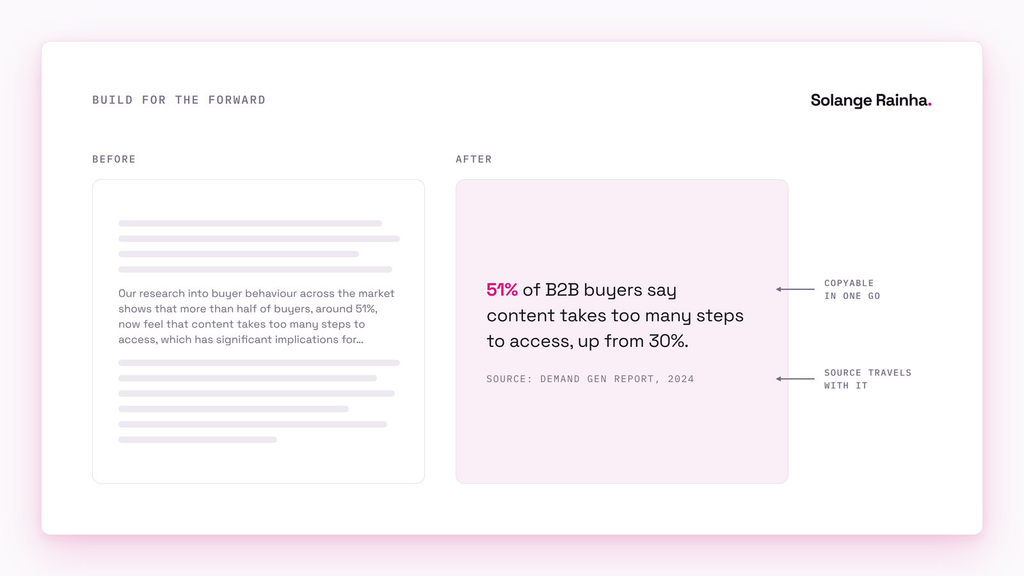
The gate makes it worse in two ways. First, Demand Gen Report’s 2024 Content Preferences Benchmark Survey found 51% of B2B buyers said content took too many steps to access, up from 30% the year before. Second, the people who do get through mostly aren’t buying: Ehrenberg-Bass research, cited in the 2024 Edelman-LinkedIn B2B Thought Leadership Impact Report, puts 95% of business buyers out of market at any one time. So your gated lead list is mostly curious people, and sales gets them as MQLs and quietly ignores them.
I’ve been on the wrong side of this myself: at one point I was tracking more than 17 KPIs a quarter, and most of them couldn’t tell me whether the content was working. I fixed it by choosing pipeline contribution as the metric I’d be judged on instead of a flattering pile of downloads, and the content operation went on to contribute to 48% marketing-sourced pipeline in peak months. I’ve covered the metrics that hold up after that switch and what sat behind the 48% separately, so I won’t repeat them here.
What do buyers do with a B2B whitepaper?
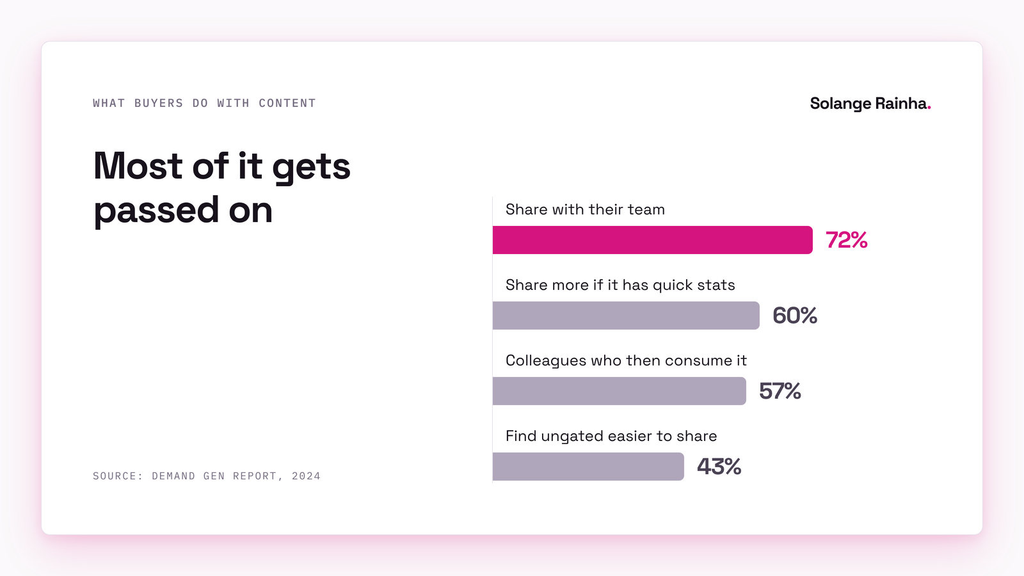
They pass it on: Demand Gen Report’s 2024 data has 72% of buyers sharing content with relevant team members, and 57% of the colleagues who received it went on to download and consume it. In the same survey, 60% said assets packed with shareable stats and quick insights made them more likely to share, and 43% pointed to content being ungated and easier to send around.
None of this is new either: a 2010 UBM TechWeb survey of about 1,000 tech decision makers, summarised by Altitude Accelerator, found 76% had shared a white paper with a colleague and 42% with their boss. Fifteen years on, we still build whitepapers for whoever downloads them and give little thought to the colleague who gets them next.
When I map what prospects want from a whitepaper, it comes down to proof they can repeat. The champion who downloads it needs a stat to drop into an email, and their CFO needs to know what it costs and what it saves without opening the fourth attachment of the week. The technical evaluator wants architecture, integration detail and security answers, and will read every page to get them. I built for exactly that split when the ICP moved to IT buyers, starting with integration blueprints and security documentation for CIOs, because that’s where deals were stalling.
Buyers also want to get there on their own: in its 2021 B2B Buying Disconnect report, TrustRadius found 87% of B2B tech buyers want to self-serve part or all of the buying process, and a form standing between them and page one works directly against that.
How should you structure a whitepaper so people use it?
Design it for the forward first, then for the skim, and leave the one person who reads it all for last, which in practice changes most of the document.
Page one is the whitepaper. Write the executive summary as if it’s the only page anyone opens, because for most readers it is: the finding, the stat behind it, what it means for the reader’s budget and what to do next, in under 300 words. It’s the same idea as writing an opening that survives the scroll, with more at stake.
Every stat that carries the argument should sit on its own line with its source attached. Nobody’s copying a figure buried mid-paragraph on page 14 into a Slack message, but they’ll happily copy a clean standalone one; AI systems lift content the same way, which is why this matches what I recommend in my tactical guide to AI-citable content.
Give the money its own page. Put cost and return on one page in plain language, and keep product screenshots off it. If the paper can’t make the financial case there, twenty pages won’t save it.
Then put it on the web: Nielsen Norman Group’s fix for PDF misery is an HTML gateway page that summarises the key points and offers the PDF as a download, which also gets the substance indexed and citable in a way a gated PDF never is. That’s step two of my AEO/LLMO content optimisation framework applied to a long-form asset.
Last, title each chart with its finding rather than its axis labels, so a screenshot still makes sense in someone else’s deck.
Which whitepaper alternatives do the same job better?
Before you commit three to four weeks, check whether the job needs a whitepaper at all. In my content strategy playbook it’s one of the most expensive formats I plan for, since it takes a lot of effort and depends on SMEs and design, and other formats do plenty of the jobs it gets assigned better.
| The job you want done | The usual whitepaper approach | The format that does it better |
|---|---|---|
| Give a champion a stat to send upward | A stat on page 14 of a gated PDF | An ungated research page with standalone, sourced figures |
| Make the money case to a CFO | An ROI section buried after the methodology | A one-page business case or an interactive ROI calculator |
| Answer technical evaluation questions | A generic architecture chapter | Integration and security documentation, kept current |
| Show you know the category | Twenty pages of trends anyone could write | Original research with data a competitor can’t copy |
| Win a head-to-head evaluation | Usually avoided | A comparison page that names the alternatives |
| Give sales a follow-up | A “here’s our whitepaper” email | A sales one-pager built from the paper’s objection section |
Calculators are my favourite of these, and I’ve started building them at OpinionX as interactive content: they hand the buyer their own number instead of an industry average, which no PDF can do. For the other rows, I’ve written about why original research beats opinion on backlinks and why B2B comparison pages are the asset most companies leave to G2.
When is a whitepaper still the right call?
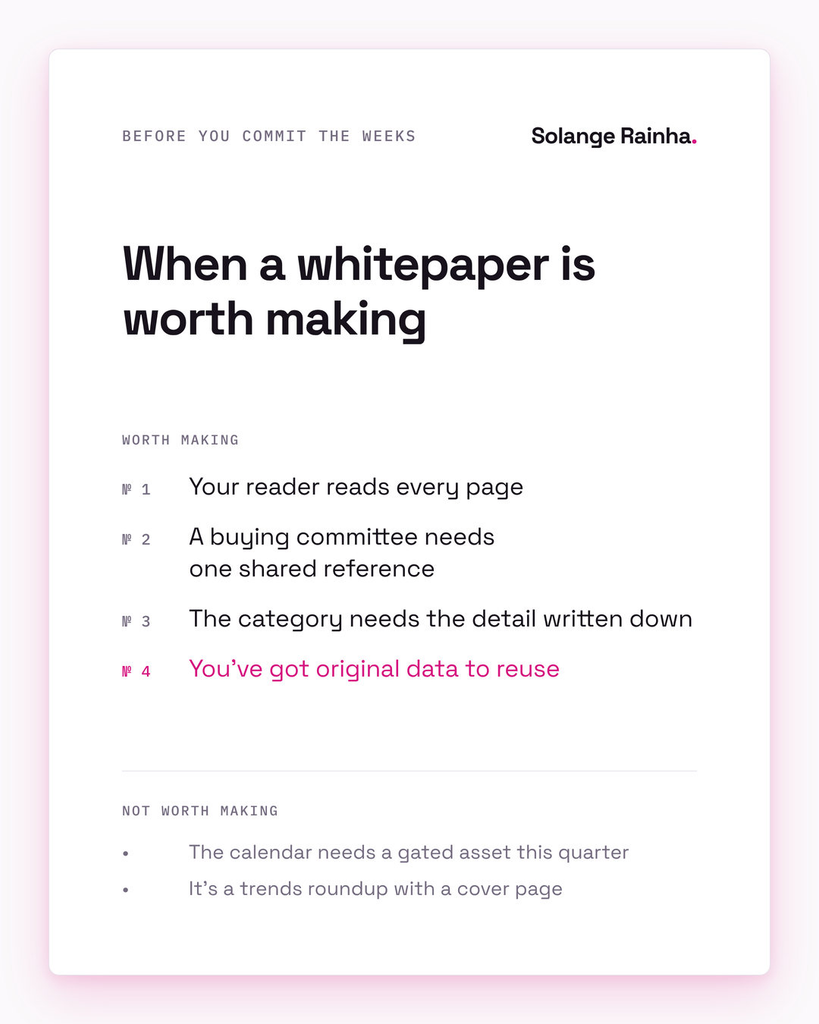
When your reader is the one who reads: technical evaluators, security reviewers and procurement teams want depth they can check, and Willerton’s engineers are exactly that audience. Long, high-consideration purchases where a buying committee needs one shared reference document justify it too, as do regulated categories where you have to put the detail in writing somewhere.
It’s also worth it when you have original data, and my playbook rates the whitepaper’s reuse yield as very high, since one research base can feed a dozen derivatives, as I laid out in my content repurposing strategy. A demand gen calendar that needs a gated asset this quarter doesn’t justify it, and neither does a trends roundup with a cover page on it.
What I’d do differently
Next time, I’d write the forward before the paper: I’d ask sales which page they’d send to a CFO and which stat they’d quote on a call, and write those two before outlining anything else. I’d turn gating off by default, with an optional “email me the PDF” field for people who want a copy, and I’d stop reporting downloads on their own; return visits to the HTML page and whether the paper shows up in sales emails on deals that close tell you far more, even though they’re messier to collect.
The limitation I can’t get around is measurement: once a PDF leaves your site it goes dark, and no tracking setup I’ve seen tells you who read page nine of an attachment sitting in someone’s inbox, which is one more reason to publish the substance as a page you can measure.
FAQ
Do people read whitepapers all the way through?
Most don’t: screen-reading research from Nielsen Norman Group suggests people read around 20% of the words on a typical web page, and PDFs perform worse, so most whitepaper readers skim the executive summary and pull out a statistic or two. Technical evaluators are the exception, and a case study of engineering professionals in Technical Communication found they often read white papers sequentially. So build the first page for skimmers and keep the depth in the body for evaluators.
Should I gate my whitepaper?
Gate a whitepaper only if the lead it produces is worth more than the reach you lose. Demand Gen Report’s 2024 survey found 51% of B2B buyers felt content took too many steps to access, and 43% said ungated content was easier to share with colleagues, which counts for a lot when whitepapers mostly travel by forwarding. A common middle ground is an ungated HTML version with an optional form for the PDF download.
How long should a B2B whitepaper be?
Shorter than most teams make it: in a 2010 UBM TechWeb survey of tech decision makers, 45% preferred white papers of 5 to 10 pages and 29% wanted 5 pages or fewer, and Demand Gen Report’s 2024 data found buyers rated short-form content the most valuable format. A B2B whitepaper should put its whole argument on page one and use the remaining pages for the evidence a technical evaluator needs to check.
What should I measure instead of whitepaper downloads?
Measure what happens after the download: return visits to an ungated HTML version, shares and forwards, how often sales attaches the whitepaper in deal emails, and influenced pipeline on opportunities where it played a part. Downloads only show that someone wanted the whitepaper once, which says nothing about whether anyone read it or acted on it.