A content rebrand is mostly transition management: you design the new identity once, but you live through the stretch where the old messaging is wrong and the new one isn’t ready every single day. I worked through that stretch on the content, design and internal comms side of a rebrand at a 700+ person software engineering company across four countries. This is how to keep publishing without making throwaway work (sort everything into three buckets), why the internal rollout decides whether the rebrand sticks, and what I’d do differently next time.
A content rebrand is mostly transition management, and the reveal everyone talks about is the smallest part of it. The new logo, the new site, the launch post and the before-and-after slide that makes the old brand look like it was designed in a bunker get the LinkedIn celebration. Nobody talks about the six months before that, when the old messaging is officially wrong, the new messaging isn’t officially ready, and you still have a publishing calendar to fill. That stretch is what breaks people, and I lived in it.
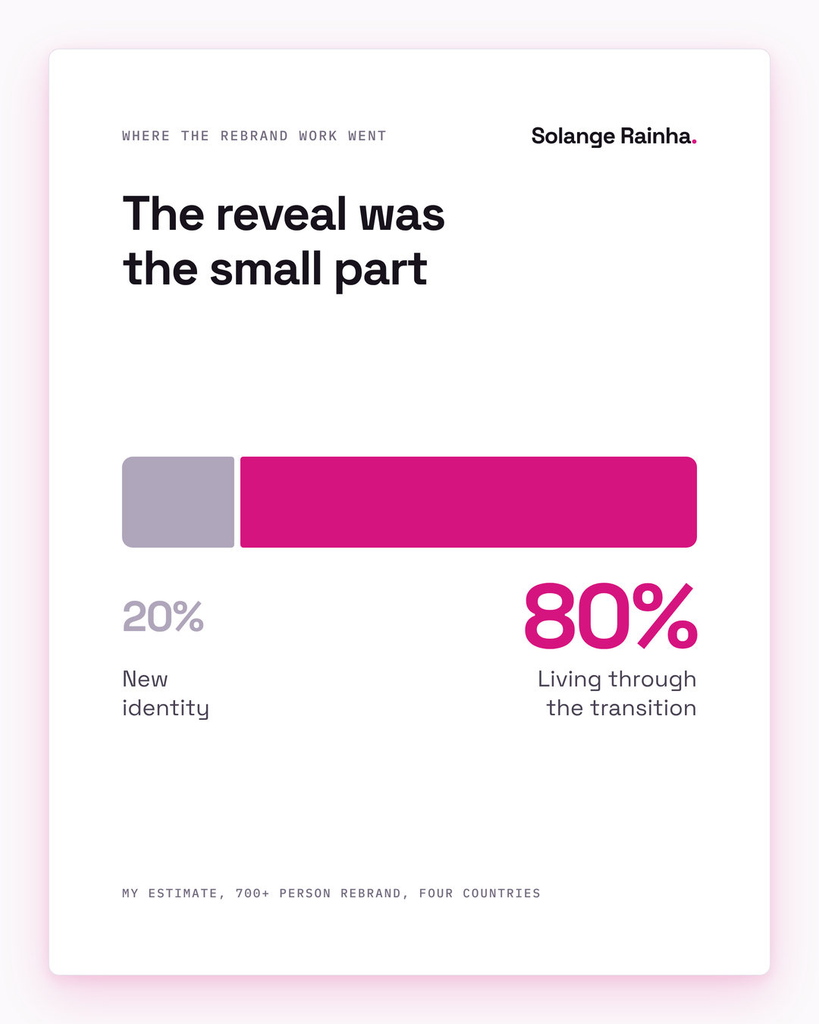
I worked on the content and design side of a rebrand at a 700+ person B2B software engineering company with offices in Portugal, the UK, Germany and the US. I produced the content and graphic design, and I ran the internal comms that kept 700+ people informed while it happened. By my estimate the visual identity work was about 20% of the job, and the other 80% was managing the transition, which is the part nobody plans for.
Why is a content rebrand mostly transition management?
Because you design the brand once and then work through the transition every day until the new identity takes hold inside the company and outside it. The creative phase, where you settle the positioning and build the voice and visual system, is finite and exciting, while the transition is open-ended and tedious and holds most of the work and most of the risk.
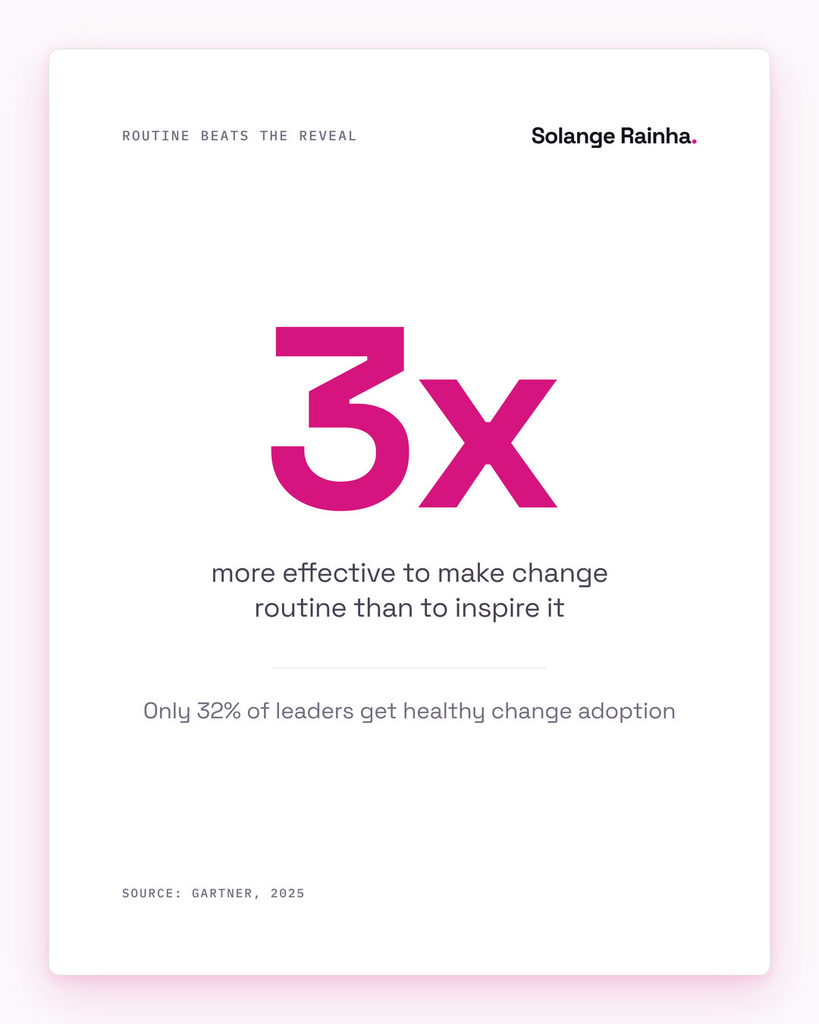
Getting people to take on a change is where most organisations struggle anyway: Gartner’s 2025 research on change management found only 32% of leaders get employees to adopt changes in a healthy way. A rebrand usually fails when internal teams never buy in and the new brand sits in a slide deck while the company keeps talking the old way, and a bad logo is rarely the cause.
Content is where that gap shows first, because it’s where the brand lives in public. Marty Neumeier’s definition in The Brand Gap is the one I keep coming back to:
“A brand is a person’s gut feeling about a product, service, or company.”
Your sales deck, website, blog, social and one-pagers form that gut feeling far more than a logo does, because they carry the voice and positioning. When the brand changes, every one of them is suddenly carrying a message that’s about to be wrong, and the content person has to manage the changeover without the whole library going stale at once.
What do you publish during a content rebrand, when the old messaging is wrong and the new isn’t ready?
Anything that won’t expire, plus anything you can convert cheaply later, and you hold the rest. That stretch is the content gap, and it’s an uncomfortable place to work: strategy meetings have already retired the old positioning, so you shouldn’t reinforce it, and leadership is still arguing over the new one, so you can’t commit to it either. Meanwhile the calendar doesn’t care about your existential crisis, and the pipeline still needs feeding.
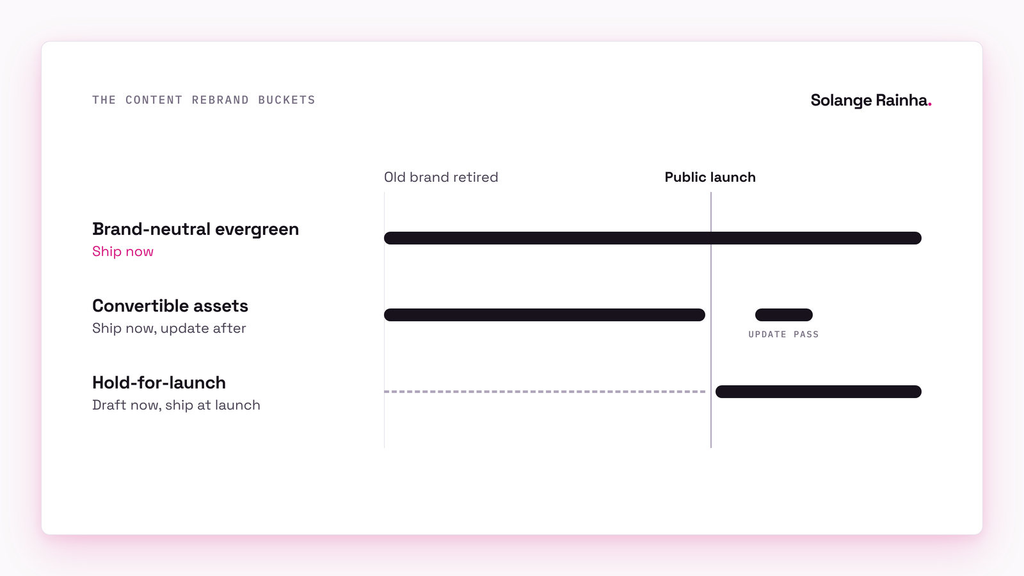
Most people handling a content rebrand go one of two ways. Some freeze and stop publishing because they’re scared of producing something that’ll be wrong in two months, so their output goes quiet right when the company most needs to look alive, and others keep cranking out content in the old voice, the only one that’s signed off, which digs the hole deeper. I did neither and sorted everything I might publish into buckets instead:
| Bucket | What goes in it | When it ships |
|---|---|---|
| Brand-neutral evergreen | Technical content, how-to material, industry analysis: anything that lives on the substance of the topic instead of on positioning | Now. It’s rebrand-proof, so it becomes the backbone of your output |
| Convertible assets | Content that leans on positioning but can be updated without a full rewrite, built with the structure intact and the brand language easy to swap | Now, flagged internally for a pass after launch |
| Hold-for-launch | Anything heavily tied to the new positioning | Drafted now, shipped as part of the launch wave |
A guide to a security standard or a breakdown of a technical problem doesn’t change because your tagline did, which is why the technical content carried most of my output through that stretch. That sorting is the whole game during the transition, because it lets you keep shipping at volume without producing stuff you’ll throw away.
Why does content get caught between the internal and external rollout?
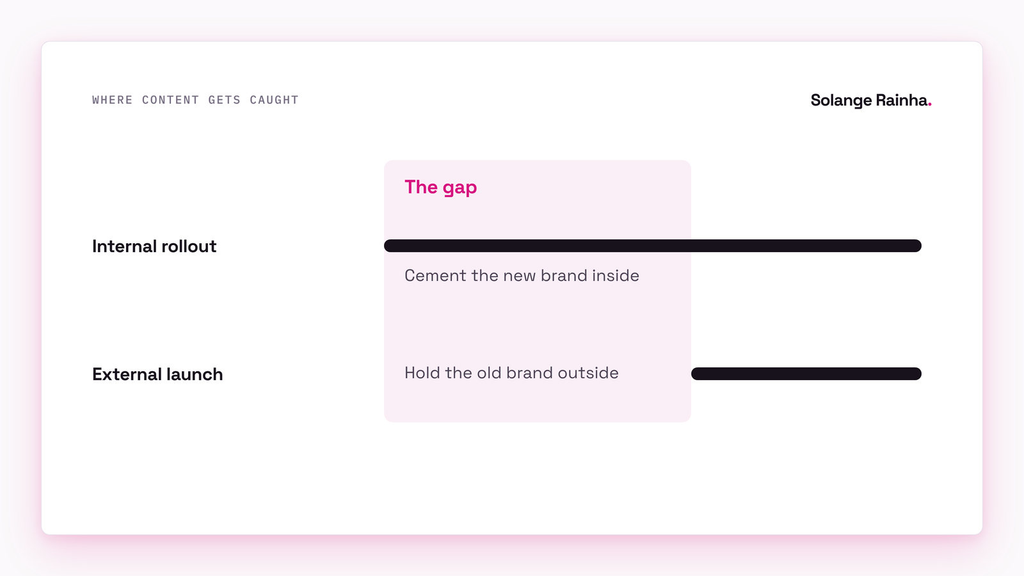
Because the internal and external rollouts almost never happen at the same time, and content has to serve both audiences while they’re on different timelines. The brand has to land inside first, since your own people sell it and say it before any customer hears it, and it can’t go public until that side is solid, or you get the worst outcome: a sales rep describing the company the old way in the same week marketing publishes the new way.
Jim Heininger, interviewed by Chief in 2024, put the employee side in one line:
“They have to be the first to tell the story.”
So the usual sequence is internal first, external second, with a gap in between, and during that gap content does two contradictory jobs: it cements the new brand inside the company through comms and enablement material, while still presenting the old, not-yet-replaced brand outside because the public launch hasn’t happened. You’re writing in two voices for two audiences who can’t see each other, and your job is to stop them colliding. The mistake I see most is treating the external launch date as the only date that counts, when the internal rollout is what decides whether the rebrand sticks.
How do internal comms make or break a rebrand?
Employees who don’t understand or believe in the new brand undermine it quietly in customer conversations, email signatures and every “well, we used to be called” aside. You can run a flawless external launch and still fail if 700 people are confused, sceptical or feel the change was done to them instead of with them.
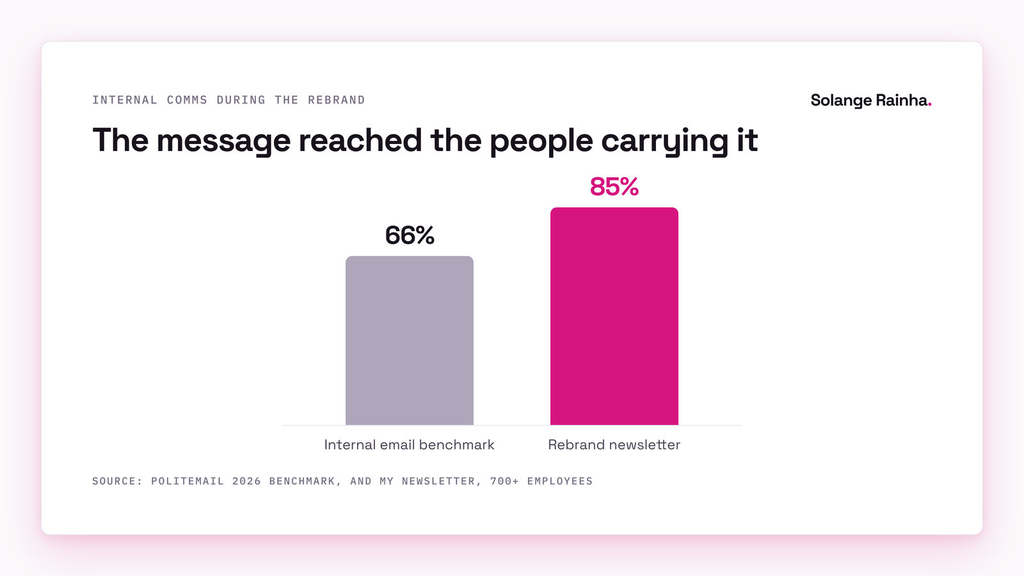
I ran the internal newsletter to 700+ employees across four countries, and it held an 85% open rate through the transition. For context, PoliteMail’s 2026 benchmark of more than 2 billion internal emails puts the average internal open rate at 66%, so the rebrand information was reaching the people who’d have to carry it.
What made it work was treating employees as stakeholders instead of an audience to make announcements at. Rebranding is emotional: you’re asking people to let go of an identity they helped build, and most of them never asked for the change, so if you treat that as an inconvenience, they’ll feel managed and check out.
So I used the internal channel to explain the why, show the work in progress instead of dropping a finished brand on people, and give them somewhere to react. By the time the external brand went live, the inside of the company already spoke the new language, which is the only reason the public launch held together. The full internal comms playbook, including how I kept four countries aligned while the direction kept moving, is in communicating a rebrand to employees.
How do you get buy-in from people who didn’t ask for the change?
Give them a reason that makes sense from where they sit, because the executive reason for a rebrand (market positioning, valuation, a strategic shift) means nothing to an engineer who wants their email signature to stop changing. In a content rebrand, the content has to translate the change into terms that count for the person reading it, and these did most of the work for me:
- Show the reasoning behind the decision. People accept change they understand far more readily than change that arrives already settled, so I used internal content to walk through why the old brand no longer fit, with specifics instead of vague reassurance.
- Make the new brand easier to use than the old one, straight away. Hand people the templates, signatures, deck masters and one-pagers ready to go, and adoption mostly takes care of itself.
- Give the sceptics a channel. The strongest resistance usually comes from people who feel unheard, and collecting their objections in a structured way, instead of letting them fester in hallway grumbling, defused most of it. Some of the objections were also just correct, and catching those early kept us from shipping the mistakes they pointed at.
The same Gartner research backs the boring approach over the big reveal:
“Establishing change as a routine is three times more effective than the inspirational approach.”
That matches what I saw: the steady weekly cadence did more than any launch-day moment could have.
What transfers from one content rebrand to the next?
The three-bucket sort, the internal-first order and written standards. The bucket sort is the most useful habit I took from that company, and I’ve used a version of it in every positioning shift since, including a mid-quarter ICP pivot. A rebrand reworks the voice and identity and an ICP pivot swaps the buyer you’re aiming at, but the transition work underneath is nearly identical.
The internal-comms-first approach transfers to any content rebrand just as cleanly, and so does the cadence of showing your work. And documentation is what holds a transition together: going into a content rebrand without a written voice and standards system is how 700 people end up improvising the new brand in 700 directions. It’s part of why I later built editorial standards from zero as a deliberate first move at a different company, and why the work of fixing 40+ off-brand assets at another started with a positioning document instead of a design pass (the positioning side is in building brand positioning from scratch).
What would I do differently next time?
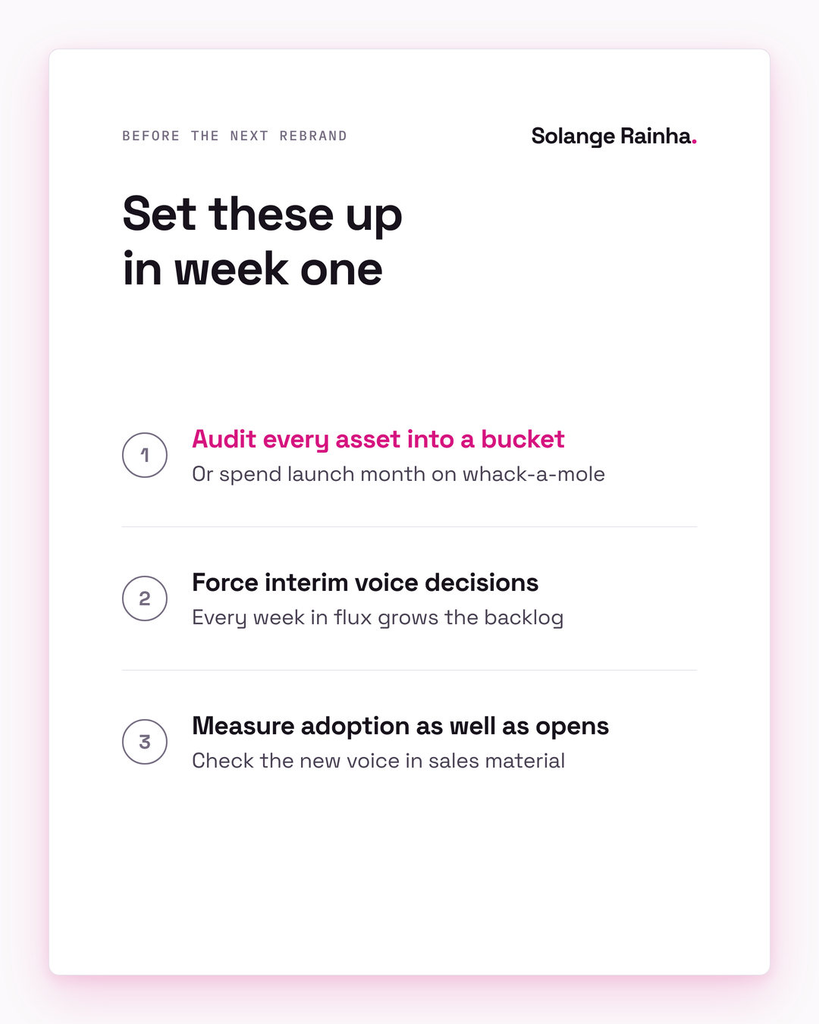
I’d start the content audit on day one, because I underestimated how much old-brand material was scattered across the site, sales folders and old decks, and spent the post-launch weeks playing whack-a-mole with outdated assets. Mapping every asset to a bucket at the start would have saved weeks, and a quick scoring pass like the one in my content prioritisation framework would have told me which ones were worth converting at all.
I’d also push harder for the new voice to be locked sooner. The longer the positioning stayed in flux, the more convertible and held content piled up, and the bigger the post-launch backlog got. Some of that was outside my control because leadership needed the time, but I could have forced clearer interim decisions instead of waiting for the perfect final answer.
And I’d build the measurement in from the start. I tracked the newsletter open rate, but I never set up a clean way to see whether sales conversations and customer-facing material picked up the new brand language after launch, which would have told me whether the voice was sticking out in the world. Next time I’d want that alongside the open rate.
The rebrand worked: the company launched the new identity across four countries with internal buy-in intact and the content library converted without a gap in output, even though I was learning the content rebrand playbook as I went, and that playbook is what I’d bring to the next one.
Frequently asked questions
The hardest part of a content rebrand is the transition period between the old positioning being retired and the new one being ready to ship. During that stretch every piece of content is both outdated and premature, the publishing calendar still needs filling, and you have to keep producing without creating throwaway work. The way through is to sort content into brand-neutral evergreen you can ship now, convertible assets you build now and update later, and hold-for-launch material you save for the public reveal.
Internal communication decides whether a rebrand sticks, because employees who don’t understand or believe in the new brand undermine it in every customer interaction. Getting people to take on change is hard in general: Gartner found in 2025 that only 32% of leaders get employees to adopt changes in a healthy way, and that making change routine is three times more effective than inspiring it. During a 700+ person rebrand I ran the internal newsletter at an 85% open rate, against a 66% internal email benchmark, by treating employees as stakeholders instead of an audience to announce at.
A rebrand changes how a company says things, meaning its voice, positioning and visual identity, while an ICP pivot changes who the content is for by shifting the target buyer. For the content function the trigger differs but the transition work is nearly the same: you sort assets by how brand-dependent they are, manage two audiences on different timelines, and keep shipping through the ambiguity without producing work you’ll throw away. In both, transition management is the core skill.