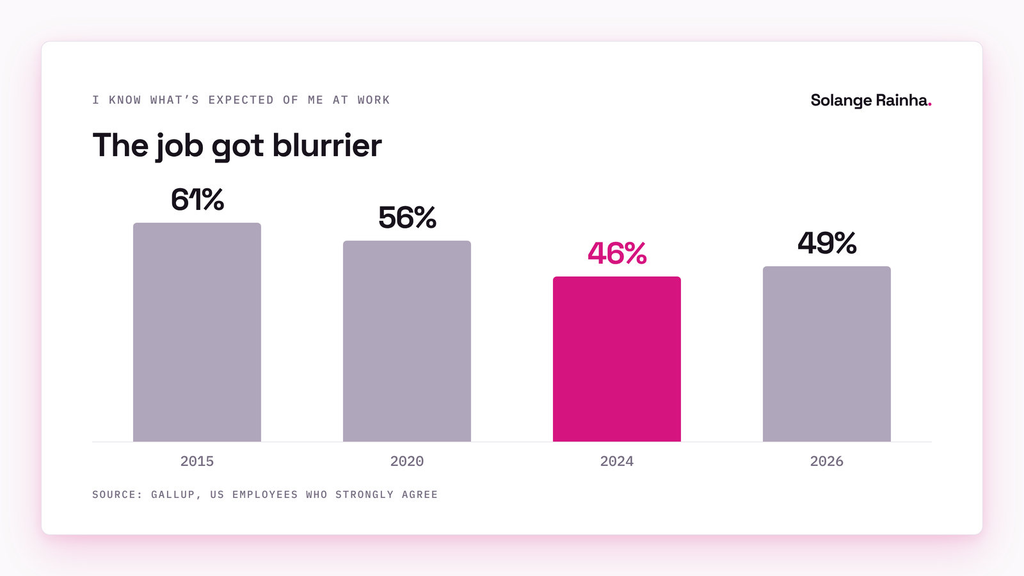
What is quiet quitting? It started as a modest idea, doing the job you were hired for and declining the unpaid extra that had crept into it, and it turned into a moral panic. Gallup’s own chief workplace scientist called it “a symptom of poor management”, and his data shows why: by 2024 only 46% of US employees clearly knew what was expected of them at work, down from 56% in 2020. After years of expectation creep blurred where the role ended, reading your own job description back onto an inflated job got recast as quitting. This is for managers who bought the panic, and it stays fair to the disengagement problem underneath it, which is separate and smaller.
What is quiet quitting? In July 2022, an engineer named Zaid Khan posted a 17-second TikTok and accidentally kicked off a moral panic. His definition was almost boringly reasonable: you keep performing your duties, you just stop subscribing to the idea that work has to be your whole life. Somewhere between that video and the thinkpiece machine that descended on it, “doing your job and nothing extra” got rebranded as a betrayal, and managers were handed a villain to point at. The discourse got the story backwards from the start: what got framed as workers withdrawing effort was mostly workers holding the line at the role they were hired for, while a lot of employers realised how much unpaid extra they’d been quietly banking on.
What is quiet quitting, before it got spun?
A boundary, and a modest one. In the viral video, which drew more than 3.6 million views, Khan made the point plainly:
“And your worth as a person is not defined by your labor.”
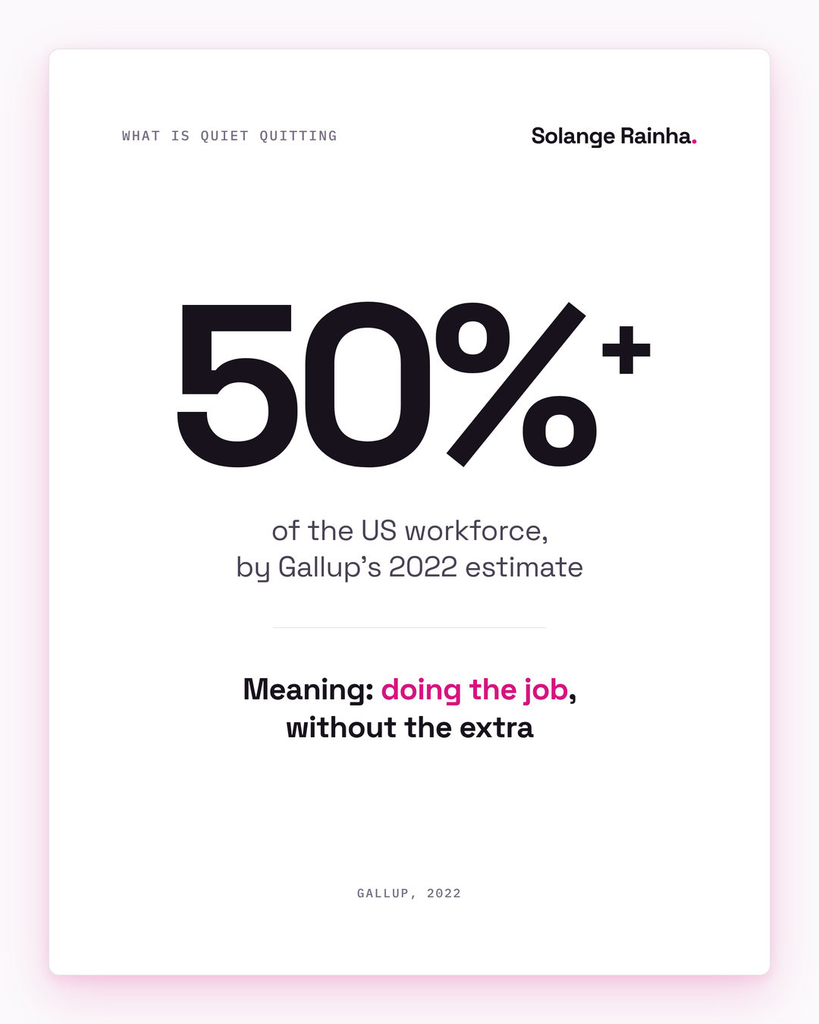
That’s the whole radical idea: do the work you agreed to do, then go and have a life. What turned it into a panic was a collision of two forces that had nothing to do with laziness. Gallup was measuring a long slide in engagement and reached for a sticky label, reporting that quiet quitters made up at least half the US workforce. That’s a scary sentence until you notice it means half of workers sat in the “not engaged” bucket, present and doing their jobs without extra emotional investment, and employers heard it as “half my people are coasting” and skipped straight to blame. Jim Harter, Gallup’s chief scientist for the workplace, drew the opposite conclusion in the same piece: “It’s clear that quiet quitting is a symptom of poor management.”
Managers recoded a boundary Khan described as stepping back from going above and beyond as theft, as if unpaid evening availability were a term of employment. Notice who never had to justify anything in that framing: the company that had come to depend on hours it never agreed to pay for. I’ve written about how every company says it wants ownership until someone takes it, and this is the same reflex: autonomy is welcome right up until it produces a “no”.
How did expectation creep make “the job” mean “the job plus everything”?
By piling tasks onto roles a quarter at a time until nobody could say where the job ended. “Just do your job” only works as an insult if everyone agrees on what the job is, and over the last decade that agreement fell apart. Gallup’s own data shows how far it fell: in 2024 only 46% of US employees strongly agreed they knew what was expected of them at work, down from 56% in March 2020, and by the first half of 2026 it had only crept back to 49%, against a peak of 61% in 2015.
That blur isn’t an accident, and it isn’t always malicious either. It’s what happens when a role absorbs a departed colleague’s tasks that never get formally reassigned, or when “other duties as required” swells to fill a headcount gap. Every quarter adds a new expectation and none ever gets removed, the scope grows while the title and the pay stay put, and the job you were hired for slowly becomes the job plus everything nobody else has time for. The hours creep too: Microsoft’s 2025 Work Trend Index, drawn from Microsoft 365 activity, found the average employee sends or receives more than 50 messages outside core business hours, and meetings after 8pm were up 16% in a year.
I’ve lived the extreme version, running an entire content function solo and shipping 60+ pieces in eighteen months because there was no one else to do it. Whether that’s heroic or exploitative comes down to whether someone named the extra work, whether I got a say in taking it on, and whether it showed up in my pay. So what is quiet quitting in practice? A lot of the time it’s a healthy employee reading the boundary of the role back onto a job that had been inflated past it, re-baselining to the job they were hired and paid to do after years of creep moved the goalposts one polite request at a time.
Does anyone owe their employer discretionary effort?
No. Discretionary effort is the effort a person chooses to give beyond what the role requires: the staying late, the weekend Slack, the emotional investment in a company’s success. The word “discretionary” is doing the work in that phrase, because it describes a gift, and gifts aren’t contractual: the moment a company starts treating discretionary effort as a standing entitlement, it has stopped earning it.
I know what earns it, because I’ve given it freely: when I rebuilt a company’s content function in 90 days, I was working well past any reasonable read of my job description, and I did it gladly, because the work was mine to own, I trusted the people I was doing it for, and we all had a stake in the outcome. Take away any one of those and the same effort curdles into resentment fast.
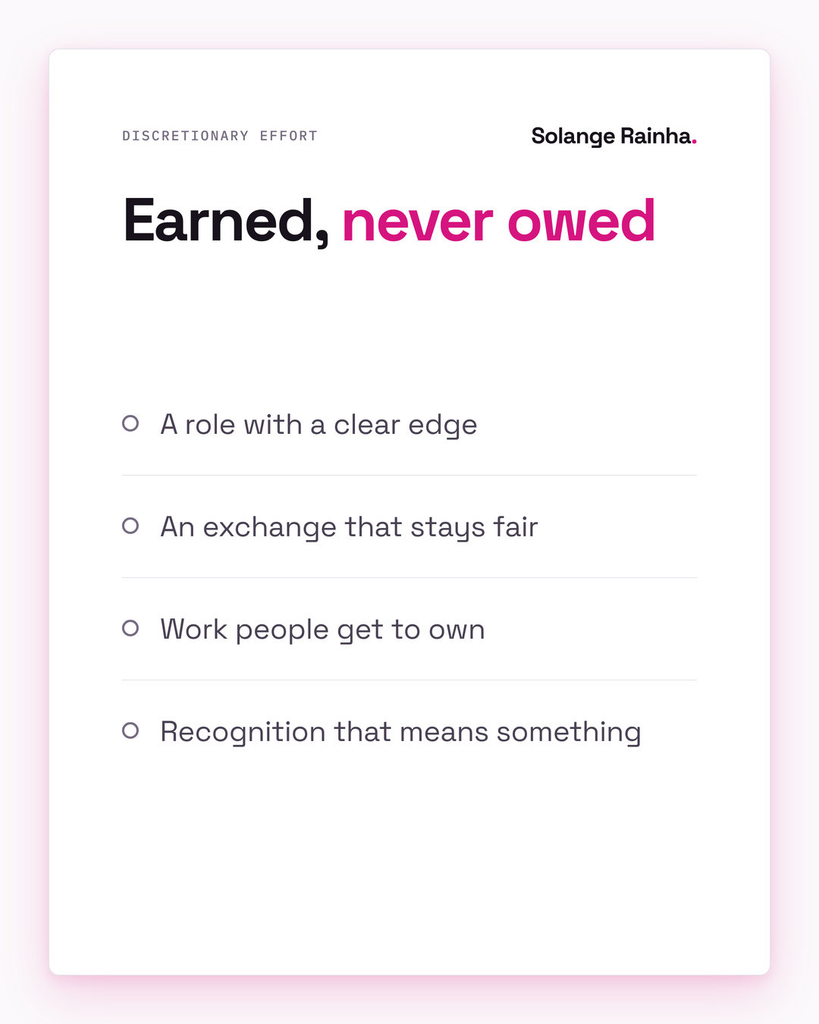
Discretionary effort runs on a fair exchange: autonomy, respect, recognition, and a deal that doesn’t keep quietly rewriting itself in the company’s favour. Even researchers worried about quiet quitting land on the same fix: Anthony Klotz and Mark Bolino argued in HBR that quiet quitting can hurt both organisations and employees, since many companies run on the extra tasks people volunteer for, and the first remedy they proposed was redefining core job tasks. A company that designs its operating model around unpaid discretionary effort has built a dependency and called it a culture, and it’ll read any boundary as an attack, because the model only worked while the boundary wasn’t there.
So what’s the manager’s job here?
To fix the conditions that earn discretionary effort, starting with making the job clear again. The wrong move is to police effort back up through guilt, surveillance or a return-to-office mandate dressed as culture, which treats the symptom and makes the cause worse. When most of your people can’t say where their role ends, that’s a management problem, and it’s yours to repair before you complain that nobody’s going the extra mile.
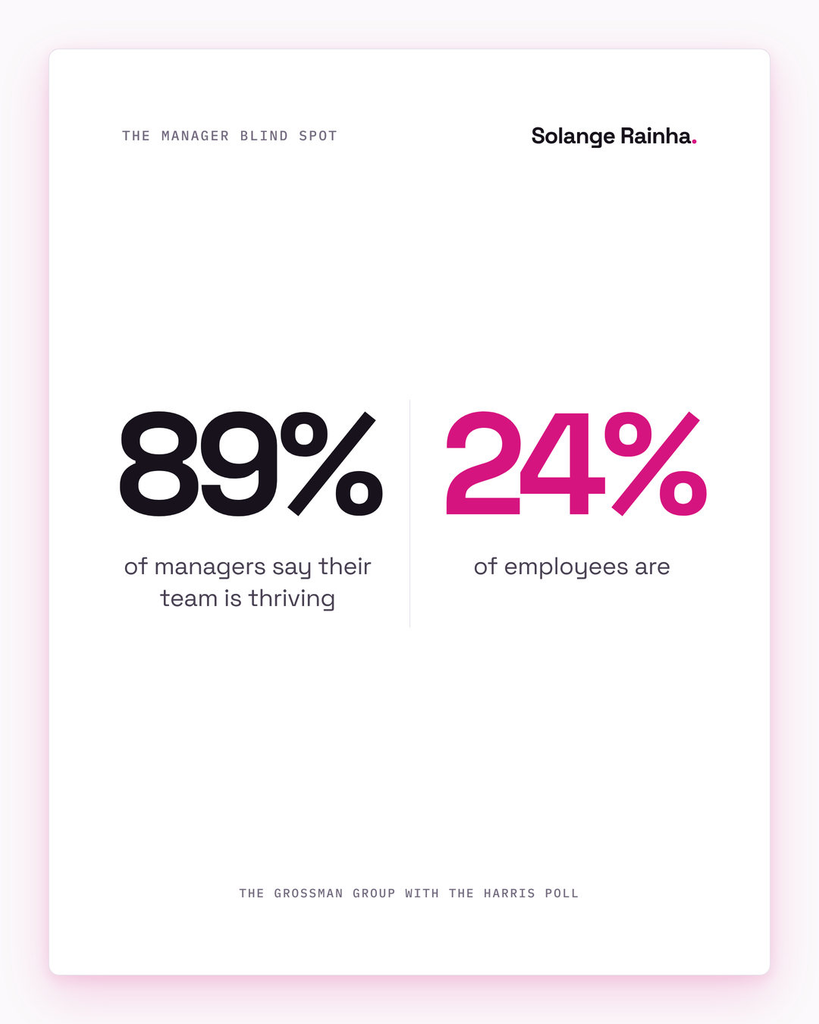
There’s a perception gap that makes this hard, because managers often can’t see the problem: the Grossman Group, a communications consultancy, found in research with The Harris Poll that 89% of managers said their employees were thriving, against an actual thriving figure of 24%. And managers aren’t immune to the slide themselves: Gallup’s 2024 data put managers at 31% engaged, no better than the people they manage. The fix is mundane: role clarity, a fair exchange, recognition people believe, and a scope that stops growing without a conversation. A once-a-year verdict won’t do it, which is part of why annual performance reviews are such a poor tool here.
When I managed a distributed team across four countries, what worked was setting clear standards and then trusting people to meet them without me hovering, and pressure earned me nothing. The structural version of the fix counts just as much, because a lot of “quiet quitting” is understaffing in disguise, which is why I keep arguing that you often need a content system instead of another exhausted body, and why I map a solo function to the roles it would hire before deciding what to delegate to AI.
When is disengagement a problem worth naming?
When someone stops doing the job properly and leaves colleagues to cover for them, which is a different problem from holding a boundary. Not every case of reduced effort is righteous, and pretending otherwise would be its own kind of dishonesty. There’s a corrosive version: the person who has mentally checked out, stopped caring about quality, lets teammates absorb the slack and coasts on a role they’ve emotionally left. Gallup separates the “not engaged” from the “actively disengaged”, and the latter group sat at 17% of the US workforce in 2024 and 18% in the first half of 2026. They do lasting damage to the people working next to them, and a manager who ducks that fails the engaged people on the team.
| Holding a boundary | Actively disengaged | |
|---|---|---|
| The work | The defined job, done well | The defined job, done badly or not at all |
| The extra | Declined, openly | Pushed onto colleagues |
| Gallup’s category | “Not engaged” | “Actively disengaged” |
| Share of US workers | At least half (2022 estimate) | 17% in 2024, 18% in early 2026 |
| What it needs | Role clarity and a fair deal | A performance conversation |
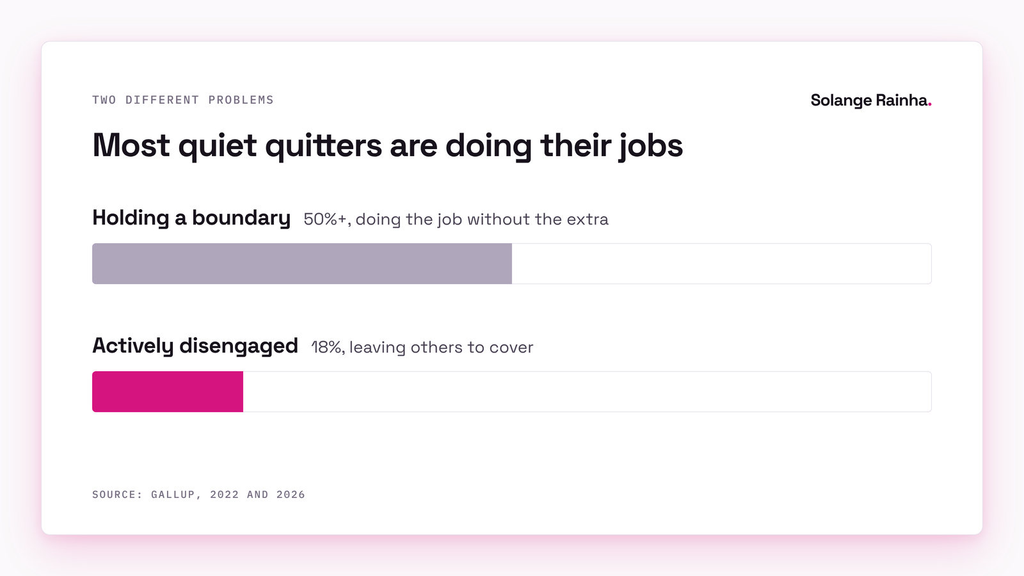
The originator’s own story adds a caveat: a year on, in an update Fortune reported, Khan said quiet quitting had brought him paranoia about being found out and a sense of dread, that filling the freed-up time didn’t make him feel better, and that he eventually left his corporate job, while still blaming poor management for disengaged workers. A boundary is healthy, while staying for years in a job you’ve stopped believing in is a slow way to feel bad, and for some people the healthiest end point is leaving. The panic’s mistake was collapsing the boundary and the disengagement into one villain so it could be angry at both at once, and once you tell them apart, most of your “quiet quitters” turn out to be your reliable people, quietly protecting themselves from a deal that stopped being fair.
If you’re a worker who was told that doing your job is a form of quitting, you were sold a story that served someone else. Managers who bought the same story can at least fix it, because the conditions are theirs to change. How a company behaves the moment you hold a boundary tells you what it thinks the deal is, a signal I’ve learned to read closely, from the contract negotiations that reveal everything the interviews hid to the due diligence I now run on employers before I apply.
Frequently asked questions
Quiet quitting originally meant doing the job you were hired for and declining the unpaid extra beyond it, with no underperforming and no leaving. The term spread from a July 2022 TikTok by engineer Zaid Khan, who described keeping up your duties while rejecting the idea that work has to be your whole life. The moral panic that followed reframed this modest boundary as laziness, and Gallup’s chief workplace scientist, Jim Harter, called quiet quitting a symptom of poor management.
No, and merging them was the panic’s core mistake. Gallup’s “not engaged” category, which the quiet quitting label got attached to, covers people who do their jobs without extra emotional investment, at least half the US workforce by Gallup’s 2022 estimate. Active disengagement, where someone stops caring about quality and lets colleagues carry them, is a separate performance problem affecting 18% of US workers in early 2026, and it deserves to be named and handled on its own.
Managers react badly to quiet quitting when their operating model has come to depend on unpaid discretionary effort, so any boundary reads as a loss. Discretionary effort is the extra a person chooses to give beyond the role, and it’s earned through clarity, fairness and recognition, never owed by default. When a role has expanded through years of expectation creep without matching pay or title, a worker re-baselining to the actual job can feel like a betrayal to a manager who was banking on the inflated version.
Fix the conditions that earn discretionary effort: make the role clear, keep the exchange fair, recognise good work, and stop letting scope grow without a conversation. Gallup found only 46% of US employees strongly agreed they knew what was expected of them in 2024, rising only to 49% in 2026, so role clarity alone is often the highest-return fix. Active disengagement still needs a direct conversation, but treating boundary-setting as a discipline problem speeds up the exit of your best people.