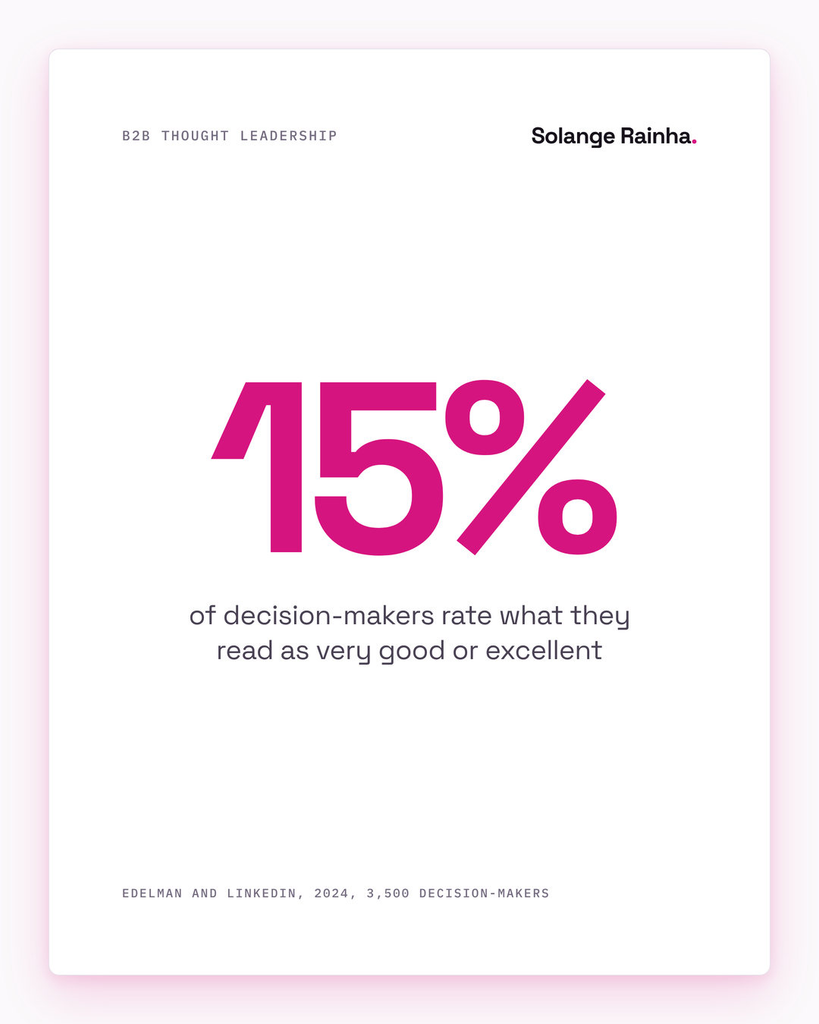
Most B2B thought leadership fails because it takes no position. Thought leadership worth the name is a point of view backed by evidence and specific enough to be wrong, and buyers can tell: in Edelman and LinkedIn’s survey of 3,500 decision-makers, only 15% rated the thought leadership they read as very good or excellent. The ones that clear the bar win business, because 70% of C-suite leaders say a piece of it has made them question a current supplier. AI has made generic content free, which makes a point of view built from your own work the scarce part. This covers what the term was meant to describe, why most of it hedges into nothing, and how to build a position worth publishing.
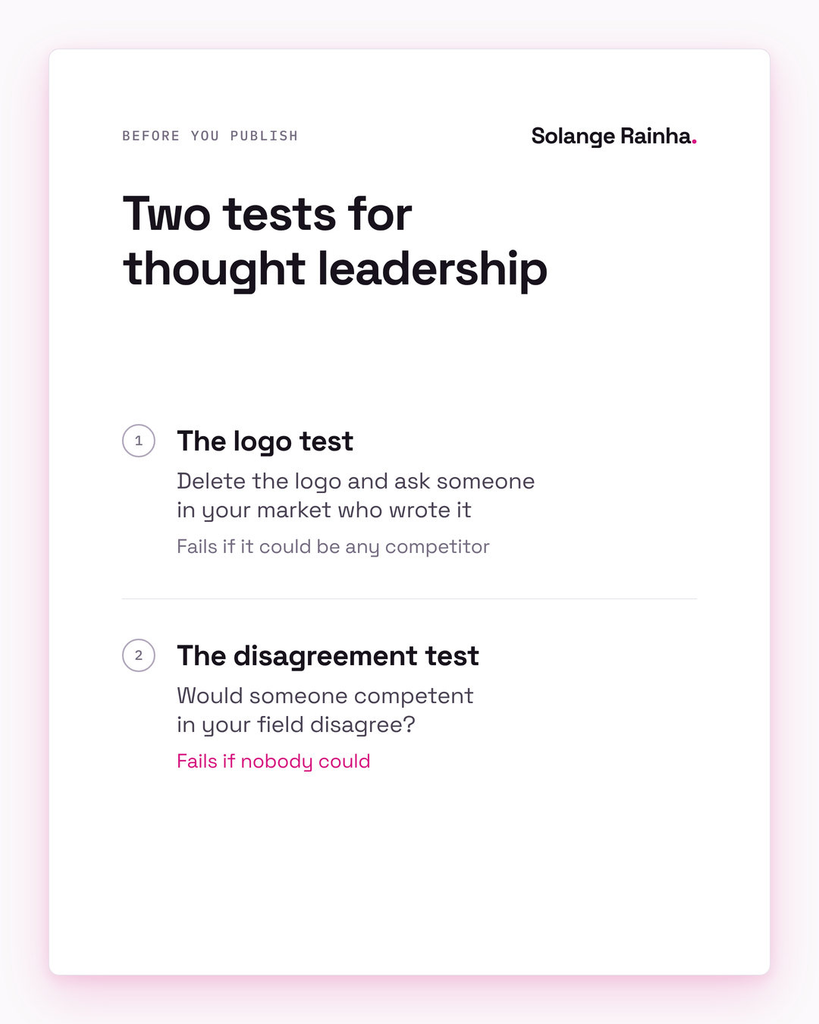
Here’s a test for B2B thought leadership: take the last piece your company published, delete the logo, hand it to someone in your market, and ask them to guess who wrote it. If they can’t, because it could have come from you, your three closest competitors or a mid-tier agency filling a content calendar, then what you published was wallpaper with a byline.
I’ve been in marketing for 15 years, a lot of it writing B2B content, and I’ve produced my share of that wallpaper, so I’m not throwing rocks from above the category. I’ve watched the term rot from the inside until it describes any blog post with a vaguely strategic headline, which means it describes almost nothing, and the label has become so cheap that having it tells you less than the paper it’s printed on.
What was thought leadership supposed to mean?
A thought leader was meant to be someone with an original idea about their industry, and the original definition is strict. Joel Kurtzman coined the term in the first issue of strategy+business, the magazine he edited, and the definition that travels with his name, as Tom Fishburne’s Marketoonist quotes it, sets a high bar:
“Thought Leaders are those people who possess a distinctively original idea”
The rest of that definition asks for a unique point of view or an unprecedented insight into an industry. The weight sits on originality: an insight nobody had framed that way before, a view that belonged to a specific person because they’d earned it.
Somewhere between then and now the meaning collapsed: the phrase became a synonym for “content we’d like executives to read”, and the requirement for an actual thought quietly fell off the spec sheet, leaving a category name that promises insight and delivers consensus.
Why does most B2B thought leadership take no position?
Because the people producing it are scared, and the fear is rational.
Most of it surveys a topic, nods at every reasonable view, hedges each claim into safety and lands on a conclusion nobody could disagree with, which is the same as saying nothing. “AI is changing marketing.” “Personalisation is important.” “Data-driven decisions drive results.” Cool, thanks, every human with a LinkedIn account already knew that.
A point of view can be wrong, annoy a prospect, contradict a board member’s pet theory or age badly in public, so the draft goes through a committee, each reviewer sands off the one edge that made it interesting, and what ships is the beige average of everyone’s caution. I’ve written about why that process makes every B2B blog sound the same; the irony specific to thought leadership is that the hedging meant to protect you is what makes the work worthless, because a claim safe enough to offend no one is usually empty enough to inform no one.
Buyers noticed years ago: in Edelman and LinkedIn’s 2024 study of 3,500 decision-makers, 15% rated the quality of the thought leadership they read as very good or excellent and 48% called it good, so most of the category sits in a wide, grey middle. A genre built on standing out has produced so much of the same piece that standing out is now the whole problem.
What does a point of view need to clear the bar?
Specificity, evidence and a willingness to be wrong in public, and safety strips out all of them.
Specificity comes first. A point of view names names, uses figures and describes a situation concrete enough that it couldn’t be about any company in any industry. Vague is the tell of someone who doesn’t know the specifics or is too scared to commit to them. When I write about a mid-quarter ICP pivot, it’s a specific one, from admissions directors to IT buyers, with the mess it caused, because the specifics are the only part anyone can learn from.
Evidence is the second: buyers in the 2024 Edelman and LinkedIn study named strong research and data as a trait of the highest-quality thought leadership more than anything else, at 55%. A position without evidence is just an opinion, and the internet has enough of those. Evidence earns you the right to the claim, and it’s what makes an AI model, or a person, cite you over ten interchangeable pages making the same soft claim, which is the argument behind why structure alone won’t save weak content and why original research is the hardest asset to copy.
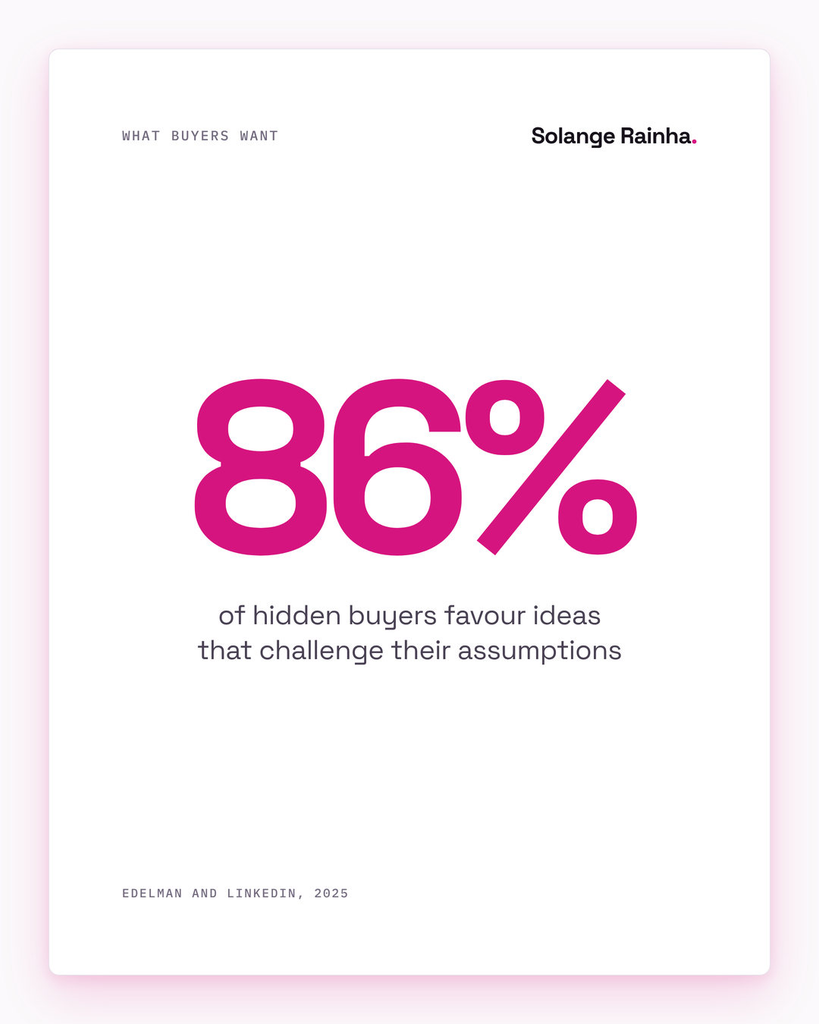
The willingness to be wrong is the hard one. If your thesis has no version where you look stupid in two years, you haven’t said anything falsifiable, so you haven’t said much at all. And here’s where the fear gets it backwards: in Edelman and LinkedIn’s 2025 report, 86% of hidden buyers, the people outside the formal buying group who still influence the decision, said they favour perspectives that challenge their assumptions over ones that validate their thinking.
| Content with a thought leadership label | Thought leadership with a thought | |
|---|---|---|
| Position | Surveys every view, lands on consensus | Commits to one claim a competent peer could dispute |
| Specifics | “Companies”, “teams”, “the industry” | Named roles, specific situations, figures |
| Evidence | Assertions, or someone else’s stat with no source | Your own data or work, plus attributed research |
| Risk | Nothing in it could turn out wrong | Has a version where the author looks stupid in two years |
| The logo test | Could have come from any competitor | Only one company could have written it |
Why does a point of view win business?
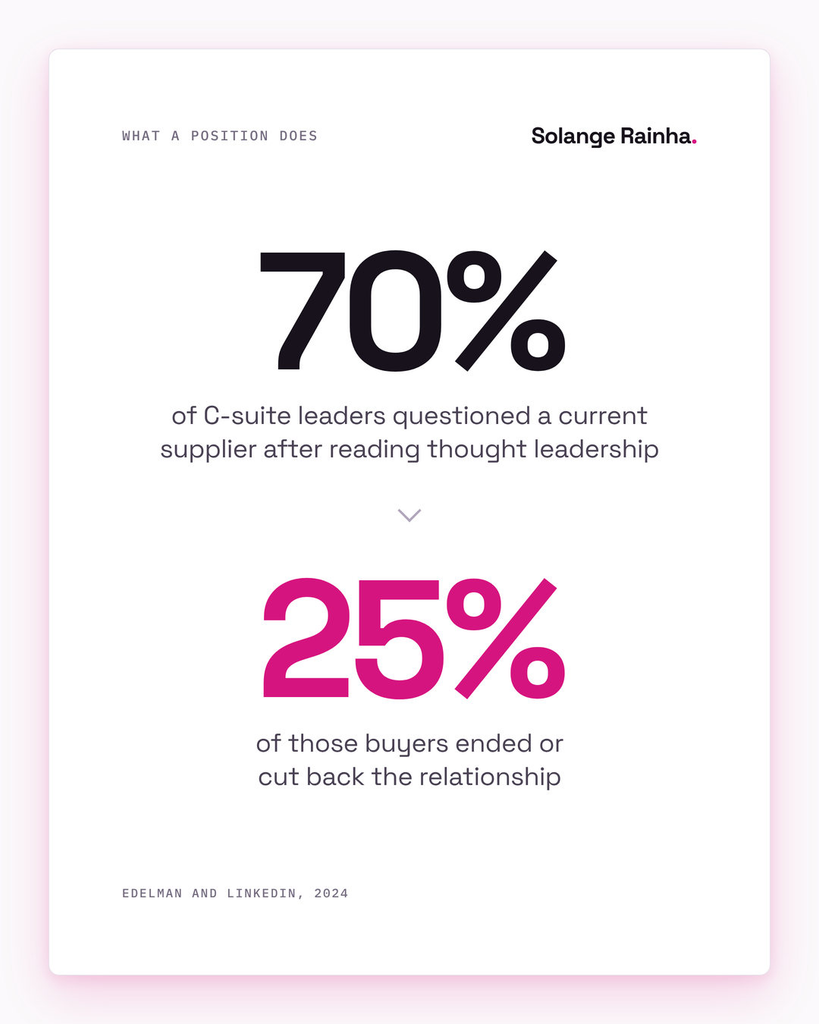
Because it makes buyers doubt the vendor they’ve already got. In the same 2024 Edelman and LinkedIn study, about 70% of C-suite leaders said a piece of thought leadership had made them question whether to keep working with a current supplier, and 25% of the buyers who questioned a supplier that way went on to end or significantly reduce the relationship. That’s the business case for B2B thought leadership that takes a position: it pulls your competitors’ customers into doubt, which a safe piece never manages.
Does AI make a point of view worth more or less?
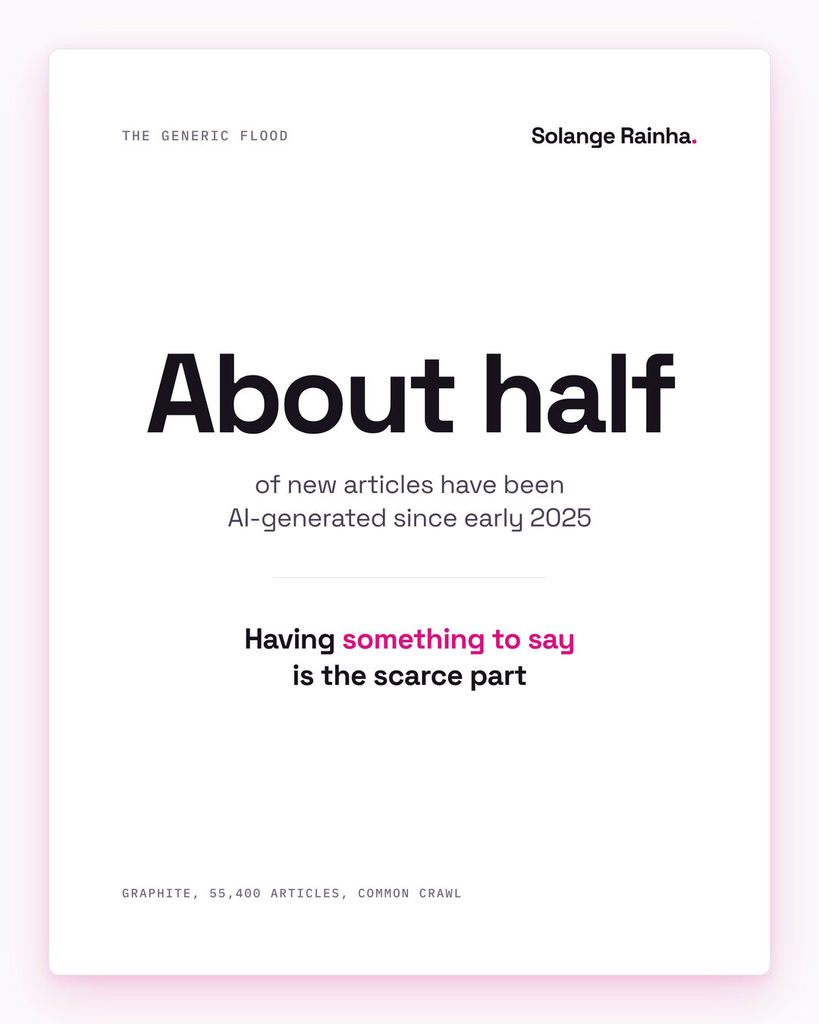
More. The obvious objection is that AI generates infinite content now, so why bother, and I beg to differ: AI has made competent, generic content free and instant, so the market is drowning in the mediocre middle that was already the problem. Graphite’s analysis of 55,400 English-language articles from Common Crawl found AI-generated articles have hovered at around half of new articles since early 2025.
When the generic piece is free, its value drops to roughly zero, and what’s left worth anything is what a model can’t produce on its own: a position that came out of specific work, an argument nobody else is making because nobody else lived what produced it. A large language model predicts the most probable next word, which makes it a consensus machine by design and a poor source of the distinctively original idea Kurtzman meant. You can measure the pull toward the middle: in Anil Doshi and Oliver Hauser’s experiment with 300 writers, published in Science Advances, stories written with AI ideas were rated more creative one by one, but stories in the group given a single AI idea came out 10.7% more similar to each other than stories written without AI.
So the scarcity flips: for years the bottleneck in content was production; now production is free and the bottleneck is having something to say, which was always the hard part everyone was quietly skipping. It’s the same reason good writing became a competitive moat.
How do you develop a point of view worth publishing?
You get it from doing the work and paying attention, and no agency can hand it to you as a branding exercise. Here’s roughly how I develop mine.
Start with what you believe that annoys people in your field. I mean a disagreement you hold, not a manufactured hot take: the meeting where you kept thinking “this is wrong” while everyone nodded. Then interrogate it: why do you believe it, what specifically happened that taught you, what evidence backs it, and, the question that counts most, what would have to be true for you to be wrong?
Then commit to it in writing, specifics attached and edge left on. The test I use before publishing is “would someone competent in my field read this and disagree?” If no one could, I’ve written wallpaper again and it goes back in the drawer, the same muscle as deciding what not to write.
None of this needs a personal brand or a keynote circuit, just a spine and the specifics to back it up. Most companies already have people holding hard-won opinions about their market, then bury them under committee review until nothing’s left. What’s usually missing is the nerve to publish the thought before the edges get sanded off, and the willingness to own the call the way content ownership demands.
Where does this argument fall short?
Most of the buyer data comes from parties with a stake in the answer: Edelman sells thought leadership programmes and LinkedIn sells the place they get distributed, so read their surveys as the best evidence available on a question few others measure, and remember the figures are what buyers say about themselves. The same 2025 Edelman research also found 41% of hidden buyers cite being the “safest choice” as a top factor when finalising a decision, so being provocative in your ideas doesn’t license being a risky vendor, and buyers still want the company behind the thinking to look dependable. And a position takes time to prove right: a piece that clears both tests can still sit unread for months before it moves anyone, which is why it has to be specific enough to keep being true.
Frequently asked questions
B2B thought leadership is content built on a specific, original point of view about a market, one that could turn out wrong, backed by evidence and specifics a competitor couldn’t copy. A piece that surveys a topic and lands on a conclusion nobody could disagree with is content, whatever the headline calls it. Joel Kurtzman, who coined “thought leader” in the first issue of strategy+business, tied the term to a distinctively original idea, and that bar still holds.
Most B2B thought leadership hedges every claim into safety, which leaves it saying nothing. Committee review sands the interesting edge off most drafts, so what ships is the average of everyone’s caution. In Edelman and LinkedIn’s 2024 survey of 3,500 decision-makers, only 15% rated the thought leadership they read as very good or excellent. The cause is structural, in how drafts get approved, more than a shortage of talent.
AI makes thought leadership worth more, because it’s made competent, generic content free. Graphite found AI-generated articles have hovered at around half of new English-language articles since early 2025, which crashes the value of the mediocre middle. What stays scarce is a point of view built from specific, lived work, which a model that predicts the most probable next word can’t produce.
Start from a belief of yours that irritates people in your field, then interrogate it: why you believe it, what taught you, what evidence supports it, and what would prove you wrong. Commit to it in writing with the specifics and the edge intact. Before publishing, run two tests: delete the logo and see if a peer can tell who wrote it, and check that a competent peer could disagree. The position usually already exists inside your company, buried under review cycles that strip it out.