Champion enablement content is what your buyer forwards to finance and IT after the demo, for people who’ll never visit your site. I write short documents for those readers with no sign-up form in front of them, and I find out what buyers forward by asking Sales.
We already know that B2B deals involve a lot of people, but most teams still build their content library for the one person who visits the website, mostly because that’s the person marketing can track. The champion (the buyer who wants your product) then has to sell it to the CFO and the IT lead, and often to procurement too. Almost nothing in a standard content library helps with that job, which is what champion enablement content is for. When I ran content at Full Fabric, which sells software to higher education institutions, my content operation contributed to 48% marketing-sourced pipeline in peak months (the share of open deal value that started with marketing).
What happens to a B2B deal after the demo?
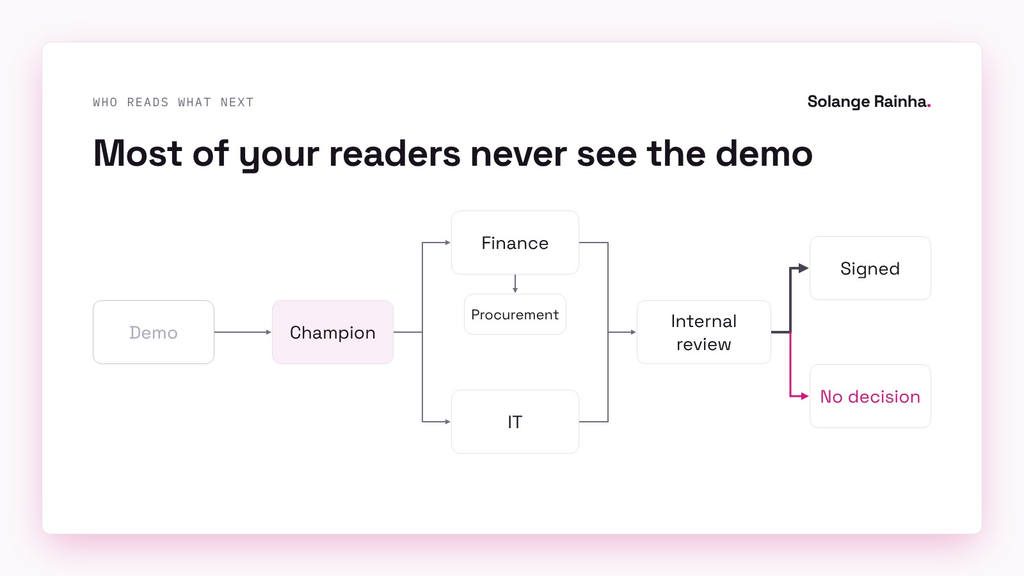
After the demo, the deal moves into meetings nobody invites you to. Gartner’s research on how B2B buyers buy found buyers spend only 17% of their purchase time meeting suppliers. Gartner also found a buying committee (everyone who has a say in the purchase) for a complex solution usually has six to 10 decision makers, and each of them brings information they found on their own. Kevin Escoda at Demand Gen Report pointed out in October 2026 that the 17% covers every supplier at once and that people repeat it without checking its date. So treat the 17% with care, and use newer research where you can.
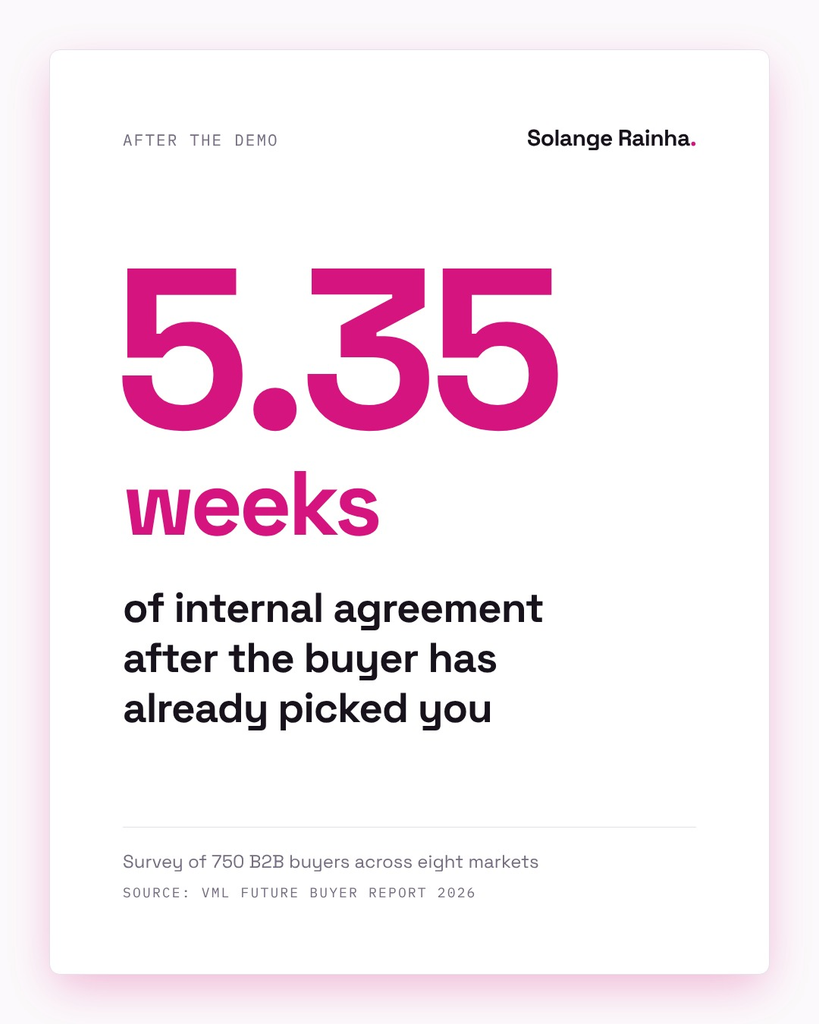
VML’s Future Buyer Report 2026 surveyed 750 buyers in eight markets and found that significant purchases now involve an average of 6.8 people. VML’s buyers also spend an extra 5.35 weeks getting everyone inside their company to agree after they’ve picked a preferred supplier. The same report found 38% of significant enterprise purchases stall or end with no decision at all. Matthew Dixon studied 2.5 million sales calls and, as he wrote for Raconteur in 2023, found that 40% to 60% of the deals Sales has qualified (the ones where Sales thinks the buyer will buy) end in no decision.
Sales leaders often blame competitors, but a lot of deals end in an internal review where your champion had to explain your product to people with no reason to care, and the champion only had whatever you’d given them. At Full Fabric, deals were stalling because IT joined late and didn’t support the purchase. The library had nothing credible for IT on integrations (how our product connected to the systems a customer already ran) or on security, so champions who wanted to buy had nothing to forward.
What’s champion enablement content?
Champion enablement content is the set of forwardable assets (the documents and pages a buyer sends on) you write for the person who wants to buy your product, so they can sell it inside their own company. The readers are people you’ll never meet, like the CFO who signs off on the budget or the IT lead who approves the integration with their systems, and writing for them is a different job from sales enablement for your own Sales team. Forrester has a report on helping champions build the business case. Champion enablement is a content job, even though few content teams treat it as one.
A forwardable asset needs four qualities: it’s short enough to read between meetings (one or two pages), and it’s specific enough to quote, with named systems and actual costs in it (timelines too). The asset also answers the objections the reader will raise before they raise them. And it has no form in front of it, because the CFO your champion forwards a link to won’t fill one out.
Most of what’s in a standard library fails at least one of those four qualities, because the library exists to get a lead in (a contact who fills out a form), and not to get a deal through:
| Why the library asset doesn’t forward well | The forwardable asset |
|---|---|
| Vendors write a case study as a success story and leave out the cost and the effort. | One page covers the customer’s problem, what it cost them to switch, how long it took and what changed. |
| A gated whitepaper is behind a sign-up form, which a CFO won’t fill out, and the stat they need is on page 14. | An ungated page puts the stat and the cost on page one. |
| Product pages assume the reader is already interested, and they list features. | Swap product pages for a one-page business case (what the purchase costs and what it saves) in the reader’s terms. |
| Demo recordings last 40 minutes and answer the champion’s questions, and not the CFO’s or the IT lead’s. | Cut a two-minute clip per role, or write a summary that answers each role’s questions. |
| Most security pages say “We take security seriously” and stop there. | A security summary names the certifications, and it says where you store the data and who can access the data. |
You can read why most buyers skim a whitepaper’s first page and forward it for more on whitepapers, since this piece doesn’t cover them in depth.
How do you write for a reader with no context and no enthusiasm?
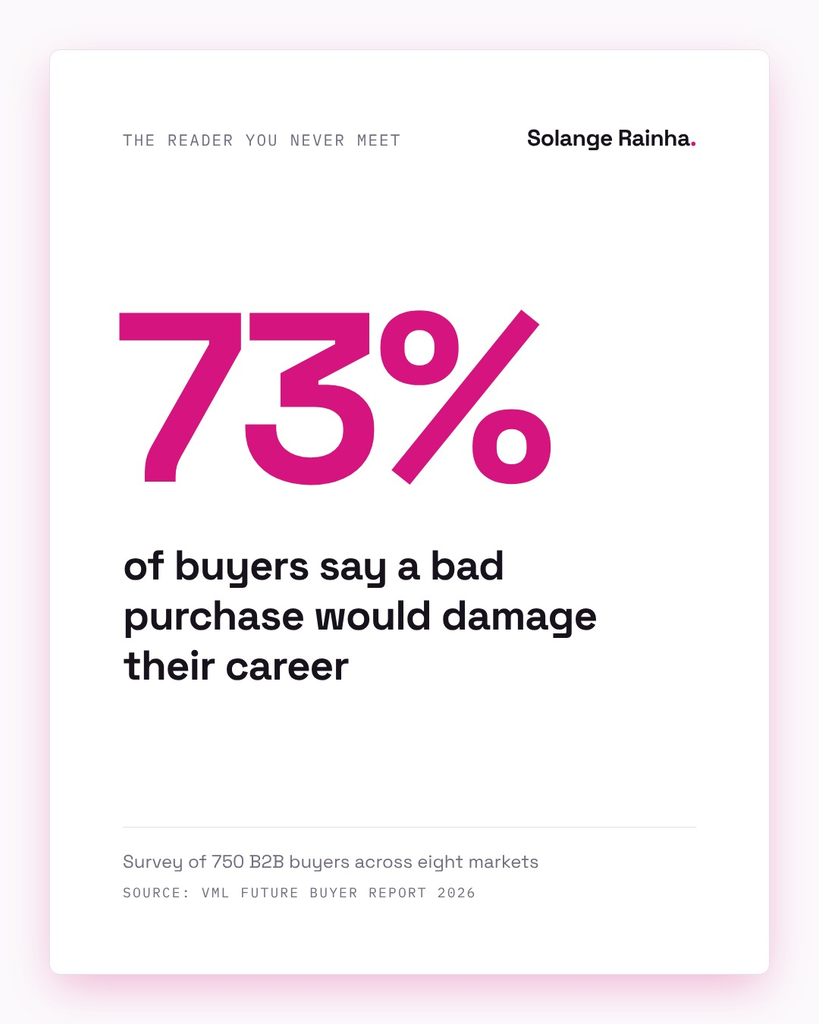
You write as if the reader didn’t ask for the asset, because they didn’t. Your champion saw the demo and liked it, but the person they forward your asset to opens an attachment from a colleague on a busy afternoon, with no idea what the product does and a lot of reasons to say no. VML found in 2026 that 73% of buyers agree an underperforming purchase would meaningfully damage their career, so the reader’s first question is what happens to them if this goes wrong. Dixon’s research found most no-decision losses come from something other than a preference for the status quo, and he traced most of them to:
“customer indecision rooted in a fear of failure” Matthew Dixon, Raconteur, 2023
So the forwardable asset has to make sense to someone who never saw the demo. Its first line tells the reader what the asset is and why it’s in their inbox, and a line like “Your team is looking at a platform to replace X, and this page covers what it costs finance” works. I’d write that first line like any opening people keep reading. Define every term where it first appears, because the reader can’t ask you, and use the rules I use for definitions: the term goes first, and no “it” points back to a document the reader never saw.
Write in the reader’s words, because your product language means nothing to a CFO, who thinks in cost and payback and how much risk they’re taking on, or to an IT lead, who thinks in what breaks and where the data goes. Simplifying until the hard parts disappear makes the asset worse, because complex products need someone to explain the complexity, and a reader who’s looking for a reason to say no will find whatever you left out.
Which forwardable assets should content marketers own?
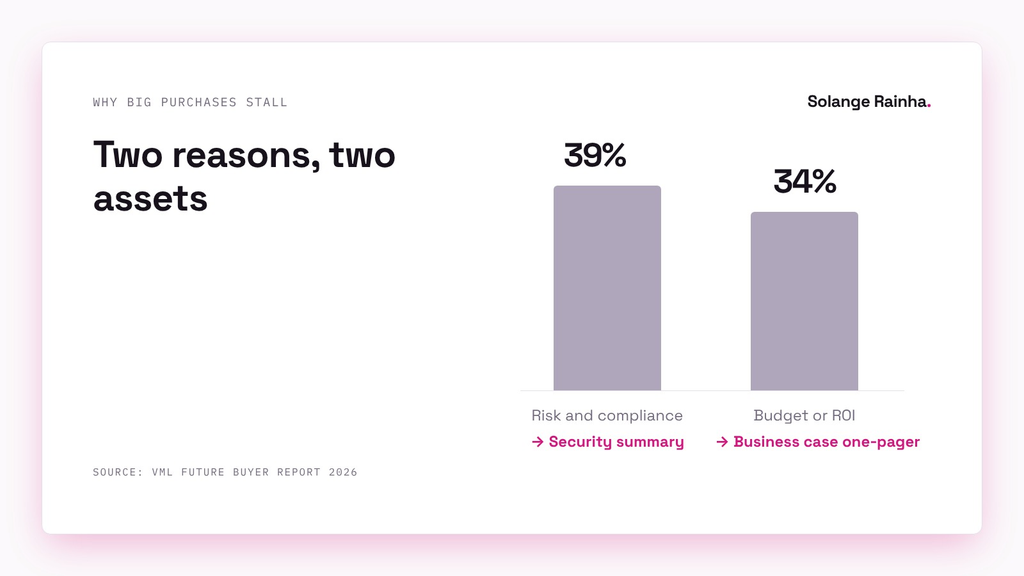
VML’s 2026 research found the two biggest reasons significant purchases stall are risk and compliance concerns (39%) and budget or ROI uncertainty (34%), where ROI means return on investment. Content marketers should own a forwardable asset for each of those, plus one for whoever has to make the product work:
- Finance gets a business case one-pager.
- IT and the risk team get a security summary.
- The people who’ll handle the setup get an integration one-pager.
For the CFO and anyone else who holds the budget, the business case one-pager is the asset to write. It fits on one page and follows the same order every time:
- Put the problem in money: say what the current way costs in staff hours and licences, and in any revenue it loses, and give the source of each figure.
- Give two or three outcomes a customer actually saw, each with its figure.
- List the full cost: the licence, the setup, internal time and whatever the buyer can switch off.
- Say how long the purchase takes to pay back, and what that estimate assumes.
- State the risk of doing nothing plainly, without scare tactics.
- Name a person to contact for the detail, with their email.
The security summary is for IT and the risk team, and it only works if it’s specific:
| The reader’s question | What to write | What never to write |
|---|---|---|
| Which standards do you meet? | Name each certification and give its date and evidence. | Avoid “industry-standard security”. |
| Where do you store our data? | Give the hosting region and provider, and say who has access. | Never promise “your data is safe with us”. |
| What happens if something goes wrong? | Describe the breach protocol and the response times. | Cut “we take security seriously”. |
| What do you need from us? | List the access and permissions your product needs. | Don’t leave this out, as if your product asks for nothing. |
Then there’s the integration one-pager, which answers whether your product will work with the systems the buyer already runs, for the person who gets the blame if it doesn’t. The one-pager names the systems your product connects to and says how long setup really takes, including whether the buyer needs custom development. It also lists the known limitations before anyone has to ask. I’ve written up how I structured integration blueprints for CIOs line by line, so I won’t repeat it here.
What did I build for finance and technical buyers at Full Fabric?
Full Fabric sells software as a subscription (SaaS) to more than 200 higher education institutions. I was its only content person, and I wrote for IT, Deans and CEOs, Admissions, Marketing and CFOs. I gave those five roles a written priority split every quarter that followed live deals, and one quarter ran 40% IT and 5% CFO, so the finance assets got a small share of my time. The finance assets went out alongside the sales enablement I wrote, which included one-pagers and soundbites, and I also wrote material for prospects.
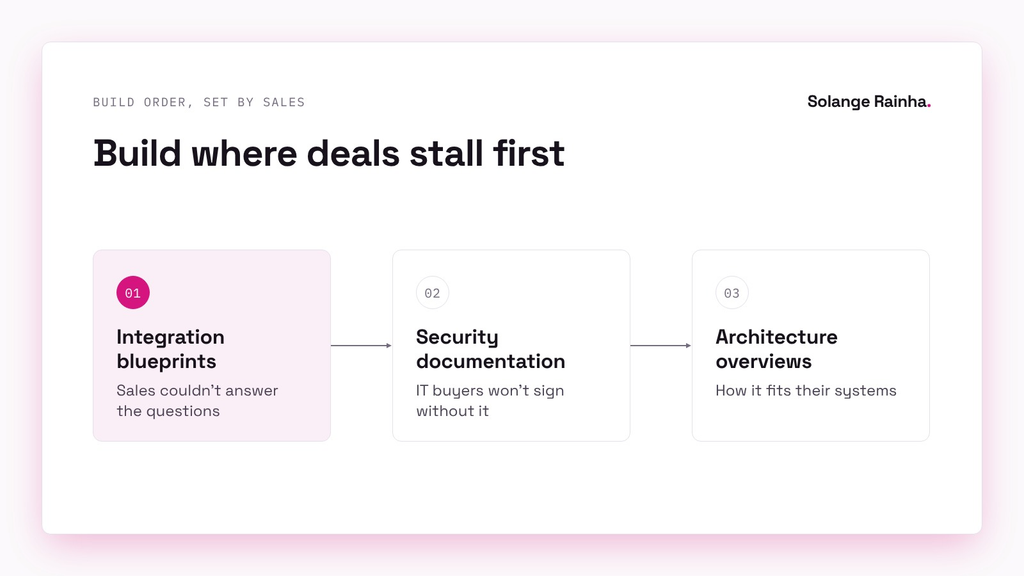
The bigger build came when leadership moved the primary buyer from Admissions to IT. I went through the whole library in about a day and a half and decided to build the new IT content in the order deals were stalling, because prospects were already asking Sales questions that Sales couldn’t answer. Integration blueprints went out first, and security documentation followed because IT buyers looking at SaaS won’t sign without it, and I left architecture overviews until last.
I wrote all of it with Sales and Product, plus engineering to check every technical claim, because a security page with one wrong line in it does more damage than having no page. The Full Fabric content operation also influenced over €230K in pipeline (open deals that content helped) in a single reporting period. You can read the method behind the 48% marketing-sourced pipeline or see the rest of my results for the detail.
How do you find out what your champions are actually sending?
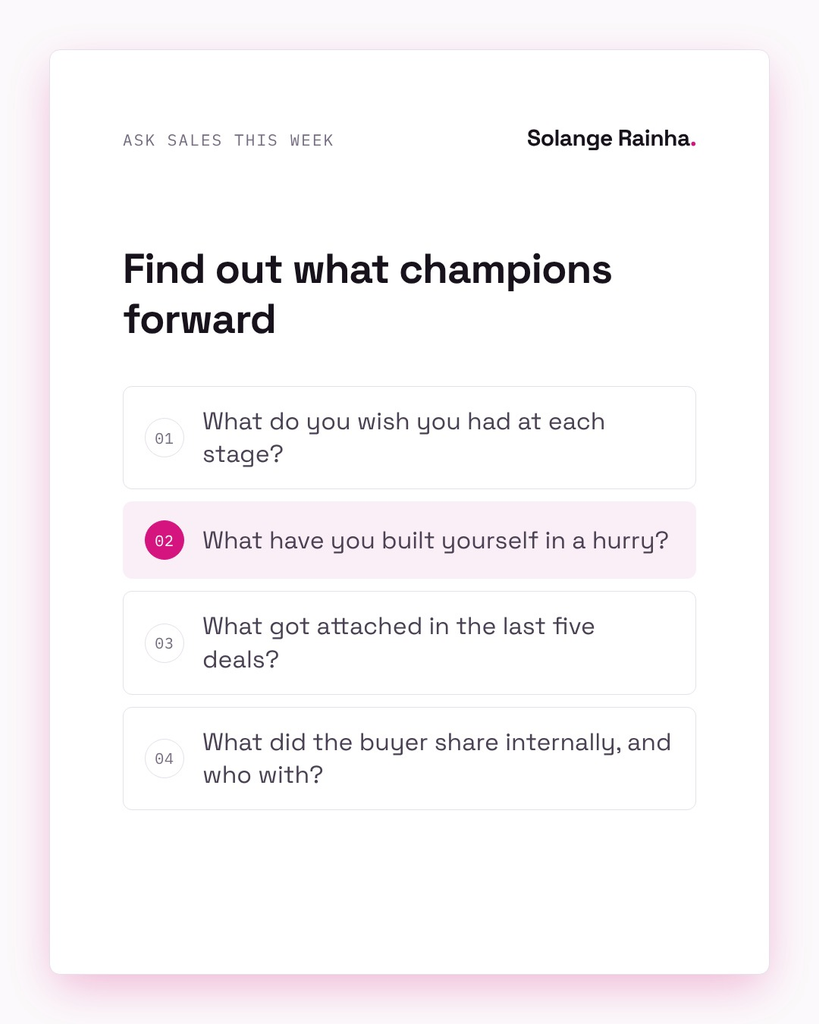
You ask Sales, because they’re the ones who see the forwards. My rule is to ask what they wish they had at each stage, then look at what they’ve been building themselves in a hurry, which is basically the spec for what to build. A rushed slide someone in Sales made for one prospect’s CFO tells you exactly what’s missing, and so do the email they rewrite every time IT asks about data hosting and the PDF they keep attaching to follow-ups.
Then check what Sales tells you against the deals: ask Sales for the email threads from the last few closed deals and the last few where the buyer stopped replying, and look at what Sales attached. Ask them to add “What did you share internally, and who with?” to every call they have after they win or lose a deal. Write the answers down in a simple deal tracker, so you see a pattern after a quarter. If the same claim goes out in five different wordings, put one approved wording in a claims register, the document that holds every approved claim.
The strongest objection to forwardable assets with no sign-up form is about that missing form: Foundry’s 2026 Customer Engagement research, a survey of 676 IT and business decision makers, found 95% are willing to share their information with a vendor to get access to content. So why lose the lead? The answer is that the champion was always going to fill out the form, and they’re already in your CRM (the system Sales uses to track contacts). A sign-up form on a forwardable asset just means the champion pastes a screenshot of the asset into an email, and the screenshot leaves out the part the CFO needed.
What I’d do differently
I’d definitely ask for a named engineering contact on day one of the move to IT buyers, since verifying technical claims was the slowest step. Every week the security documentation waited for a check, the champion had nothing to send. I’d also have made “where did you first hear of us” a required field on sales calls, because none of my 17 KPIs (the measures I reported on) covered that question, and it’d have been the cheapest way to find out.
If you’re building forwardable assets for your own champions, I’d like to hear what they end up sending: [email protected] or LinkedIn.
Frequently asked questions
Champion enablement is giving the buyer who wants your product the assets they need to sell it inside their own company, to people the vendor never meets, like the CFO or the IT lead. Champion enablement content usually means a business case one-pager and a security summary, plus an integration one-pager, each short and ungated so the champion can forward them. The test is whether the asset still makes sense to someone who never saw the demo.
Sales enablement material, like competitor cheat sheets and call scripts (pitch decks too), stays inside your company for your own Sales team, whereas champion enablement content goes out with your champion to readers with no context who didn’t ask for it. Both kinds of material can use the same facts, so make sure they both take their wording from one source, like a claims register.
No, don’t gate forwardable assets, because the people a champion forwards them to won’t fill out a form to read a link a colleague sent. The champion is usually already in your CRM, so a gate on a forwardable asset loses readers and gains almost nothing. If you need to track use, ask Sales which assets they attach to deals and what buyers say they shared internally.
A business case one-pager should be one page, which usually means 300 to 500 words plus a small table of costs and outcomes. The one-pager needs the problem in money, the outcomes a customer actually saw, the full cost and the payback period, with what that estimate assumes. If a business case doesn’t fit on one page, the argument usually isn’t clear yet, so make sure to fix the argument before you add pages.
Champion enablement content works best when content marketing writes it and product marketing and Sales supply the facts, since writing for a reader with no context is a content marketer’s everyday job. In a lot of B2B companies, content marketing and product marketing overlap anyway, which I’ve written about. Whoever owns it, make sure engineering checks every technical claim before the asset goes out.
You measure champion enablement content by whether Sales attaches it to deals, since page views tell you little about an asset people usually send by email. Ask Sales which assets go out on deals that close and on deals that stall. Add a question about what buyers shared internally to the calls after Sales wins or loses a deal, then track influenced pipeline (the value of open deals where Sales used an asset).