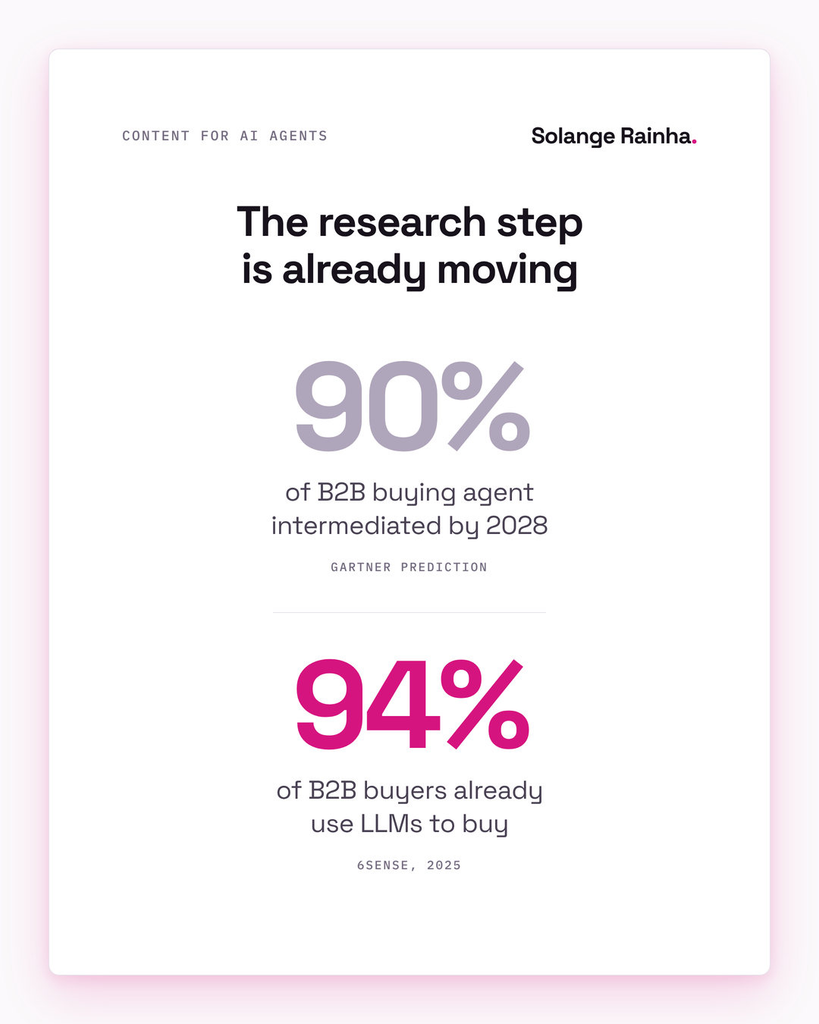
By 2028, Gartner expects 90% of B2B buying to run through AI agents. Writing content for AI agents is mostly the answer-engine work I already do, with the persuasion split off from the facts and the verification turned up, then sold back to you as a shiny new specialism. This piece covers what an agent extracts from your page, why a buried value proposition or hidden pricing gets you cut from its shortlist before a human sees you, and the part of the decision that still belongs to a person.
An AI agent has probably already read one of your pages, and it didn’t admire the hero image, scroll to feel the brand or give your fuzzy claim the benefit of the doubt. Writing content for AI agents starts from that unglamorous reality: the first reader you have to satisfy is a machine deciding whether you belong on a shortlist, and it won’t squint past what a sympathetic human tolerates.
The buying research step is the one moving fastest. Gartner predicts that by 2028, 90% of B2B buying will be AI agent intermediated, pushing over $15 trillion of B2B spend through AI agent exchanges. That’s a prediction, and I treat analyst forecasts as directional, while the research behaviour underneath it is already here: 6sense’s 2025 Buyer Experience Report, from nearly 4,000 buyers, found 94% use large language models during their buying process.
What does “AI does the buying research” mean?
It means software that carries out a multi-step buying task for someone, and doesn’t stop at answering a question. Agentic AI researches options, compares them against stated criteria, assembles a shortlist and, in some cases, completes the purchase inside its own interface.
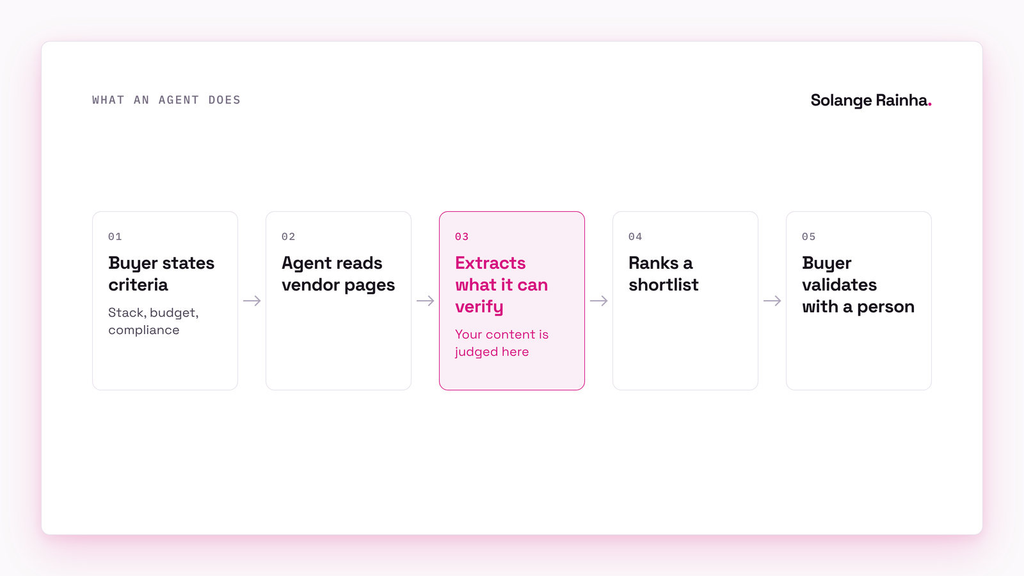
For a B2B buyer, that looks mundane and specific: someone tells an assistant they need a scheduling tool that integrates with their stack, sits under a certain price and handles a particular compliance requirement; the agent reads a stack of vendor pages, extracts what it can and comes back with a ranked set. The buyer never types your name into a search bar or lands on your homepage, and may never see a single email in your nurture sequence.
The consumer data shows how fast this reorders once trust builds: Adobe’s analysis of more than a trillion US retail visits found AI-referred traffic converted 42% better than other traffic in March 2026, a reversal from converting 38% worse a year earlier. That’s retail, so I wouldn’t lift that figure into a B2B deck, but the mechanism transfers: someone arriving from an assistant already did the comparing and lands pre-qualified, on the strength of content you may not have written for that reader. If you want to see the B2B version in your own data, start by learning to track AI traffic in GA4.
Why is an AI agent your least charitable reader?
Because it’s your existing buyer stripped of patience and goodwill, reading everything at face value. A human prospect reads “we help teams move faster” and fills in what you probably mean, while an agent reads the same sentence, finds nothing it can extract or verify, and gives the slot to a vendor who stated what the product does.
Every soft spot you’ve been getting away with becomes a disqualifier at that level of literalness: a value proposition that gestures at an outcome without naming it, a price parked behind “contact sales” so nothing comparable can be pulled, a CTA buried three screens down that assumes the reader keeps scrolling, or a confident claim with no source sitting next to a competitor’s identical claim that carries a citation.
None of these lose a deal with a warm human who already likes you, but all of them cost you the shortlist slot when the first reader is a machine ranking vendors on what it can lift off the page. I made a version of this argument about human readers in good writing is your competitive moat.
What makes content for AI agents machine-actionable?
Clear specifications, comparison data and pricing signals an agent can parse, delivered as text. Machine-actionable content is content an agent can read, extract a specific answer from and act on without a human interpreting the page for it, and most of the weight sits in those three before delivery comes into it.
Clear specs mean the facts of what your product is and does, written as text and never baked into an image or a diagram. Comparison data means the trade-offs between you and the alternatives presented as structured evidence, because an agent assembling a shortlist can lift a table and can’t lift a vibe; the format that does this best is a B2B comparison page you write yourself. And for pricing, you need enough of your pricing model on the page that an agent screening on budget doesn’t drop you for having nothing to compare.
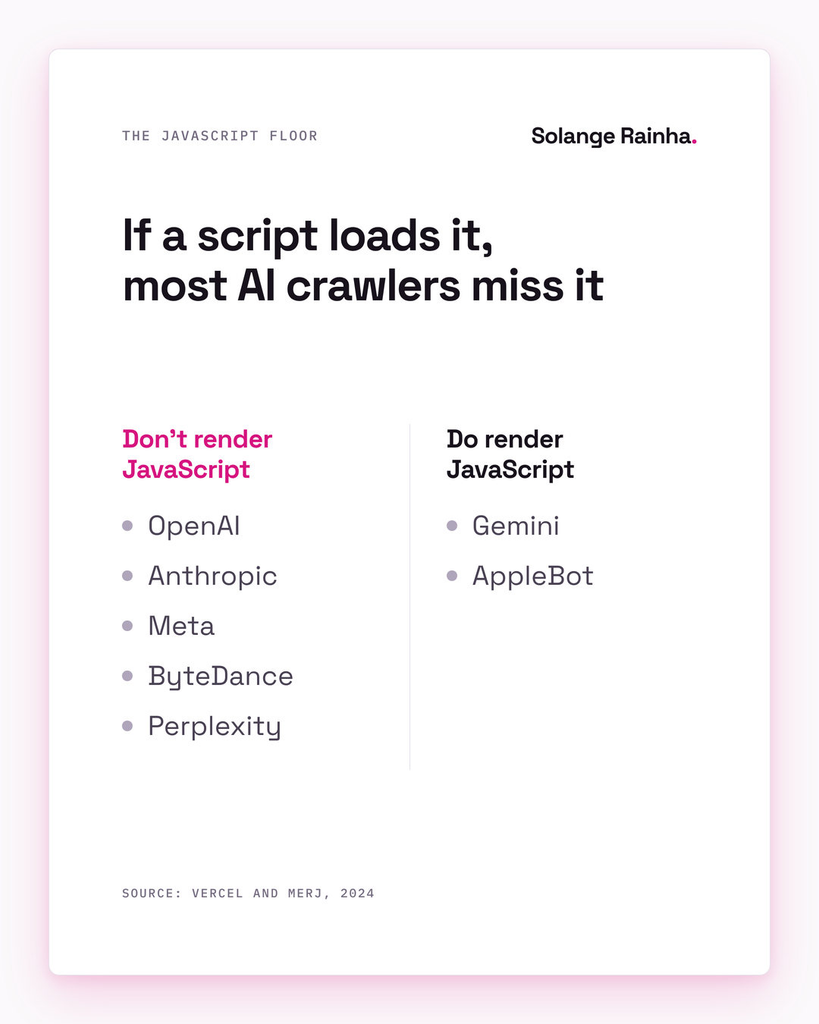
Under all of it sits a technical floor: Vercel and MERJ’s analysis of AI crawler traffic found none of the major AI crawlers render JavaScript, naming OpenAI’s, Anthropic’s, Meta’s, ByteDance’s and Perplexity’s, while Gemini and AppleBot do. A spec or price that only appears after a script runs may as well not exist to most of them. Adobe’s read on why retail AI traffic is uneven points the same way: the average retailer homepage scored 75% for readability to language models, so roughly a quarter of the content wasn’t optimised for them at all.
The gap between the two readers is easiest to see side by side.
| What’s on the page | How a human reads it | How an AI agent reads it |
|---|---|---|
| “We help teams move faster” | Fills in the gaps from context and gives you the benefit of the doubt | Finds nothing to extract and hands the slot to a vendor who states what it does |
| Price behind “contact sales” | Mildly annoyed, might still enquire | No comparable price signal, so you drop out of a budget-screened set |
| A CTA three screens down | Scrolls and eventually finds it | Doesn’t infer intent, so the next step never gets picked up |
| A claim with no source | Trusts the brand and moves on | Gives the unverifiable claim less weight than a sourced rival’s |
| A comparison written in prose | Reads it fine | Can’t lift a structured answer, so a competitor’s table wins the citation |
| Specs rendered only by JavaScript | Sees them load in | Fetches raw HTML, sees a blank and treats the spec as absent |
A couple of shortcuts won’t fix this: a root-directory file won’t, because llms.txt has no measurable effect on AI citations and agents read the page itself. And a blocked crawler reads nothing: Cloudflare’s new AI crawler defaults are worth checking before you spend a week on copy an agent never gets to see. The tactical half of structuring pages for extraction is in write for humans, structure for machines, and if you want to know where your library already fails, that’s a page-by-page job I broke down in how to audit your content library for AI readiness.
How do you get into the consideration set an agent assembles?
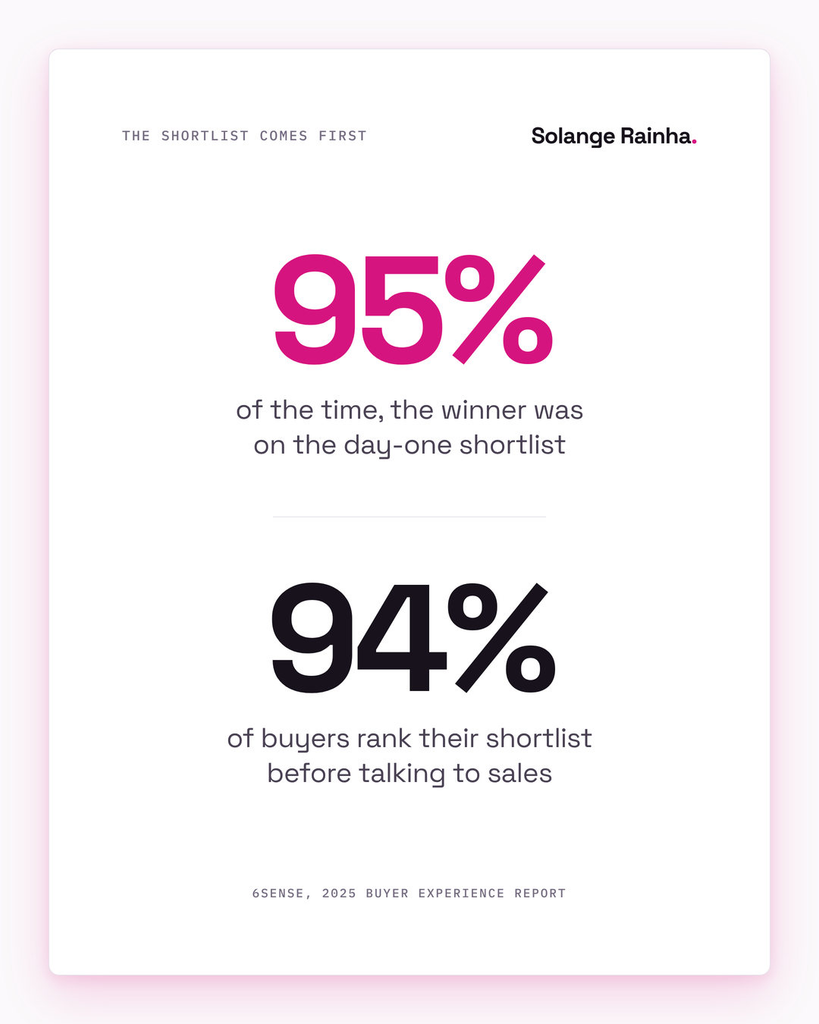
You earn it upstream, before your sales team hears anything, because the shortlist is decided there. In human buying, most buyers already picked their vendors before contacting a rep: the same 6sense report found 94% of buyers rank their shortlist before contacting sellers, and the winning vendor was on the day-one shortlist 95% of the time. An agent hardens that logic, because it builds the ranked set from what it can read and verify across the open web, and there’s no charming your way in after the fact if it never pulled you in.
Getting into that set is a citation problem before it’s a persuasion problem. The agent reaches for sources it can extract a clean answer from and attribute, and the research on what earns that is consistent: in the Princeton GEO study (Aggarwal et al., KDD 2024), which tested content changes across 10,000 queries, adding statistics lifted a page’s visibility in generative engine answers by about 31%, quoting named sources by about 41% and citing sources by about 28%. Treat the sizes as directional, because the engines have moved on since 2024, but the direction has held everywhere I’ve applied it.
It’s also measurable: at OpinionX I set up AI citation tracking on 20 buyer prompts across ChatGPT, Perplexity, Claude, Gemini and Google AI Overviews, and the first baseline had OpinionX named in 38% of answers, cited as a source in 37%, at an average list position of 2.3. That last figure is the one this article cares about, because a list position is a shortlist rank, and it’s the one to watch as the content gets more extractable. I’ve written up how to measure AI visibility when the referral data doesn’t show it.
What still needs a human in the decision?
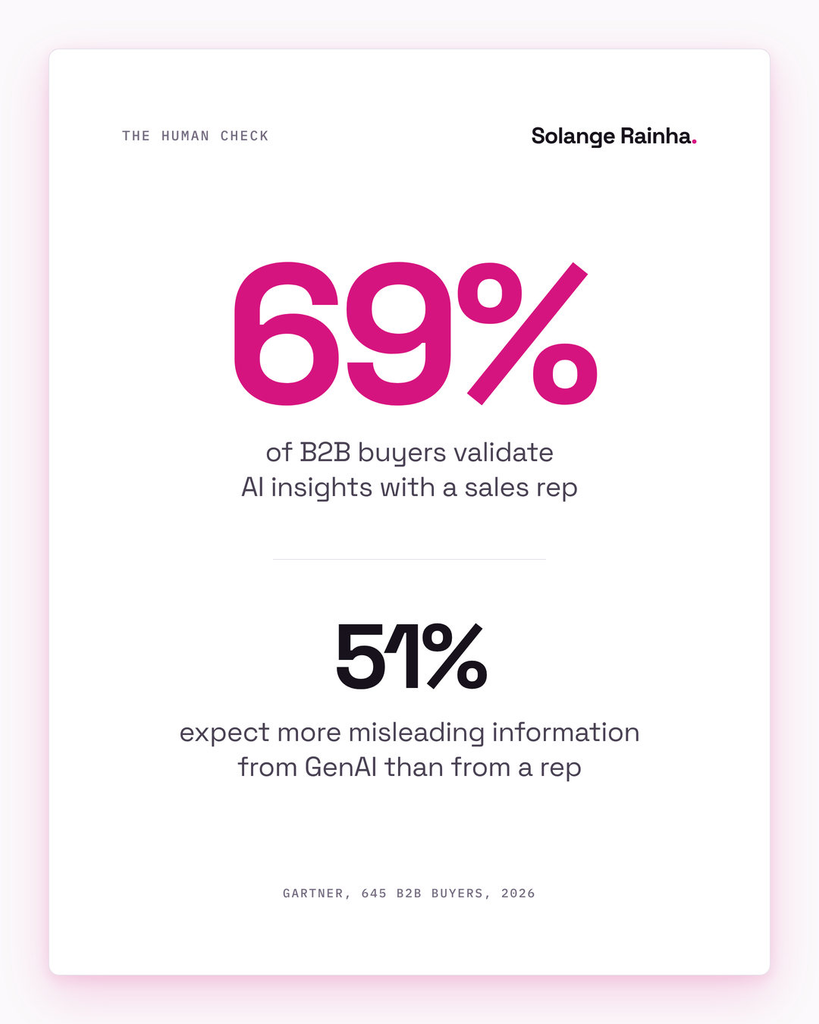
The decision itself, because the agent screens the field and a person still signs. Gartner’s survey of 645 B2B buyers, published in May 2026, found 69% prefer to validate AI-generated insights with sales reps, and 51% think they’re more likely to get misleading information from generative AI than from a rep. Gartner also predicts that by 2030, 75% of B2B buyers will prefer sales experiences that prioritise human interaction over AI. Robert Blaisdell, VP Analyst at Gartner, put it plainly:
“Buyers still turn to sales reps to validate AI-generated insights.”
The machine is very good at narrowing a field on stated facts, but it doesn’t build confidence in a six-figure commitment, pick up on the politics in a buying committee or carry the risk when a call turns out wrong. So the play is to make the facts extractable enough that you survive the machine screen, then keep a human-facing layer where persuasion, proof and trust-building happen for the person weighing the decision.
What’s the checklist for content for AI agents?
Run it against your highest-intent pages first: product pages, comparison pages, pricing, and the content a buyer’s agent would reach for when screening your category.
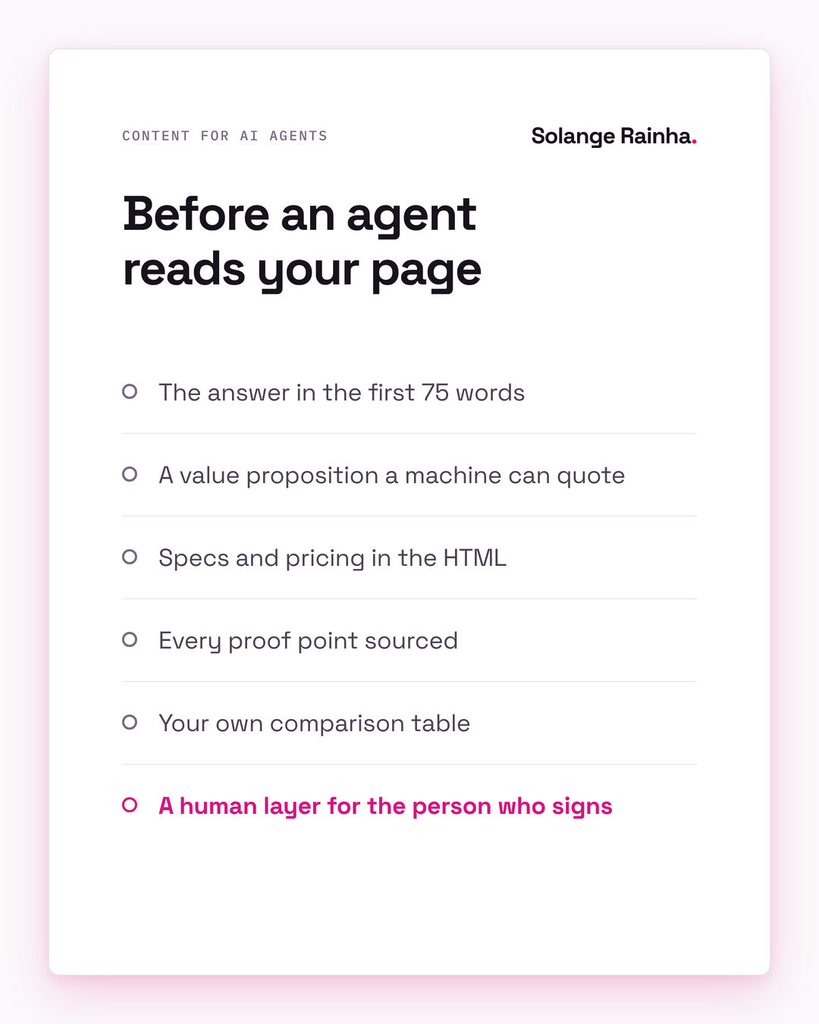
- Lead every key page with the answer in the first 40 to 75 words: what the product is, who it’s for and the pricing model, before any brand throat-clearing.
- State the value proposition as a plain claim a machine can quote, with the specifics attached. “Move faster” gives an agent nothing to compare, while “cuts approval time from days to hours” does.
- Put specs, integrations and pricing signals in readable text and tables, in the HTML itself.
- Attribute every proof point to a named source or your own data.
- Build the comparison a buyer’s agent will assemble anyway, as a table on your own page, before a competitor frames it for you.
- Make each page answer one question and stand on its own, so a fragment lifted out of context still holds up.
- Check your docs as hard as your marketing pages, because product documentation is often what an agent trusts most.
- Keep a human layer for the persuasion the agent doesn’t do, because the person signing off still needs a reason to trust you.
None of this needs a new content function, just the standard you should have been holding anyway, applied to a reader who has stopped being polite about the gaps, and teams already writing plainly, sourcing every claim and building pages for extraction have far less to fix than the ones leaning on a warm human’s willingness to fill in the blanks.
Frequently asked questions
Content for AI agents is web content structured so an autonomous AI system can read it, extract a specific answer, and act on it without a human interpreting the page first. In a B2B buying context, that means an agent doing research on a buyer’s behalf can pull your specs, pricing signals, and claims, compare you against rivals, and decide whether you make the shortlist. It’s the same substance-first content discipline good marketers already use, held to a reader with no patience for vagueness.
No. The agent typically screens and shortlists; the human still makes the final decision and still reads the page. Gartner found 69% of buyers prefer to validate AI-generated insights with a sales rep at key moments, so persuasion and trust-building for the human buyer stay essential. The move is to make the facts machine-extractable so you survive the agent’s screen, while keeping a human-facing layer for the person who signs.
SEO optimises to rank a page so a human clicks it, and answer engine optimisation (AEO) structures content so AI systems cite it in an answer. Writing for AI agents extends that to the buying task itself: the agent goes further than citing you, evaluating you against stated criteria and deciding whether to put you in a shortlist it hands to a buyer. The underlying work overlaps heavily, since all three reward clear, extractable, well-sourced content, but the stakes shift from visibility to consideration.
Partly, and the forecasts run ahead of today’s reality. Gartner’s 90%-by-2028 figure is a projection, not a current state. What is already measurable is that the large majority of B2B buyers now use AI somewhere in the purchasing process, and consumer data shows AI-referred visitors arriving pre-qualified after researching inside an assistant. The research and shortlisting step is moving now, so making your content machine-actionable is a present-tense job, not a 2028 one.