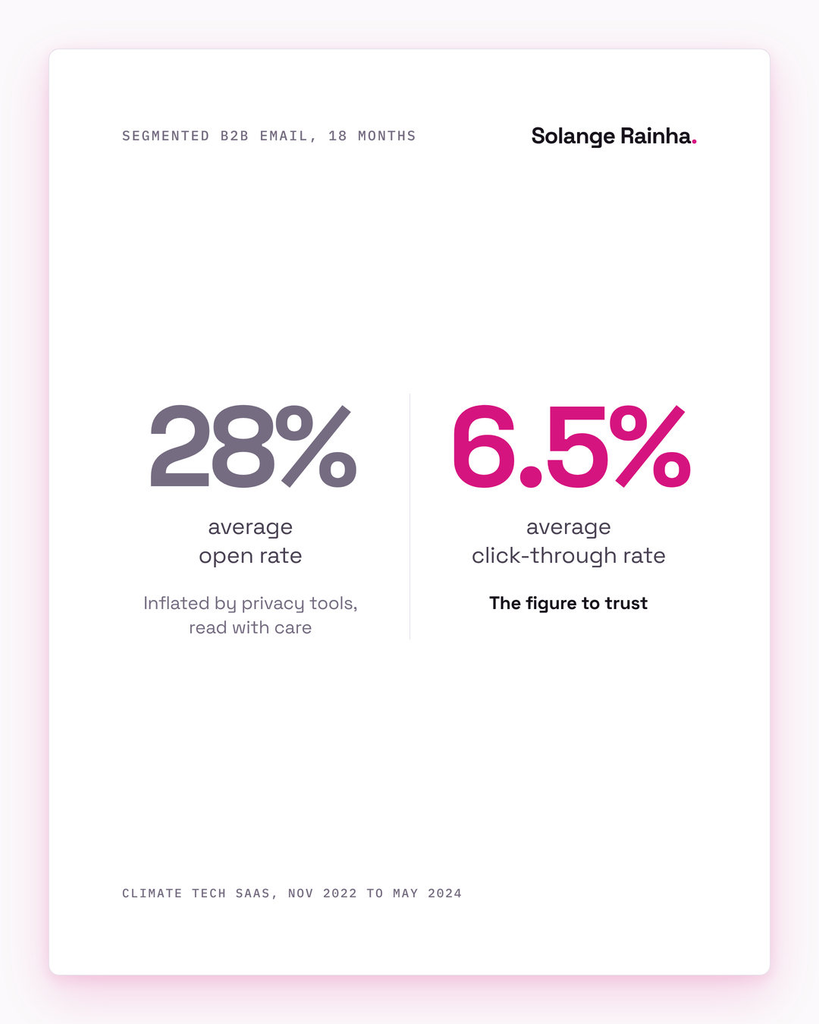
B2B email campaigns underperform because of segmentation far more often than subject lines, and the fix that worked for me was building the segments with Sales. Running digital marketing solo at a climate tech SaaS company, my campaigns averaged a 28% open rate and a 6.5% click-through rate. The click-through rate is the figure to trust: since Apple’s Mail Privacy Protection, opens count whether or not anyone reads, while clicks have held steady. Below is how the segments were built, what went inside each email, how I measured email’s share of pipeline without overclaiming, and what I’d change now.
B2B email campaigns mostly fail before anyone reads the subject line, because the email went to people it was never written for. Over 18 months running digital marketing solo at a climate tech SaaS company selling into energy markets, my B2B email campaigns averaged a 28% open rate and a 6.5% click-through rate. I’ll come back to why the 6.5% is the one I’d put my name on and the 28% is the weaker brag. First, the part nobody running a sad-looking email programme wants to hear: if your campaigns are underperforming, your subject lines almost certainly aren’t the problem.
Everyone reaches for the subject line first because it’s the cheapest fix: swap a few words, add a question mark, A/B test the send time, feel productive. Meanwhile the email flopped because it went to 4,000 people when it was only ever relevant to 600 of them, and the other 3,400 either ignored it or quietly trained their inbox to send you to the promotions tab. You can’t subject-line your way out of that.
Why do most B2B email campaigns underperform?
Weak segmentation, nearly every time. Most B2B email campaigns blast one message to the whole list because it’s faster, then blame the open rate when it tanks, but a generic email to a mixed list stays generic however clever the subject line is, because the reader can tell within two seconds it wasn’t written for them.
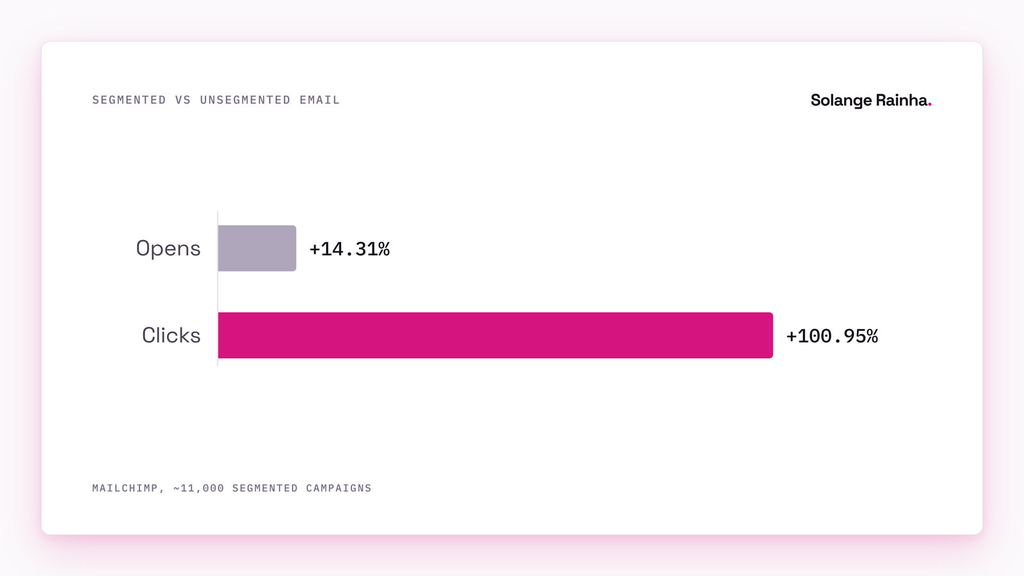
The data on this is old but consistent: when Mailchimp compared about 11,000 segmented campaigns with the same users’ unsegmented sends, segmented campaigns got 14.31% more opens and 100.95% more clicks. Look at where the lift lands: segmentation barely moves the open, which the subject line and sender mostly decide, while clicks double, since a click is where relevance shows up. The programmes that win run the opposite of the volume playbook, sending fewer emails to more precisely defined audiences.
In B2B this hits harder than in B2C, because the buying decision is considered and slow, and it’s made by people with full inboxes and no patience for an email that doesn’t speak to their specific problem. A facilities manager at an energy cooperative and a CFO evaluating a SaaS subscription care about different things, and an email that tries to talk to both ends up talking to neither. Segmentation is the discipline of refusing to send that email. In my case the split ran by buyer type, with decision-makers, energy community managers and residential consumers each getting different content tailored to their regulatory context and their reason to buy.
How did Sales help build the email segments?
Sales told me which buyer types were in-market and why, and I built the segments around that instead of around CRM fields. That’s the part that moved the click-through rate, and it’s the part marketing teams skip because it means giving up sole control of the list.
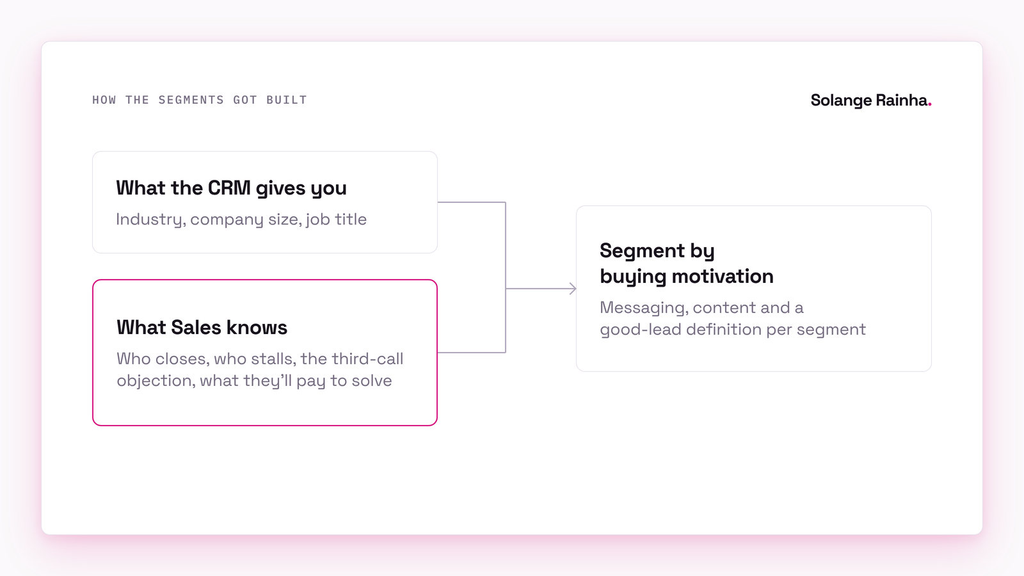
Marketing tends to segment by the data that’s easy to pull: industry, company size, job title, whatever the CRM fields happen to be, which gets you tidy-looking lists that don’t map to how anyone buys. Sales knows what marketing usually doesn’t: which segments close, which ones kick the tyres for six months and vanish, what objection comes up on the third call, and which problem a given buyer type will pay to solve. That knowledge sits in the heads of the people on the phones, and it almost never makes it into the email strategy.
So I sat down with the sales team and we defined the segments together: I turned what they told me about who was in-market and why into messaging and content that matched each segment’s stage and pain, and we agreed on what a good lead from each segment looked like. The segments stopped being demographic buckets and became groups of people who shared a buying motivation, which is the difference between a list and an audience. I went into how this kind of alignment works across a whole content function in the piece on running five buyer personas solo, but email is where the payoff shows up fastest, because the feedback loop runs in days instead of quarters.
What goes inside a B2B email that earns the click?
One idea and one call to action, matched to the reader’s buying stage. Segmentation gets the right email to the right person; the content inside decides whether an open turns into a click, and for considered B2B purchases I held to a few rules every time.
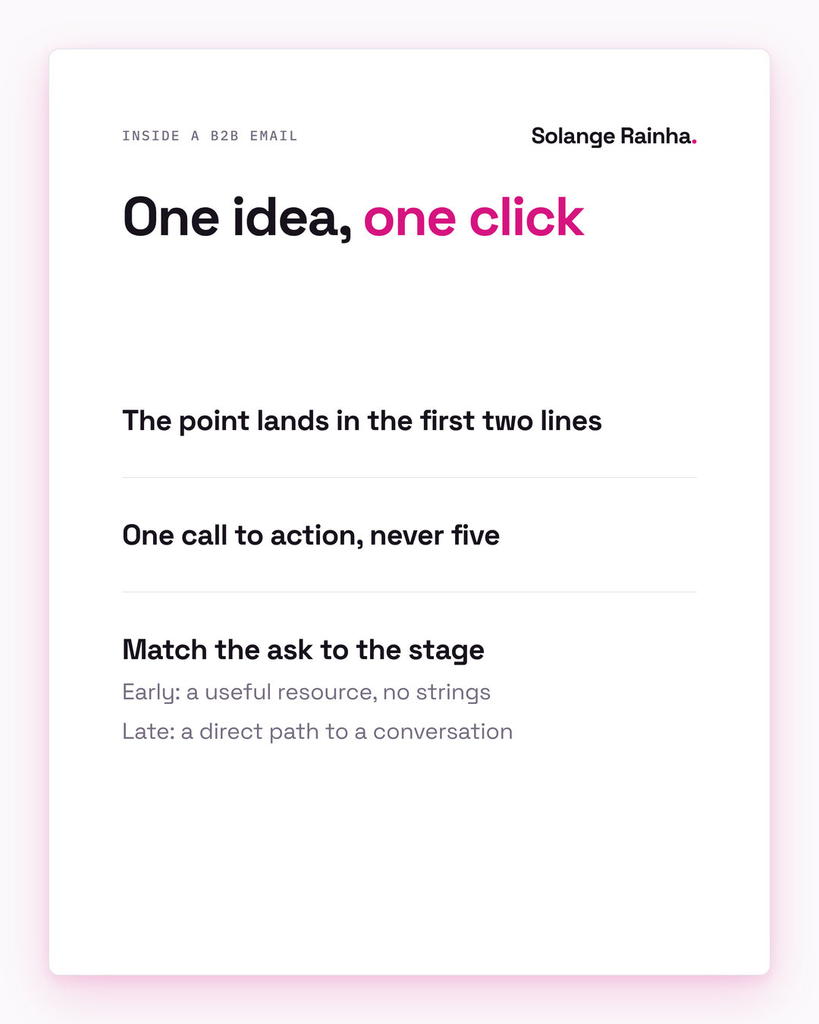
The point goes in the first two lines, because most people skim marketing email, often on a phone, so the reason to care has to land before anyone has to scroll; bury it under a paragraph of throat-clearing about how excited we are to share an update and it’s dead. I wrote more about openings that survive the scroll separately, and email is the least forgiving place to get them wrong.
Keep it short, too. A B2B email isn’t a blog post, and it isn’t trying to close the deal on its own: its single job is to earn one click through to what does the heavy lifting, whether that’s a case study, a comparison page or a demo booking. The fastest way to kill a click-through rate is to stuff an email with five competing calls to action, because a reader facing five choices makes none of them. One clear call to action, phrased as the next logical step for someone at that stage, beat every busy multi-link layout I tested.
The ask has to match the buying stage. An early-stage segment got a link to a useful resource with no strings, because asking a cold buyer to book a demo is how you get unsubscribes (the same logic behind awareness stage content that earns attention before it asks for anything), while a late-stage segment that Sales had flagged as close got a direct, low-friction path to a conversation. Segmenting the audience is pointless if every segment gets pushed toward the same generic button.
I still tested subject lines, for what it’s worth: every list big enough to split got an A/B test, and specific, benefit-led lines won every test I ran, with “How [specific municipality type] is cutting energy costs by [percentage]” beating “The future of community energy”. That’s polish on top of the segmentation, though, and it can’t stand in for it.
Which email metrics can you trust after Apple’s Mail Privacy Protection?
Clicks, click-through to high-intent pages, and conversion; opens only with a heavy caveat. Apple’s Mail Privacy Protection, live since 2021, downloads remote content in the background “regardless of whether you engage with the email”, tracking pixel included, so a chunk of every open you count is a machine.
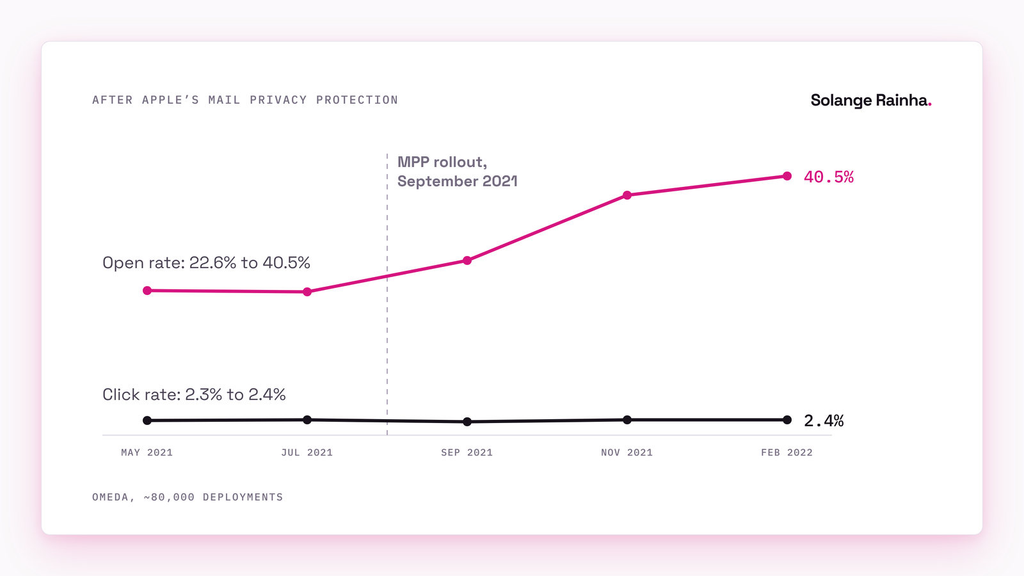
The distortion is large and well measured: Omeda tracked about 80,000 email deployments, roughly two billion emails per period, and in its six-month review of MPP total open rates rose from 22.6% before the rollout to 40.5% after, while total click rates sat at 2.3% to 2.4% the whole way through. As Omeda’s Kalin Webber put it, “both the total and unique opens rates have nearly doubled.” That jump came from the pixel firing on Apple’s servers, with no extra reading behind it. Apple’s clients now account for 76.56% of the opens Litmus tracked in September 2026, a share MPP itself inflates. Brevo now reports both versions in its 2026 Marketing Orchestration Benchmark: a 20.73% average open rate with MPP opens stripped out, and 33.87% with them left in.
| Metric | What it tells you | How MPP affects it | Trust it for |
|---|---|---|---|
| Open rate | Whether the subject line and sender got attention | Inflated, because Apple preloads the pixel | Rough trends on the same list, never benchmarks |
| Click-to-open rate | How well the body converts readers | Deflated, because fake opens swell the denominator | Comparing your own emails, with care |
| Click-through rate | Whether the email was relevant enough to act on | Barely affected | Your headline email metric |
| Conversion within a segment | Whether email moved buyers toward a deal | Not affected | Email’s contribution to pipeline |
Against that backdrop, a 28% open rate isn’t a headline, since it sits below Brevo’s MPP-inclusive average, and software opens run lower than the all-industry figure anyway: MailerLite’s 2025 benchmarks put software and web apps at 39.31% against 43.46% overall. What I’d claim for the 28% is that it came off a properly segmented list instead of one padded with people who’d stopped caring.
The 6.5% CTR is the figure I’d stand behind in a job interview, because it measures whether the content was relevant enough to make a busy buyer do something, which is the entire point of the email. Brevo puts the average marketing campaign at a 2.27% CTR and its top 10% at 5.22%, and its information, technology and software category averages 1.88%. MailerLite’s 2025 click rate for software and web apps is 1.15%. Both datasets cover all senders and are newer than my campaigns, so read them as a yardstick, but 6.5% sits above every one of them.
How do you measure email’s contribution to pipeline?
Through conversion within each targeted segment, never last-touch attribution, because B2B email rarely deserves sole credit for a closed deal. Across the segments we targeted, conversion rose roughly 10% once the messaging matched the buyer, and it’s the result I’m most careful about claiming.
Email is almost always an assist: the buyer reads the email, clicks through, comes back three weeks later from a search, talks to Sales and converts. Run last-touch attribution and you’ll either over-credit email or ignore it, depending on where it happened to fall in the chain, and both readings are wrong. So I tracked email’s contribution through the segments themselves: conversion rate within each targeted segment before and after the segmentation overhaul, click-through to the high-intent pages, and what Sales reported back about the quality of email-sourced leads, and I never claimed email closed the deals on its own.
That framing fits what email does well in B2B, which in my experience is keeping an already-interested buyer warm and moving, more than generating volume. I made the broader argument about attributing content to pipeline in what 48% marketing-sourced pipeline looks like, and email is a smaller, sharper version of the same problem: credit it for the assist it made, and leave the rest to the touches that earned it. If you’re choosing what to report upwards at all, which content marketing metrics to track covers the same ground for the whole function.
How much personalisation in B2B email campaigns is worth the effort?
Relevance to a segment is worth nearly all of it, while name tokens and one-to-one copy on broadcast sends are mostly wasted effort. There’s a spectrum, and most of what people pour into personalisation goes to the wrong end of it:
| Level | What it looks like | Cost | Payoff |
|---|---|---|---|
| Cosmetic | {{first_name}} in the subject line | Close to zero | Close to zero; every inbox has seen it ten thousand times |
| Segment relevance | The buyer type’s problem, their world, the next step for their stage | Moderate, and it scales across hundreds of people | The bulk of the click-through lift |
| One-to-one | Bespoke copy for individuals on a broadcast send | Hours per email | Only worth it for a hot prospect, which is a salesperson’s job |
The cosmetic end doesn’t hurt, but a buyer can smell the mail merge, and teams treat it like the main event. Segment relevance is just segmentation done well: an email that speaks to the specific problem a buyer type is trying to solve, references the world they work in and offers the next step that makes sense for their stage feels personal even if it never uses the recipient’s name. That’s what moved our click-through rate. One-to-one customisation is a fine use of a salesperson’s time for a prospect who’s signalled intent, and a terrible use of a marketer’s time across a list; the trick is knowing where on the spectrum a send sits and spending the effort on relevance instead of on tokens that look clever in a demo.
What would I change about the programme now?
Two things, if I were rebuilding those B2B email campaigns today, and a caveat about the results.
I’d move further away from the open rate as a success measure and build reporting around clicks, click-through to high-intent pages and downstream conversion from day one, so nobody on the team feels good about an MPP-inflated open figure. The metric stopped being trustworthy years ago, and the reporting should say so.
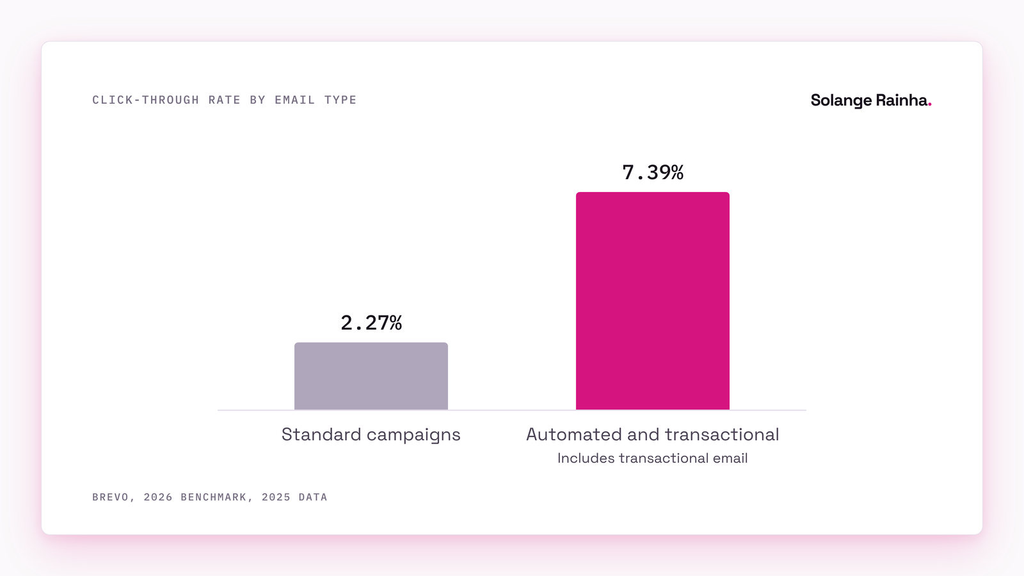
The bigger change: I’d shift much more of the programme from scheduled broadcasts to behavioural automation. Brevo’s benchmark puts automated and transactional emails at a 7.39% CTR against 2.27% for standard campaigns, roughly three times higher, because they fire when intent is hot instead of when the calendar says so. That comparison folds receipts and password resets in with marketing automation, so the gap for marketing flows alone is likely smaller, but the direction holds. An email that goes out the moment a buyer visits the pricing page or finishes a case study is working with the buyer’s own timing. We did a lot manually that should have been a triggered flow, and that’s where I’d start.
The caveat: the 10% conversion lift is a before-and-after reading within segments, with no holdout group, so other changes landing at the same time could account for part of it. I’d set up a small control segment from the start next time, because that’s what turns “conversion went up” into evidence.
I covered the wider story of running that whole function solo in 60+ marketing pieces in 18 months, how email fits a zero-budget plan in content distribution with no budget, and the same discipline on social in the LinkedIn playbook that hit 12% engagement.
Frequently asked questions
Judge B2B email campaigns on click-through rate, because Apple’s Mail Privacy Protection has inflated open rates since 2021. Brevo’s 2026 benchmark shows a 20.73% average open rate with machine opens stripped out and 33.87% with them left in. For clicks, Brevo puts the average marketing campaign at 2.27% and the top 10% at 5.22%, with its information, technology and software category at 1.88%. Anything above 5% is strong; the 6.5% CTR described here sits above all three.
Weak segmentation, far more often than weak subject lines. Teams send one message to a mixed list because it’s faster, and a generic email reads as irrelevant however good the subject line is. Mailchimp’s comparison of segmented and unsegmented sends found segmentation lifted opens by 14.31% and clicks by 100.95%. The fix is sending fewer, more targeted emails to segments defined by buying motivation instead of whatever demographic fields sit in the CRM.
Define the segments with the sales team instead of building them alone from CRM data. Sales knows which buyer types are in-market, which objections come up and which problems a segment will pay to solve, and that knowledge rarely reaches marketing’s list logic on its own. Turn what they tell you into segment-specific messaging and content, and agree together on what a good lead from each segment looks like. The segments then group people by buying motivation, which is what makes the messaging land.
Skip last-touch attribution, because B2B email is usually an assist in a long buying cycle. Track conversion rate within each targeted segment before and after a change, click-through to high-intent pages, and lead-quality feedback from Sales on email-sourced contacts. Add a small holdout segment if you can, so a before-and-after lift becomes evidence. That gives you email’s contribution without claiming email closed the deals by itself.