Solo digital marketing works at volume if you build the system before the content and decide early what you won’t make. For 18 months at a climate tech SaaS company I was the whole digital and content marketing function, and I shipped 60+ pieces, restructured the website, and built social and email from zero; qualified leads rose 15% and organic traffic 22%. Around month twelve the pace started costing me quality, and fixing that meant producing less. This is what shipped, the system behind it, what I cut, how to read the results, and what I’d tell anyone about to try it.
From November 2022 to May 2024 I ran solo digital marketing at a climate tech SaaS company selling across Portugal, Europe and Brazil, to B2B buyers and residential consumers at the same time. There was no content team and no demand gen specialist, and the social media manager was also me. The brief was “do everything”, which in practice meant prioritise hard, because nobody else was coming.
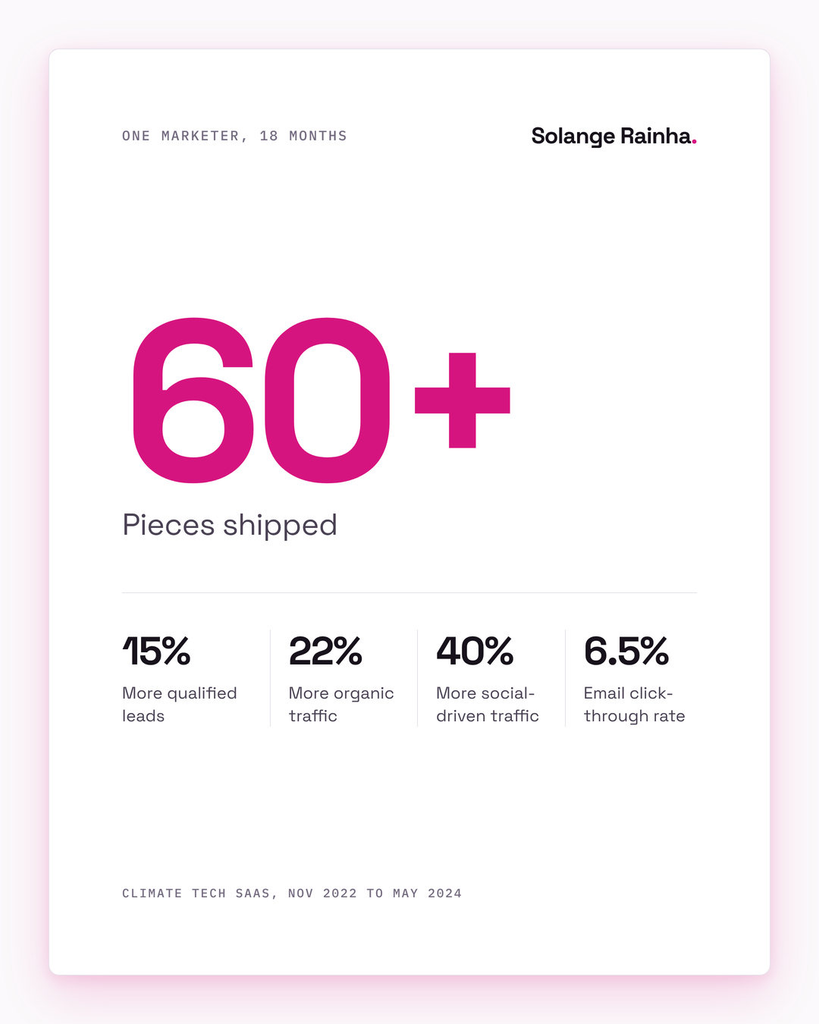
Over those 18 months I shipped 60+ pieces of content, restructured the product messaging and user flow on a 20-page website and built the changes in HTML and CSS, and set up social and email from nothing. Qualified leads went up 15% and organic traffic 22%, social-driven website traffic rose 40%, and email averaged a 28% open rate with a 6.5% click-through rate. The principles behind it live in building a content system as a solo marketer, and this piece is the production record, including where it broke.
What did 60+ pieces of solo digital marketing look like?
About one substantial piece a week, with spikes during sprints. The headline figure sounds big until you spread it over 18 months, and the formats behind it cost wildly different amounts of time:
| Format | Output over 18 months | Where the time went |
|---|---|---|
| Blog articles | 25+, 1,200 to 1,800 words each | Keyword research, drafting, internal review, SEO and a header graphic for every one |
| Case studies | 4 | Customer interviews, data checks and approval cycles; three to four times as long per piece as a blog post |
| Press releases | 6 | Leadership review, which took far longer than the writing |
| Website pages | 20+ reworked | The largest single block of time and the highest impact: bounce rate down 18% and session duration up 25% |
| Social posts | 200+ across LinkedIn, Instagram and Facebook | Starting from no presence and no following |
| Segmented campaigns throughout | Segmentation by geography and buyer type |
The blog did a different job for each audience: educational pieces for B2B buyers (municipalities and energy communities), explainers for residential consumers looking into community energy (the B2B2C audience), and thought leadership to make the company a credible voice in the energy transition.
The mix moved over time too: the first six months went mostly on foundations (the website rework, core positioning pieces, email setup), the middle stretch settled into a regular blog and social cadence, and the last months leaned into case studies and press because by then there were customer outcomes worth showing.
How do you keep solo digital marketing volume sustainable?
With a system, because heroics run out around month four. And a team of one isn’t some exotic edge case: in the Content Marketing Institute’s 2025 B2B research, 54% of B2B marketers with a dedicated content team said it had two to five people, and lack of resources was the most cited challenge, also at 54%. My system had four parts.
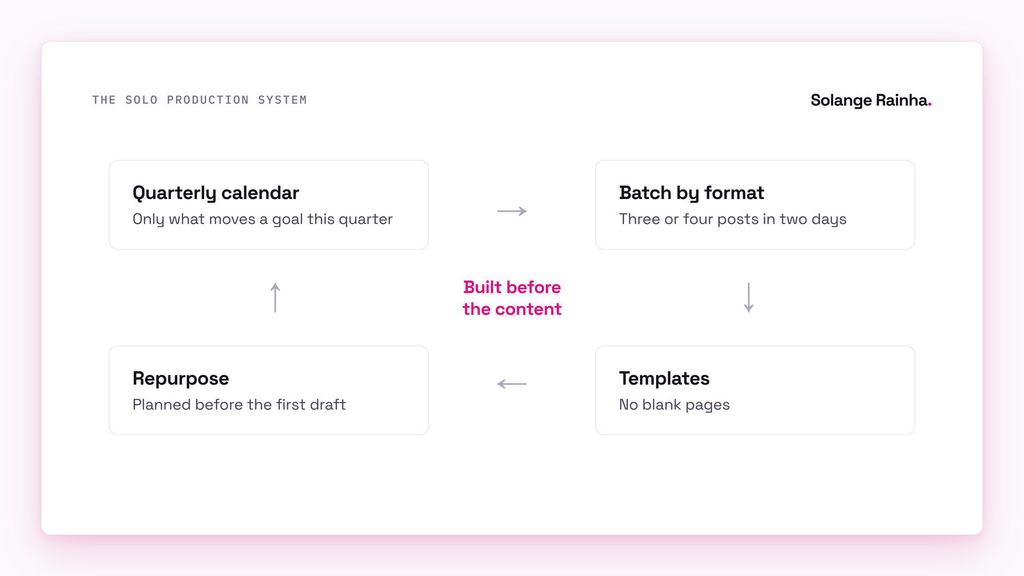
Batching by format. I wrote blog articles three or four at a time over two concentrated days, and grouped social, email and web copy the same way. Every switch between formats costs a little, and the American Psychological Association’s summary of the switching research cites David Meyer’s estimate that those mental blocks can eat as much as 40% of someone’s productive time. Blog weeks and social weeks never separated perfectly, but I was never drafting a blog post, a social post and an email in the same afternoon.
Then templates for anything repeatable: a blog template (keyword-researched outline, drafting framework, SEO checklist, header image spec), an email template for segmentation, subject line tests and content blocks, and a bank of social formats (value post, company update, link share, visual asset) with a rough distribution target.
I planned repurposing before writing. Every blog post produced two or three LinkedIn posts, an email snippet and sometimes a visual summary for Instagram, while case studies turned into a sales-ready PDF, a blog summary and a social proof series. I knew which social angles I’d pull from a post before I wrote it, so I wrote the post with them in mind. I repurpose far more systematically now, and that method is in my content repurposing strategy.
The last part was a calendar I was willing to break: a quarterly calendar with monthly reviews, and I didn’t make anything that wasn’t going to move a goal that quarter. When priorities shifted mid-quarter, which they did all the time, the calendar moved with them. I’ve since turned that habit into a content prioritisation framework, and the tools I run solo today are in my solo content marketing workflow.
What gets cut in a one-person marketing team?
The work that needs a team, which mostly means anything slow, collaborative or both. Here’s what I wanted to make and didn’t.
- Video. I had ideas for short explainers, customer testimonial clips and animated product walkthroughs, and none of them happened. Video needs a team, and a solo marketer who tries to fit it in alongside everything else ends up with bad video and slower everything else.
- An annual research report with original data. Research and writing would have taken two to three weeks of focused time, which meant two to three weeks without blog posts, social or email, and at our stage that trade wasn’t worth it.
- I also wanted more case studies: four in 18 months was what the coordination allowed, and I wanted eight. Every conversation with the customer success team turned up another story worth telling, but each one was a multi-week commitment once interviews and approvals were in.
That list is the strongest argument against the solo setup, and some people take it all the way. Debra Andrews, who runs a fractional marketing firm and so sells the alternative, argued in Fast Company in March 2026 that:
“the solo marketer model is no longer viable.”
I’d put it narrower: a one-person marketing team works for the work it’s built for, and the list above is everything outside that, so a company that wants video, original research and eight case studies a year from one person is asking one salary to cover a team’s work. Most of the skill in solo digital marketing is choosing what to make, and accepting that some of it won’t happen.
How did solo email campaigns hit a 6.5% CTR?
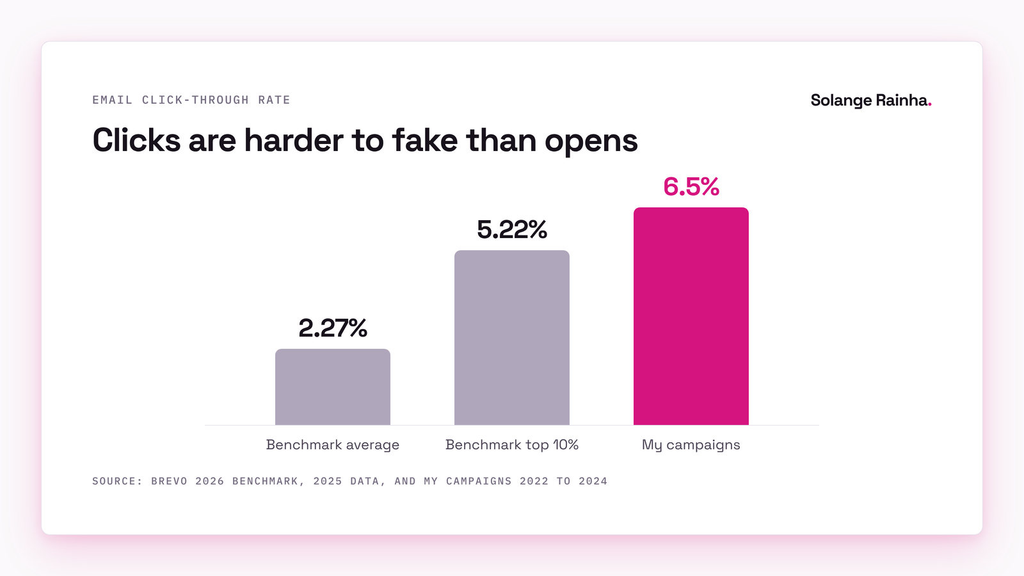
Through segmentation and relevance, and the click-through rate is the figure I’d stand behind. Across the 18 months, campaigns averaged a 28% open rate and a 6.5% CTR. For a yardstick, Brevo’s 2026 Marketing Orchestration Benchmark, built on 2025 sends from more than 175,000 customers, puts the average marketing campaign at a 20.73% open rate and a 2.27% CTR, with the top 10% reaching 5.22%. Their data is newer than my campaigns, so read it as a rough comparison.
I’d caveat the open rate, though: Apple’s Mail Privacy Protection downloads remote content in the background “regardless of whether you engage with the email”, so part of any open count is a machine, and clicks are much harder for a privacy tool to fake.
Splitting by buyer type drove the clicks: decision-makers, energy community managers and residential consumers each got different content, tailored to their regulatory context and why they’d buy.
Every list big enough to split got an A/B subject line test, and specific, benefit-led lines won every test I ran: “How [specific municipality type] is cutting energy costs by [percentage]” beat “The future of community energy”. And the emails stayed short, one takeaway and one call to action, with the full story on the blog for anyone who wanted it. The full playbook, including the sales partnership that made the segmentation possible, is in B2B email campaigns that convert.
How did solo social media work from zero?
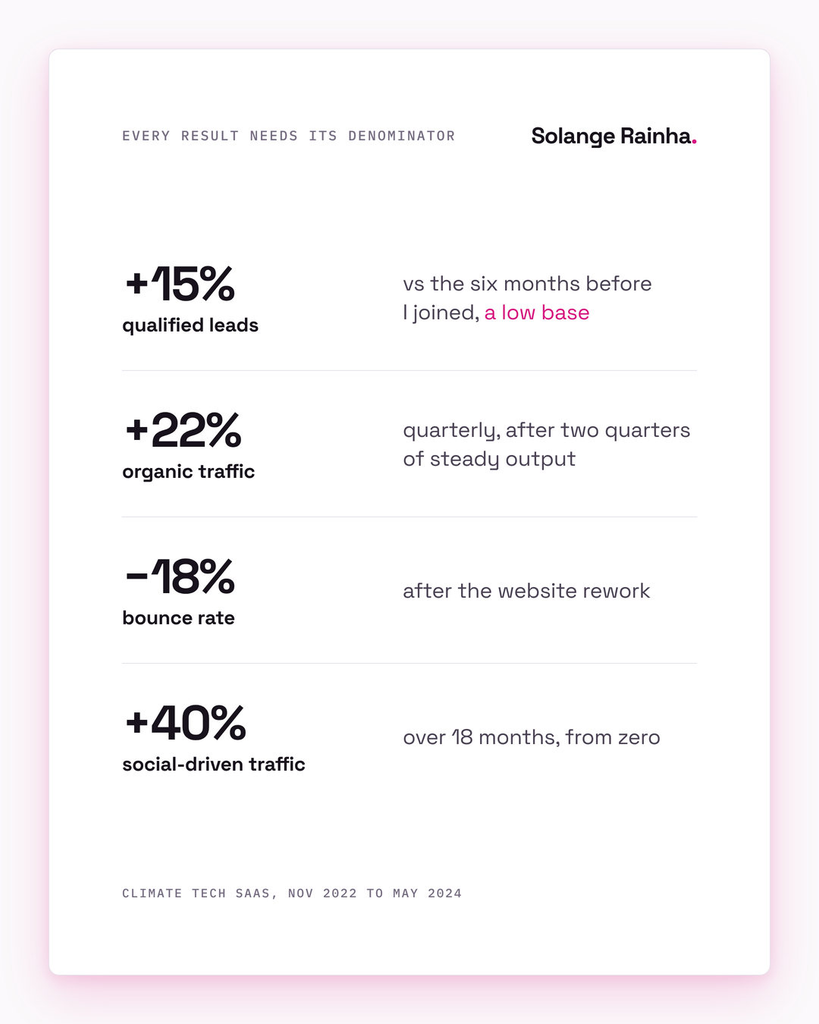
Slowly for two months, then it compounded. Building from nothing is one of the most time-hungry parts of solo digital marketing, because there’s no audience to grow from and every post in the first couple of months went out to roughly nobody. After 18 months the tally was 200+ posts across LinkedIn, Instagram and Facebook, social-driven website traffic up 40%, and brand awareness up 30%, measured through proxies (branded search volume and direct traffic growth), so treat that last one as a direction.
Each channel had its own job:
- LinkedIn carried most of it, because the B2B audience lived there: roughly three posts a week, mixing educational content, company milestones and industry commentary. Engagement built slowly for three months and then picked up as the audience grew and the posting stayed consistent.
- Instagram was for building the brand: visual posts about renewable energy, community energy projects and the company’s impact. It sent less traffic than LinkedIn but helped credibility in recruitment and partner conversations.
- Facebook ran in maintenance mode, mostly cross-posted from the other two with small format changes, so it got the lowest engagement for the least extra effort.
I planned social alongside blog content and email so the messaging held across channels. Most solo marketers skip that step because the planning feels like a luxury, and it’s what makes the channels add up to one brand. The full build, including how I measured awareness for a company nobody had heard of, is in social media from scratch.
What do 15% more qualified leads and 22% organic traffic mean?
Less than they sound on their own, which is why both need their denominators, the same way I’ve argued pipeline attribution needs denominator context. I measured the 15% rise in qualified leads against the six months before I joined, when the company had very little marketing activity, so the baseline was low. A 15% rise off a low base is a good start and nowhere near a transformation: it showed the content was attracting and qualifying interest, and it still needed a working sales side to turn that interest into pipeline.
The 22% organic traffic growth was a quarterly comparison after the first two quarters of steady production. It tracked the blog cadence and the website rework closely: both went live in the first quarter, the search effects built through the second and third, and the growth was the organic channel responding to content that hadn’t existed before.
I’m proud of both, and neither is spectacular; they’re what 18 months of solo digital marketing, building a function from scratch, can produce. What came later built on them: two roles on, at a B2B EdTech SaaS company, the content operation contributed to 48% marketing-sourced pipeline in peak months, and the production discipline behind that started here. The metrics I’d report now, and the ones I’d drop, are in content marketing metrics that hold up.
Where did I hit the wall as a solo digital marketer?
Around month twelve. The production cadence was sustainable on paper, but the load of being the only person responsible for an entire function wasn’t, and the sign was quality slipping before output did. I started cutting corners I’d never cut before: blog posts going live without a final proofread, emails going out without a subject line test because I didn’t have the energy to set up the split, social posts that were adequate instead of good.
The World Health Organization has a definition for that pattern, classing burn-out as an occupational phenomenon resulting from:
“chronic workplace stress that has not been successfully managed”
Reduced professional efficacy is one of its three dimensions, and skipped proofreads are what reduced efficacy looks like in a content calendar. It isn’t a solo-marketer quirk either: in Marketing Week’s 2025 Career and Salary Survey of more than 3,500 marketers, 58.1% said they’d felt overwhelmed in the past year and 50.8% reported emotional exhaustion; working solo just means nobody else notices first.
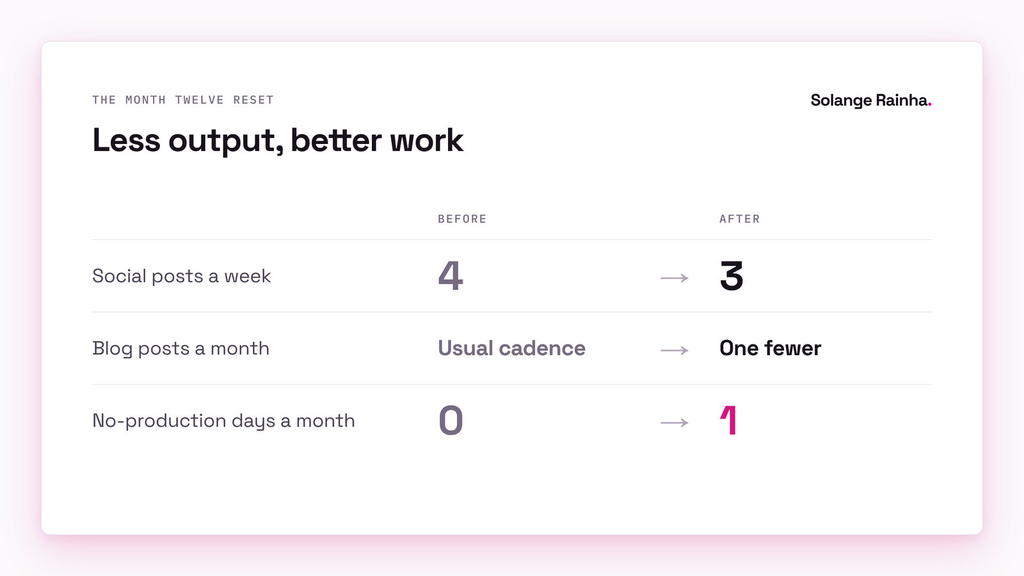
So I cut volume to protect quality: social went from four posts a week to three, I took one blog post a month off the calendar, and one full day a month became a no-production day for strategy review and planning. Output fell slightly while quality recovered, and I’d make that trade again.
What would I tell someone about to run marketing solo?
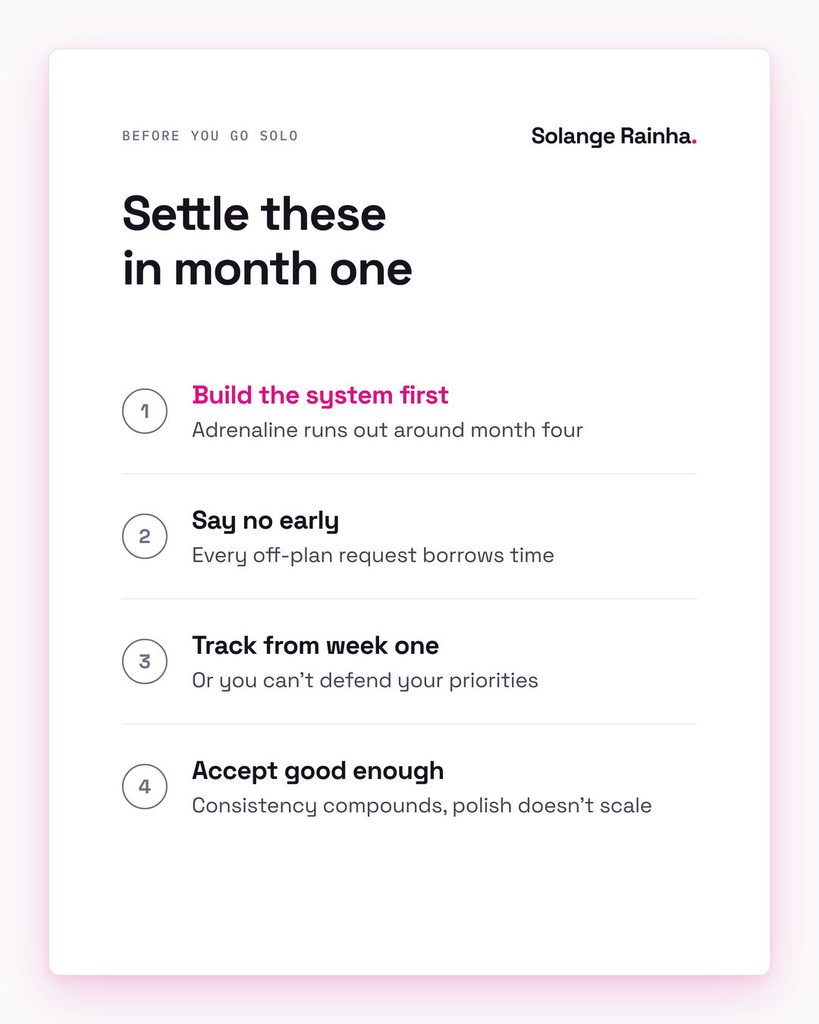
If you’re about to take on solo digital marketing, build the system before the content: templates, a calendar, batching habits and repurposing plans. The system is what makes the volume sustainable, and without it you’re running on adrenaline, which runs out around month four. If you’re starting a function from nothing, my 90-day plan for a content function covers the order I’d do it in.
Say no earlier than feels polite: every stakeholder request that doesn’t serve the quarter’s goals takes time from the content that does, and you’ll get plenty of them, so learn to spot those requests before you’ve written a first draft.
Track everything from week one, because if you can’t show what the content produced in leads, traffic and engagement, you’ve got nothing to point to when someone asks why you’re not doing more video, more events, or whatever they saw a competitor doing last week. CMI’s 2025 B2B research found 41% of B2B marketers cite insufficient resources or budget as a measurement challenge, and a team of one is about as under-resourced as measurement gets.
And make peace with imperfection: some pieces will be good enough rather than great, because volume needs that compromise. Fewer, more polished pieces sound better in theory, but you’d often lose the consistency that makes the results compound.
Frequently asked questions
A solo digital marketer can sustain roughly one substantial piece a week (a blog post, case study or equivalent) alongside three or four social posts a week, regular email campaigns and the occasional larger project such as a website rework. Over 18 months at a climate tech SaaS company, I produced 60+ pieces alongside 200+ social posts and ongoing segmented email. What keeps that volume going is a production system built on batching, templates and planned repurposing, and a willingness to cut formats like video that need a team.
With proper segmentation, a solo marketer can beat average email benchmarks, and the click-through rate is the metric to judge it by. My campaigns averaged a 28% open rate and a 6.5% CTR, against a 2.27% average CTR and 5.22% for the top 10% in Brevo’s 2026 Marketing Orchestration Benchmark. Apple’s Mail Privacy Protection inflates open rates because it loads emails whether or not anyone reads them, so treat opens as a rough signal. The results came from segmenting by buyer type and geography, testing subject lines and keeping each email to one takeaway and one call to action.
In my 18 months of solo digital marketing, the warning sign came around month twelve, when quality started slipping before output did: posts going live without a final proofread and emails skipping subject line tests. What fixed it was cutting volume before quality fell further, dropping social from four posts a week to three, removing one blog post a month and adding one full day a month with no production, only planning. Marketing Week’s 2025 survey found 58.1% of marketers felt overwhelmed in the past year, so it helps to plan for the wall instead of hoping to dodge it.
A one-person marketing team is viable for steady content, social, email and web work when it runs on a system, and it isn’t viable for video, original research or a large case study programme on top. Debra Andrews, who runs a fractional marketing firm, argued in Fast Company in March 2026 that the solo marketer model is no longer viable, and she’s right about companies that expect a team’s output from one hire. I ran solo digital marketing for 18 months and grew qualified leads 15% and organic traffic 22% by being clear about what one person won’t make.