The people who check a vendor for risk, like security and procurement reviewers, can drop you from a shortlist before Sales hears about the deal. They decide in a vendor security review (the check a buyer makes on any vendor that will handle their data), and they work from documents that most content teams don’t treat as content. Marketing should own those documents with the vendor’s own legal and IT teams.
We already know that B2B deals involve a lot of people, but most content teams still write for the person who fills in the form, mostly because that’s the person marketing can track. The reviewers who can end a deal rarely fill in a form at any point in a vendor security review. Many vendors gather those documents on a trust centre (one public page or small site that holds a vendor’s security and privacy documents). In this piece I’ll call all of those documents trust content, and the web pages that hold them trust pages. Most companies keep trust content outside the blog, or don’t have it at all.
In my current role I wrote the security documentation and the pricing page myself.
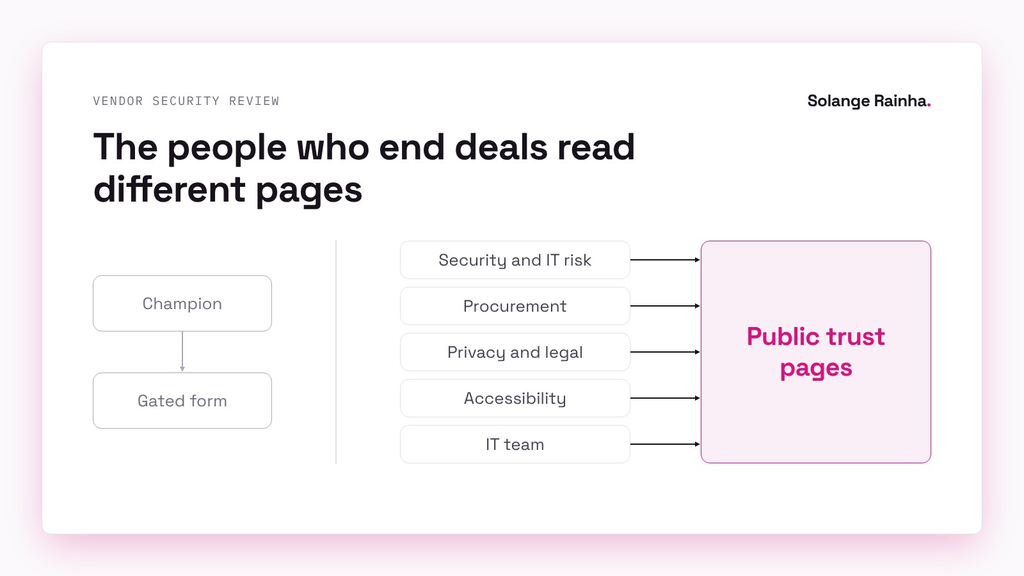
Who rules you out before Sales hears about the deal?
The reviewers who rule vendors out belong to the buying group (everyone inside the buyer’s company with a say in the purchase), and their job is to find risk, which they usually do before anyone talks to Sales. Forrester’s State of Business Buying 2026 found a typical purchase involves 13 people inside the buyer’s company. Forrester also found procurement professionals are decision-makers in 53% of buying cycles, and they take part from the start.
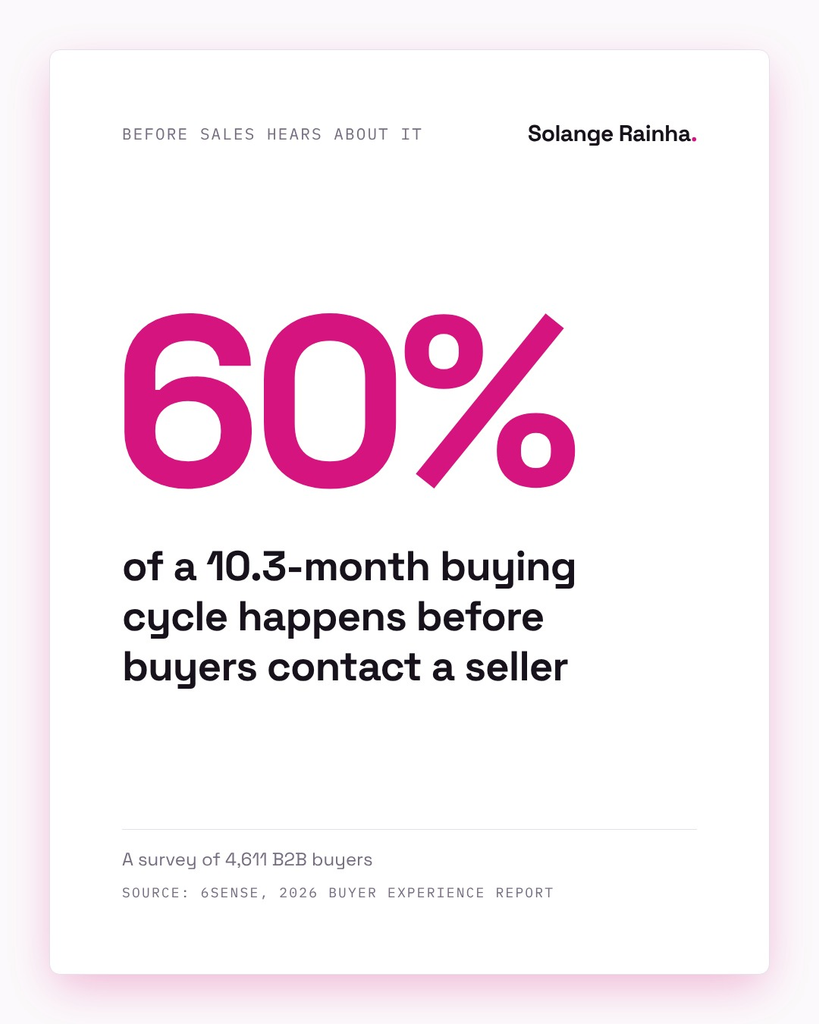
In 6sense’s 2026 Buyer Experience Report, which surveyed 4,611 B2B buyers, buying groups spent about 60% of a 10.3-month cycle before contacting a seller, and the vendor they favoured at that point won 82% of the time. I wrote more about that early shortlist in my piece on awareness stage content.
Five kinds of reviewer come up in most software deals:
- Security and IT risk teams send a security questionnaire (a long list of questions about how you protect data), and they want to know where you host their data and who can reach it, plus the certifications that prove both.
- Procurement looks at the commercial terms, mainly how your pricing works and what the contract commits them to.
- In Europe, the data protection officer (the person responsible for GDPR compliance) usually does the privacy and legal check, and reads your data processing terms and the list of every other company that handles the data.
- Accessibility reviewers, mostly in the public sector and higher education, ask whether people with disabilities can use the product.
- The buyer’s IT team checks how your product connects to the systems the buyer already runs.
None of these reviewers books a demo to find out, and a 2025 survey by Kiteworks found 63% of the people it asked look for detailed security and compliance information before they even contact a vendor. More than half of them said they struggle to get enough of that information when they compare vendors. Kiteworks sells data security software, so treat the survey’s figures with care.
What do reviewers check in a vendor security review?
Reviewers in a vendor security review check a short list of documents, and most of those documents exist because a law or a standard asks for them, which is why buyers ask for them the same way in every deal. Under Article 28 of the GDPR, a vendor that processes personal data for a customer (the GDPR calls it a processor) has to work under a contract, the data processing agreement (DPA). The same article says the vendor can’t bring in another processor without the customer’s written authorisation, so buyers ask for a sub-processor list (the public list of every third party that handles their data).
Accessibility has its own document, the accessibility conformance report (ACR), which is the vendor’s filled-in copy of the Voluntary Product Accessibility Template (VPAT) for one product version. Level Access wrote in October 2026 that higher education institutions are among the buyers who use ACRs to compare vendors. In the EU, Article 42 of the public procurement directive says a public buyer’s tender requirements (the rules in its formal call for bids) must take accessibility into account for anything people will use, except in cases the buyer can justify. Any public university buying software in the EU has to follow that rule.
The security row in the table below mentions two certifications: SOC 2, an independent audit of how a company protects customer data, and ISO 27001, the international standard for managing information security. The last column shows a quiet no, which is when a buyer drops you without ever telling you why.
| Reviewer | What they check first | What answers it | What a quiet no looks like |
|---|---|---|---|
| Security and IT risk | They want your certifications and hosting region first, and then they ask who can reach their data and what you do after a breach. | A security page or trust centre should name your SOC 2 or ISO 27001 certification. | The buyer sends a long security questionnaire your trust pages could have answered, and the deal stalls. |
| Privacy and legal | The data protection officer reads your contract terms for personal data and asks about every third party that handles the data. | Your DPA and your sub-processor list cover both points. | The data protection officer can’t find your DPA, so they move on to a vendor that publishes one. |
| Procurement | Procurement wants to know how your pricing works and what it’ll cost at their size, and then asks about the contract length. | A pricing page that explains how you build the price answers most of it. | Nobody can estimate the cost, so you don’t make the shortlist. |
| Accessibility | Accessibility reviewers check whether the product meets WCAG (the Web Content Accessibility Guidelines) and the EU standard EN 301 549. | An accessibility statement (a public page on how accessible your product is) and an ACR show how the product scored against those standards. | The buyer scores you down on a tender criterion that’s mandatory. |
| IT team | The buyer’s IT team asks which systems you connect to (your integrations) and what your product needs from their systems. | Integration docs and an architecture overview answer both. | The buyer’s IT team says they’ll review your product next quarter. |
You can read how to write the security summary a champion (the buyer who wants your product) forwards to IT in my piece on champion enablement, since this piece covers the reviewers nobody sends anything to.
Why should marketing share ownership of trust content?
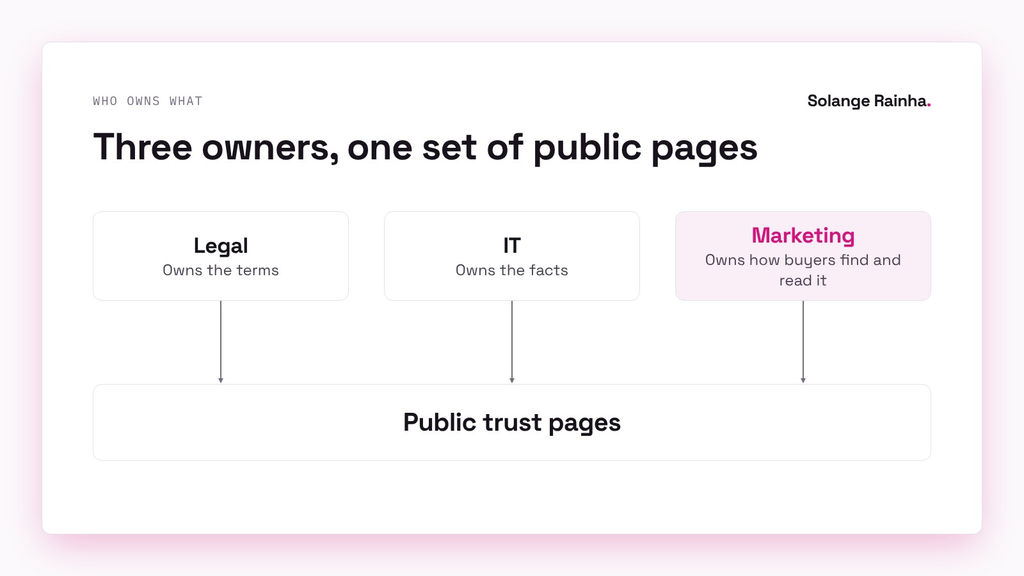
Marketing should own how buyers find and read trust content, and the vendor’s own legal and IT teams should own what it says, because each team is good at a different part of the job. Legal writes a DPA to protect the company in a dispute, and IT answers security questionnaires one at a time. Neither job includes checking whether a buyer can find a trust page and read it in five minutes, or whether an AI tool gives a correct answer about it. Marketing does that work every day for every other page on the site. Marketing can also keep the dates on every piece of trust content current.
IDC’s 2024 analyst brief on trust centres found buyers rated the trust centres of vendors they considered and didn’t pick as the weakest. IDC also found 84% of security leaders said their own trust centre had room for improvement. Vanta, which sells trust centre software, sponsored the brief, so read it carefully, but the brief fits what Forrester found about buyers:
“B2B buyers are under immense pressure to justify investments and minimize risk.” Barbara Winters, vice president and principal analyst, Forrester, 2026
The strongest objection I hear is that legal will never let marketing edit a DPA, and legal is right about that. Marketing leaves the DPA alone and makes sure the trust centre says the DPA exists (and what it covers), and how a buyer can sign it without booking a call. The facts behind every trust page go into a claims register, one document that holds every approved claim and its source, so the security page and the questionnaire answers match.
What did I build for CIO and CTO buyers at Full Fabric?
Full Fabric sells software to more than 200 higher education institutions. Six months into my time there, leadership moved the primary buyer from Admissions Directors to IT leaders, which meant CIOs and CTOs as well as heads of infrastructure. Deals were stalling because the buyer’s IT team joined the buying group late, and the company lost several deals outright when that IT team raised concerns partway through that nobody could resolve in time to close. The content library (every article and page the company had published) had nothing credible for IT on integrations (the ways a product connects to the other systems a customer already uses) or on security, let alone architecture.
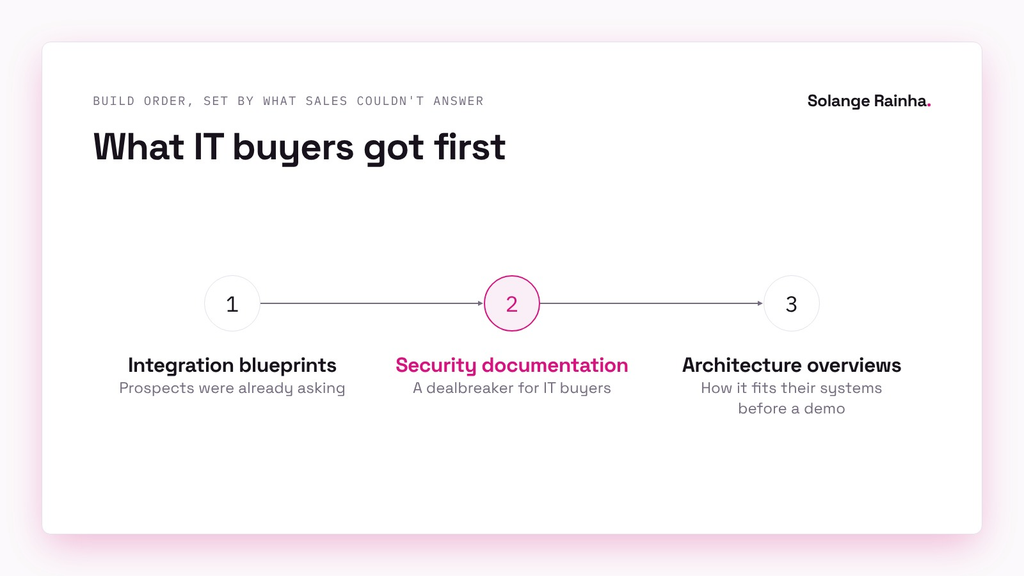
I went through the whole library in about a day and a half and set the build order by the questions Sales couldn’t answer, since prospects were already asking them. Integration blueprints, which show how the product connects to each system, went out first. I wrote the security documentation next, since it’s a dealbreaker for IT buyers looking at software as a service (SaaS). The company never used that documentation, because the mass layoff that ended my role there came first.
Architecture overviews came last, so CIOs could see how the product fit with the systems they already run before a demo. I wrote all of it with Sales and Product, and engineers checked every technical claim.
The content operation I ran there contributed to 48% marketing-sourced pipeline (the share of deal value that started with marketing) in peak months, and it influenced over €230K in pipeline in a single reporting period. Content rarely closes a B2B deal alone, so I report those figures as a contribution. You can read the method behind the 48% or see the rest of my results. I’ve written up the library triage (deciding what to do with every page) in how I rebuilt the content strategy after leadership changed the primary buyer. I’ve also written up how I researched the IT content in how I wrote technical content for CIOs.
How do you make trust content findable in search and AI answers?
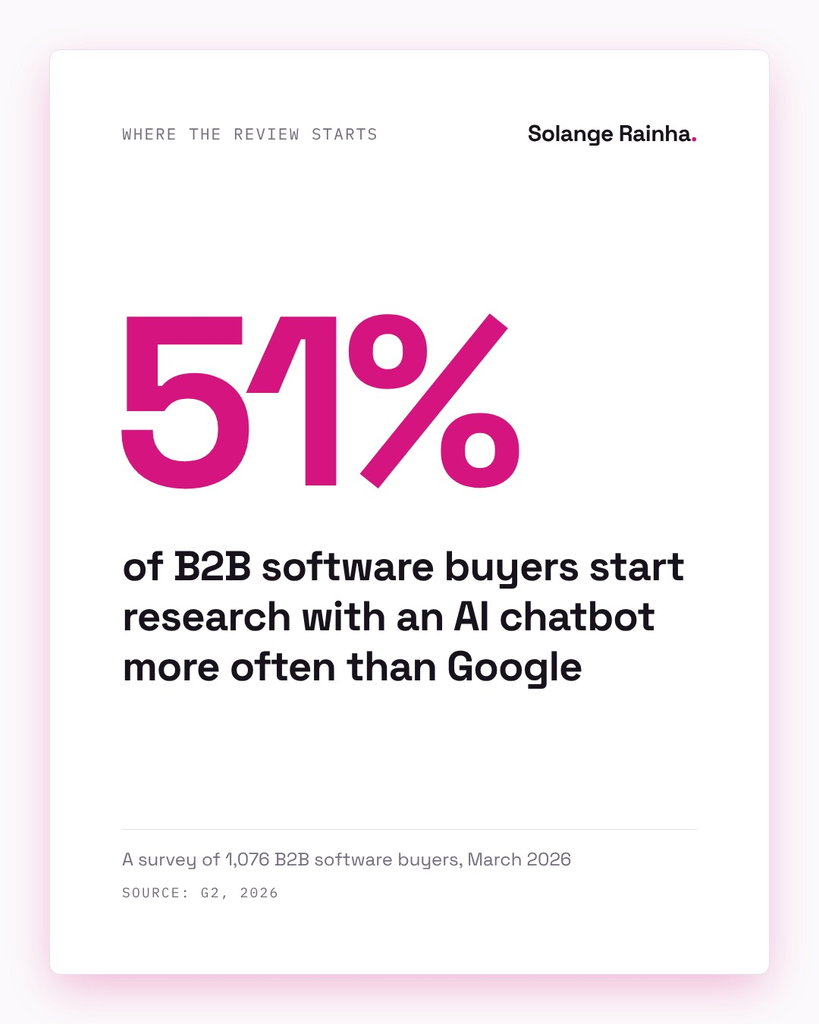
Buyers find trust content when each document has its own ungated web page (one with no form in front of it) that answers one question. Reviewers search one question at a time, and AI tools quote short passages that answer one question. G2 surveyed 1,076 B2B software buyers in March 2026 and found 51% now start their research with an AI chatbot more often than with Google. G2’s report on the survey found AI chatbots are the top source influencing which vendors make a shortlist, and 54% of buyers named them.
A reviewer who asks ChatGPT whether your company holds SOC 2 gets an answer either way, and if your only proof is a PDF behind a form, the answer comes from someone else’s guess.
For each trust page, I’d do this:
- Publish the page in HTML on your own domain with no form in front of it, and offer any PDF as a download from the page, because buyers mostly skim the first page of a whitepaper and forward it, as I covered in do people read whitepapers.
- Use a question heading on each page, like “Who are our sub-processors?”, and define each term where it first appears with the rules I use for definitions.
- Put a date on everything, since an undated sub-processor list looks abandoned.
- Run a schema markup audit on the trust pages, so the schema markup (the code that tells search engines what kind of page each one is) doesn’t mislabel the trust pages.
- Add trust prompts (the questions reviewers ask about security and privacy) to your prompt set, the fixed list of questions you put to AI tools on a regular schedule.
- Report your trust pages as their own group, the way I treat product documentation in AI answers under my answer engine optimisation framework, which is my method for writing content that AI tools like ChatGPT can quote and cite.
How do you measure content whose job is to prevent a quiet no?
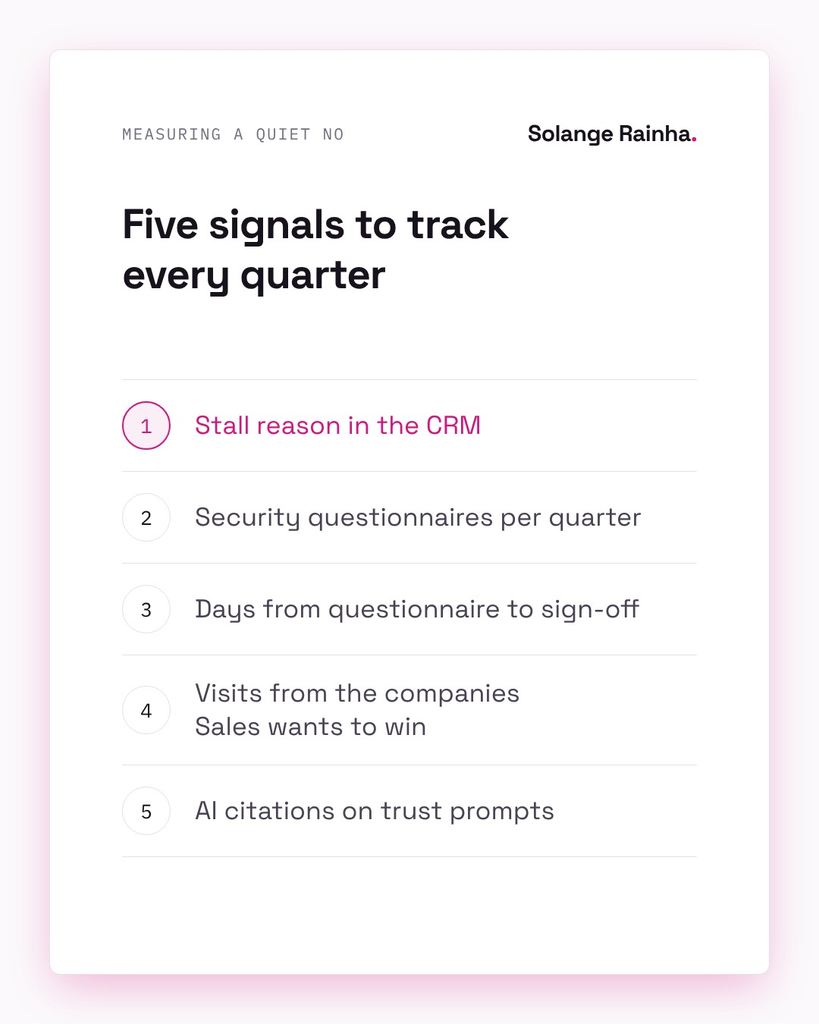
You measure trust content by what happens to deals, since page views tell you little about a page whose best outcome is a reviewer who never needed to ask. I don’t have a before-and-after figure for this yet, so read what follows as the setup I’d use. The first signal is a required “stall reason” field in the CRM (the system Sales uses to track deals), with each reviewer as an option, so you can see which reviewer stalls each deal.
Then I’d count the security questionnaires that come in each quarter and the days each one takes to sign-off, because trust pages that work should bring both down. Snitcher finds the companies visiting your site, so it shows whether the companies Sales is trying to win read the trust pages before a demo. After every won or lost deal, I’d ask the buyer what their security team checked and write it in a simple deal tracker. AI citations on trust prompts (an AI tool linking to your page as a source) go into the same monthly check as my AI citation tracking.
What goes on the trust content checklist?
Marketing owns the wording and the upkeep of every row in the checklist below, and the last column says who owns the facts and where the page goes.
| Document | What it should say | Who owns the facts, and where it goes |
|---|---|---|
| Security page or trust centre | List your certifications with their dates and your hosting provider and region, then say who can access customer data and how you respond to incidents. | IT owns the facts, and the footer links to the page’s own URL. |
| SOC 2 or ISO 27001 report | Name the report and its date, and say how to request it, often under a non-disclosure agreement. | IT owns the report, and buyers request it from the trust centre without a sales call. |
| DPA | Confirm you’ve got a DPA, then explain what it covers and how a buyer can sign it. | Legal owns the DPA, and a trust centre page links to a request or a download. |
| Sub-processor list | Every third party goes on the list with what it does and where it’s based, plus the date of the last update and how customers hear about changes. | Legal and IT own the list, and the list has its own dated page. |
| Accessibility statement and ACR | State the standard you tested against and the test date, and list any known gaps. | Product and engineering own the results, and the footer links to the statement with the ACR as a download. |
| Pricing page | Explain how you build the price and what changes it, then list what’s included and the contract terms. | Finance and Sales own the facts, and the page stays public even when the final price needs a quote. |
| Integration docs and architecture overview | Name the systems you connect to and what you need from the buyer, and state the known limits. | Product and engineering own the docs, and product pages link to them. |
| Claims register | The register holds every claim above with its source and owner. | Marketing owns the register, and it stays internal. |
If you don’t have a technical background, how I write for technical audiences covers getting the facts out of engineers.
What I’d do differently
I’d definitely ask for a named engineering contact on day one of a move to IT buyers, since checking technical claims was the slowest step at Full Fabric. Every page waiting for a check meant one fewer page the buyer’s IT team could read. I’d also start the triage before leadership announces a change of primary buyer, because the reviewers who end deals won’t wait for the new content to go out.
The smallest version of a trust content setup needs only the security and procurement questions from the last five deals that stalled and one ungated, dated page that answers them. You can build that page without buying a trust centre tool.
If you’re splitting trust content with your own legal and IT teams, I’d like to hear how you’ve divided it: [email protected] or LinkedIn.
Frequently asked questions
A trust centre is a public page or small site where a software vendor keeps its security and privacy documents. Most trust centres hold the vendor’s certifications and its data processing agreement, and the sub-processor list usually goes there too. The buyer’s security and procurement teams use the trust centre for most of a vendor security review, without contacting the vendor. A good trust centre has no form in front of it and shows a date on every page, and the vendor shares sensitive audit reports on request.
A sub-processor list is the public list of third parties that handle a customer’s personal data for a vendor, such as hosting and email providers. Buyers check the sub-processor list because Article 28 of the GDPR says a processor can’t bring in another processor without the customer’s written authorisation. Make sure the list says what each company does and where it’s based, and show when you last updated it.
No, keep security documentation ungated, because the reviewers who read it rarely fill in forms and they’ll move on to a vendor whose answers are public. Vendors usually share detailed audit reports, like a SOC 2 report, on request under a non-disclosure agreement. Your trust centre should still say the report exists and how to get it, since gated security documentation hides the answer from the people and AI tools looking for it.
Trust content (the security and privacy documents buyers check before they buy) works best when the vendor’s legal and IT teams own what it says and marketing owns how buyers find and read it. Legal keeps control of the data processing agreement (DPA), and IT signs off on every certification claim. Marketing’s job is to keep the pages that hold those documents easy to find and dated, in the same wording as the rest of the site. A claims register, one document that holds every approved claim and its source, keeps all three teams using the same wording.
An accessibility conformance report (ACR) is a vendor’s filled-in copy of the Voluntary Product Accessibility Template (VPAT), the form the Information Technology Industry Council publishes. The ACR shows how one product version meets accessibility standards like WCAG and EN 301 549. Public sector buyers and higher education institutions often ask for an ACR during procurement. Put a date and a product version on the ACR, and link it from your accessibility statement.
You measure trust content through deals, so start with a required stall reason field in the CRM (the system Sales uses to track deals). Count the security questionnaires that come in and how long each one takes. After every won or lost deal, ask the buyer what their security team checked. Visits to trust pages by the companies Sales wants to win are a supporting signal. Make sure to track whether AI tools cite your trust pages when buyers ask them about your security and privacy.