I’ve written content for Portugal and Brazil, and European and Brazilian Portuguese differ enough that anything that has to sell needs writing again for each market. Content that only informs needs an adaptation and a native check.
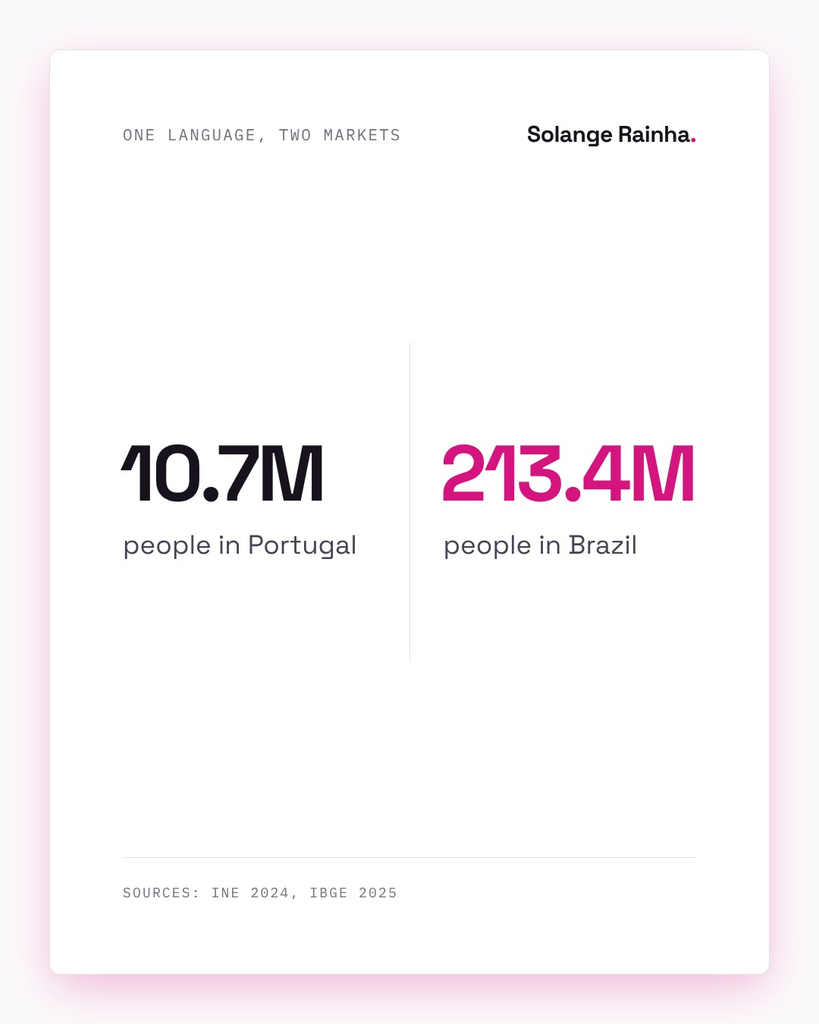
We already know that buyers would rather read about a product in their own language, but a lot of companies still budget for one Portuguese, mostly because it looks like a single line on a translation quote. European and Brazilian Portuguese are the same language, and they still differ in many of the words and much of the tone a buyer notices. At Cleanwatts, I produced more than 60 pieces in 18 months for Portugal and Brazil, along with the rest of Europe. I adapted the Brazilian versions from the European ones, often on instinct, because there was no Brazilian reviewer.
Why can’t you translate between European and Brazilian Portuguese?
Tone costs the most money of all the differences between European and Brazilian Portuguese, and vocabulary is the quickest one to show. When DeepL, a machine translation tool, added Brazilian Portuguese as a separate output in 2020, its example was “the girl is having breakfast”: Portugal says “a rapariga está a tomar o pequeno-almoço”, Brazil says “a menina está tomando o café da manhã”. Almost every word changes, and “rapariga”, which is neutral in Portugal, is an insult in parts of Brazil. The P3B3 test set from 2026, which checks which Portuguese AI models default to, gives more examples of vocabulary differences, like “autocarro” in Portugal against “ônibus” in Brazil for bus, or “tu” against “você” for “you”.
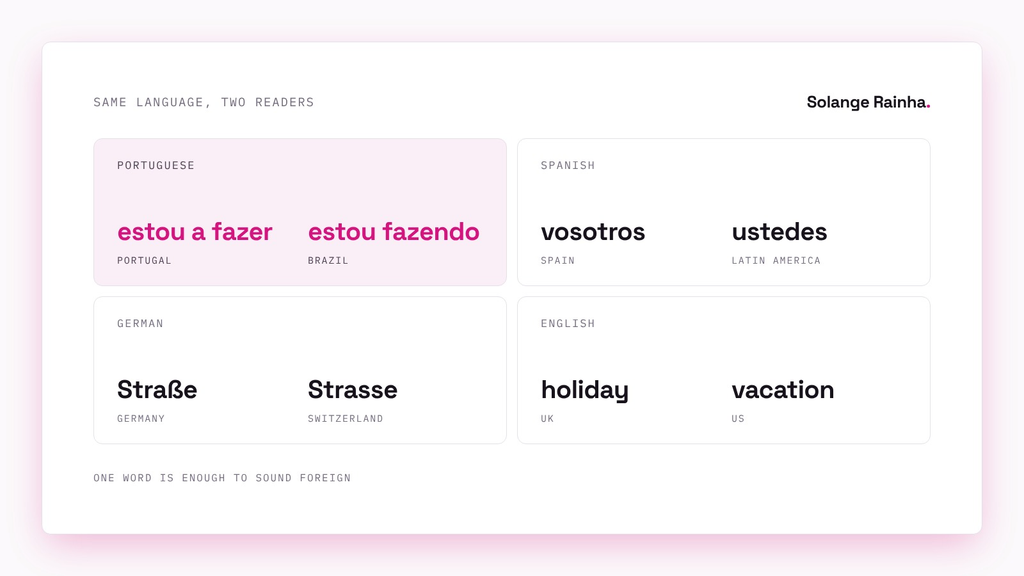
Readers also spot grammar quickly, since people in both countries notice the other country’s verb forms in the first line: the Brazilian “-ndo” form (“fazendo”) against the Portuguese “a + infinitive” form (“a fazer”). Tone is harder to catch: Brazilian brand copy tends to be more casual and more direct, and that casual tone can read as overfamiliar in Portugal, where business-to-business (B2B) readers expect a more formal tone.
| What differs | European Portuguese | Brazilian Portuguese |
|---|---|---|
| Formal address | “o senhor” | “você” |
| Screen | “ecrã” | “tela” |
What’s composition, and how is it different from translation?
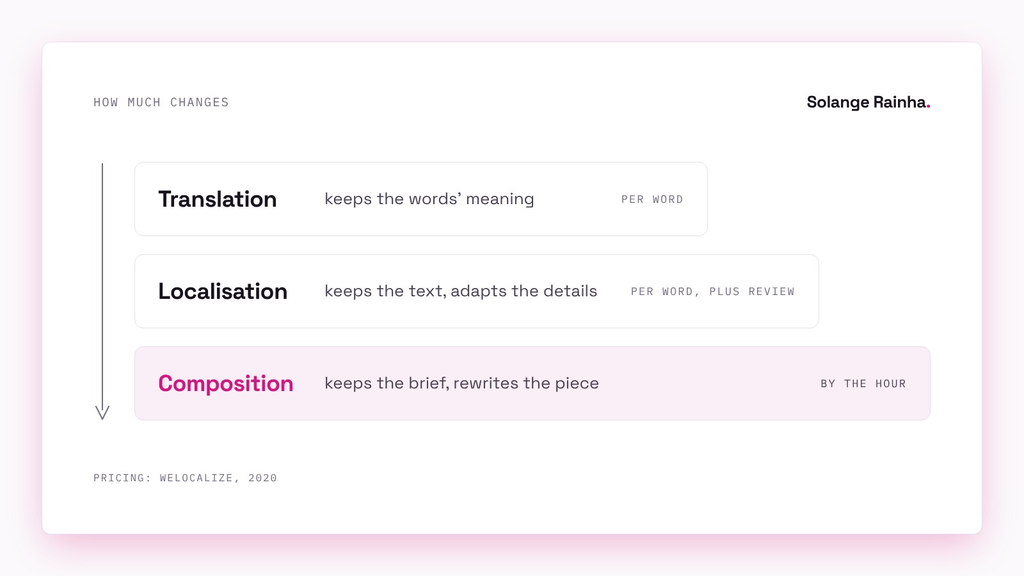
Translation moves the meaning of a text from one language into another, as close to the original as the target language allows. Localisation adapts that translated text to a specific market, like its currency, dates, legal references and the words people there actually use. Composition, which the industry calls transcreation, keeps the brief and the job of the content, then writes the piece again for that market, so the reader feels and does what the original wanted them to.
Composition costs more because the work is different: Welocalize, a localisation agency, says that translation projects usually cost a rate per word and transcreation projects cost an hourly rate (2020), since you’re paying for a copywriter’s judgement instead of a word count. Most localisation budgets leave out the hourly work, because a per-word quote looks cheaper at first.
Don DePalma, of CSA Research (a firm that studies the translation industry), put the commercial argument for localising in the 2020 “Can’t Read, Won’t Buy” release:
“Localization improves customer experience and increases engagement in the brand dialogue.”
How did I plan content for three markets at Cleanwatts?
At Cleanwatts, I was the only digital marketer for 18 months, and I worked with Sales to split the audience by buying motivation instead of the fields in our customer database: decision-makers and energy community managers (plus residential consumers). I built the content plan for Portugal and Brazil, along with the rest of Europe, around that split. Over 25 of the 60-plus pieces were articles, and the rest included 4 case studies and 6 press releases. You can read how one person produced all of that, since this article focuses on the languages instead of how I organised the production.
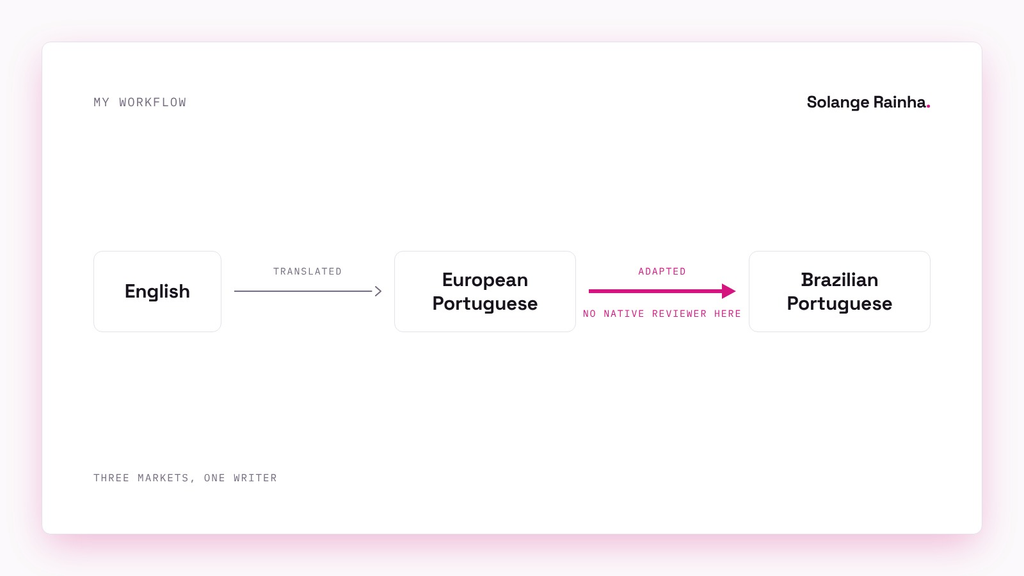
I always wrote in English first and translated into European Portuguese before I started on Brazilian Portuguese. The order worked for the rest of Europe, where English was the shared language, and for Portugal, where I’m a native speaker. Brazil was harder, mostly because I’m not Brazilian and there are nuances I could only judge by instinct.
I pushed for a Brazilian reviewer, since instinct isn’t a quality check, and we never got one. The Brazilian versions were good adaptations by a trained translator, but they were still adaptations of a European text. An adaptation is fine for a press release, but not for a landing page that has to make a Brazilian energy buyer act.
When should you adapt a piece and when should you start over?
My translation degree gave me a simple rule I still use: machine translation and literal translation are fine for quick, low-stakes content, but not for anything serious, because a literal translation moves the words and loses the tone. Human translation is better, but only when the translator knows the audience’s culture and customs, otherwise they’re moving one language into the other and the text never reads as local. People forget the part about culture and customs, and it’s why a fluent European Portuguese speaker isn’t automatically the right person to write for Brazil.
So the test I use is the job of the text. Adapt anything people only have to understand, like an installation step or a privacy notice, and get a native speaker to check the terms. A headline or an email subject line has to make someone act, so I start that kind of text again from the brief in the market’s own language. A translated headline keeps its meaning and loses what made people click, and it ends up sounding like everyone else’s.
Case studies are in between: you can translate the facts and quotes, but the story has to open with a problem the local reader recognises, and that part is composition.
Does the same problem show up in other languages?
Every language with a separate standard in more than one country has the same split as Portuguese. In Spanish, Spain uses “vosotros” for a group and Latin America uses “ustedes”, and DeepL offers European and Latin American Spanish as separate outputs for the same reason it splits Portuguese. The gap in market size is bigger than with Portuguese, since the Instituto Cervantes 2025 yearbook counts more than 500 million native Spanish speakers, most of them outside Spain.
You can see the English split on this blog: I write in British spelling with American vocabulary, because my readers are split between British and American English, and British spelling doesn’t slow an American reader down, but a British word like “holiday” for time off can. German has the smallest gap and the most surprising one: Switzerland doesn’t use the German sharp s (“ß”), and the Swiss newspaper NZZ last printed it in 1974 (The Local, 2023). If a Swiss landing page says “Straße”, the reader can tell the brand didn’t plan for Swiss readers.
How do you build a localisation decision tree on a small budget?
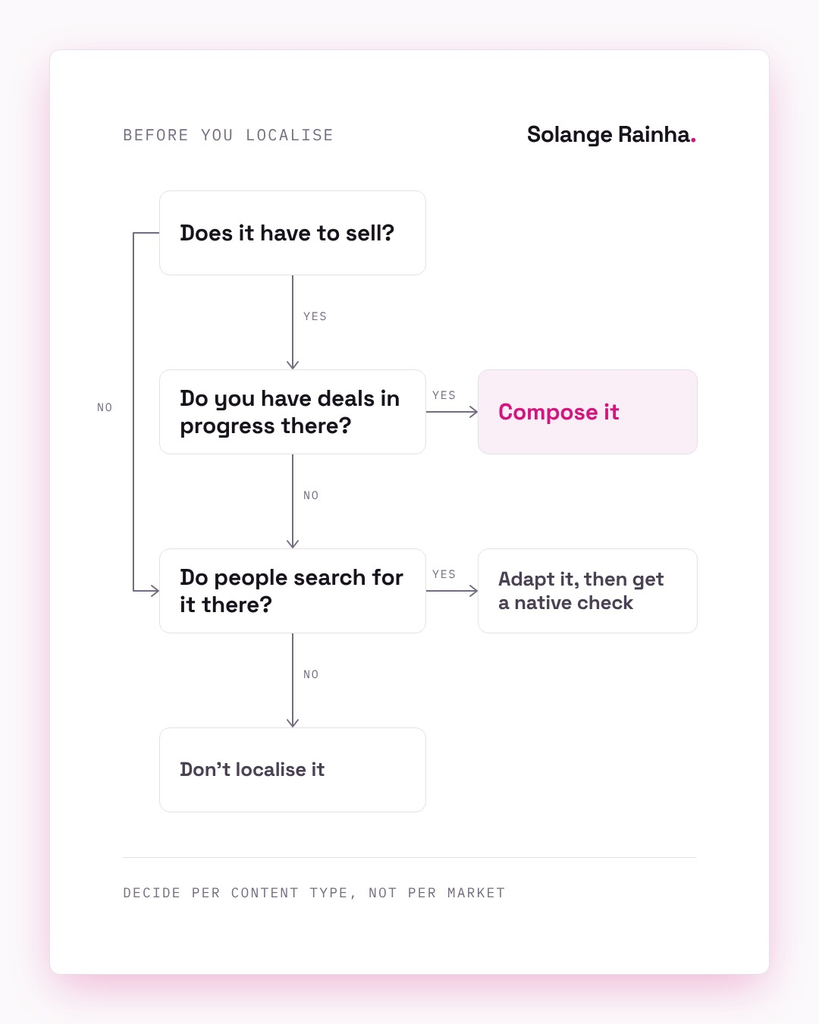
A small budget means you can’t compose everything, so you decide per content type instead of per market. For each piece, I ask these questions about the second market you’re entering, in order:
- Does the piece have to sell, or is its job to inform or support customers?
- How much of your pipeline (the sales deals in progress) or revenue is in the second market this year, or how much should be?
- Do people in the second market actually search for the piece’s topic in their own words? You only find that out with separate keyword research per market.
If a piece sells and you have deals in progress in the second market, compose it. For a piece that only informs, an adaptation with a native speaker’s check is enough in a small market. When nobody searches for a piece in the second market and Sales doesn’t need it either, skip the localisation and spend the translation budget on the pieces that sell. My content prioritisation framework does the same job for topics: it scores each idea on total effort before the idea gets a slot, and localisation is one more line of effort in that score.
| Content type | What to do for the second market | Who checks it |
|---|---|---|
| Taglines and homepage headlines | These sell, so compose them from the brief. | A native copywriter should sign them off. |
| Landing pages and sales emails | These sell too: compose them and reuse the structure and proof. | Ask a native copywriter or a salesperson in that market. |
| Case studies | Translate the facts and quotes, then rewrite the opening for local readers. | Get a native editor to read them. |
| Blog articles | Adapt them once you’ve done separate keyword research. | Native editors are the right check here. |
| Press releases | Translate them and localise the details. | Hire a native proofreader for these. |
| Help articles and support replies | Machine translation works here if someone checks the terms. | Any native speaker can check them against a glossary, the agreed list of terms. |
What’s machine translation actually good for now?
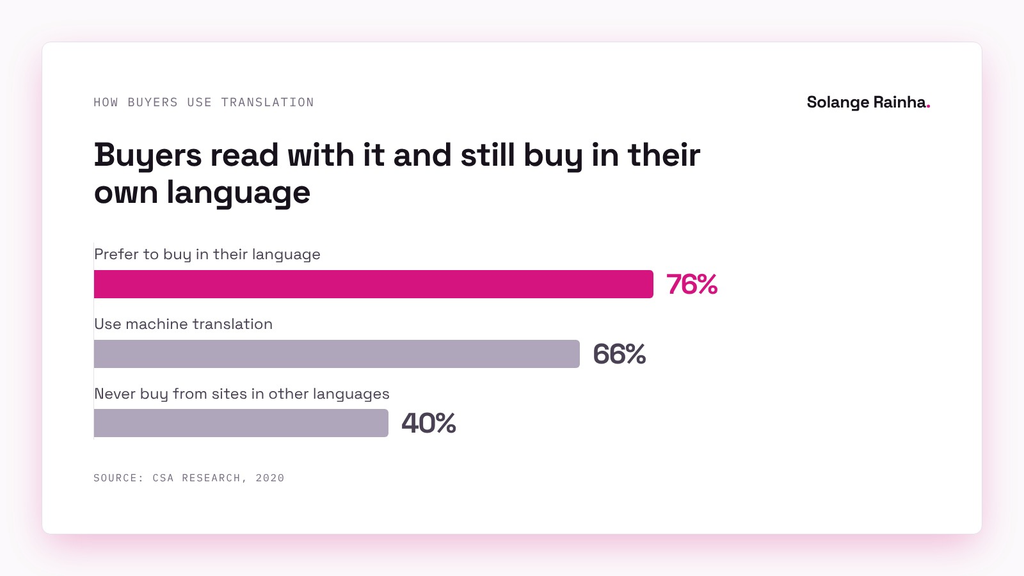
Machine translation is very good at giving you the gist of a page in a language you don’t read. CSA Research found in 2020 that 66% of online shoppers use machine translation. The same survey found that 76% prefer to buy with information in their own language and 40% will never buy from websites in other languages.
For Portuguese, the problem is that the tools default to Brazilian Portuguese. Catarina Costa and Sebastian Padó found in a 2026 paper at PROPOR, a conference on Portuguese language technology, that standard machine translation systems produce Portuguese that’s typically closer to the Brazilian standard. The reason is that there’s far more Brazilian text to train them on. The P3B3 test set, which a 2026 workshop of the Association for Computational Linguistics (ACL) accepted, found that most large language models (the AI models behind tools like ChatGPT) show a strong bias toward Brazilian Portuguese. Some models also follow an instruction to write European Portuguese more reliably than other models do.
I use machine translation and AI tools for first drafts of support content and for reading competitors in the other market. I use AI the same way in the rest of my work, and I review everything before I publish it. Selling copy never goes out without a native editor, and in European Portuguese I check every output against a glossary and for Brazilian forms, because they usually show up.
What I’d do differently
I’d do separate keyword research for Brazil before writing anything for that market, instead of adapting the European keyword list, since Brazilian buyers search with their own words for the same problem. I’d also put together a shared European and Brazilian Portuguese glossary before the first piece, so every agreed term, like product names or calls to action, was in one place. A claims register keeps a team’s facts in one list, and a glossary would have done the same for terms.
I’d push harder for a Brazilian reviewer too, at least on the pieces that sell. Today I’d make the case with the content-type table from the decision tree section. I’d ask for a few hours a month of a freelance Brazilian editor, the way I worked with freelance specialists in four countries at One Hundred Group.
If you’re about to launch a brand in a second market that shares your language, I’d like to hear how you’re handling it at [email protected].
Frequently asked questions
One Portuguese website can technically serve both markets, but it’ll sound foreign to one of them, usually Portugal, because most tools default to Brazilian Portuguese. It depends on what the site has to do, since a documentation site can use just one kind of Portuguese and a site that sells can’t. If budget only allows one version, pick the market with more of your pipeline and tell visitors which Portuguese the site uses. Make sure your sales pages get a separate version for the second market as soon as it starts bringing in deals.
Composition, which the industry calls transcreation, usually costs more than translation. The gap depends on the content, since a tagline might take a copywriter hours for very few words. Keep composition for the content that has to sell, like headlines and sales emails, and translate or adapt everything else.
DeepL and ChatGPT are good enough for European Portuguese drafts and low-stakes content, but not for final sales copy. Two 2026 studies (Costa and Padó’s paper and the P3B3 test set) found that machine translation systems and most large language models default to Brazilian Portuguese, so Brazilian forms end up in European text. Always pick the European Portuguese option where the tool has one, and have a native speaker check every output that a customer will read.
A European company should pick its first Portuguese by where its pipeline is, not by which market is closer on the map. For a European B2B company with its sales team selling in Portugal, that’s usually European Portuguese. A consumer brand that wants the biggest audience has a strong case for Brazil because of its size. Whichever you pick, write the selling content natively for that market and adapt the rest.
European and Brazilian Portuguese need separate keyword research, because buyers in each market describe the same problem with different words. If you adapt a keyword list between the two, you’ll miss terms people actually type and keep terms nobody uses. Do the research in each market’s own search data, and treat the two as different keyword sets from the start.
The cheapest way to localise for Brazil is to sort your content by job and only compose the few pieces that have to sell. Everything else can be an adaptation that a native speaker checks. A freelance Brazilian editor for a few hours a month costs far less than a full hire and catches the nuances a European Portuguese speaker misses. Build a shared glossary early, so every adapted piece uses the same agreed terms.