How long does content marketing take? New pages need six to twelve months to rank, and most never reach Google’s top 10, while refreshing pages Google already ranks can move in weeks. This piece puts dated figures on both clocks, shows what to watch month by month, and gives the timeline I agree with leadership before anything ships, so nobody cuts content in the quarter it was about to start working.
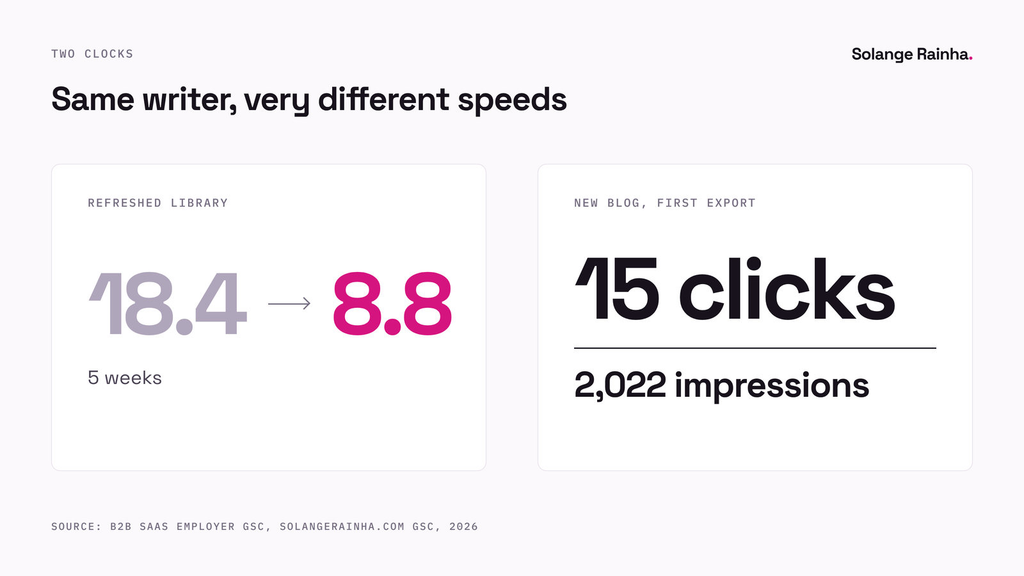
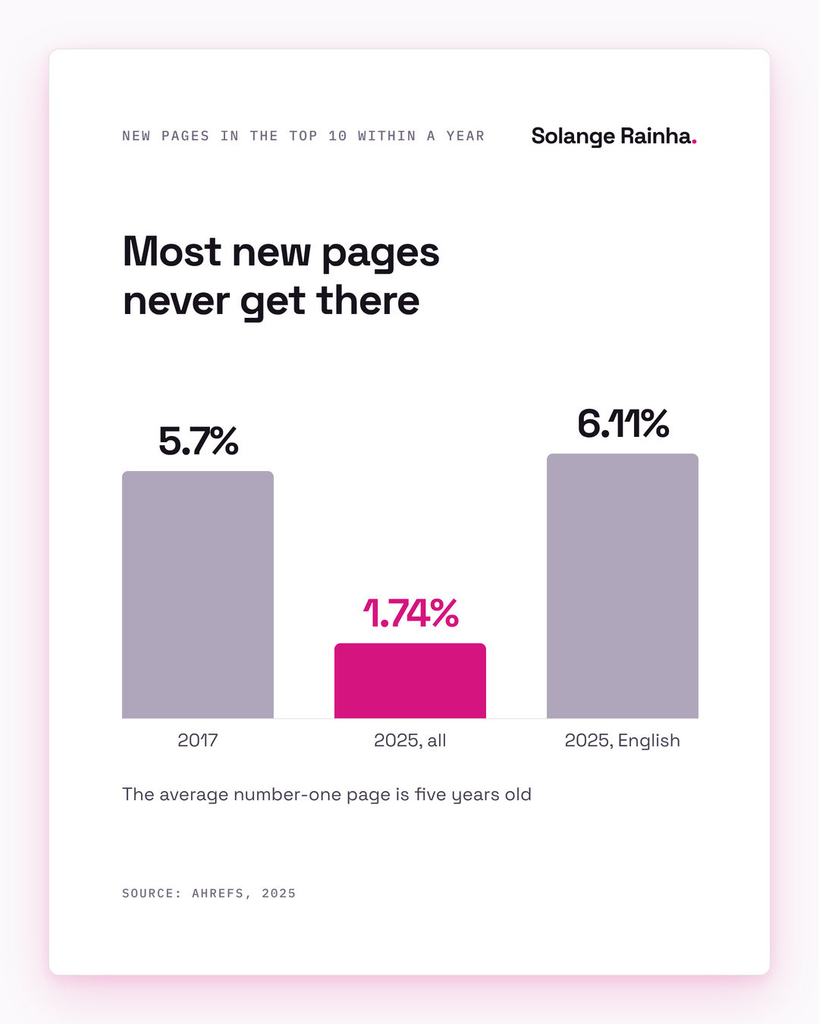
New content takes six to twelve months to pull its weight in search, and most of it never gets there. Ahrefs’ 2025 rerun of its ranking study found only 1.74% of newly published pages reached the top 10 within a year, down from 5.7% in 2017 (6.11% on a fairer English-only sample). Refreshed content runs on a faster clock: when I refreshed a B2B SaaS market research platform’s indexed blog library, average search position went from 18.4 to 8.8 in five weeks. So when leadership asks “how long does content marketing take?”, “it depends” is a timeline you can write down: two of them, plus a date where you stop waiting.
How long does content marketing take to rank in Google?
Leadership usually judges content on the window it judges paid ads on, 30 days, and the ranking data says that window is off by a factor of six or more.
The Ahrefs study, written by Patrick Stox and published in May 2025, is the most useful dataset I know on this. The average page ranking first in Google is about five years old, up from two years in 2017, and 72.9% of top 10 pages are more than three years old. There’s a twist that gets less attention, though: 40.82% of the pages that did reach the top 10 got there within a month. Winners often show themselves early, and everything else crawls.
Google’s own line is older. In its 2017 How to hire an SEO video, Maile Ohye put it like this:
“In most cases, SEOs need four months to a year…”
The full sentence covers making the improvements first and then seeing benefit. It’s nine years old, which is ancient in SEO time, but nothing newer argues for a shorter window and the Ahrefs data says ranking got harder since. Google’s John Mueller has also said rankings for new sites can fluctuate for up to a year while Google works out where they belong.
Practitioners are more optimistic: when Ahrefs polled 3,680 people on LinkedIn and X, the majority said SEO typically takes three to six months. That tracks with every SEO I’ve ever met, me included: we remember the pages that worked.
Why do refreshed pages move faster than new ones?
A page Google has already crawled, indexed and ranked has history, and moving it from page two to page one is a much smaller job than getting a new URL noticed at all, so refreshes run on weeks and new content runs on months.
At a B2B SaaS market research platform, the blog library was indexed and mostly stuck in the teens. I audited the whole library and updated it for AEO/LLMO (answer engine and large language model optimisation, which means structuring and sourcing content so AI systems can extract and cite it). Average Google position went from 18.4 to 8.8 in five weeks, and search CTR came in 54% up on the Q3 average. I wrote up the audit method in how I score a content library in a week.
My own blog is the slow case. Its first Search Console export, in July 2026, showed 15 clicks from 2,022 impressions, a 0.74% click-through rate, a few months after I started publishing. Most of those impressions came from junk queries and old pages I’d forgotten existed, and I dug into why pages get seen and not clicked in impressions but no clicks. If I’d judged the blog on that export, I’d have shut it down, and I didn’t, because I knew which clock I was looking at.
Most of the skill is labelling: when a flat chart lands in front of leadership, ask whether it shows new pages earning trust from zero or old pages spending trust they already have.
What should you see in month one, month three and month six?
Signals arrive in order: indexing and impressions first, then average position on the queries you’re targeting, then clicks, and pipeline last. Report them in that order too, and don’t let anyone skip to the last one in week four.
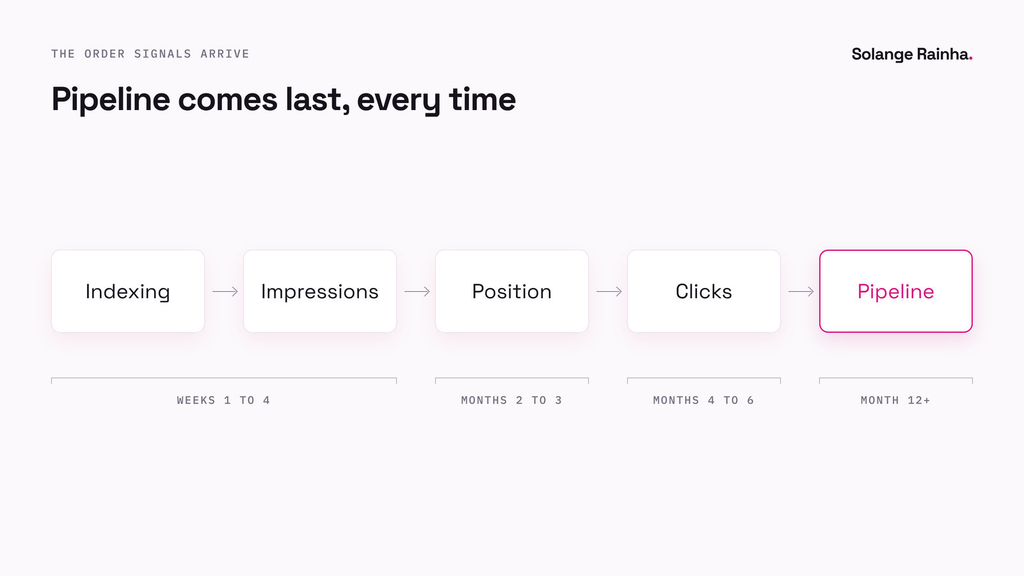
Here’s the version I hand over, built for a new content programme on a B2B site with some existing domain history; a brand-new domain sits further right on every row.
| Window | New content should show | Refreshed content should show | Counts as early proof | Not a verdict yet |
|---|---|---|---|---|
| Weeks 1 to 4 | Pages indexed, first impressions in Search Console | Position moving on pages that already ranked | Indexing complete, impressions rising week on week | Clicks, leads, pipeline |
| Months 2 to 3 | Impressions growing, target queries ranking somewhere in the top 50 | Gains holding, CTR up | Average position improving on target queries | Lead volume, revenue |
| Months 4 to 6 | First page-one rankings on lower-competition queries, first clicks worth reporting | Traffic and assisted conversions compounding | Clicks on target queries, content showing up in conversion paths | Pipeline on a long sales cycle |
| Months 6 to 12 | Steady clicks, assisted conversions, review of every page still outside the top 10 | Next refresh round on pages that slipped | Content-influenced opportunities | Pipeline totals for a 200-day cycle |
| Month 12+ | Sourced and influenced pipeline | Sourced and influenced pipeline | Pipeline with content in the path | Nothing, this is the verdict window |
The rows are expectations, and their weight comes from being agreed before launch, so month three gets judged against month three.
How does a long B2B sales cycle stretch the lag?
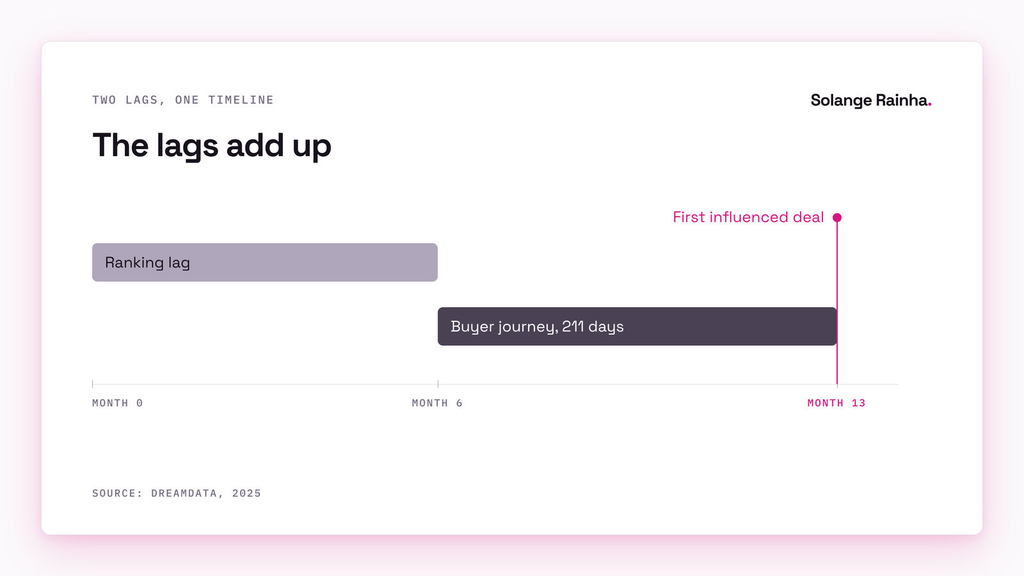
The ranking lag and the buying lag stack on top of each other. Dreamdata’s 2025 benchmark put the average B2B buying process at 211 days and 76 touches, so a page that starts ranking in month six reaches its first buyer around then and influences a closed deal somewhere past month 12.
That’s why pipeline sits on the last row of the table. When I worked at a B2B SaaS company serving 200+ higher education institutions, the content operation contributed to 48% marketing-sourced pipeline in peak months, and none of that would’ve been visible on a 30-day read. I’ve written up the method behind the 48% and which content metrics to report past the MQL.
Where do AI citations fit on a content marketing timeline?
AI citations are a third clock, faster in places and much noisier everywhere. A page that already ranks can start turning up in AI answers within weeks of a refresh, but the answers change from one run to the next. A SparkToro and Gumshoe study reported by Search Engine Land had around 600 volunteers run 12 prompts through ChatGPT, Claude and Google’s AI nearly 3,000 times, and the odds of getting the same list of brands twice were under 1 in 100. Some brands still appeared in 60% to 90% of answers for a given intent, which is why I track citation share over a fixed prompt set and ignore list position.
At a B2B SaaS market research platform, the first baseline across 20 buyer prompts had us named in 38% of answers and cited as a source in 37%. I read that monthly and judge it quarterly, because one month on its own tells you almost nothing. The full setup is in how I track AI citations, and the branded search side is in measuring AI visibility without analytics.

The timeline I agree with leadership before anything ships
I put this in the kickoff doc, on one page, and get it signed off before the first article goes live.
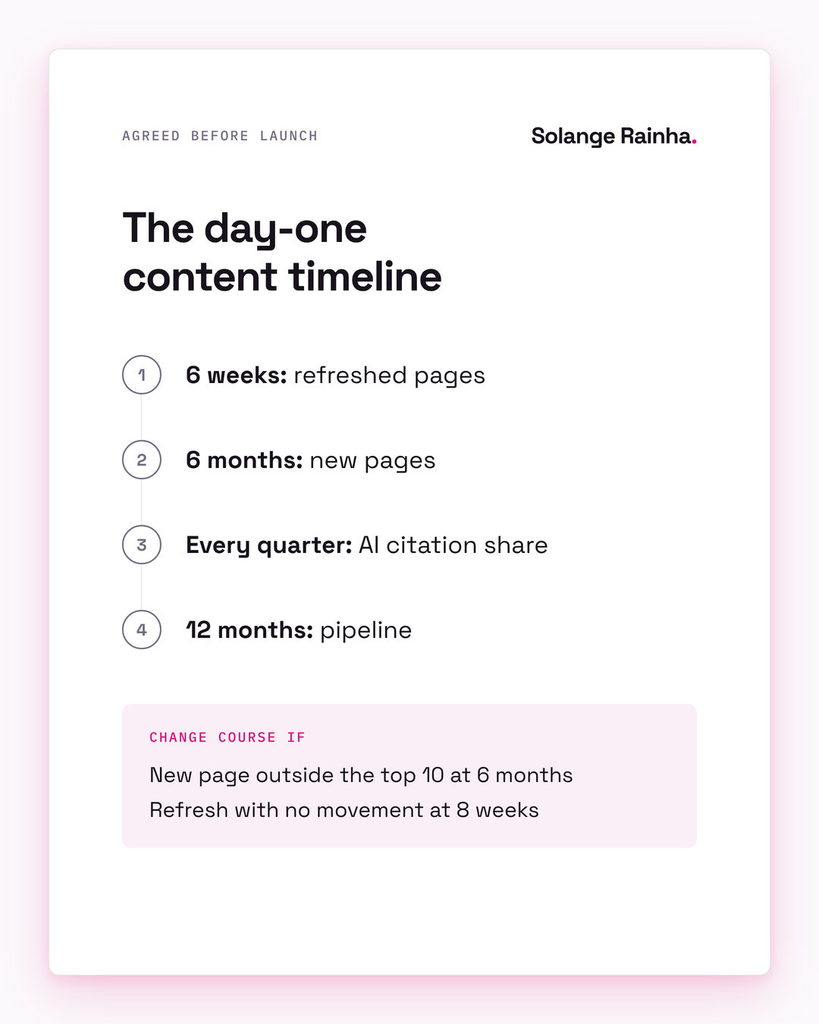
Review windows, set per goal. Refreshes get judged at six weeks, new content at six months, AI citation share monthly with a verdict each quarter, and pipeline at twelve months, longer if the sales cycle runs past 200 days. One window for everything is how a refresh win gets ignored and a new page gets killed at week four.
What counts as early proof, in writing. Indexing done, impressions climbing, position improving on named target queries. I list the queries. If leadership agrees in month zero that rising impressions on “pricing research methods” counts as progress, month two’s conversation is a short one.
Then there’s the point where we stop waiting, set before the start, because waiting forever is how content teams lose credibility. Stox’s advice in the Ahrefs study is that a page still outside the top 10 after about six months should get updated, because its chances are “pretty low after that unless you make some changes.” That’s my rule for new pages. For refreshes, no movement after eight weeks means the refresh missed and the page goes back into the audit queue.
None of this is complicated; it just has to exist before the first flat chart does, which is the same reason most full-funnel strategies die in 90 days and why expectation-setting sits in the first month of my 30-60-90 day plan for a new content function.
What I’d do differently
For most of my career I explained the content lag after the fact, in the quarterly review where the chart had gone flat. Every word was true and it still sounded like an excuse, because I was protecting a budget instead of reporting against a plan. Said in the kickoff, the same facts read as a plan.
I’d also lead with the fast clock. A library refresh gives leadership a visible win inside two months, and that buys the patience new content needs. I used to start with net-new articles because they felt more like strategy, which put the slowest results first.
And I’d stop reporting site-wide average position. My own blog’s average in that first export was 49, dragged down by a handful of junk queries. Report position on the target queries you agreed up front, which is what the AEO/LLMO framework measures against anyway.
Frequently asked questions
How long content marketing takes depends on which clock you’re watching. Refreshing pages Google already ranks can move them within weeks; OpinionX’s library went from an average position of 18.4 to 8.8 in five weeks. New pages usually need six to twelve months, and Ahrefs found only 1.74% of new pages reach the top 10 within a year. Pipeline on a long B2B sales cycle comes last, typically past month 12.
A refreshed page already has history with Google: it’s crawled, indexed and ranking somewhere, often on page two. Improving it moves an existing ranking, which is a smaller job than getting a brand-new URL discovered and trusted. Starting a content programme with a library refresh gets an early win while new pages mature.
In the first month of a content programme, report indexing, Search Console impressions and position movement on refreshed pages, and say plainly that clicks and pipeline aren’t due yet. Agree in writing before launch which target queries count as early proof, so month one gets judged as month one.
Set the exit point before launch. For new pages, Ahrefs’ Patrick Stox suggests updating any page still outside Google’s top 10 after about six months, because its chances drop sharply after that without changes. For refreshed pages, I review anything with no position movement after eight weeks.