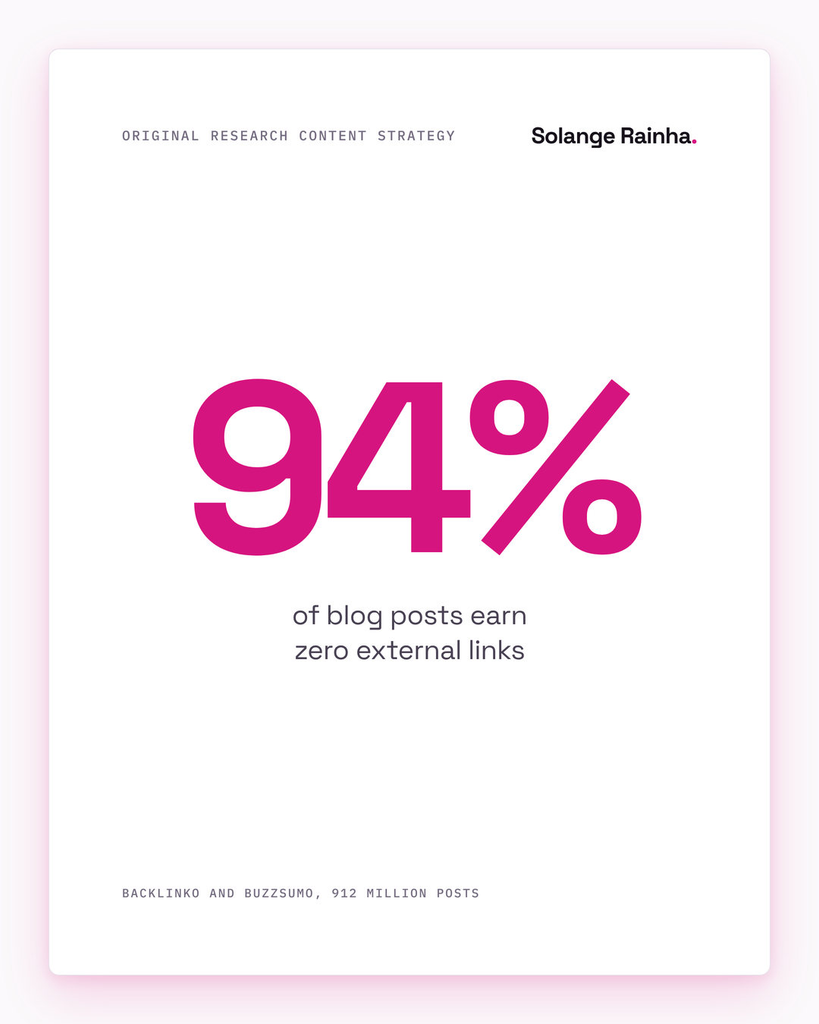
An original research content strategy builds content around data you generated yourself: a survey, your own internal data, or a structured analysis nobody else has run. It’s the most durable asset a content team can own, because neither a model nor a competitor can reproduce data that lives only in your files. The evidence points the same way from several sides: 94% of blog posts earn no external links at all, 40% of journalists say original data or research makes a pitch valuable, and adding statistics lifted visibility in AI answers by about 31% in the Princeton GEO study. You don’t need a research budget; internal data, a small survey or a rigorous look at public information will do, as long as you’re straight about the sample.
An original research content strategy is the way out of interchangeable content, and the best-performing content I’ve ever shipped proves it to me: it won because I had a number nobody else had, and I hadn’t written it any more carefully than the pieces that flopped. When you own the data, every other publication in your space has to come to you to cite it, which changes the economics of the work. Most content could have come from anyone, and now a machine can generate that stuff for free. Proprietary data is the one asset that gets more valuable as generic content gets cheaper, because you can’t prompt your way to a survey of 500 people in your industry and no model can hallucinate your internal conversion rates into existence.
First things first, my limits: I’ve never run a 10,000-respondent industry benchmark with a research team and a five-figure budget. What I’ve done is lean, scrappy primary research inside content roles with no headcount and no research line item, which is what most content teams can pull off, and that’s what this article covers.
Why does original data earn citations and backlinks that opinion pieces can’t?
Because you can only cite a statistic back to whoever generated it, while an opinion is one more voice in a crowded topic. A link or a citation is a vote of credibility, and a proprietary dataset has no competitor, so everyone writing about that topic ends up pointing at you as the source.
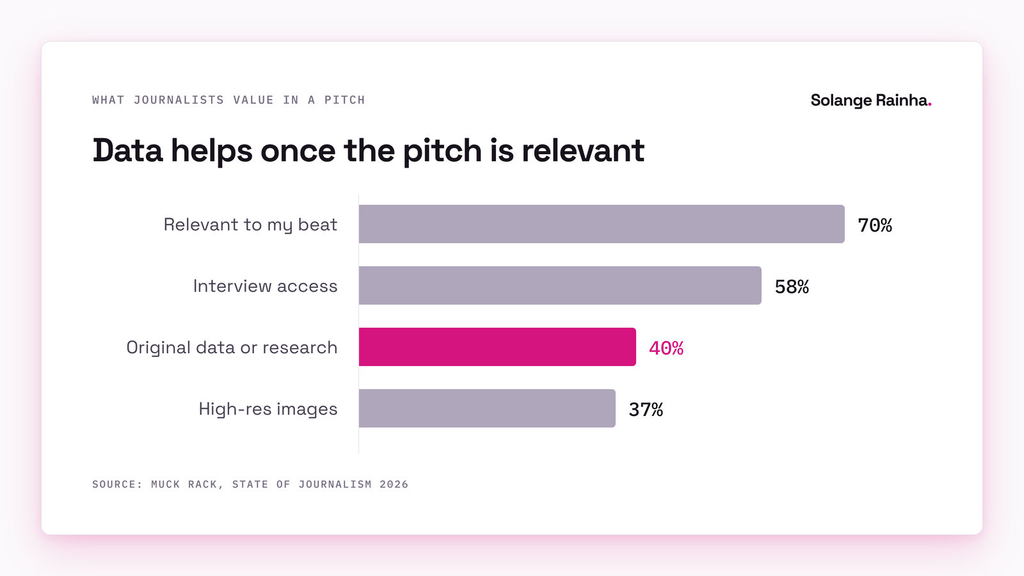
Links are hard to earn across the board: Backlinko and BuzzSumo’s analysis of 912 million blog posts found 94% had zero external links, so the gap between the few pages people cite and the many they ignore is enormous, and data is one of the few reasons a stranger has to link to you at all. Journalists say the same in their own terms: in Muck Rack’s State of Journalism 2026 survey, 40% said original data or research made a pitch valuable, behind clear relevance to their beat (70%) and access to interview sources (58%), as the University of Minnesota’s write-up of the report breaks down.
Most teams skip it for the same reason it pays: primary research has a high barrier to entry, and writing another hot take is easier. That difficulty is the moat: if a piece of content is cheap to produce, your competitors can produce it too, and then nobody has a reason to link to yours over theirs. An opinion can still earn its place, but only when it’s a position a competent peer could argue with, and even then evidence is what makes it stick.
Why do AI systems favour primary sources?
Because a model assembling an answer reaches for a claim it can attribute, and a proprietary statistic with a visible method is the cleanest of those. Generic content can copy the format of a data-led piece, but it can’t manufacture a statistic that isn’t there.
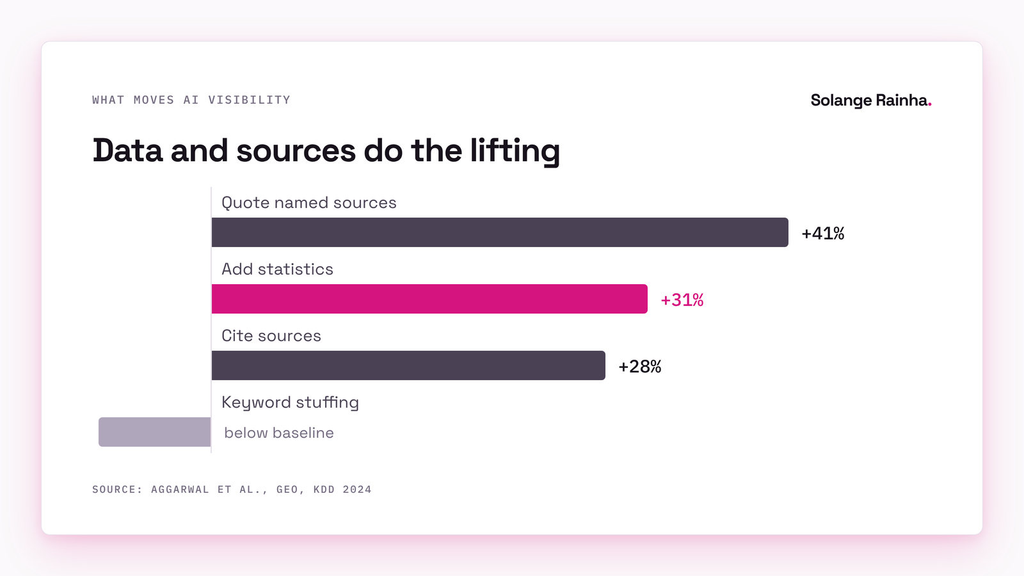
The Princeton GEO study (Aggarwal et al., KDD 2024), which tested content changes across 10,000 queries on generative engines, measured how much each change lifted a page’s visibility in AI-generated answers. Adding statistics lifted it by about 31%, quoting named sources by about 41% and citing sources by about 28%, while keyword stuffing came in below baseline. Citing sources did far more for pages starting lower down: Search Engine Land’s write-up of the study reports a 115.1% lift for the site ranked fifth. The engines have changed since 2024, so treat the sizes as directional, but every method at the top of that list is substance a page either has or doesn’t.
That’s the same substance-over-structure case I made in AEO won’t save your content strategy and built into my AEO/LLMO framework, AEO and LLMO being the work of getting cited in AI answers. Original data is the purest form of citable substance, because it’s a claim a model can’t get anywhere else.
How do you run an original research content strategy on almost no budget?
You need a question nobody has answered yet and one of three cheap sources of data, and I’ve used all three inside content roles with zero research budget.
Your own internal data is the fastest route in and the one teams overlook most. Every company sits on data nobody has bothered to package: conversion rates by segment, sales-cycle length, support-ticket patterns, content performance across channels. At a B2B SaaS company serving 200+ higher education institutions, I tracked more than 17 KPIs a quarter, and some of those metrics were benchmarks for our niche that no analyst had published.
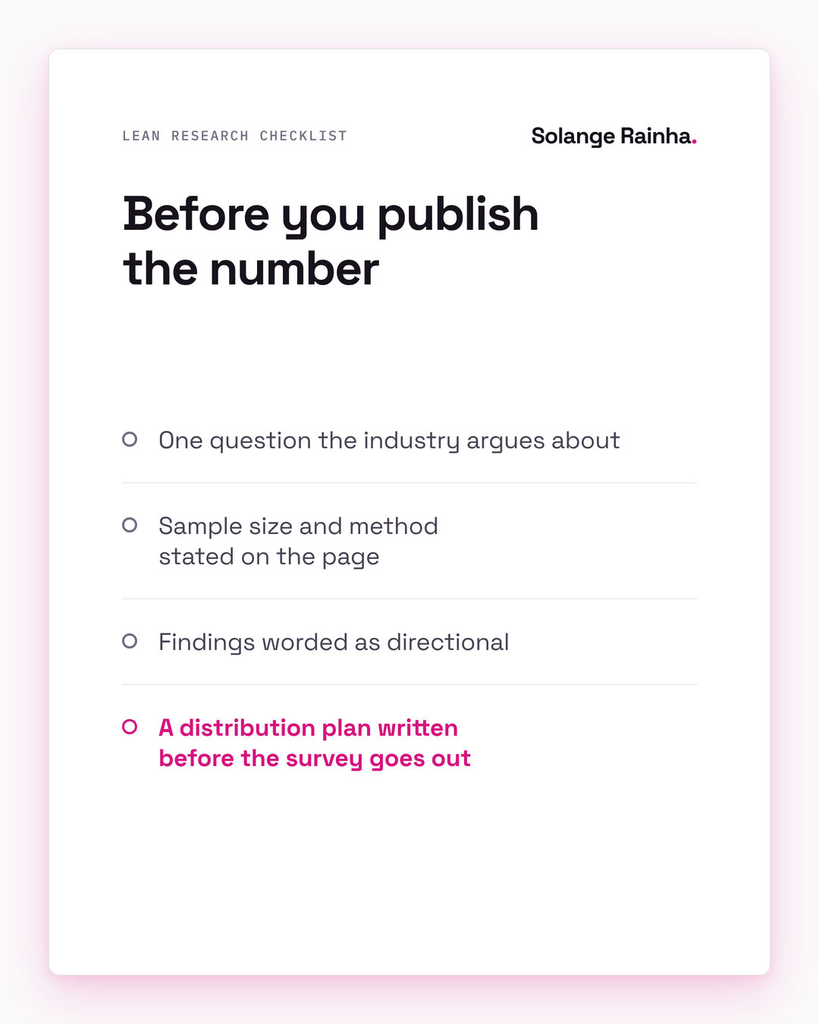
A small survey works if the questions are sharp: you don’t need 2,500 respondents, and a tight survey of 100 to 300 people in your space, run through a cheap tool and sent out through LinkedIn and your newsletter, produces citable findings as long as you report the sample size openly. The trick is asking the one question your industry argues about and nobody has measured.
Then there’s structured analysis, where the research is a rigorous look at information nobody has bothered to quantify: scoring 50 competitor pages against a rubric, sorting a year of your own content by outcome, or finding the pattern in a dataset anyone could pull. When I scored my own site against my AI readiness audit and published the failures, that’s what it was: a rubric, my own pages, and a result nobody else could have produced, with my blog scoring 8 to 9 out of 10 and the pages that get me hired scoring 6 and 7.
Here’s how the three compare when you have no budget:
| Method | Cost | Effort | Credibility | Best for |
|---|---|---|---|---|
| Internal data | Near zero | Low, the data exists already | High, it’s proprietary | Benchmarks and performance findings only you can see |
| Small survey | Low, a cheap survey tool | Medium, design plus distribution | Solid if the sample size is stated plainly | Settling a question the industry argues about |
| Structured analysis | Near zero | Medium to high, the analysis is the work | Solid, the rigour is the credibility | Quantifying public information nobody has organised |
All three give you a directional read at best: a survey of 150 people isn’t a census, and you have to say so. Overclaiming on a small sample is the fastest way to burn the credibility the research was meant to build, and it’s riskier now that one oversold stat gets a piece discredited the moment a model or a reader cross-checks it.
How do you turn one dataset into a year of content?
You treat the dataset as a source and mine it for every angle it holds, because burning it on a single post wastes most of what you paid for, and spreading the upfront cost across a dozen pieces is what turns a one-off project into an original research content strategy. The flagship report comes first, and from there you spin out single-finding posts, a contrarian piece where your data contradicts the consensus, a comparison table built from the data, a LinkedIn series that drips one stat at a time, and a follow-up six months later showing what changed.
I’ve written up the full method in my content repurposing strategy, which takes one idea to twelve assets, and about why that kind of reuse is what makes a solo function survivable in you don’t need a content team, you need a content system. Original research is the richest input that system can run on.
The payoff compounds: links to a data study keep arriving for months and years as people reference the findings, and every citation is another site vouching for you, which feeds the third-party signals AI models weigh when they decide whom to cite. You own the data, so you own the conversation around it, and that’s the same argument I make about writing quality in good writing is your competitive moat: the assets worth building are the ones that compound.
What would I do differently?
I underinvested in distribution early on. Running the research is maybe 40% of the job, and getting it in front of the journalists, analysts and practitioners who might cite it is the other 60%, but I used to treat publishing as the finish line. A dataset nobody sees earns nothing, and the Muck Rack figures above say relevance beats data in a pitch, so outreach has to be aimed. Today I’d build the distribution plan before the survey goes out, the same people-first approach I use for content distribution on zero budget.
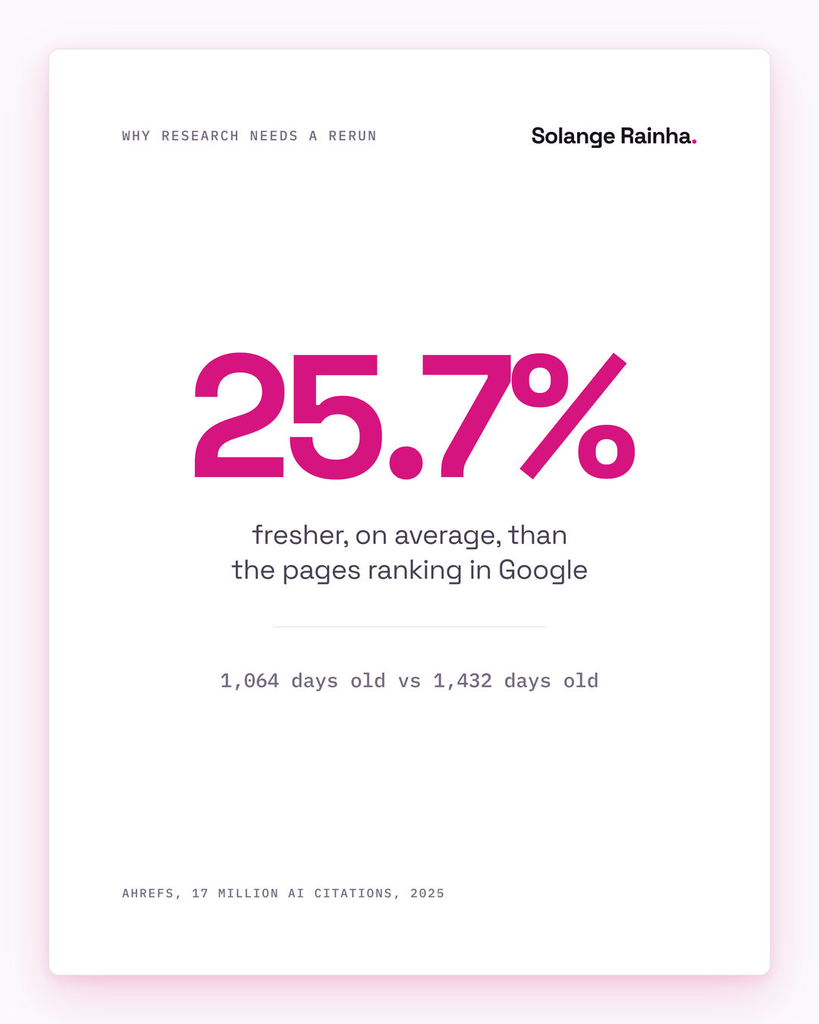
First-party data also needs a refresh cadence, which I learned by watching good research go stale: Ahrefs analysed about 17 million AI citations and found the pages AI assistants cited were 25.7% fresher on average than the pages ranking in Google’s organic results. Ryan Law, who led the study, put it simply:
“Compared to traditional search results, AI assistants prefer citing fresher content.”
A benchmark from two years ago loses to a fresher one on the same topic, so pick research you can rerun every year and turn it into a recurring report, which also builds authority as your dataset becomes the reference people wait for.
The measurement discipline counts too: a report can read brilliantly and still earn nothing, so the only scoreboard for original research is whether it pulls citations and backlinks after publishing, which means tracking AI visibility beyond a referral report and holding it to the same standard I apply in the content marketing metrics I report.
Frequently asked questions
An original research content strategy is a content approach built around data you generate yourself, whether that’s a survey, your own internal performance data or a structured analysis of data nobody else has quantified. Instead of publishing opinions or summaries that compete with everyone else’s, you create a proprietary dataset that other publications, journalists and AI systems have to cite back to you. It’s the most durable content asset a team can own, because the data has no substitute.
Original research gives people a reason to link that most content doesn’t, and links are scarce: Backlinko and BuzzSumo’s analysis of 912 million blog posts found 94% earned zero external links. A unique statistic only has one source, so anyone writing about the topic has to point at it. Journalists back this up, with 40% in Muck Rack’s 2026 survey saying original data or research makes a pitch valuable, though relevance to their beat ranks higher.
Yes. The three cheapest sources are your own internal data (conversion rates, benchmarks, performance data you already track), a small survey of 100 to 300 people in your space with the sample size stated plainly, and structured analysis of public information nobody has bothered to quantify. The barrier to original research is effort far more than money, which is why so few teams bother and why it works as a differentiator.
AI answer engines lean toward content with specific, attributable claims, and original research supplies exactly that. In the Princeton GEO study, adding statistics lifted a page’s visibility in AI answers by about 31%, quoting named sources by about 41% and citing sources by about 28%. AI assistants also favour fresh content: Ahrefs found the pages they cite are 25.7% fresher on average than Google’s organic results, so research you rerun every year keeps its place in AI answers.