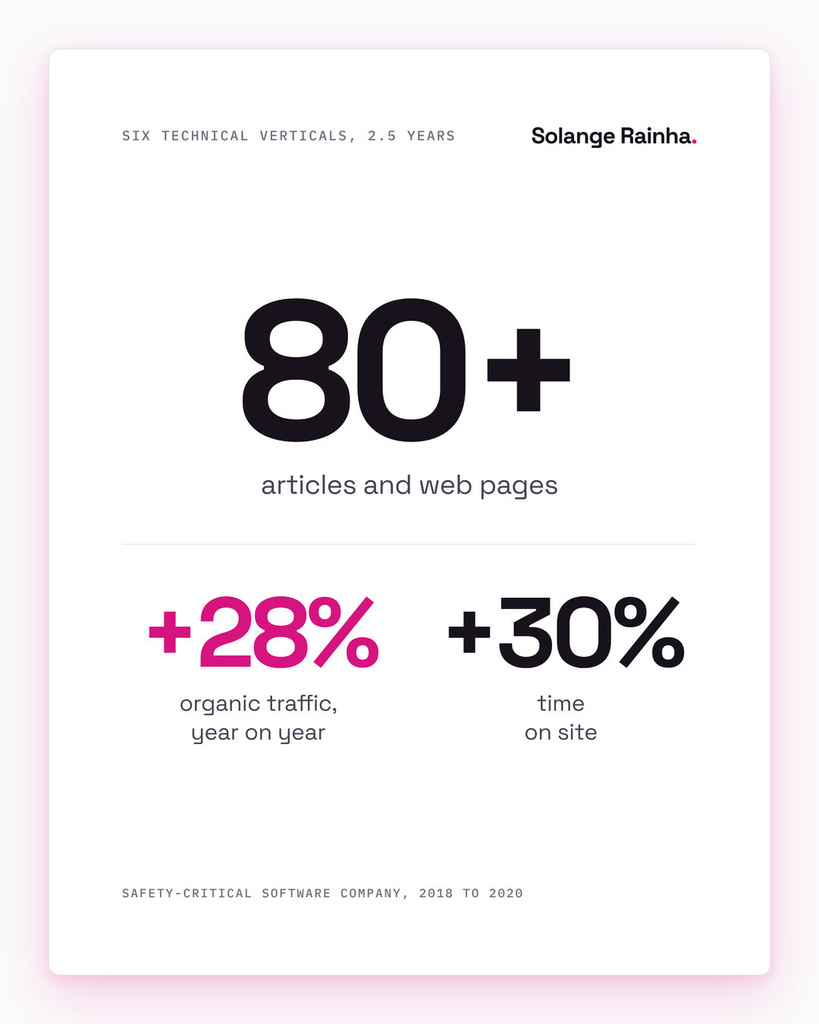
Writing for technical audiences doesn’t require being a technical expert, but it does require a process rigorous enough to earn an expert’s trust. Over two and a half years at a safety-critical software company, I wrote 80+ articles and web pages for defence, aerospace, transport, healthcare, energy and financial services, and organic traffic grew 28% year on year. The method: do the reading before you meet the subject-matter expert, ask them to correct you instead of teach you, trace every claim to a source, and learn what credible sounds like in each field. What it can’t do is replace an expert’s review on claims that only an expert can judge.
Writing for technical audiences means writing for readers who know their field far better than you ever will, and the job is to be useful to them without pretending otherwise. Over two and a half years at a company that builds safety-critical software for industries where mistakes have consequences, I wrote more than 80 blog articles and web pages for some of the most demanding readers in B2B: defence, aerospace, transport, healthcare, energy and financial services, most of them engineers and specialists. Organic traffic grew 28% year on year and time on site rose 30%, which tends to surprise people, because the instinctive assumption is that writing for technical audiences requires being a technical expert yourself. It requires something else, and it took me a good chunk of those 80 articles to work out what.
How do you write credibly about a field you’re not an expert in?
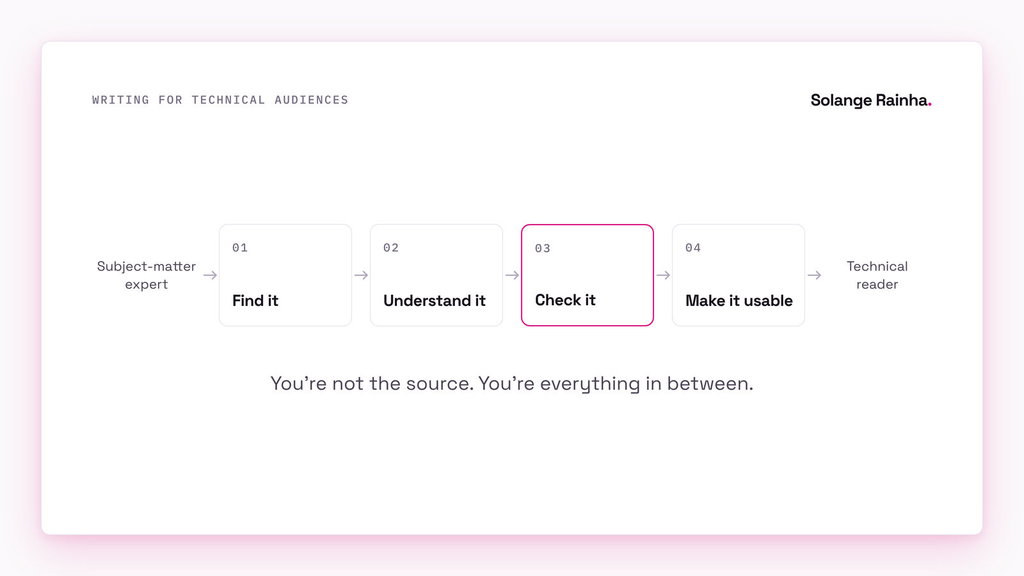
By being clear about your job, which is where writing for technical audiences starts: instead of being the source of the knowledge, you’re the person who finds it, understands it well enough to explain it, checks it with someone who knows, and turns it into something a reader will trust and act on. The moment you forget that and start performing expertise you don’t have, a technical reader catches you, because people in these fields can smell a bluff in a sentence.
Google’s own guidance lands in the same place: its self-assessment for helpful content asks whether content is “written or reviewed by an expert or enthusiast who demonstrably knows the topic well”, and whether clear sourcing and visible expertise make the reader want to trust it. The word doing the work there is “reviewed”: the credibility can come from the rigour of the process, with an expert in the loop, instead of from a job title you don’t have. I made the fuller version of this argument in you don’t need to be technical to write for technical buyers, which is about CIOs, and this company was where I first learned it, across six fields at once.
How do you get knowledge out of a subject-matter expert without wasting their time?
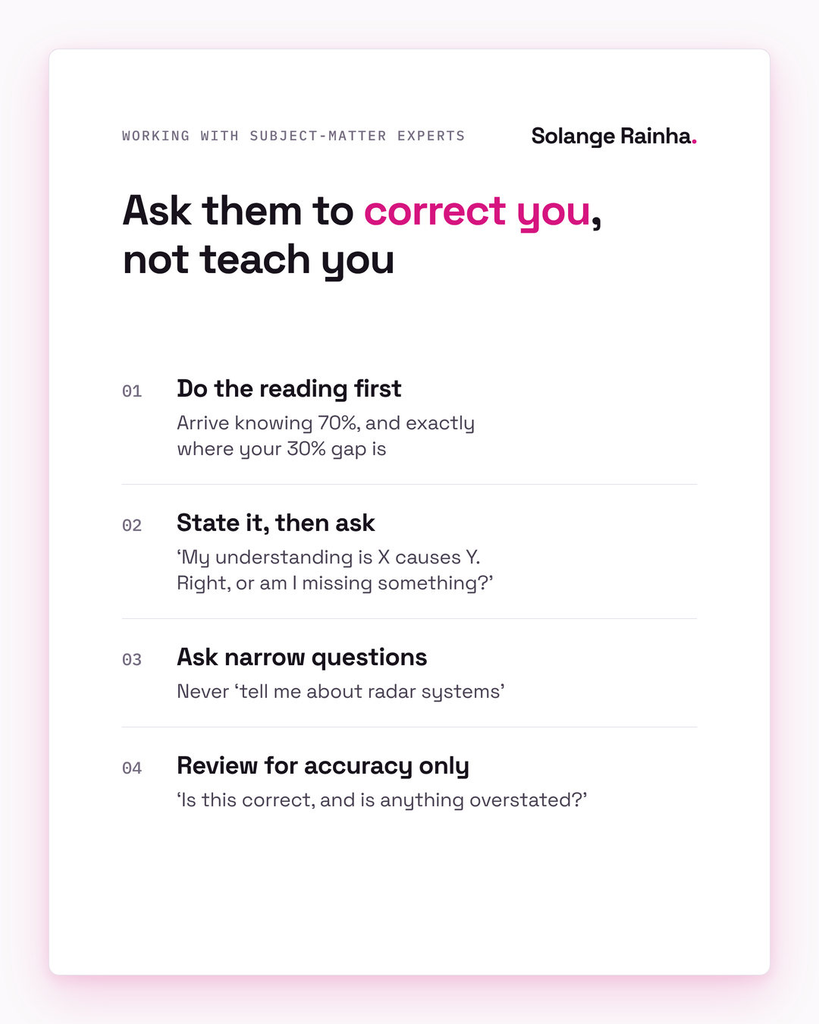
Arrive already understanding most of the topic, and ask them to correct you instead of teach you. It’s the skill nobody trains you in, and for technical audiences it counts most: the engineers and specialists I needed were busy, senior and allergic to fluff, their time was the most expensive input in the whole process, and wasting it was the fastest way to never get a second meeting. It’s a common bottleneck, too: 33% of B2B marketers in CMI’s 2025 research said accessing subject-matter experts was a challenge.
So I never walked in empty: before talking to an expert I’d already done the reading (public documentation, existing material, competitor content, whatever I could find) so I arrived understanding maybe 70% of the topic and knowing exactly where my 30% of confusion was. Instead of asking them to teach me the basics, which they resent, I asked them to fill specific gaps and correct specific misunderstandings, which they’re usually happy to do because it’s fast and it interests them.
I asked sharp, narrow questions instead of “so tell me about radar systems”. I’d say what I thought was true and ask them to correct it, because experts find it much easier to fix a wrong statement than to summarise a whole field from scratch. A good prompt was “my understanding is that X causes Y, is that right or am I missing something?”, and the correction that came back was usually worth more than an hour of open-ended explanation.
When I sent drafts back, I asked for an accuracy check and nothing else. Engineers will happily rewrite your prose into something unreadable if you let them, and that’s no character flaw: Steven Pinker calls it the curse of knowledge, the difficulty of imagining what it’s like not to know what you know, and wrote that it “is a major reason that good scholars write bad prose.” Their readers don’t want the dense version either: Nielsen Norman Group’s research with domain experts in science, technology and medicine found experts want plain, scannable language too, because it saves them time. So I’d flag the specific technical claims and ask only “is this correct, and is anything overstated?” That kept the review fast for them and protected the readability for me, and respecting their time that precisely turned one-off favours into people who’d pick up when I called again.
Why can’t you afford errors in defence or healthcare content?
Because in these fields a wrong claim costs you the reader for good, and in the regulated corners it can become a liability. In most content marketing an error is embarrassing; for a defence or aerospace audience, one wrong technical claim marks the whole piece as amateur, and the reader stops trusting your company’s content. Google weights this explicitly too: for topics that could significantly affect people’s health, financial stability or safety, its helpful content guidance says its systems give extra weight to strong signals of experience, expertise, authoritativeness and trustworthiness, the framework Google shortens to E-E-A-T.
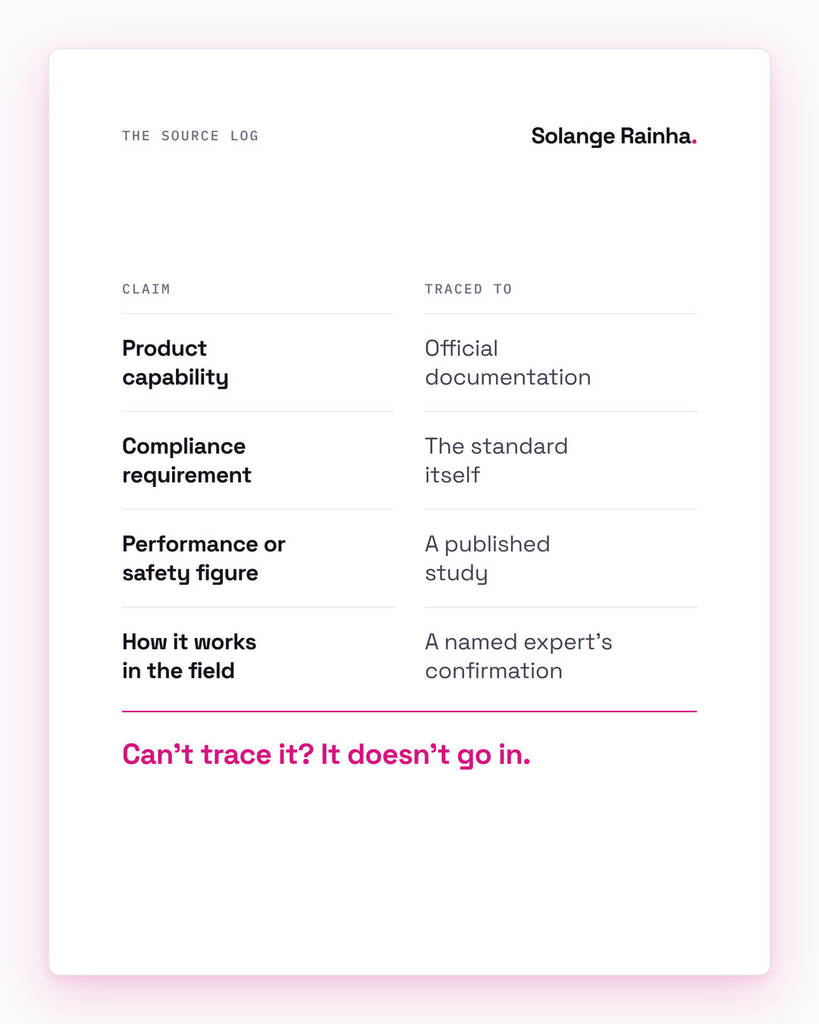
So when I was writing for technical audiences, I built accuracy into the process from the start instead of adding it as a final polish. Every technical claim in a piece traced back to a specific source: official documentation, a standard, a published study or a named expert’s confirmation. I kept the equivalent of a source log, so that if anyone challenged a statement, I could show exactly where it came from. Anything I couldn’t verify didn’t go in, however good it sounded, because a confident sentence I couldn’t back up was a risk.
How does the vertical change writing for technical audiences?
Completely, and underestimating that is how generic technical content dies. The six fields I wrote for had different expectations, and the same article structure that worked in one would quietly fail in another:
| Vertical | What credible sounds like | Where the risk sits |
|---|---|---|
| Healthcare, financial services | Heavier sourcing, precision over enthusiasm, caution around anything that reads as advice | Google treats health and finances as topics where trust signals carry extra weight |
| Defence, aerospace, transport | Measured and evidence-led; exact about capabilities, never past what the company can stand behind | Safety-critical and often security-sensitive detail; the audience distrusts hype |
| Energy, wider engineering | More room to be expansive and educational | Technical precision still has to hold |
In practice, healthcare and finance readers meant more sources per claim and a tone that earned trust through precision, defence, aerospace and transport meant being exact about capabilities and careful around anything confidential or regulated, and energy gave more room to teach without letting the precision slip. Each field had its own definition of what credible sounded like, and learning to hear that difference was most of the job. It’s also why I’d push back on anyone who treats experience across industries as a weakness, which I argued in cross-industry content marketing.
What does writing 80 articles in two and a half years look like?
Less glamorous than it sounds, and more systematic. That pace, roughly 30 to 35 substantial pieces a year, ran alongside the rest of the job, which included internal communications for more than 700 employees, content and design for a company rebrand across four countries, and segmented email campaigns. The volume was only possible because the process was repeatable: research to a point, find the gaps, get expert input efficiently, draft, verify against sources, publish.
High output is supposed to mean cutting corners, but a sloppy process is the slow one: chasing experts for the same answer twice, fixing accuracy problems after publication and rewriting pieces that missed a field’s tone all cost far more time than getting the system right once. I wrote about running this kind of solo content operation at volume in 60+ marketing pieces in 18 months, and the lesson held here too: speed comes from the system, never from skipping the rigour. The editing half of that system, catching what’s inaccurate before anyone else does, is its own skill, which I covered in why the best marketers are editors first.
Why did credible technical content grow organic traffic 28%?
Because credibility earns both the reader and the links. When a piece is accurate and useful, technical readers stay longer, which is most of why time on site rose 30%, and other credible sources in the field reference and link to it. Google’s own explanation of how ranking works counts whether other prominent websites link to or refer to a page as one sign of quality, and nobody in a technical field links to content that gets the basics wrong.
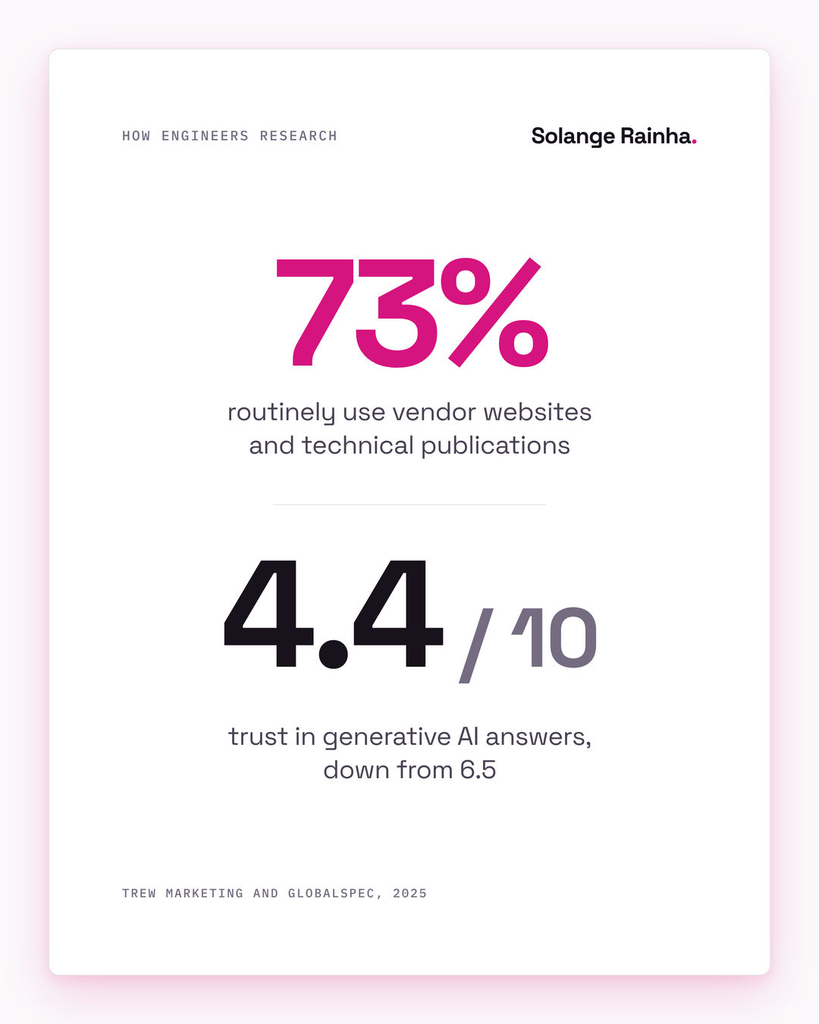
Technical buyers are also looking for exactly this material: in TREW Marketing and GlobalSpec’s 2025 State of Marketing to Engineers research, with more than 1,000 engineers and technical professionals, 73% said they routinely turn to vendor websites and online technical publications when researching a work purchase, and their trust in generative AI answers fell to 4.4 out of 10, from 6.5 the year before. A vendor site with accurate, sourced technical content sits in the place engineers already look, and the case for writing it carefully has only grown as AI-generated filler floods the field. It’s the commercial case for quality I made in good writing is a competitive moat in B2B, and in technical verticals it’s starker, because the audience is more discerning and looking amateur costs more.
What would I tell someone writing for technical audiences for the first time?
Drop the pressure to sound like an expert, because you’ll fail and they’ll notice. Aim to be the most rigorous non-expert they’ve worked with instead: the person who did the reading, asked the precise questions, checked every claim, and respected the reader’s intelligence enough not to dress thin understanding up as authority.
Find your experts early and treat their time as the scarce resource it is. Learn the specific field’s idea of what credible sounds like before you write a word in its voice, because the tone that lands in energy will misfire in healthcare. And when you’re not certain a claim is right, leave it out; a shorter, accurate piece beats a thorough one with a hole in it every time. If the product itself is hard to explain, resist the urge to flatten it, which I covered in content strategy for complex B2B products.
Where does this approach fall short?
Where a claim needs judgement only an expert has. The method gets you accurate, readable content about what experts know; it doesn’t let you form new technical opinions of your own, and it shouldn’t try. On the most specialised pieces, the right move is to put the expert’s name on the review, or on the byline, because Google’s own question asks whether content is written or reviewed by someone who knows the topic, and readers in these fields check who’s behind a claim.
It also depends on access: if the company won’t give you time with its engineers, the whole process stalls, and no amount of desk research replaces the “is that right?” conversation. And this was 2018 to 2020: the tools have changed since, and AI drafting makes it easier than ever to produce plausible technical prose nobody has checked. The engineers in the TREW research already trusted AI answers less in 2025 than the year before, which makes the verification step worth more now, not less.
Frequently asked questions
No, but you need a process rigorous enough to stand in for expertise. Writing for technical audiences means researching thoroughly, finding exactly what you don’t understand, getting those gaps filled and checked by subject-matter experts, and turning the result into something accurate and usable. Google’s helpful content guidance asks whether content is written or reviewed by someone who knows the topic, so expert review counts. What sinks people is performing expertise they don’t have, because technical readers spot a bluff fast.
Treat their time as the most expensive input in the process. Do your reading first, so you understand most of the topic and can ask narrow questions instead of asking them to teach you the basics. State what you believe is true and ask them to correct it, since experts find it faster to fix a wrong statement than to explain a whole field. When you send drafts back, ask for an accuracy check only and flag the specific claims to verify, because experts tend to rewrite prose into something denser than their own readers want.
Yes, a lot. Healthcare and financial services touch topics where Google says its systems give even more weight to trust signals, so the sourcing bar is higher and anything resembling advice needs care. Defence, aerospace and transport are safety-critical and often security-sensitive, demanding precision about capabilities and caution around regulated or confidential detail. Each field also has its own sense of what credible writing sounds like, and treating all technical audiences as interchangeable is how a piece fails the readers it was written for.
Build verification into the process instead of treating it as a final check. Trace every technical claim to a specific source: official documentation, a recognised standard, published research or a named expert’s confirmation. Keep a source log so you can show where any claim came from, and leave out anything you can’t verify, however good it sounds. On the most specialised pieces, name the expert who reviewed it. A shorter, fully verified piece beats a broader one with an unchecked claim in it.