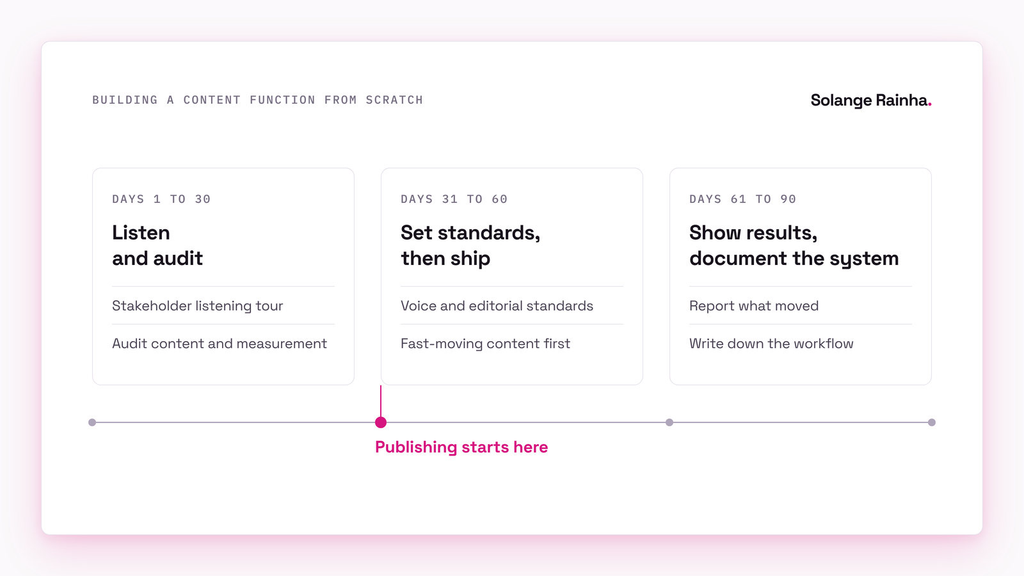
Building a content function from scratch in 90 days works when you do it in the right order: listen and audit in month one, set standards and ship fast-moving work in month two, then report what moved and document the system in month three. I’ve done it three times, at a climate tech SaaS company, an eMobility scale-up and a B2B EdTech platform, and the order held every time. The catch is timing: the work that pays off most, organic authority and pipeline, takes a year or more, while you get judged in about 90 days. The playbook exists to close that gap.
Building a content function from scratch comes down to sequence, because a new content hire gets judged long before the slow work can pay off. I’ve done it three times now, at a climate tech SaaS company, an eMobility scale-up and a B2B EdTech platform. Each was a different industry with different buyers and its own particular mess to walk into, and the playbook that worked was the same every time, with the first 90 days deciding most of it.
Here’s the trap that catches most new content hires: you land the role, you’re keen to prove yourself, so you start publishing in week one. Three months later you’ve shipped a stack of blog posts, none of them ranks yet because organic search doesn’t move that fast, nobody internally knows what you’ve been doing, and your value is invisible at exactly the moment people start wondering what the new content person does all day. You did the work; you just did it in the wrong order.
Why do the first 90 days decide whether a new content function survives?
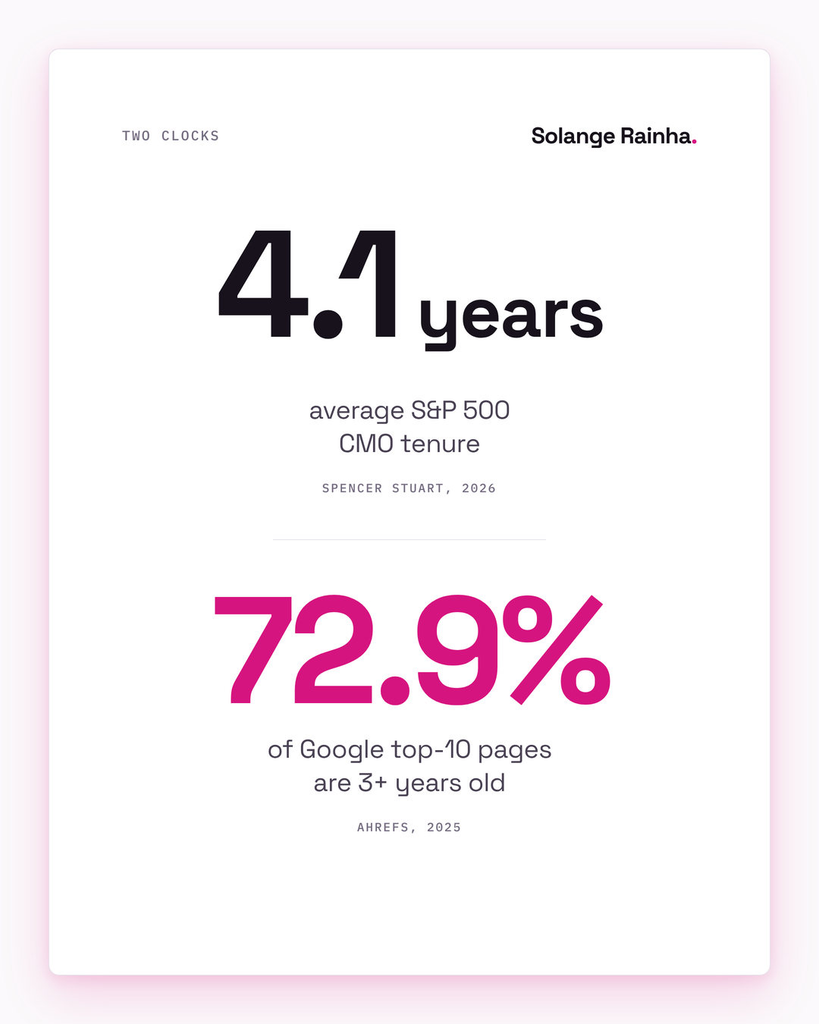
Because marketing gets judged on a short clock while content pays off on a long one. Marketing results have to come fast and everyone can see them, and the pressure shows at the top: Spencer Stuart’s 2026 CMO tenure study puts average CMO tenure at S&P 500 companies at 4.1 years, against 5.0 years for the C-suite as a whole, and only COOs last less. That pressure trickles down from the top to whoever was hired most recently, which in a new content role is you.
Content’s biggest payoff runs on a completely different clock: Google’s Maile Ohye said in a 2017 Google video on hiring an SEO that an SEO needs “four months to a year to help your business first implement improvements”, and the ranking data is harsher still. Ahrefs’ 2025 study of top-ranking pages found 72.9% of pages in Google’s top 10 were more than three years old, and only 6.11% of new English pages reached the top 10 within a year.
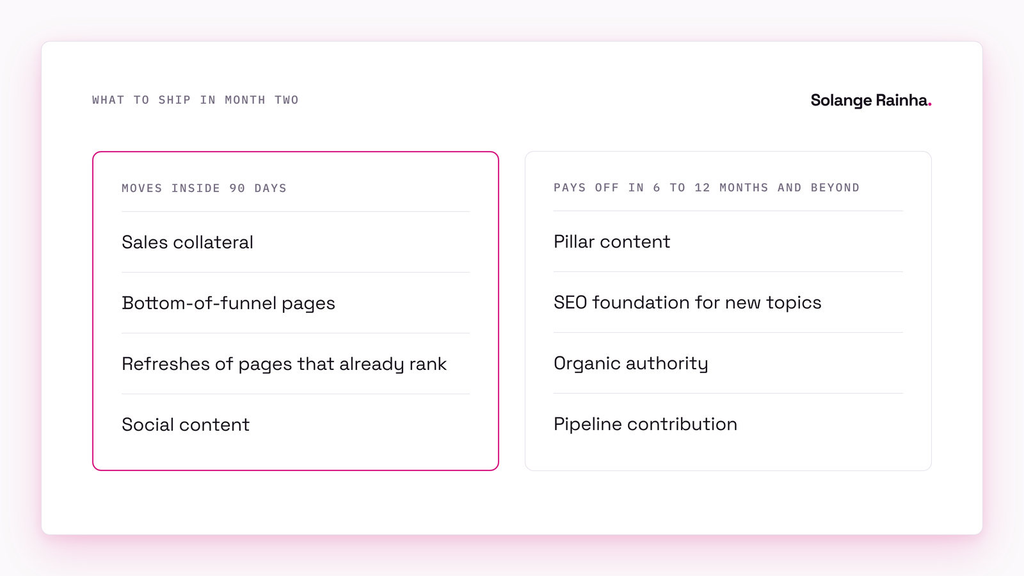
So you’ve got a content function whose biggest wins arrive in months six to twelve and beyond, and roughly 90 days to show you were worth hiring. Michael Watkins, who wrote The First 90 Days, tells managers to set new hires up “to score early wins”, and in a content role you usually have to engineer those wins yourself. The playbook closes that gap: ship what moves fast to buy credibility, and lay the foundation for the slow-burn work alongside it. Get the sequence right and you earn the runway, which beats explaining a pile of unranked blog posts to a sceptical founder.
| Phase | Focus | What you ship | What you report |
|---|---|---|---|
| Days 1 to 30 | Listen and audit | One low-risk fix, at most | What you inherited and what’s missing |
| Days 31 to 60 | Standards, then fast-moving content | Sales collateral, bottom-of-funnel pages, refreshes of pages that already rank, one sharp opinion piece | Early movement on those pieces |
| Days 61 to 90 | Results and a documented system | The workflow, written down | What moved, what’s in place, when the slow work lands |
What should you do in the first 30 days of a new content role?
Listen and audit, and resist the urge to publish. Every instinct screams to get something out the door so it looks like you’re working; ignore it, because the first 30 days are for understanding the business well enough that everything you ship afterwards lands.
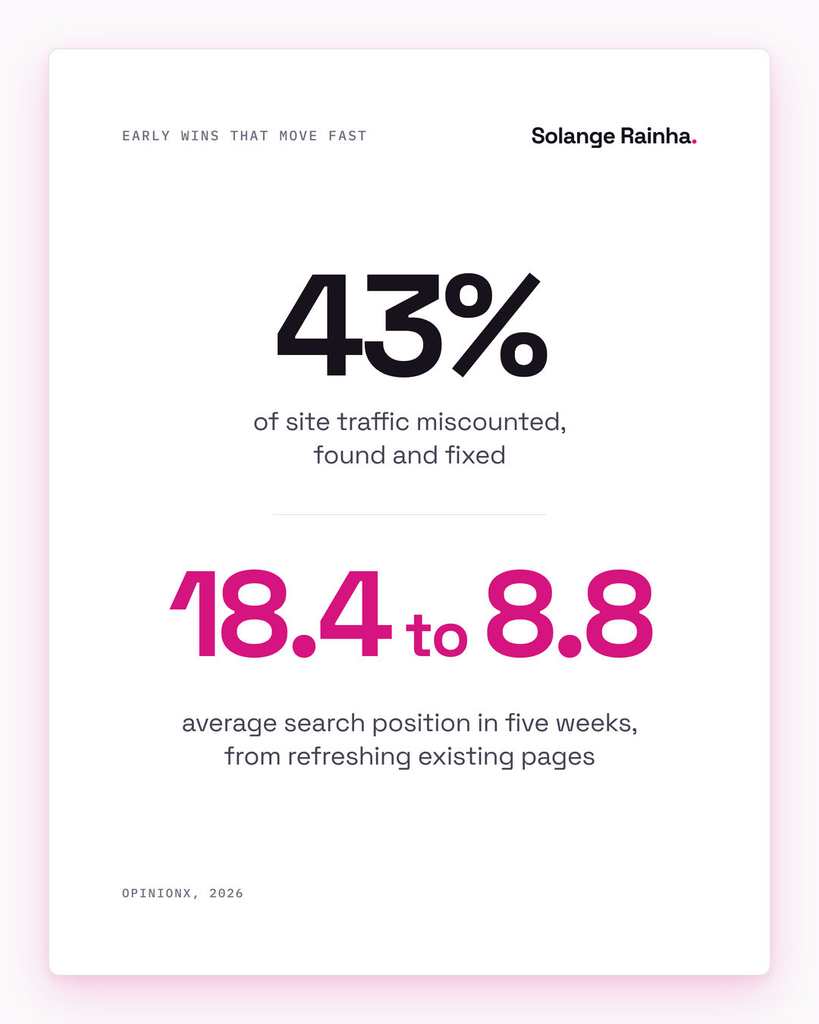
Week one is plumbing and reading: get access to everything (the CMS, analytics, the CRM, whatever brand or messaging docs exist, the old content, the email tool, the social accounts). Read the last year of whatever marketing shipped, then pull the analytics to find out what’s getting traffic and what’s a ghost town. Check that the analytics are right before you trust them, too: in my current role at OpinionX, the first audit turned up a measurement error that miscounted 43% of site traffic, and every report built on it would have been wrong. (I wrote up how to track AI traffic in GA4 for the same reason.)
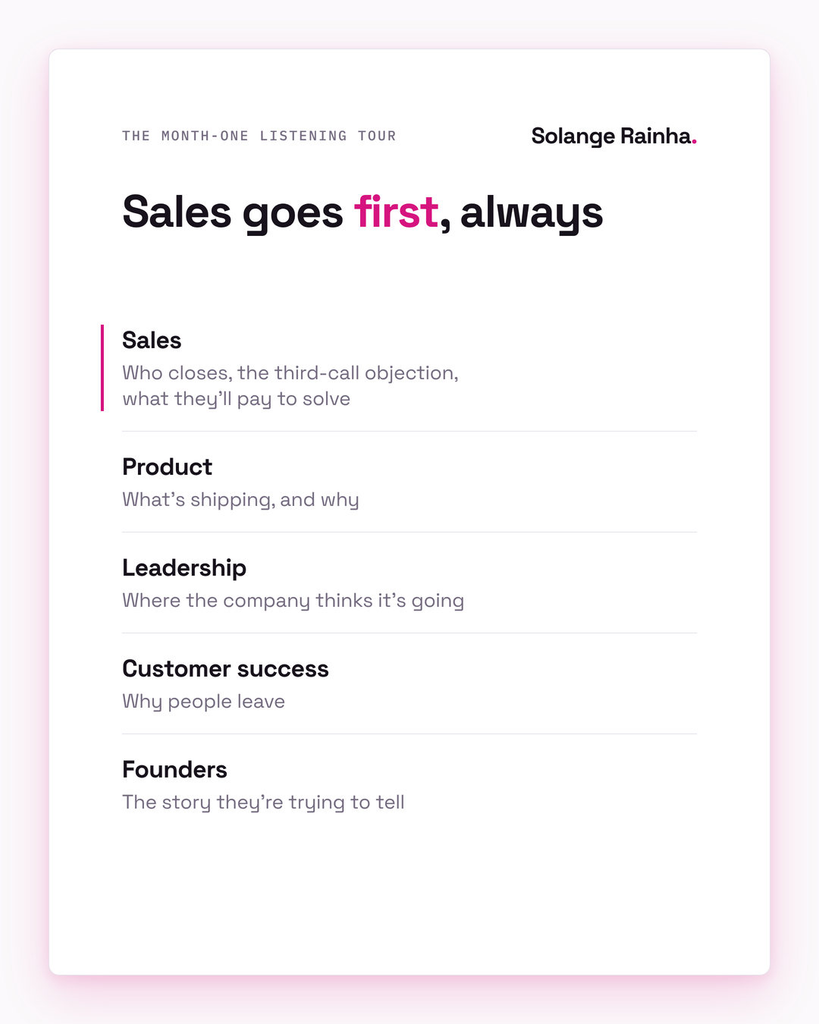
Then comes the stakeholder listening tour, the part that counts most and the part new hires most often skip. I sit down with everyone who touches the customer or the strategy, and Sales always goes first, because they know what marketing usually doesn’t: which buyers close, what objection comes up on the third call, which problems people will pay to solve. Product tells me what’s shipping and why, leadership where the company thinks it’s going, customer success why people leave, and the founders the story they’re trying to tell. I’m listening for the gap between how the company talks about itself and how its buyers describe their problem, because that gap is where most of the useful content lives. The audience starts to take form here, and mapping it properly is its own discipline, which I went deep on in running five buyer personas as a solo content marketer.
Alongside the listening, I audit what’s already there: what content exists, what’s ranking, what’s quietly inaccurate, and whether there’s a brand voice or just a vague sense that things should sound professional. I log the gaps, the outdated product references, the pages that contradict the help docs and the topics nobody’s covered, so that by the end of month one I’ve got a clear read on what I’ve inherited and what’s missing.
You can ship exactly one thing in month one, and only if it’s low-risk and visibly useful: a sales enablement fix, a broken or badly outdated web page, a one-pager Sales has been begging for. Save the big strategic content play for later, because month one is where you earn the right to make one.
What happens between days 31 and 60?
You turn the listening into a system, then start producing against it: standards come before volume, which is the order most people get backwards. Before I write a stack of articles, I build what keeps them consistent: brand voice guidelines, editorial standards, and the rules for how content gets made and checked. It feels slower at the time, but without it every piece drifts in a slightly different direction and you spend month four cleaning up month two.
The longer version of this argument, why the system counts for more than the headcount, is in you don’t need a content team, you need a content system. When there’s no brand voice to inherit at all, building positioning from nothing is its own job, which I broke down in building brand positioning from scratch.
With the standards in place, you decide what to make first, and it’s a prioritisation call. I run every idea through a hard filter for impact before it touches the calendar, because a content function built from scratch has no time to waste on pieces that won’t earn their keep. The full method is in how I decide what not to write, and it counts most in exactly this window, when the temptation is to make everything at once.
The first proper content has one job: show movement fast, which means leaning into work that pays off quickly over work that compounds slowly. That’s sales collateral that closes gaps the team flagged in week two, bottom-of-funnel pages that catch buyers who are already looking, a sharp opinion piece that gets shared because it says something, and social content that builds visibility now. Refreshing pages that already rank belongs on that list too, because it moves far faster than publishing new ones: at OpinionX, updating the existing blog library for AI search moved average Google search position from 18.4 to 8.8 in five weeks. The slow-burn work, the pillar content and the SEO foundation for new topics, starts in this window as well, but you do it knowing it won’t show up on the scoreboard inside your 90 days, so it’s never all you’re judged on.
How do you show content results in 90 days?
Report the metrics that move inside 90 days and say plainly which ones don’t. That means engagement on the new social content, Sales using the collateral you built, early traffic on the quick-win pages, ranking movement on refreshed pages, and content showing up as an assist in deals that are progressing, all of which you can see now. What you don’t do is promise that organic traffic has transformed, because it hasn’t had time to, and overclaiming there is how you lose trust the moment someone checks Search Console.
Measurement is where plenty of teams struggle anyway: a third of B2B marketers named measuring content effectiveness as a top challenge in CMI’s 2026 research, so a clear, accurate report already sets you apart. I set the expectation plainly: here’s what moved in 90 days, here’s the foundation now in place, and here’s when the compounding work should start to land. Being straight about the timeline is what makes the eventual results believable, and I’ve written more on which content marketing metrics to report and which to leave off the slide.
The other job for month three is making sure the content function can run without you holding it all in your head. I document the workflow: how a piece goes from idea to published, who checks what, where the standards live and how you measure it. A content function that only runs when you personally drive every step is just you, and you’re the bottleneck.
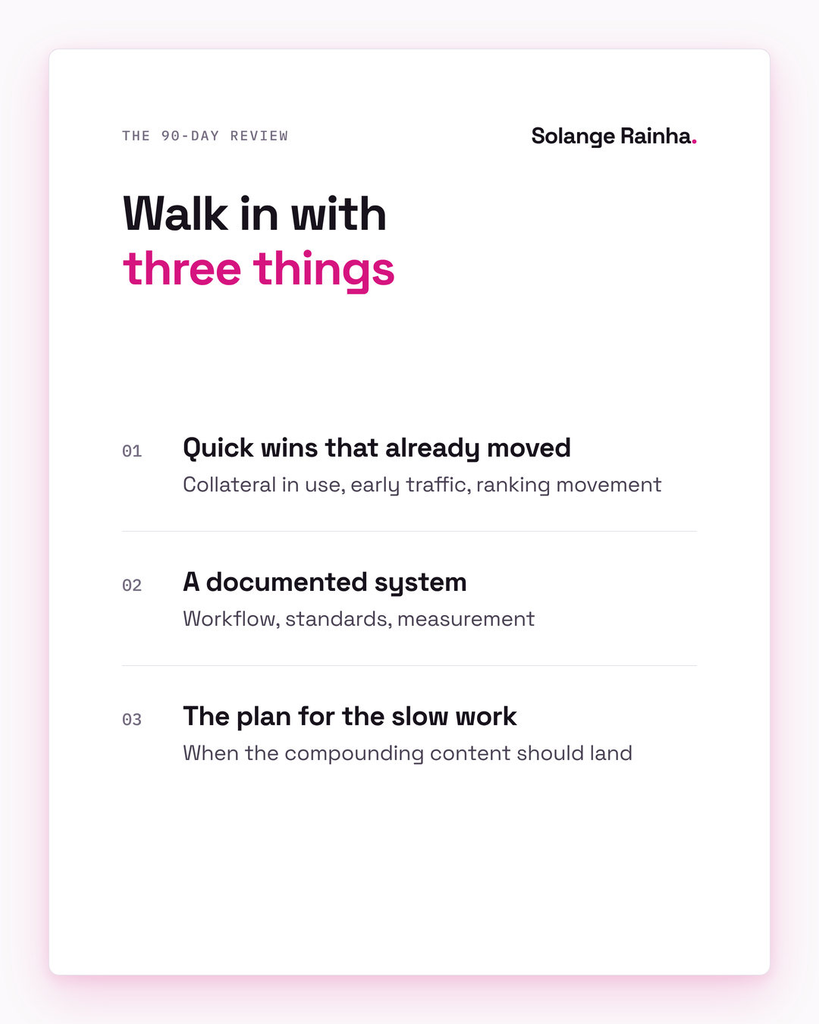
By day 90, I want to walk into a review with the quick wins that already moved, the documented system now in place, and a clear picture of where the slower work is headed. That combination buys the runway for the part that makes a content function valuable, the compounding authority and pipeline contribution that shows up over the following year. At the EdTech company, that foundation grew into a content operation that contributed to 48% marketing-sourced pipeline in peak months, which I broke down in what 48% marketing-sourced pipeline looks like, and it came well after the first 90 days, off the back of the long game.
What has building a content function from scratch three times taught me?
Mostly that the order counts for more than the industry. The specifics were wildly different each time: the eMobility build was launch-heavy and ran on tight campaign windows (more on that in product launch content on zero budget), the climate tech one had me as the entire digital and content team across Portugal, Europe and Brazil, and the EdTech one meant rebuilding a strategy mid-pivot as the company changed who it sold to. The 30-60-90 sequence held through all of it, which is the main reason I trust it.
The listening tour is non-negotiable, and Sales is the most valuable conversation in it. Every time I’ve been tempted to skip ahead and start producing, the content suffered for it, because the fastest way to write something nobody needs is to write it before you know who it’s for.
Standards have to come before volume: on the build where I rushed and tightened the editorial standards later than I should have, I paid for it in inconsistent content I had to go back and fix, while on the ones where I built the rules first, everything downstream moved faster.
Quick wins aren’t the goal, but they keep you employed and trusted long enough for the compounding work (the SEO, the authority, the pillar content) to mature, and that’s where a content function earns its value, none of it inside 90 days.
Resist the pull toward vanity output, especially in month three, when the urge to look busy peaks. A new content hire under pressure starts measuring themselves by how much they published, and a high output figure feels safe to report, but it’s also the fastest route back to the dumping-ground content nobody asked for. Forrester has reported that 60% to 70% of content produced by B2B marketing organisations goes unused, so the bar for adding to the pile should be high. I’d rather walk into the 90-day review with four pieces that each did a job than forty that filled a calendar, and I’d rather report a metric tied to a deal than a pile of pageviews. Saying no to low-value work is hardest when you’re new and want to prove yourself, which is exactly when it counts most.
Where does the 90-day playbook break down?
Building a content function from scratch this way assumes access and a seat at the table. If leadership won’t give you access to the data or time with Sales and the founders, no 30-60-90 structure saves you, and it’s worth finding that out in month one instead of month three. Ninety days doesn’t finish a content function either: it proves the approach and earns the trust, and the work that pays is measured in years.
Team size makes a difference too. In CMI’s 2025 B2B research, 54% of B2B marketers with a dedicated content team said it had two to five people, and on most of my builds I was the content team. Building a content function from scratch works solo, but it means the listening tour, the standards and the first content all compete for the same hours, so the prioritisation filter in month two stops being optional.
Frequently asked questions
Listen and audit before you publish anything. Get access to the CMS, analytics, CRM, and any existing brand or content assets, then read the last year of marketing output to understand what’s been tried. Run a stakeholder listening tour across Sales, product, leadership, customer success, and the founders, with Sales first because they know which buyers actually convert. Audit the existing content for gaps, inaccuracies, and the absence of any brand voice. The only thing worth shipping in month one is a small, low-risk, visibly useful fix, not your big strategic play.
Lean on the metrics that move fast and be honest about the ones that don’t. Organic search typically takes four to twelve months to produce meaningful results, so it won’t transform inside a quarter. What does move in 90 days is engagement on new social content, Sales actively using collateral you built, early traffic on bottom-of-funnel pages, and content assisting deals already in progress. Report those honestly, set clear expectations on when the slower compounding work will land, and never overclaim on organic traffic, because that’s how you lose credibility the moment someone checks the data.
No, with one narrow exception. The first week is for getting access, reading existing material, and starting the listening tour, not for publishing. Shipping in week one almost always means shipping before you understand the buyer, which produces content nobody needed. The exception is a small, low-risk, obviously useful fix, like correcting an outdated web page or delivering a one-pager Sales has been asking for, which signals you’re useful without committing you to a strategic direction you haven’t earned the context to choose yet.
Build them in month two, before you produce at volume, not after. Start with brand voice guidelines and editorial standards drawn from what you learned in the listening tour about how the company talks and how its buyers describe their problems. Document how a piece moves from idea to published, who reviews what, and how quality gets checked. Building standards early keeps every subsequent piece consistent and saves you from cleaning up drift later. When there’s no existing positioning to build on, defining that comes first, because the voice has to sit on top of a clear point of view.